Meet our entire 2026 Farm Equipment Dealer Hall of Fame class:
Editor’s Note: With over 100 pages of transcripts and notes, and countless hours of videos and audiotapes, this HOF article was a challenge to write.
That’s because our company, which acquired Farm Equipment in mid-2004, has a personal 20-year history with Hall of Fame recipient Ron Birkey. Ron was the first dealer to byline an article for us; our second edition in October 2004 (“Financial Guideposts Signal the Road to Success or Failure”). He was the first to ask us to present the news of their Dealership of the Year before his staff at a company event (July of 2007). He allowed our entire content team to “invade” numerous locations in 2010 for the first-ever “Dealership Minds” special edition published a few months later, and which sired the “all-colors” dealer-only event model by the same name, now in its 12th year. He and his team also opened the doors for our first offsite strategic planning in a dealership, an immersive experience that gave some their first look inside a dealership. (It was a historic meeting as the On the Record broadcast was greenlighted that day.)
As a result, my Rolodex was filled with Birkey folks that Ron introduced to us — the now-retired Mark Foster, Mike and Jeff Hedge, Jim Campbell (and son Quint) and Phil Fayhee as well as contemporaries like Mike Carley, Brady and Dusty Foster and Jason Hecht. Following his example, each made themselves available to share their own truths, best practices and discoveries. A mindset permeated throughout that a knowledgeable industry was a better one for all to operate in. – Mike Lessiter, editor/publisher.
As is often said, the legacy of a leader cannot be measured until long after the retirement party and presentation of the gold watch. More specifically, the leader is valued on how the principles and core tenets translate over and into the preparedness of the next generation for the enterprise’s continuity.
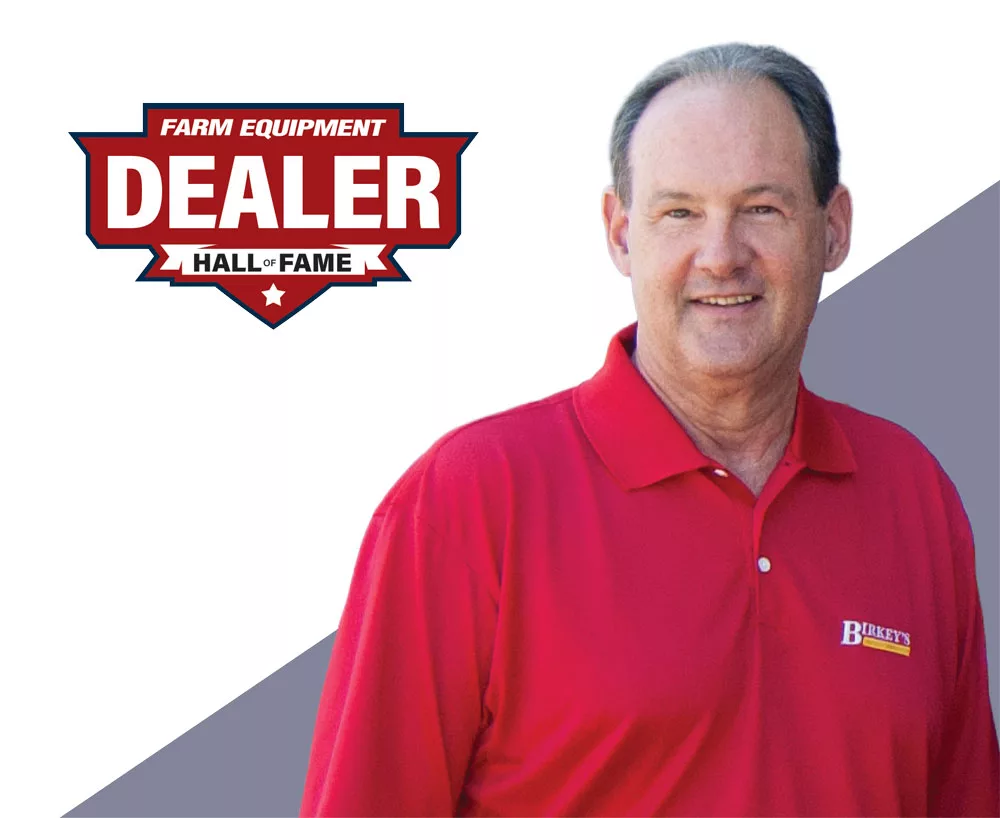
Fast forward to today, 13 years after Ron Birkey retired from the day-to-day operations of Illinois-based Birkey’s Farm Store (Case IH and Kubota group). With the successful transition of two subsequent CEOs he influenced (Mike Hedge retired in 2024 with Brady Foster now at the helm), that legacy is secure.
Birkey’s HOF-worthy credentials are obvious. Long before the multi-store tradition rapidly spread throughout the industry, he led the growth from 7 stores at $56 million to 13 stores and $346 million in 2012. During that time, the value of Birkey’s business increased by more than 1000% as the company became Case IH’s largest privately held group at the time and did so without taking on outside capital investment nor silent partners.
All of this took place during a time when dealers were largely directed by autocratic dealer-principals. Yet Birkey’s succeeded by an unusual team of entrepreneurs setting aside the excitement of iron-peddling to adhere to a disciplined means to managing assets, inventory turns (Birkey’s was routinely at the top of its peer group performance), leverage (ease of attracting bank investment) and cashflow. Open-book management was embraced to encourage expedient, correct decisions at all levels.
But having the soft-skills to keep former owner-operators at the table for bigger picture success might be the strongest ask of the CEO at that time in company history.
And perhaps more important than his accomplishments are the fact that more Hall of Fame inductions are surely to come from the Birkey’s family tree.
A Time of Change
Birkey was a student of the industry as change rapidly took place, starting with a longtime relationship with mentor Dr. Jim Weber in the 1980s. Weber challenged Birkey to dive deep into understanding all financial variables, which he says prepared him for what would be possible upon Mike Hedge joining his dad, Gary, and brother, Jeff, in 1992. Birkey was active in Weber’s peer group, which exposed him to the industry’s best concepts. He also invested in the relationship with Case IH Advisory Boards and had close collaboration with renowned VP Jim Irwin. He devoured business books like The Great Game of Business and Good to Great.
Early in his sales career, Birkey was known for both his listening and understanding skills. Longtime retired colleague Mark Foster cites Birkey’s amazing recall of customer faces, names and details. But Birkey admits that was a memory skill he worked at and developed.
Birkey was tasked with an unusual set of circumstances upon being named CEO in 2000. He had big shoes to fill in taking over as chief executive from Gary Hedge, who’d at that point been an owner for 33 years. Plus, the firm was still bringing together a set of mergers. In 1995, Birkey assumed the role of board chairman and continued to work with 13 minority shareholders in pursuit of a more unified strategic direction.
Birkey, who’d studied personnel management, organizational leadership and psychology in his college years, had to get everyone to park their big personalities and autocratic styles outside the boardroom and rally around something greater.
Feedback from colleagues, advisors, OEMs and even competitors brought words like humility, selflessness, collaboration and vision. Listening, rather understanding — with customers, employees and suppliers — also was evident on observations on his career.
Ron Birkey: 36 Years of Leadership
After 4 years with International Harvester (first calling on dealers and then moving into regional parts and service marketing roles), Ron Birkey joined his dad (Floyd), uncle (Kelly), and Gary Hedge in sales for the 2-store company at its Paxton, Ill., location. In the winter of 1978, when the company added a 3rd location in Hoopeston, he became the store manager at Paxton. At that same time, 3 other employees, Bob Stalter, Wayne Coffin, and Harold Hovelin became owners as well. Mergers with two more organizations in the 1990s brought Jim Campbell, Bob Carley, Jim Faker, Phil Fayhee and Jess Schowalter in as shareholders.
Later, Ron went on to manage the Hoopeston store before becoming the Ag Sales Manager in 1977. Then in 2000 he was named president/CEO, a role he held until his retirement at the end of 2012. He stayed on as board chairman until 2018 (The first retiree to serve on the board). Upon his retirement, CFO Mike Hedge took over the role as president/CEO.
His leadership involved two separate stints (20 years apart) as chair of the Case IH North American Dealer Advisory Board.
Selfless Commitment to Growth
Birkey’s story as leader includes a selfless personal commitment that spoke volumes about he, the company and its commitment to farmers. In 2001, the multi-store Integrated Ag went out of business in Western Illinois and left Case IH customers without another red dealership for 100 miles. After a year of assisting Case IH with the asset liquidations, the OEM asked Birkey’s to reopen a location in Galesburg — 3 hours from its nearest store.
“We’d only added contiguous dealers up to that time, where we could see and feel the benefits of shared assets and personnel. Going 150 miles away would mean a major departure from our growth strategy to that point,” he says.
Remote oversight of a distant territory — even with transplanting another manager — would not be an easy task. It would test the dealer group’s managerial mettle.
Following some soul-searching, the board approved the deal to proceed based on the commitment offered by CEO Ron and wife, RaNae, to relocate to the area. Birkey’s opened the store in 2002, and the couple spent 80% of their time in Galesburg over the next year.
“We had to convey our commitment to the area,” he says. “The customers and employees over there felt like they had been abandoned. Being in the community was a visual reminder of our commitment.”
The move provided room for others to grow — personally and professionally. Mark Foster moved in as Ag Division Manager and Mike Hedge was overseeing finance, HR and information technology. The other acquisitions became easier, Birkey says, because of that experience and seeing the obstacles and solutions.
“What Ron lacked in finance or operations proficiencies of talents he worked along side, he more than made up for in his thorough understanding of the big picture & the strategic decisions needed to achieve the vision he foresaw…” – Dr. Jim Weber, consultant
“Ron was instrumental in our moving to the western Illinois,” says Mark Foster, retired VP of Ag. “When we went to Galesburg, he rented an apartment and was onsite for almost a year while we got the store up and running. This move got us on the road to 5 more stores. Without him at Galesburg, I don’t know if we would have made all those next moves as well as we did.”
Growth opportunities can be limited, so when the stars align you need to move quickly, Birkey says. Neighboring geographic opportunities can be few and far between.
Once the Galesburg store proved successful, the company gained a confidence that would only increase. “Because we developed a more robust platform, adding stores became more natural for us.” After Galesburg, the company added stores in Macomb, Prophetstown, Polo, Annawan and Henry. Birkey would oversee 13 stores during his time. (Since 2012, the company has grown to 19 locations.)
Subordination & Greater Good
Formed by 3 Birkey brothers and another partner in 1954, the company had never operated from a template of dictatorial or dominant control. That was an institutional strength. But the mergers also brought more type-A personalities that had to be led.
The org chart from 2000-2012 showed Birkey sitting as president, CEO and chairman of the board — yet he was explicit about where authority rested. As CEO, he was responsible for executing strategy and operations. The task of board chairman meant setting the agenda and facilitating discussion.
A critical distinction was how he “subordinated to the board.” Governance and management were separate functions, even when embodied in one individual. Birkey fully participated as a board member but couldn’t dominate outcomes simply because of title or tenure.
That required a strength that was not rooted in position power alone.
Something Birkey clearly believed in — and openly discussed and taught — was how all had to yield self-interest. Not every CEO is secure enough in confidence and collaboration to be fit for that duty.
“Not all sole proprietors readily understand subordination,” says Birkey. It was a challenge to arrive at a process where we understood our roles as owners, as board members and as operating managers. We worked through that learning process and poked our head up at just the right time relative to the opportunities with Galesburg and so on.”
The fact all the owners were contributing with heavy loads also was key — and a strength. “We had great talents, and varying skills and personalities. We capitalized on those variances — on different strengths and putting individuals in roles to get a greater return. And that’s also the model we could sell to the employees. We brought a lot of great people who understood our system and we plugged them in – and we were off and running.”
The board operated in a way that Birkey says resulted in the “strongest thoughts and ideas rising to the top like cream.” The outcome was possible if the leader’s ideas could be challenged and overturned under the authority of the board. Without majority ownership, the board functioned as a crucible where ideas were openly examined – and either supported, refined or rejected. “A constant creation of the cream,” as Birkey puts it.
None of the 13 shareholders ever owned more than 18% of the company, and all owners, by design, were active managers, most of whom had “called their own shots” prior to merging. Until an exception was made for Birkey at his retirement date to continue as chairman of the board (through 2018), all owners needed to serve in active management capacities.
In addition to the selflessness and sacrifice in the Galesburg move, he also helped all see that protection of the “Birkey’s Way” would be needed in every new acquisition or startup.
Prone to Action: 'Just Do It'
Hall of Fame dealer Ron Birkey, retired from Birkey’s Farm Store, says that strategy and planning is vital but there’s another little secret worth mentioning. That is, getting the work done.
“You don't need to pontificate on a plan forever and ever – just figure it out. But then it’s still about hard work and just rolling up your sleeves – laying out what needs to get done and getting it done.”
One thing he said was so striking about all the successful dealers he witnessed in the 20 dealer groups was that there was so much variance in approach. “That meant everybody had a different way of doing things, and yet, they were all successful. It’s important to take the time away to figure out a strategy. But it’s also critical that you just ‘get about’ the process of doing it.
“We grew a lot through that period, but there was a lot of work to do. And enjoyed it, but you've got to be prepared to do it.”
Letting the Talent Run
Birkey built an organization where expertise was respected, authority was shared and leadership was multiplied. He was not an exec who had to be the smartest person in the room.
He surrounded himself with leaders he described as far stronger in their domains — notably in financial management and operations (Mike Hedge and Mark Foster, respectively) — and they had the room to lead. Trust flowed both up and down the organization and inside and outside of it — accelerating execution on the way toward a revenue picture that grew 6-fold in those 13 years.
Disciplined Passion
At a different time where dealer-principals equated leadership with unilateral control, Birkey demonstrated how to make a multi-store, multi-owner operation thrive.
Birkey, it seems, was the right man at the right time. The company understood trust and how to ensure smooth transitions as shareholders retired. The result was a forward-looking company that could change leaders without loss of direction or financial constraint, which has been further reinforced by the firm’s transition to an ESOP in 2022.
Birkey says he’s most proud of the establishment of the new fiscal responsibility, something he credits Mike Hedge for instilling.
“When people talk about making money, they’re thinking about the difference between the cost of a piece and what it sells for,” he says. “But we figured out how to affect the 500 different impacts that bring money to the bottom line. This business is about managing your leverage, which provides the means to grow your business and also how to make it through tough times. Return on assets is far more critical than return on equity, as companies who exponentially increase their assets can also sell themselves right out of business – if they aren’t careful.
“We focused very hard on inventory turnover, which is the biggest driver to bottom line performance, and can be a killer in this industry. Once we got our heads in the right position on that issue, we started implementing all those actions that drive it. If there was a metamorphic change, it was the realization of what needed to change in financial management.”
Birkey maintains that he and his team became good at executing. The concepts extolled by Weber and others weren’t hard to comprehend but they took great work and perseverance to execute.
At age 74, Birkey splits time between the beaches of Florida and the Lake of the Ozarks and says the biggest decision of each day is where to take RaNae for dinner. He fills his day with lots of reading and picks at his guitar each day (classic rock and blues).
“Learning to play the guitar is about muscle memory — it’s repetitive. Repetition is the father of learning.”
It’s like the farm equipment business in that way, and not entirely unlike the role he was asked to play in constantly reinforcing the truths of the business via listening, adjusting and improving.
He has replaced his appetite for daily metrics reviews with a deep dive into the analytical theory of music, he says, which flexes some of the same muscles as his dealership days.
Nominate a Future Farm Equipment Dealer Hall of Famer
Submit a nomination for the next class! The Farm Equipment Dealer Hall of Fame recognizes the achievements of individuals who excelled in farm equipment dealer retail sales & service.
More Web-Exclusive Hall of Fame Content
- View the full class of 2026 Farm Equipment Dealer Hall of Fame Inductees
- Watch the 2026 Dealer Hall of Fame Video Series
- Financial Guideposts Signal the Road to Success or Failure (2004) by Ron Birkey
- Birkey’s Farm Store: Dealership of the Year (2007)
- Majority Rules with Minority Stakeholders (2011)
- Inaugural “Dealership Minds Special Issue” on Birkey’s Farm Stores (2011)