In this episode of On the Record, brought to you by Associated Equipment Distributors, we look at the implications Deere's settlement with the FTC has on the broader industry. In the Technology Corner Noah Newman visits the Bayer Crop Science Farm and goes 1-on-1 with farm manager Josh Dukeman, who highlights some of the eye-opening research being conducted at the farm. Also in this episode, we take a look at recent moves both AGCO and CNH have taken in it their technology leadership positions.
.png)
This episode of On the Record is brought to you by Associated Equipment Distributors — the leading association in North America for the equipment distribution industry.
Power up your Q3 with AED’s must-attend lineup of leadership events, industry conferences, and hands-on training built to connect and elevate equipment professionals. From the high-impact Leadership Conference to the Women in Equipment Conference, plus expert-led seminars and certification programs, AED delivers real-world insights, skill-building, and unmatched networking opportunities that drive performance and growth. Whether you’re developing your team, staying ahead of industry trends, or building stronger relationships, AED’s Q3 programming gives you the edge to compete in today’s economic challenges. Learn more at www.aednet.org.
TRANSCRIPT
Jump to a section or scroll for the full episode...
- Deere Settlement with FTC Adds Enforcement Mechanism to Right to Repair MOUs
- Precision Technology Showcased at Bayer Crop Science Research Farm
- Commodity Ticker
- AGCO Aligns Leadership to Advance PTx Growth Strategy
- CNH Names New Chief Technology Officer
- DataPoint: Sentiment Stronger Among Livestock Producers, But Challenges are Similar to Crop Producers
Deere Settlement with FTC Adds Enforcement Mechanism to Right to Repair MOUs
During a special panel discussion at the Dealership Minds Summit, we brought in John Schmeiser, retired dealer association exec, and COO of TI Technology Corp; Eric Wareham, vice president of policy with AED and Brett Davis, CEO of NAEDA, to help break down the impact the FTC/Deere agreement will have on dealers of all colors.
At the end of the day, Davis says the agreement isn’t a major change and that Deere — and the industry as a whole — was already moving in this direction.
"Not even just Deere. I think the industry was moving in the general direction. I mean, I go back and if you do a quick comparison between the famous MOUs with the OEMs from the Farm Bureau, which is the Federal Farm Bureau, there's not that much different in the settlement from the MOU if you read the language in the context. So it's nothing all that earth shattering. And the one thing that is completely absent, there is no mention of the Farm Bureau in the settlement at all and no commitment. So we're still going to see the states have causes of actions. That's still going to continue because that's not prohibited by the settlement whatsoever. But honestly, I don't think it really going to change that much. When I look at a dealer's profile, could they lose a little bit of service here and there? Sure. But they may also have an opportunity to make it up on additional parts sales too and some of the tool sales."
"So it could be a balance. I don't think it's earth shattering. I think it looked big in the paper, but at the end of the day, it's kind of like John alluded to, I'm not sure it really changes the landscape materially."
While the industry was moving this way with the MOUs various OEMs had agreed to, Wareham says this adds an enforcement mechanism.
"While we're searching, I'll just add this. One of the important distinctions, Brett said it, that largely the settlement codifies the MOU. It mirrors it in a lot of. And he's correct. One of the big distinctions is that in all of the battles at the state level or provincial level, when we talk about MOUs, the criticism was always that they're kind of a pinky promise, that there was no enforcement mechanism for the MOUs. Now, I mean, the reality is that the reputational risk, if you violated those MOUs would be insurmountable for a manufacturer. But still, it was a legitimate criticism that there was not a legal enforcement mechanism. With this settlement, that is no longer true. This is a court settlement. There is a complaint mechanism within the settlement that anyone can bring to the FTC and thereby get adjudicated by the courts. And so now there is an enforcement mechanism."
"This is legally binding. That's a huge distinction to go to the state legislatures and say, what do you need to run legislation for? One, it may conflict with the settlement. But two, there's no need. There's an enforcement mechanism and it's a living mechanism that's going to last for 10 years."
Schmeiser stresses that while the settlement is specific to Deere, the other OEMs are likely working on their response and how they will handle it right now.
"So this is an industry issue. And like you said, Deere was the whipping boy on this. And I think one of the challenges that both NAEDA and AED are going to have when we see a state bill come is they're going to say, well, yeah, that FTC settlement affects John Deere, but there's Case IH, there's New Holland, there's AGCO, there's Claas out there as well. And so my assumption would be that those companies right now are looking about what they can do because they were part of the industry commitment going back, when was that? 10 years ago where the industry commitment came together and all these OEMs came together and said, "We're going to provide special tools and diagnostic equipment." Because they took an initiative then, I'm sure they're looking at where do they go now? Because they're going to be asked about it. The customers, dealers are already asking their OEMs, "What are you going to do in response to this?" So I do believe that they're working on that response right now."
"And it's probably going to align with what Deere has, but Case IH or New Holland's solution to this can't be identical to what Deere's is because they're different companies. And the same thing with maybe like a shortline manufacturer. They're different as well. So everyone is probably going to have the same principle that Deere has, but tweaked for their individual business."
All three agreed that for the most part this settlement doesn’t shift the needle drastically for the industry on the issue and that we are largely sitting in the same spot as we were previously.
Dealers on the Move
This week’s dealer on the move is Malvese Equipment, which announced its 2 locations have been acquired by Dobbs Equity Partners.
The Kubota and New Holland dealership will remain at its current locations in Hicksville & Riverhead, N.Y., under the Malvese name.
Technology Corner: Precision Technology Showcased at Bayer Crop Science Research Farm
All right, we're kicking the program off here with Josh Dukeman, farm manager for the Bayer Crop Science Research Farm. And Josh, first of all, thanks for hosting this pre-conference workshop for the National Strip-Tillage Conference. Tell us a little bit about what you guys have going on out here at this farm.
Josh Dukeman: "Yeah, I guess first it's been great. We've had an awesome crowd. Appreciate you guys including us and giving us the opportunity to do this. We've had several stations set up today. I think the growers have taken a lot away from our digital platform. You asked me about the research farm. We're about 11, 1200 acres of large scale grower equipment type research. So we're a little unique in that realm. We do anything from density testing on our precision corn. We do a fair amount of cover crop work, staying in that sustainability realm. We do a lot of work with fungicides. Gosh, I don't know. I'm getting lost in all of our different trials, but we've got a lot and it's tough to go through them all. But I guess the most important thing would be everything is done and recorded through our Fieldview platform digitally and the data return and what we're able to provide some insights into growers is second to none."
Noah Newman: "So this platform records everything from yield data, applications, I Might be putting you on the spot with this, but any key takeaways jump out from some of the research that you covered here today at the event?"
Josh Dukeman: "Just in general conversation with the customers or just what we're doing?"
Noah Newman: "Yeah, general conversations. When you were giving your presentations, what are some key points maybe that really resonated with people?"
Josh Dukeman: "Yeah, I think some of the trial work that I presented, not necessarily in this map, but some of the fungicide blocks, I think the people here were really keyed in on how accurate I was able to dissect R3 applied fungicide versus untreated versus maybe a V5 application. I think they felt it dead on accurate in terms of breaking that stuff out. I also think they learned pretty quickly that they could be their own research farm and their entire operation could be very similar to what we're doing here. It just takes getting in the platform and learning how to use it."
Commodity Ticker
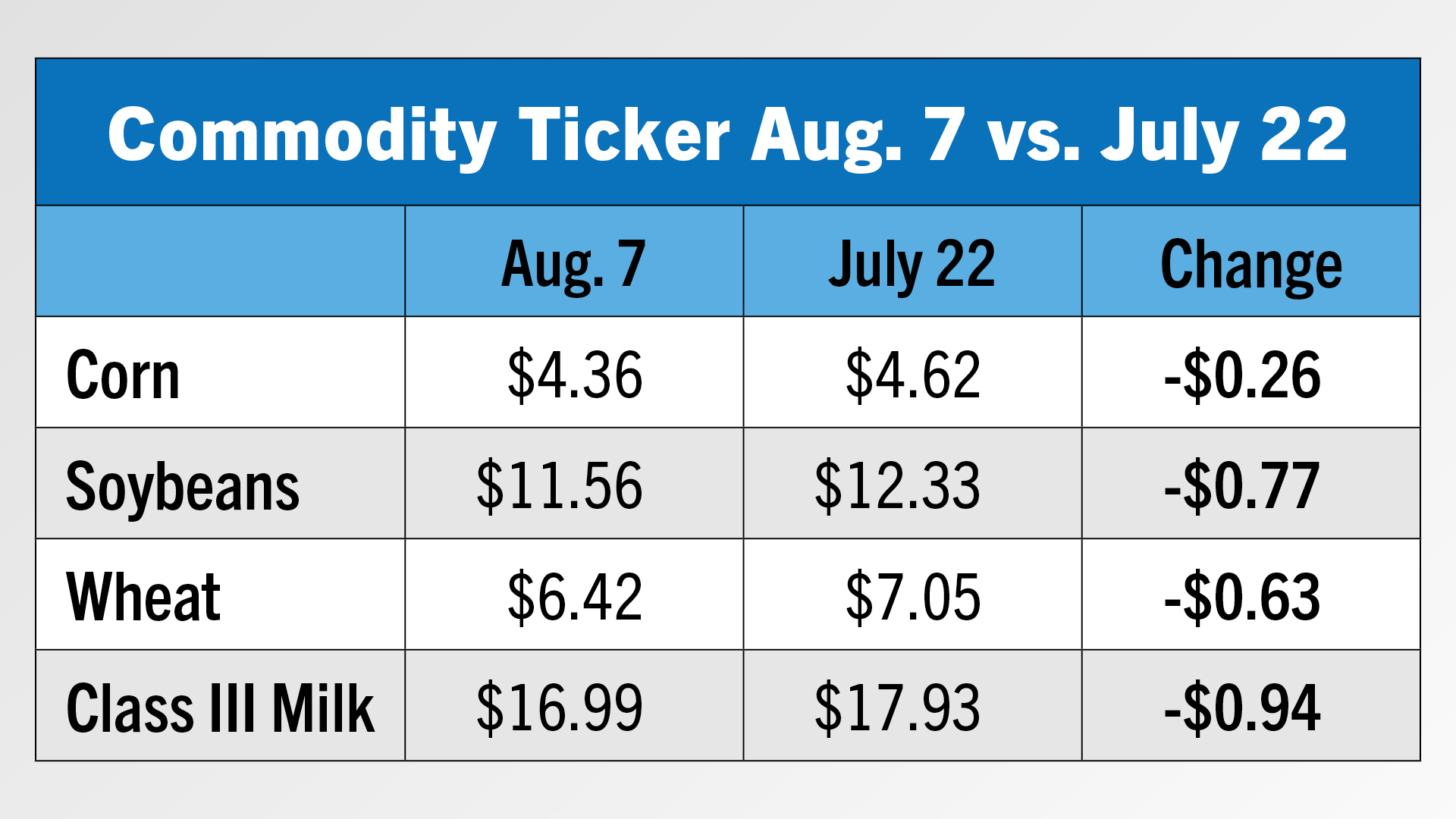
As of July 22, corn prices were $4.36, down 26 cents from our last episode. Soybeans closed at $11.56, up 77 cents. Wheat closed at $6.42, down 63 cents and Class III milk prices closed at $116.99, down $0.94.
AGCO Aligns Leadership to Advance PTx Growth Strategy
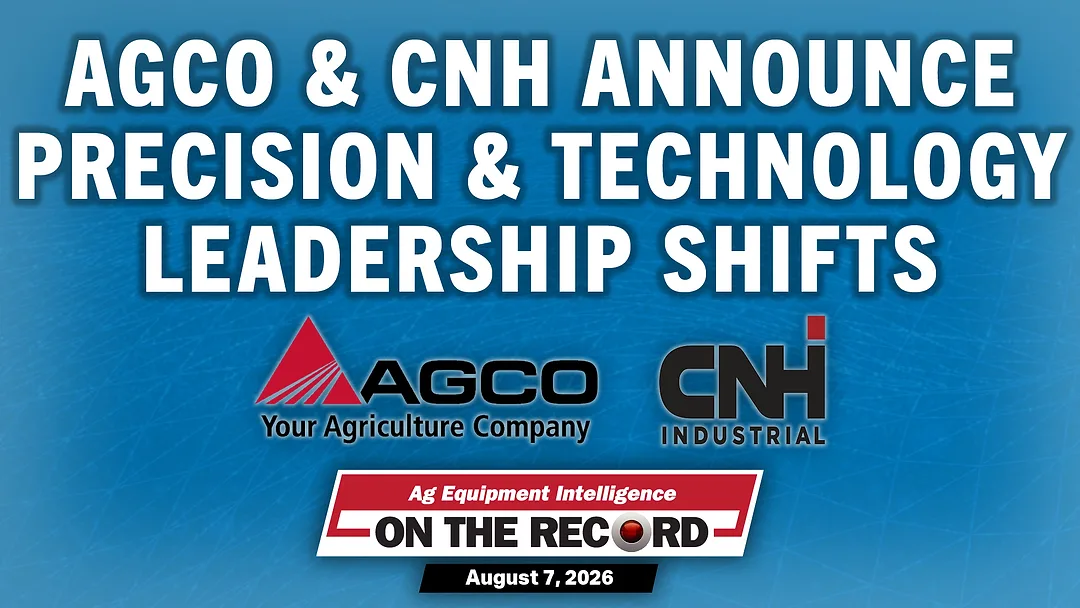
On August 3, AGCO announced a series of executive leadership changes effective August 1, 2026.
Damon Audia, previously Senior Vice President and CFO, was named President of PTx & Corporate Strategy, encompassing AGCO's precision agriculture business and the enterprise strategy and transformation teams.
AGCO says Brian Sorbe, who served as President of PTx, has stepped away from the company to focus on other personal and professional priorities.
AGCO’s announcement states PTx is central to its growth strategy, bringing together the company's precision agriculture technology solutions and a significant opportunity to create more value for farmers as the trusted partner for industry-leading, smart farming solutions.
Audia currently leads corporate strategy, which will move with him to PTx.
During the Dealership Minds Summit in Springfield, IL this week, we spoke with Benjamin Land, Vice President of Ag Sales at Atlantic and Southern Equipment, an AGCO dealer in Tifton, Georgia with store locations across the panhandle of Florida and eastern North Carolina.
We asked him what this change means for their dealership, customers and AGCO’s precision-ag strategy moving forward.
“We’re 48 hours from the announcement of Damon been put in that role. From the ground level, just dealer network, our own perspective is it’s a pretty big change for AGCO, but they’ve tapped one of their key leaders to put in a pretty critical role to get this PTX thing in the right direction and make sure AGCO’s investment is taken care of. So Damon I think is very well respected amongst his peers at AGCO. And so I feel like it’ll be a good push for AGCO putting somebody of that caliber in charge. As far as how it will affect us day to day, I don’t think there’ll be any effect. I think this PTX thing, Trimble Joint Venture, as it continues to go, I think we’ll get more definition, more clarity on how we can support the customer organization.”
Land says he thinks Adia’s CFO experience and business expertise will serve him well in his new role and that he should be able to get up to speed with the precision ag business very quickly.
“He already knows globally how AGCO operates. He knows the vision, the strategy, and he’s got all the contacts already. So I feel like there’ll be a little bit of a ramp up probably for him, but in his head, I would guess, as smart a gentleman as he is, I would guess he’s already got a good idea of where he wants things going for AGCO.”
Land went onto say he has confidence in AGCO as an OEM and feels like the recent changes are a step in the right direction as they continue to go after a larger part of the precision ag market.
“Our relationship with AGCO right now is stronger than it’s ever been. Atlantic and Southern’s been in business for 16 and a half years now as an AGCO dealer. It’s with Brad Arnold, Mike Long, Rashear Patel, even Stefan in the mix now. We’ve got a really good relationship with the staff at AGCO and all the way through the channel. I feel like AGCO really continues to put good people in place that want to help us and work with us, work with the dealer channel in growing the AGCO brand product portfolio.”
CNH Names New Chief Technology Officer
CNH announced upcoming leadership changes in late July.
According to the company’s Form 8-K filed, Jay Shroeder, Chief Technology Officer, will retire from his position effective Jan 1, 2027.
He currently serves as Vice President, Precision Technology Product Management at the company, a role he has held since June 2025. During his more than 25-year career with the company, Shuman has held leadership roles across product management, quality, manufacturing, and global product development.
He previously held the position of VP and general manager of Raven. During his time there, he oversaw significant growth in the business and scaled our electronics manufacturing site to meet those needs.
DataPoint: Sentiment Stronger Among Livestock Producers, But Challenges are Similar to Crop Producers
Crop and livestock producers reported different views of the agricultural economy in the July 2026 Purdue University-CME Group Ag Economy Barometer survey.
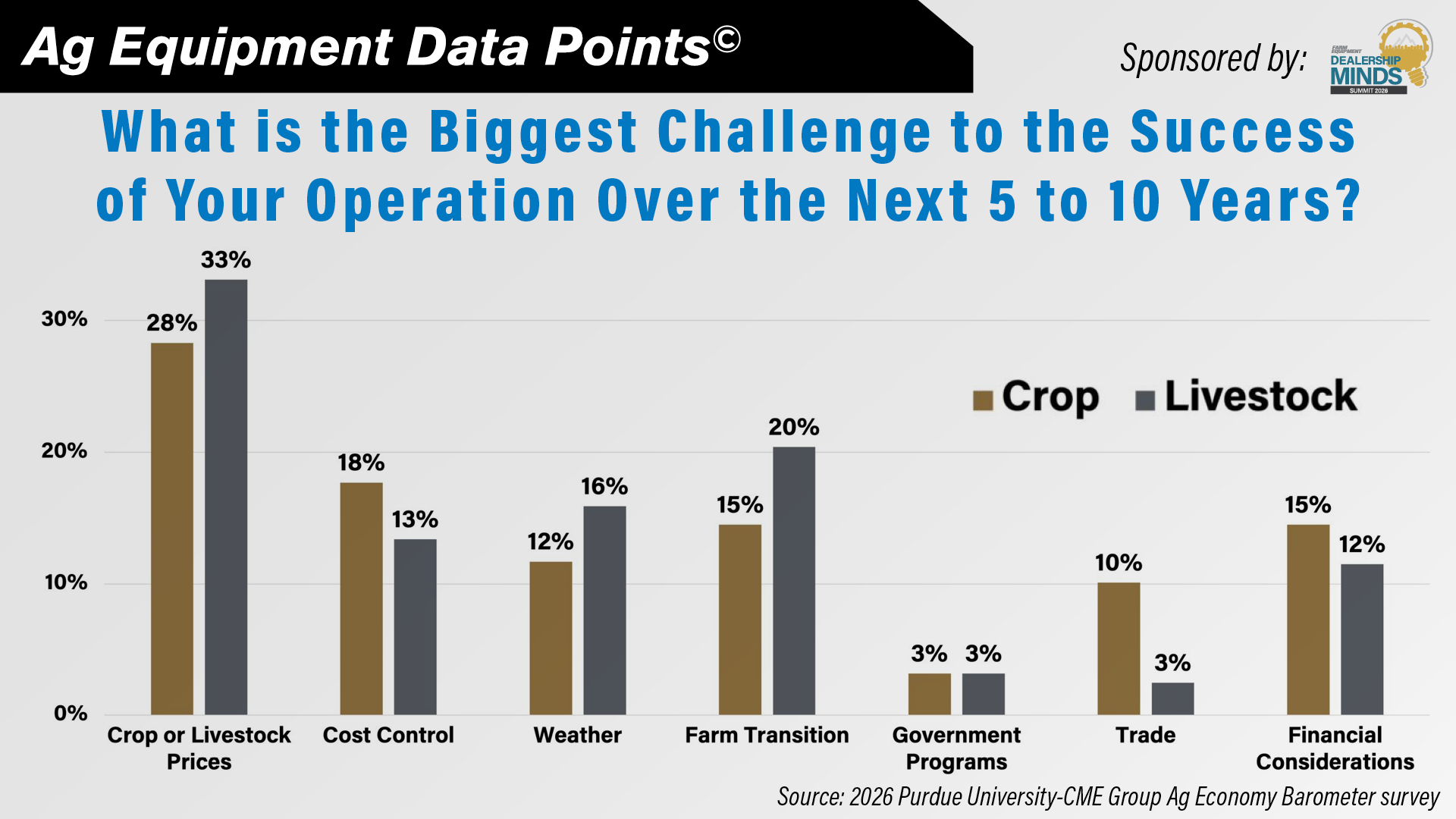
Livestock farmers expressed stronger sentiment than crop producers, particularly regarding current economic conditions. However, both groups identified many of the same concerns, educational needs, and long-term challenges.
Respondents were asked to select the biggest challenge to their operation over the next 5-10 years given the following choices: crop or livestock prices, cost control, weather, farm transition, government programs, trade, and financial considerations.
Purdue’s Michael Langemeier says crop or livestock prices were clearly the biggest challenge facing both crop and livestock producers, selected by 33% of livestock producers and 28% of crop producers.
Farm transition was chosen by 15% of crop producers and 20% of livestock producers as the biggest challenge, while financial considerations were selected by 15% of crop producers and 12% of livestock producers.
Thanks Jenna. That wraps up this week’s episode, coming to you for Springfield, Ill.
On the Record is now available as a podcast! We encourage you to subscribe in iTunes, the Google Play Store, Soundcloud, Stitcher Radio and TuneIn Radio. Or if you have another app you use for listening to podcasts, let us know and we’ll make an effort to get it listed there as well.
We’re interested in getting your feedback. Please feel free to send along any suggestions or story ideas. You can send comments to kschmidt@lessitermedia.com.