In this edition of On the Record, brought to you by Associated Equipment Distributors, we take a look at CNH’s announcement to spin off its construction business through a joint venture with Kobelco. In the Technology Corner, Noah Newman has a report from FIRA on the Verdant Robotics SharpShooter. Also in this episode, what the ‘Blue Wave’ election results could mean for the ag equipment industry and Linamar’s 3 ag brands — MacDon, Bourgault and Salford — are gaining market share.

This episode of On the Record is brought to you by Associated Equipment Distributors — the leading association in North America for the equipment distribution industry.
Ready to connect with industry leaders, discover new opportunities and prepare your dealership for what’s ahead? Join the Associated Equipment Distributors (AED) January 25–27 at the 2027 AED Summit at the Rosen Shingle Creek Resort in Orlando. The Summit brings equipment dealers, manufacturers, and industry partners together for three days of networking, education, business insights and relationship-building. Attendees can explore the latest products and services in CONDEX, connect one-on-one with manufacturers and peers, and gain valuable perspectives on the issues impacting equipment distribution. Don’t miss the opportunity to grow your business network, gain new ideas and help shape the future of the industry. Make plans to join AED in Orlando for the 2027 AED Summit! Learn more and register at www.aedsummit.com.
TRANSCRIPT
Jump to a section or scroll for the full episode...
- CNH to Spin Off Construction Business
- Commodity Ticker
- Bigger, Faster, Smarter: Inside Verdant’s New SharpShooter
- Blue Wave Means Many Changes For Ag On Capitol Hill
- Linamar Reports Market Share Gains for Ag Brands in U.S. Despite Downturn
- DataPoint: Shift in U.S. Farm Inputs from Labor & Land to Capital, Material & Purchased Inputs
CNH to Spin Off Construction Business
Four years after CNH Industrial spun off its on-road trucking business with Iveco, the OEM announced it is spinning off its construction business. The company is establishing a joint venture with Kobelco. CNH will retain 30% ownership, with Kobelco the majority owner at 70%.
CNH CEO Gerrit Marx described the transaction as the next step in the company’s years-long transformation of CNH into a pure-play agriculture equipment technology and service company.
He said quote, “Building on our acquisition of Raven Industries in 2021 and the spin-off of our on-highway operations into Iveco Group in 2022, today’s news advances our portfolio simplification and sharpens our focus on agriculture,” Marx said. “This transaction will position CNH as the largest pure-play agricultural machinery OEM that covers the full crop cycle.”

Marx said the partnership creates a “very strong full line” construction player that will allow a “very competitive product portfolio” into CNH ag dealerships.
“We are talking a lot about on- and off-board systems,” Marx said. “In the off-board world for construction, its digital job sites, that’s the equivalent and also our farmers will need to operate these construction machines in digital layers of the off-board system. And hence, there is a great deal of meeting of minds for our ag network to get machines that will flawlessly interplay and work side-by-side with our ag machines on the farms around the world.”
Marx said CNH is not going to consider using Kobelco dealers to distribute ag machines.
As for what it means for the ag side of the business, Colin Hlavinka, vice president and director of sales for Case IH dealer Hlavinka Equipment, told us time will tell, saying “If the cash is brought in to use for innovation and product advancements, then it is a good thing for ag. If it is just used to prop up the balance sheet then in the long run it will probably still be good but not as immediate and noticeable.”
Commodity Ticker
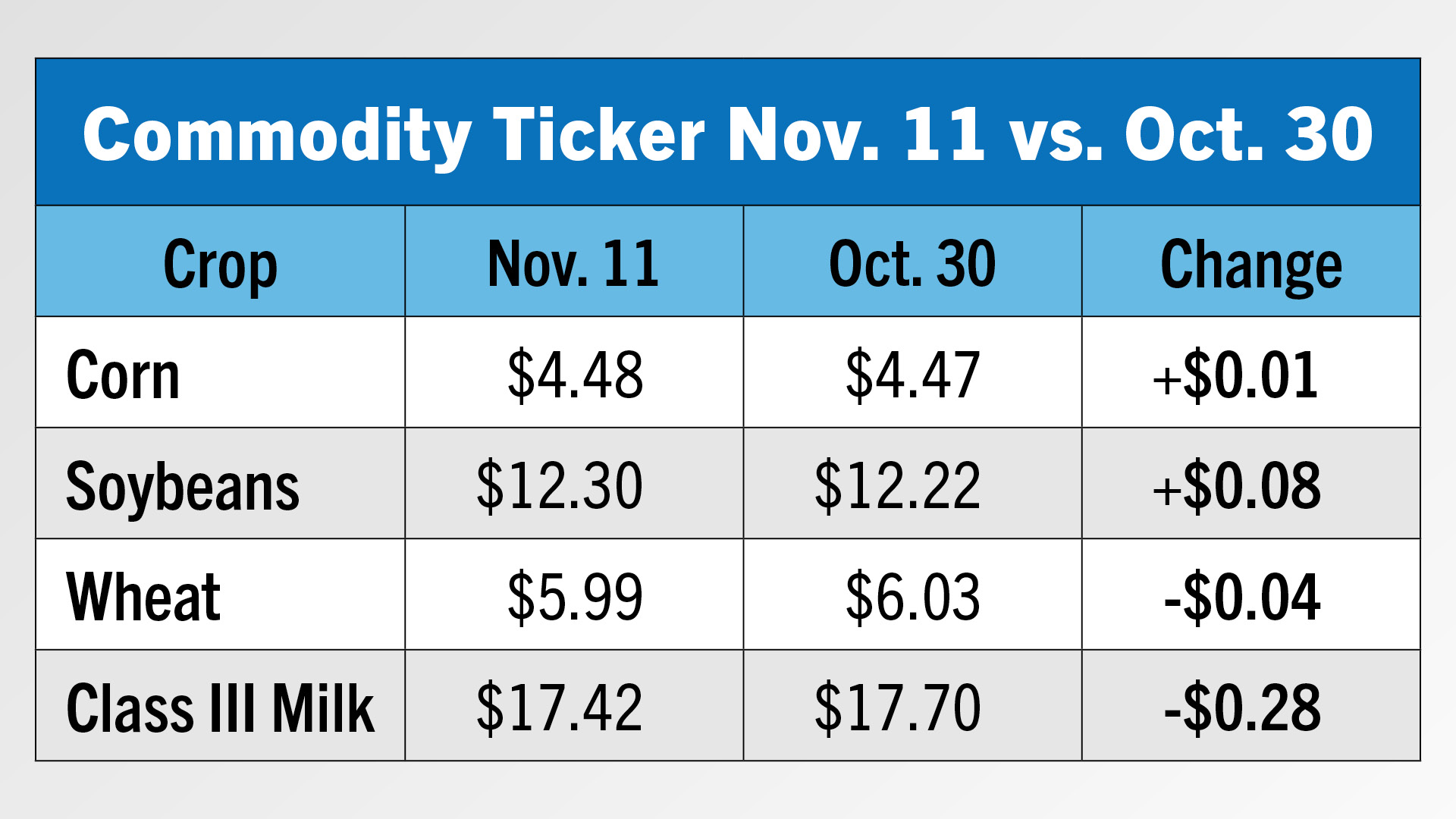
As of November 11, corn prices were $4.48 up a penny from our last episode. Soybeans closed at $12.30, up 8 cents. Wheat closed at $5.99, down 4 cents and Class III milk prices closed at $17.42, down 28 cents.
Bigger, Faster, Smarter: Inside Verdant’s New SharpShooter
Growers, manufacturers, researchers and investors got an up-close look at some of the top cutting-edge farm innovations at the FIRA USA ag robotics conference a couple weeks ago in Yakima, Wash.
The three-day event showcased over 40 robots, some of which you see here during this special parade of robots. The Verdant Robotics SharpShooter garnered plenty of interest from attendees. We caught up with Tony Zamarron for details on the latest model of the AI-powered precision application system.
“Today I want to tell you about one of our new products, the 24-foot Verdant Robotics SharpShooter. We’ve progressively gotten better with the technology. We’ve updated our turrets, which are able to take more shots per second than previously. Our light system has also been enhanced. Overall, with this machine, at 24-feet, we’re able to cover more ground, more acres per hour and making it more efficient for the customer and helping them with their ROI.”
“Ultimately it’s for the growers who are looking to get rid of hand labor and go with strictly using AI technology to take care of the weeds within the crops that they’re growing. We currently have over 100 different crop models available for growers to utilize.”
Verdant is expanding its dealer network, according to its website. The company also recently partnered with Sabanto to integrate its autonomous tractor tech with the SharpShooter.
Blue Wave Means Many Changes For Ag On Capitol Hill
The results of the mid-term elections leaves the U.S. with a divided government.
Democrats holding the majority in Congress and a Republican in the White House, will make legislating harder, said Katherine Grady, director of Federal Affairs at the Association of Equipment Manufacturers. “The question now is where Democrats and President Trump might find common ground.
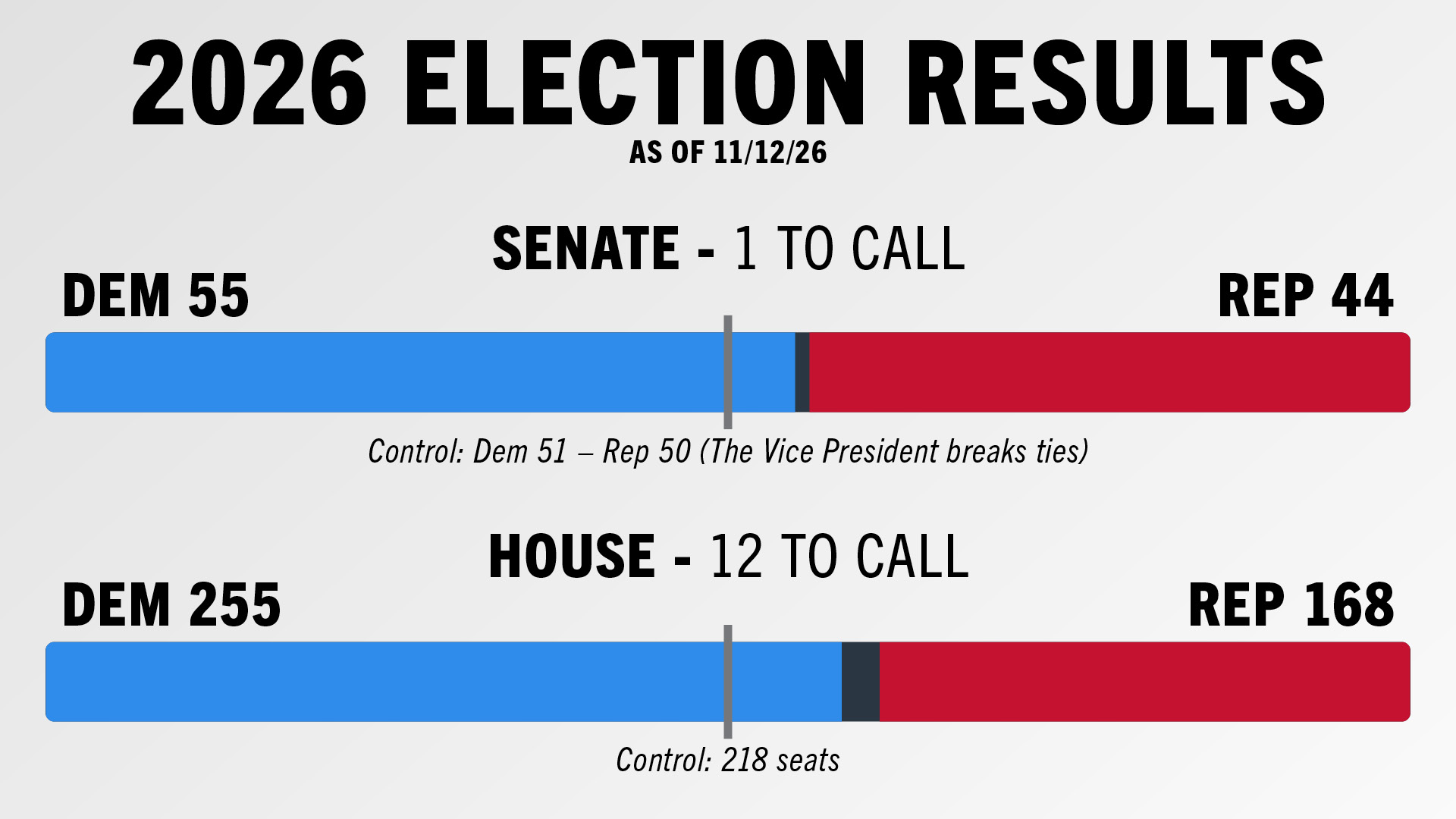
Farm Journal reported there were 139 Ag Voices in Congress before Nov. 3, 2026. As of Nov. 9, 2026, 31 of those are leaving, 99 are staying, and 9 are involved in races too close to call.
At least 119 ag voices have secured seats in the incoming Congress, according to Farm Journal. The tentative roster includes 84 house members and 35 senators with direct ties to ag.
U.S. farm equipment industry now faces a revamped legislative landscape with immediate consequences for commodity cashflow, the stalled Farm Bill, and trade and tariff pressures.
How do these changes impact the passing of the U.S. Farm Bill? One industry executive we spoke with said it’s not likely the Farm Bill makes it through the lame-duck session unless Republicans decide to rewrite it and make concessions on SNAP and conservation.
He noted that Congress has ceded power to the executive branch over the past 30 years, particularly on trade and tariffs. That means there’s a lot the President can do unilaterally.
The NAEDA executive recalled the impact Trump’s tariffs had on ag during his first term. “Tariffs decimate farmers’ markets. Back in 2018-2020, Trump’s tariffs with China dropped soybean purchases from about $26 billion a year to like $4 billion. Tariffs and trade wars only hurt farmers.”
Tariffs, trade and the Farm Bill are all important issues that need to be addressed.
Linamar Reports Market Share Gains for Ag Brands in U.S. Despite Downturn
Linamar reported its 3Q ag division revenues increased 22.8% to $761.3 million compared to the same period last year.
“Sales were up 23% in our industrial business with access markets growing, offset by a continued softness on the ag side, which was tempered happily by market share growth of our ag businesses,” said Linda Hasenfratz, executive chairman of the board at Linamar, during the company’s earnings call on Nov. 4.
Market conditions are still challenging with industry demand expected to be down approximately 10% to 15% in North America for the year.
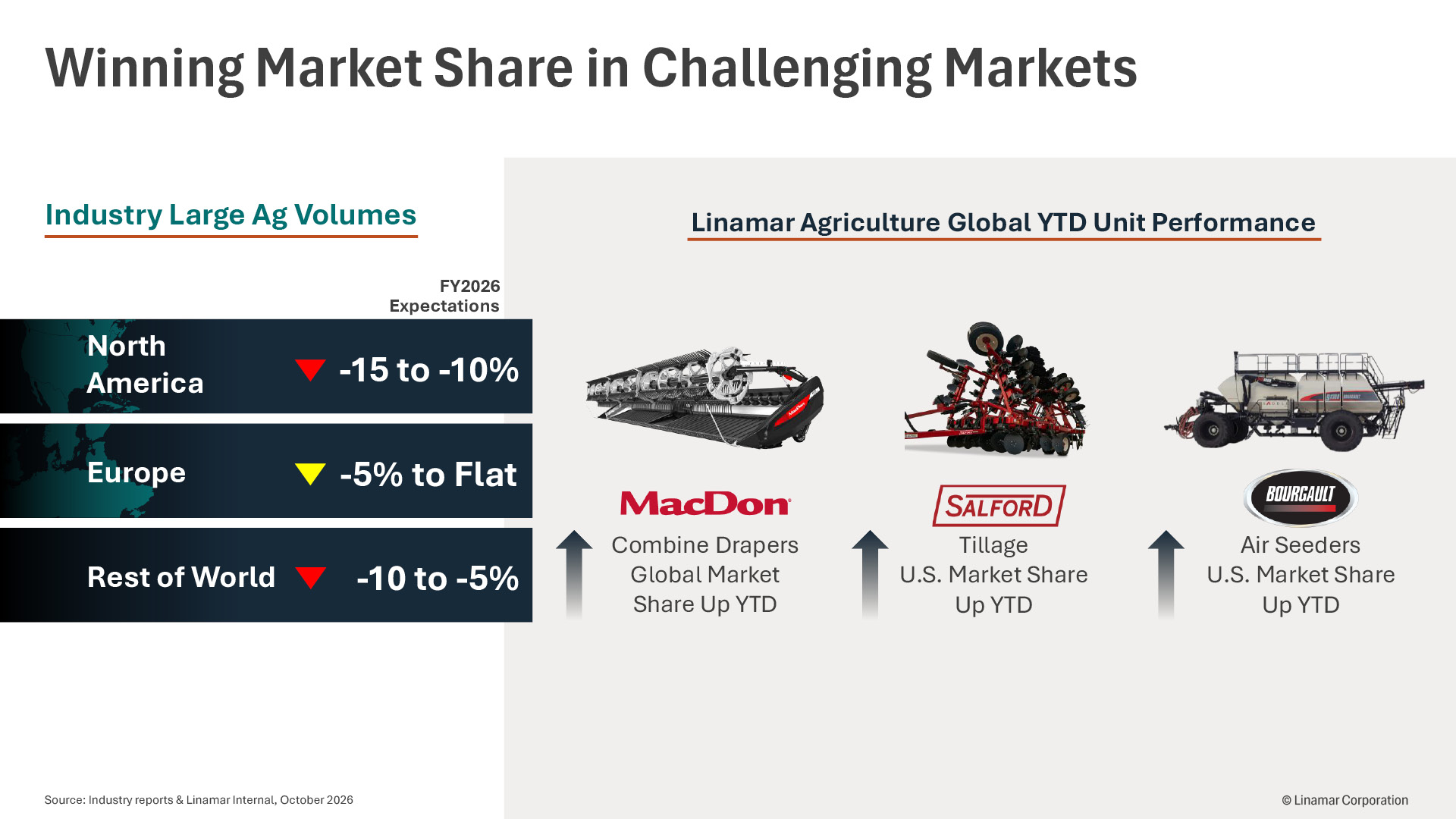
“Despite that backdrop, all 3 of our brands continue to gain market share on key product lines,” Hasenfratz reported. “Year-to-date, MacDon has grown its combine drapers’ global market share. Salford has grown its U.S. tillage market share. And Bourgault’s air seeders’ U.S. market share has grown.”
In North America, she said crop commodity pricing has improved slightly but not enough to overcome hesitancy around farmer optimism.
“Certainly, fertilizer and diesel fuel prices also continue to squeeze farm income expected for ‘26. And overall input costs being higher is negating some of the potential gains from commodity pricing,” she said.
DataPoint: Shift in U.S. Farm Inputs from Labor & Land to Capital, Material & Purchased Inputs
This week’s DataPoint is brought to you by the Precision Farming Dealer Summit. To see the full program and to register, visit PrecisionSummit.com.
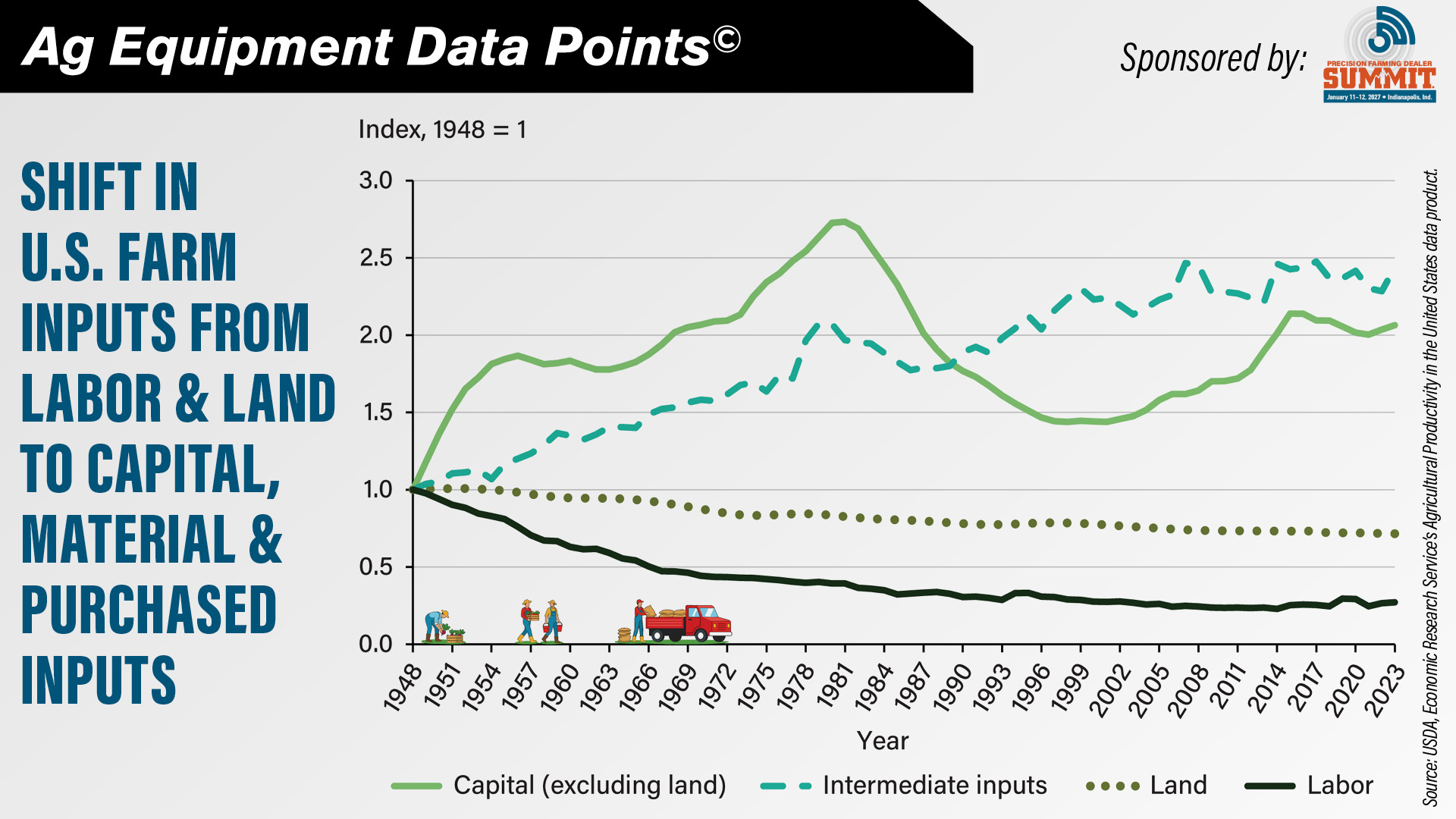
U.S. farm output — the total amount of livestock, crops and other farm-related output produced in a year — nearly tripled between 1948 and 2023, while the mix of inputs used in production has shifted.
According to data from USDA, during this 75-year period, the total amount of inputs used in U.S. farm production increased only slightly, rising at an average rate of 0.12 percent annually. This modest increase reflects a continued shift away from labor and land and toward capital and intermediate inputs.
Over the period, the amount of farm labor used in agricultural production fell by 73 percent, and land use declined by 28 percent. Meanwhile, the use of intermediate inputs—such as fertilizer, pesticides, energy, feed, and purchased services—grew by 144 percent, and the use of capital inputs, including machinery and farm structures, increased by 106 percent.
According to the USDA research agricultural economist Eric Njuki, technological advances have made machinery and agricultural chemicals more affordable and effective, enabling farmers to increase their use of these inputs while using less labor and land.
He writes, “More importantly, the net increase in the use of inputs (0.12 percentage points per year) has been greatly exceeded by the increase in agricultural output (1.52 percentage points per year). The “total factor productivity” remainder of 1.4 percentage points per year remains the primary driver of growth in U.S. agricultural output.”
On the Record is now available as a podcast! We encourage you to subscribe in iTunes, the Google Play Store, Soundcloud, Stitcher Radio and TuneIn Radio. Or if you have another app you use for listening to podcasts, let us know and we’ll make an effort to get it listed there as well.
We’re interested in getting your feedback. Please feel free to send along any suggestions or story ideas. You can send comments to kschmidt@lessitermedia.com.