An equipment dealer calls a tech school looking for someone who can diagnose today’s equipment and get right to work. The school has a graduate who understands the fundamentals, but has never handled a service call alone. In addition, the student wants meaningful work, a path forward and pay that competes with other possibilities.
Sean Fitzgerrel, vice president of the Associated Equipment Distributors Foundation (AEDF), sees these expectations collide often. Dealers need experienced technicians now. Schools need equipment, instructors and employer participation to prepare the next generation. Students, on the other hand, need a chance to learn the job and earn a living doing it. The distance between those expectations keeps the shortage from easing.
“The role of education is to create an entry-level technician, a baseline,” Fitzgerrel says. “The school teaches core systems and safety; the dealership develops the experience that a retiring technician takes with them.”
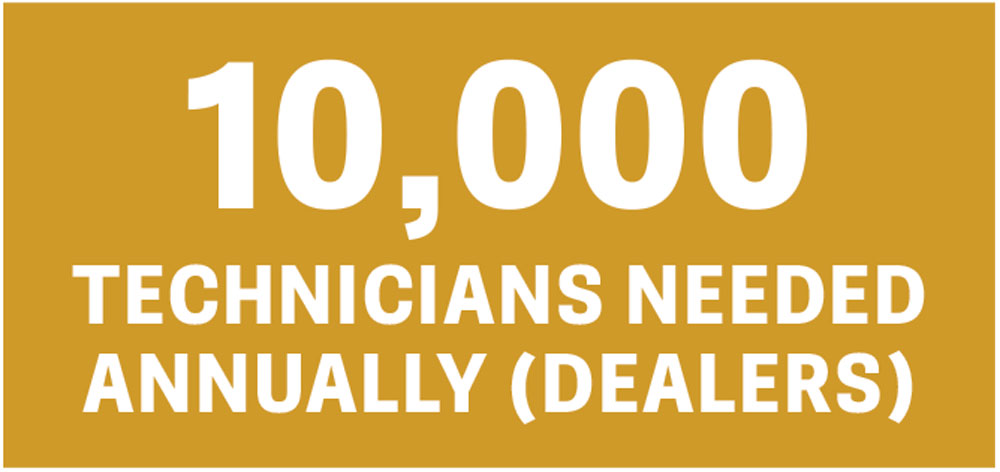
The AEDF’s 2026 Technician Shortage Report estimates that agriculture and construction equipment dealers together need nearly 10,000 technicians each year over the next 3 years to replace departures and meet growth goals.
By the numbers | The dealer challenge
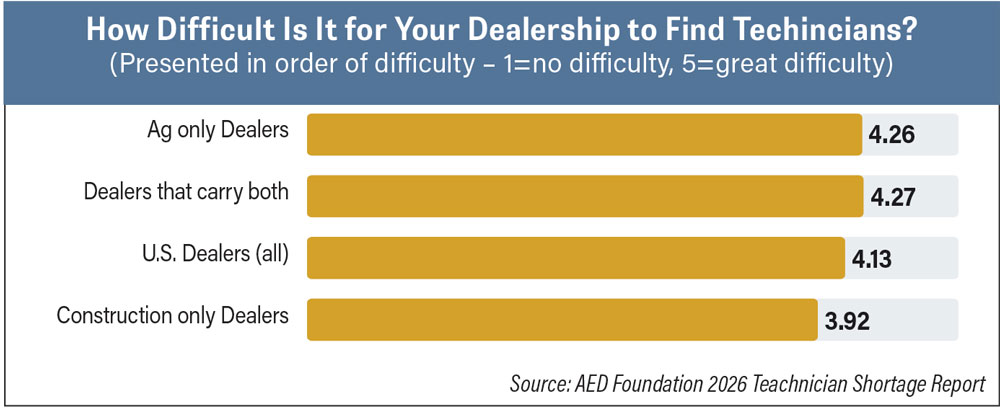
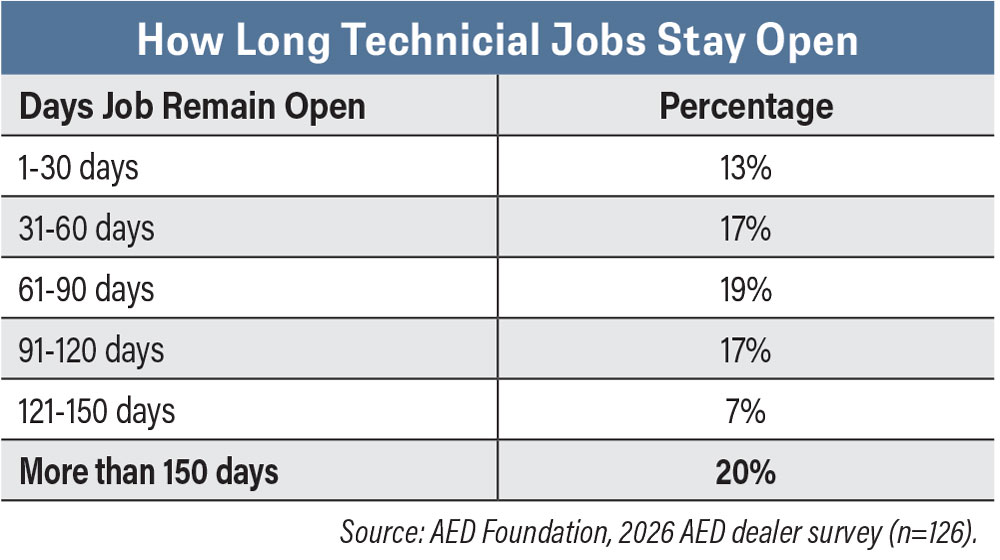
56% of agriculture dealer technician openings remained unfilled for more than 90 days, according to the AED survey. 77% of dealers across agriculture and construction said the shortage hindered business growth.
Source: AED Foundation, 2026 Technician Shortage Report.
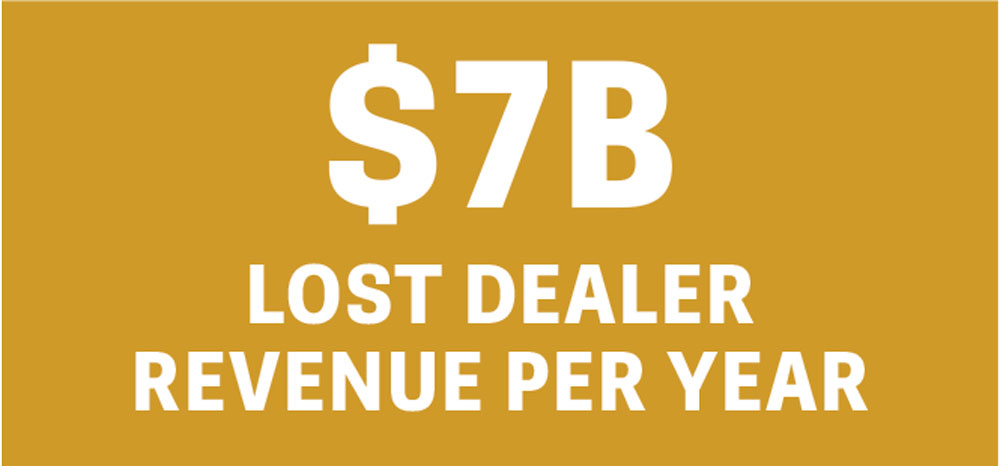
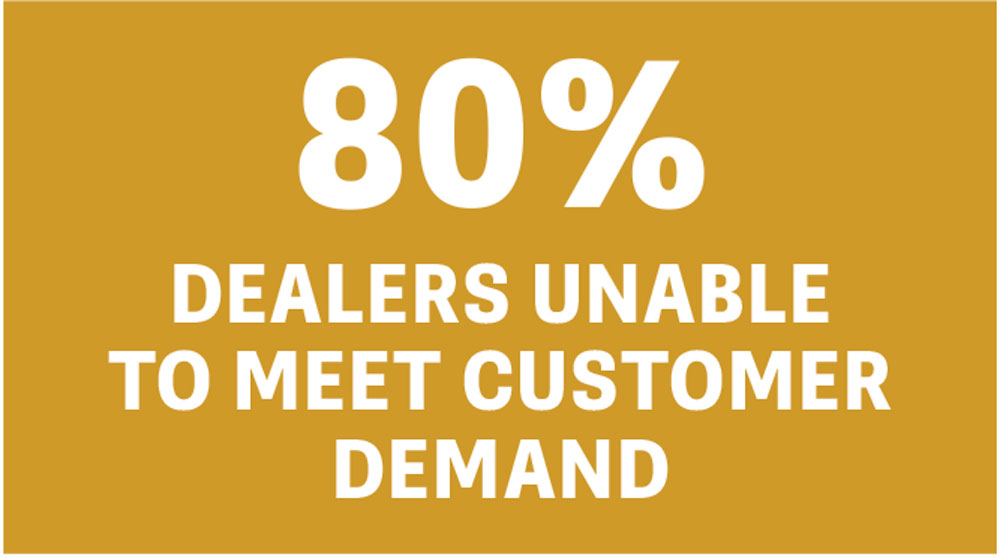
It also reports that unfilled technician positions cost dealers about $7 billion a year in potential service and parts sales. Among dealers surveyed, 80% said the shortage prevented them from meeting customer demand.
Closing that gap requires dealers, schools and students to understand what each can deliver.
A Reality Check: Where Are We At?
Dealers understandably want someone who can contribute on Day 1. But expecting a new graduate to replace an experienced field technician only sets both the hire and dealership up for frustration.
Fitzgerrel describes the school’s role as establishing a foundation in engines, hydraulics, electrical systems, heating and air conditioning, safety and measurement. The dealership then must build on that knowledge with product training, mentorship and experience from doing actual repairs. A new graduate should not be expected to take a field service truck out alone, he adds.

Nick Lindloff, an instructor at the Agricultural Equipment Technology Program at Madison College in Wisconsin, agrees and also sees the challenge growing. He explains that more incoming students do not come from farms, so dealers and schools cannot assume they arrive with years of experience around large machinery.
“To someone who didn’t grow up around this equipment, the size of it can be very intimidating,” Lindloff says. “The complexity of the systems that agricultural equipment uses to operate is also staggering.” A dealership may service new machines, but also tractors that are 50 years old. The range of knowledge expected from a technician (and their schooling) keeps growing.
Lindloff also points to the farm economy. When producers have money to spend, service work increases and dealers need more people, and yet a downturn can reverse that very fast. A constantly changing workload makes it harder to build a steady workforce for dealers, even as retirements continue.
He does say that even a farm-raised student will have something to learn. Fitzgerrel points out that repairing a machine at home differs from working in a service department, where time is billed and a technician builds or destroys a customer relationship. Schools can introduce those expectations, and a dealer must help a new hire learn to meet them in their unique business environment.
The Educational Component
Schools, too, can expect more than a dealer can readily deliver. Fitzgerrel hears requests for the latest technology, but equipment has a cost to the dealership. Plus, manufacturers cannot supply every program with every current machine. This becomes even harder as AI and precision technology rapidly changes. He says it’s more productive to identify the systems a student must understand, then find ways for both students and instructors to experience the newer technology in the field.
By the numbers | Classroom capacity
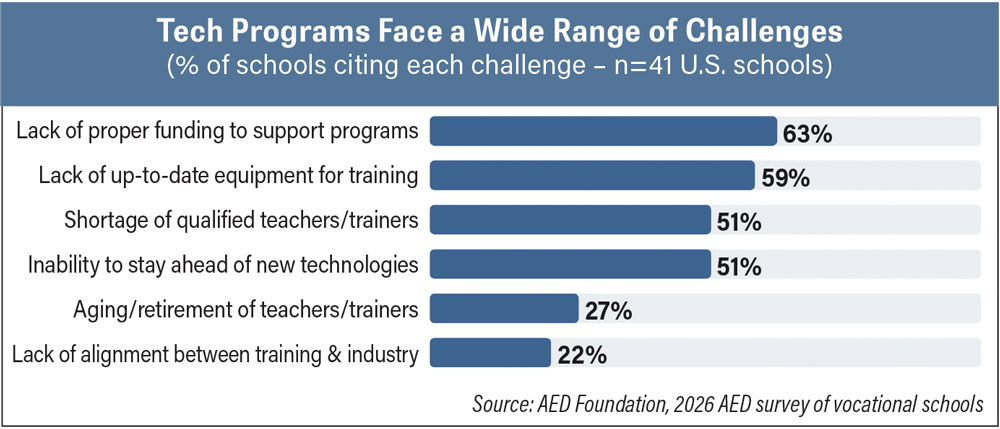
Among 41 U.S. schools surveyed, 63% cited insufficient funding, 59% outdated training equipment and 51% a shortage of qualified teachers or trainers. Schools could select more than one challenge.
Source: AED Foundation, 2026 Technician Shortage Report.
And herein lies another issue. In the AED Foundation survey of 41 U.S. schools, 51% cited a shortage of qualified instructors and 27% identified aging or retiring instructors. Fitzgerrel says a number of programs have waiting lists because they simply cannot staff more classes.
A senior technician can often earn more staying in the shop or becoming an internal trainer than taking a teaching position. Without instructors, schools cannot expand the pool from which dealers hope to hire.
There is No Quick Staffing Fix
Tom Ballweg, owner of Ballweg Implement, thinks that problem deserves a more forceful response from school leadership.
In a conversation with Farm Equipment Executive Editor Kim Schmidt, he described a period when Waupun’s school district struggled to replace aging agriculture teachers and the program risked shrinking. Ballweg recalls speaking at a community meeting to urge school leaders to make the hires a priority.
Three weeks after the meeting, the district had hired 2 agriculture teachers, Ballweg recalls. For him, the outcome reinforced his belief that filling those positions had to move to the top of their to-do list.
He argues that technical education needs support from superintendents and principals, and universities must have what they need to prepare the next generation of teachers. His message is pointed, but the underlying issue reaches directly into dealerships: an empty teaching position today limits the pool of prepared applicants tomorrow.
Erin Wierenga, who works in career readiness for Wisconsin’s CESA 6, sees a related constraint in high schools. Many cannot make agricultural technology a major classroom offering because the equipment and technology cost more than schools can fund, she notes. Youth apprenticeships, however, offer another route for interested juniors and seniors.
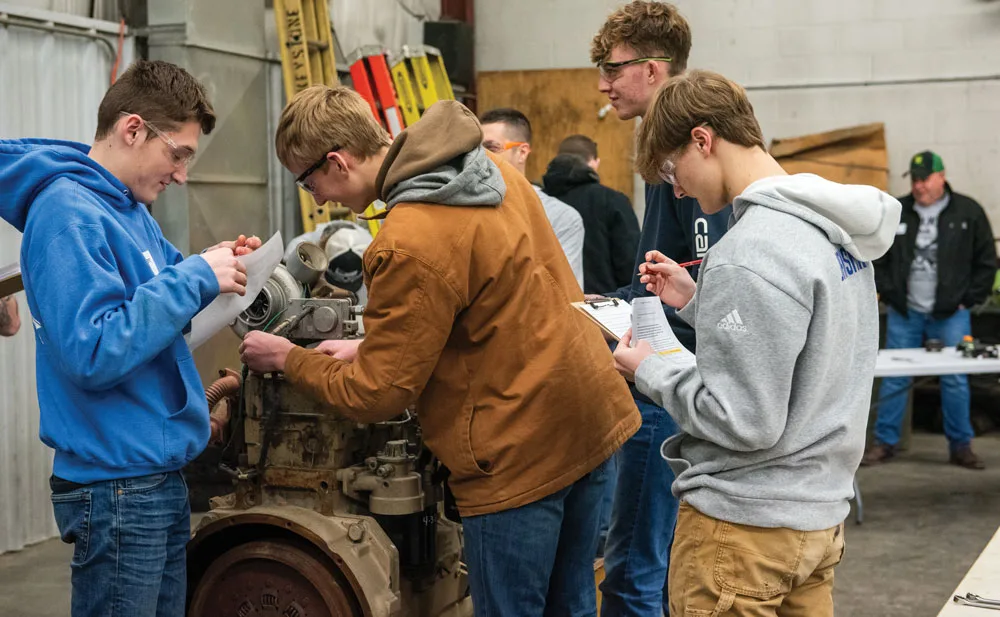
FFA’s Agricultural Technology and Mechanical Systems Career Development Event provides another place for dealers to meet interested students. The popular event tests practical skills, technology, problem solving and teamwork. In Wisconsin, Lindloff serves as the state event’s superintendent. Its 2026 lab stations included electrical troubleshooting, combine harvest loss, sprayer rate calculations, corn planter setup and hydraulics.
It relies on professionals to help students learn and compete, as well as develop a stronger interest in the industry for the long term. A dealer could offer equipment, demonstrate a repair or invite participants to see a service department for these contests, which are then held at a national level each year.
The Tech’s Perspective
The third gap appears when students enter the shop. A young person may picture sophisticated diagnostics and immediate independence; a dealer may expect the new hire to first prove basic shop habits. Both need to know what the first year will actually involve.
“Just because you graduated from the program or you’re in the program doesn’t mean that you’re an expert,” Fitzgerrel notes. At the same time, meaningful work and a close trainer should help a student see that the dealership takes the career seriously. Clear expectations about assignments, training and advancement opportunities make the transition easier on both sides.
Lindloff says an internship is required for students to graduate with an associate degree from Madison College’s Agricultural Equipment Technology Program. Dealers hire those students hoping an internship will lead to long-term employment. Sometimes it does, he says, but less often than it once did. Dealerships also compete with other fields for experienced people, who may leave for better pay or more time off.
Wierenga sees similar value in high school youth apprenticeships. Both sides can test the fit before investing in specialized training. She points to Ballweg Implement as a dealer that has hired youth apprentices who later became full-time techs.
The next challenge is keeping them. The AED Foundation report found that turnover at surveyed ag dealerships was most likely to peak between years 2 and 5, as techs were becoming more productive.
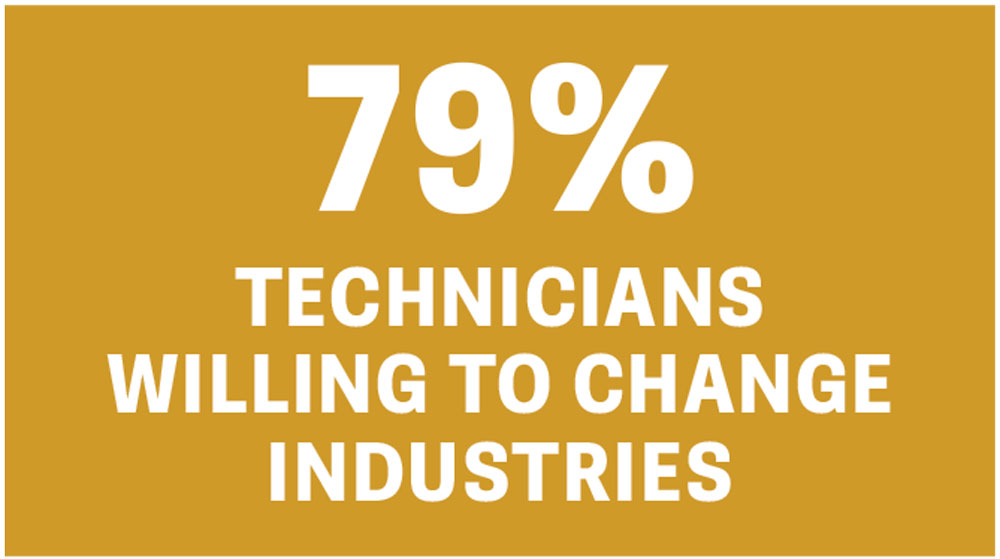
In its survey of technicians, 79% said they would consider a job in another industry if it improved their situation. Better pay, benefits, work culture and promotion opportunities all figured into their answers. Training people without giving them reasons to stay leaves the pipeline leaking at its most valuable point.
A Place to Start Together
Fitzgerrel has a question for the dealer who calls a school at graduation looking for its best student: “What have you done for me lately? Why do you deserve my best student?”
Other dealers may have spent months getting to know that student. They have hired interns, brought technicians into classrooms, served on advisory boards or helped instructors secure and understand the equipment in their shops. When the student chooses an employer, those dealerships then are familiar places with familiar people.
A trusted partnership helps the school, too. An instructor teaches the fundamentals but needs to know what happens when a graduate enters a live and busy service department. A dealer can explain which skills new hires use immediately, where they struggle and what they will learn through manufacturer training. The school, on the other hand, can be clear about what its program can deliver.
“There is definitely that disconnect between education and industry when it comes to the role of education,” Fitzgerrel adds.
A placement works only if the dealer makes room to teach. Give the student real repairs alongside an experienced tech who can explain the diagnosis, check the work and gradually hand over more responsibility. That technician needs time for it. If mentorship is simply added to the busiest person’s workload, it will disappear when repairs pile up.
By the numbers | A shared solution
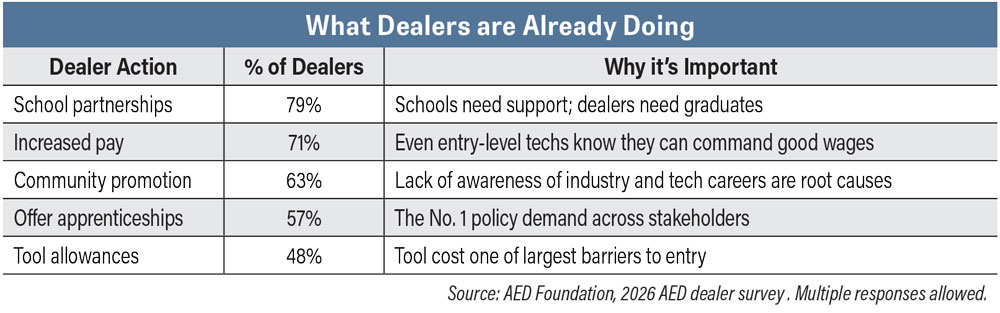
75% of surveyed dealers, 79% of technicians and 74% of schools selected work-based learning or internships as a priority. 57% of dealers reported offering apprenticeships.
Source: AED Foundation, 2026 Technician Shortage Report.
Some senior techs may welcome a defined teaching role, including those who want less field work as they approach retirement. Their knowledge of older machines, best practices learned through failures and customer expectations is hard to replace. Ask whether the role interests them, then give them the time to do it well.
Dealer Tip: Start with one nearby school. Ask the instructor where students need more hands-on experience, then show them what the work looks like in your shop. Together, identify a useful first assignment for students, and use that same approach with your interns and new hires.
Help is Already Here
Fitzgerrel says the AED Foundation employs 2 dedicated workforce coordinators who are ready and willing to connect schools and dealers. The Foundation also offers support to recognized high school programs, accredited colleges and businesses setting up registered apprenticeships. It can also aid with program administration and identifying potential state and federal funding.
Those school programs serve different stages. The foundation’s high school recognition requires safety instruction and introductory technical standards; its college accreditation sets standards for entry-level technicians. Fitzgerrel sees the coordinators as a bridge between educators and dealers who often struggle to communicate what they need from each other, and align on expectations.
He believes that help is underused. A Pennsylvania dealer, he recalls, gave up on an apprenticeship when the process became too cumbersome.
“They wanted to do this, and it became overly complicated because of the bureaucratic process, and that’s what we’re trying to do: streamline this process,” he explains.
Fitzgerrel sees a particular need among regional dealer groups doing roughly $300-$500 million in business: large enough to need a steady training program, but without staff to build and run one alone. Dealers outside that range often ask about school connections and available programs.
The dealer calling a school needs to know what the school can teach and what the shop must teach next. The school needs to know what work its graduates will face; the student needs real work and a path to learn it. Bringing those expectations into the open gives all three a better chance of developing a technician who stays.
The AED Foundation 2026 Technician Shortage Report offers much more comprehensive data and troubleshooting ideas on this topic. Visit aedfoundation.org to download the full report for free.
“The only way we’re going to do this is to continue to work together,” he concludes. “I think that’s the role that we at AED have taken is to be the nucleus behind this. How do we pull in dealers? How do we pull in schools? How do we pull in the OEMs to have this conversation and make sure that we’re all pulling in the same direction instead of pulling against each other?”