Original Post: May 28, 2026
On May 11, 2026, Ag Equipment Intelligence learned of CNH’s layoffs and a reorganization for a combined management authority over BOTH the New Holland and Case IH dealer networks. A brief mention of the CNH leadership reorganization around a consolidating of the brand oversight was reported in Ag Equipment Intelligence, in its May 15, 2026 newsletter.
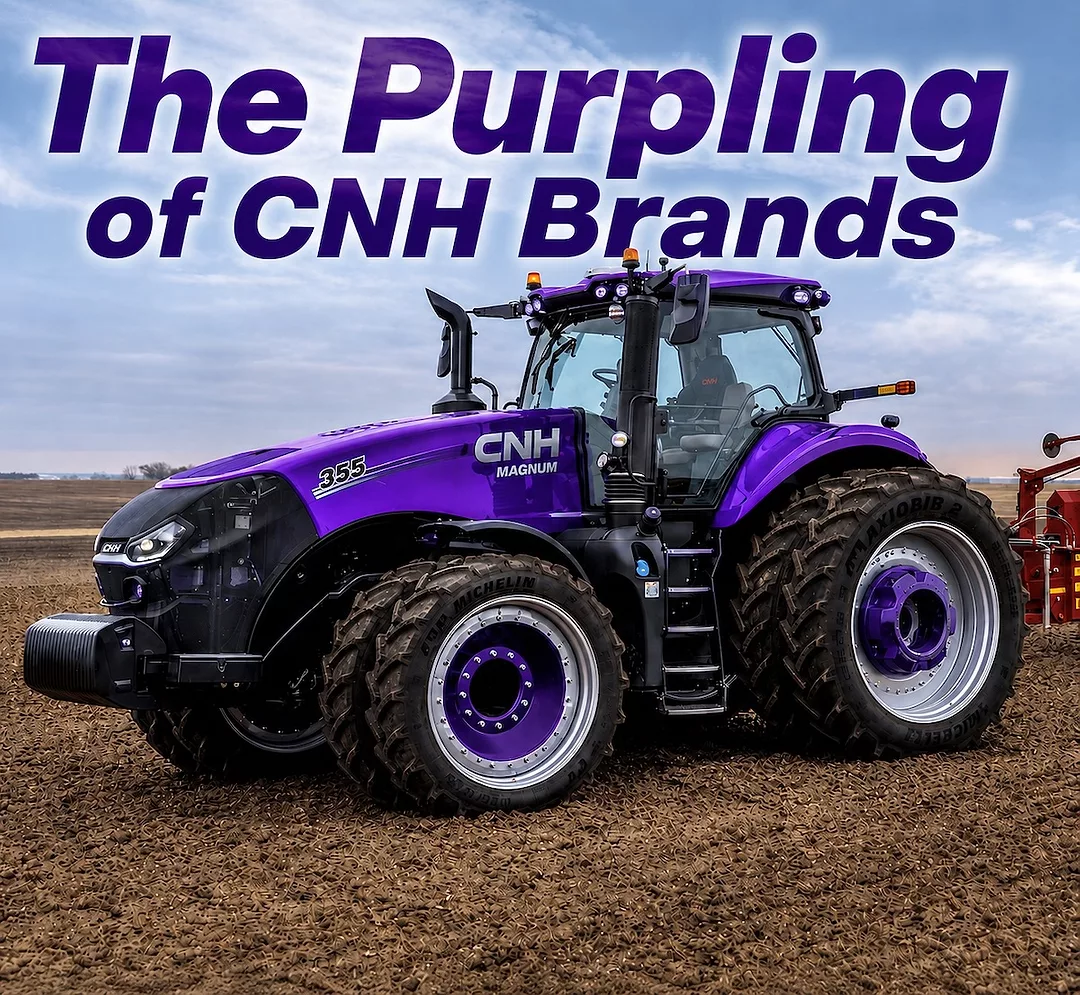
A week later, several at this week's Ag Equipment Intelligence Executive Summit described it as a “purpling” of the organization known for its New Holland (blue) and Case IH (red) colors. Another update was provided in the May 25, 2026 episode of Ag Equipment Intelligence’s On The Record broadcast.
It was big news for a company that navigated and integrated major mergers before. In 1985, when Case and International Harvester merged and again in 1999 when the new company was merged with New Holland after the purchase by Fiat. Brian Osterndorff, CEO of Roberts Equipment, a 6-store Ontario New Holland dealer noted the recent events are “clearly a pivotal moment for the CNH dealer network.”
On Thursday, May 21, editors reached out to both dealer networks for context and reaction, which is included in the text below.
Some didn’t even know about it and asked Ag Equipment Intelligence basic questions like whether their current rep was handling both lines.
Another added that recent communications have been poor. “I would’ve guessed they’d announced it in one of their 3-5 meetings held each month. I found out about it when I called a service rep for assistance.”
Dealers were mixed in their responses, with most of the larger dealers indicating support for the change. Most had questions on what it means and how it plays out between rival dealers in the same AOR and whether access is gained to the other-colored equipment. Other industry observers opined if this was an attempt toward “forced” dealer consolidation and whether more trimming of overhead was coming.
That was on the mind of one small New Holland dealer who asked his name be withheld. “It makes sense for CNH cost efficiency. But change always causes stress, including questions among New Holland dealers if this is the first step toward ‘merging’ the brands and, at minimum, future product and large lines moving exclusively to CIH.”
Joint Statement: What Case IH & New Holland Say …
On Sunday, May 24, 2026, CNH PR staffers emailed Farm Equipment and Ag Equipment Intelligence editors saying they were aware of pending media coverage and questions to their dealer network, and “would appreciate, at minimum, a response from your side on availability for an interview.”
Farm Equipment and Ag Equipment Intelligence editors eagerly agreed to and accepted the proposed 3:30 CST time on Tuesday, May 26. Less than 2 hours before the appointed interview time interview, however, it was cancelled. Editors made the phone call as planned but it was not picked up nor returned.
At 9:33 p.m. on Tuesday May 26, this joint statement from Case IH and New Holland North America was received:
“Recently, we conducted a reorganization of our North America commercial business for Case IH and New Holland Agriculture. This change does not impact our brands, which will continue to operate as distinct, collaborative go-to-market organizations supported by dedicated dealer networks. Our brand organizations have always worked together closely, and our dealers across Case IH and New Holland have had a consistent support structure and processes for years. This evolution is focused on further simplifying how we work together internally to better support our dealers and deliver stronger outcomes for customers today and into the future.”
Combining Brand Oversight
Several dealers pointed to what AGCO has accomplished, with myriad brands to support dealers but yet only one rep to cover them all. “There’s no real benefit to the dealer or the customer, but CNH can use fewer bodies to do the same work,” said a longtime manager at a large dual-branded group who asked his name be withheld.
A small New Holland and Massey Ferguson dealer agreed. “This will go down as the brands have for AGCO. The only difference is there are two brands versus the larger number of brands at AGCO. The dealer will be asked to do more for less. There will be less assistance from the brand.”
Les Olson, CEO of Plains Ag, a 16-store Case IH and New Holland dealer in North Dakota, Montana, Kansas and Colorado, cited the efficiencies of the move. They won’t be doubling up on two TSMs, two parts, two service personnel, etc., to become more efficient in an industry that will have fewer farmers.
“What I’ve been hearing is that anybody who runs a good dealership will stay. It isn't mandatory where they're going to be combined or anything like Case IH and in the Tenneco days.”
Like Olson, Jason Hecht, director of sales, Birkey’s Farm Store, a 20-location Case IH dealership headquartered in Illinois, agreed that one point of contact was meaningful to dual-branded dealers. He added that he believes “this should be a step in the right direction for the brands, dealers and customers moving into the future.”
Randy Benson, Minnesota Ag Group, Inc, agreed that farm consolidation and demographics made the streamlining a foregone conclusion. “As the customer base shrinks, dealer numbers shrink and many dealers become dual-branded, it makes sense to consolidate corporate field staff. Of course, if the industry was in a sales boom currently, this would not be happening. Staff shrink only happens in down markets.”
But Benson agrees that if implemented properly, “this can work out.”
Johnson Tractor’s Patrick Johnson, an 11-store Case IH, New Holland and Kubota group in Wisconsin and Illinois, agreed on the benefits of less duplication and greater internal alignment and said many of his peers expected this day would come. “When management combines things, the focus tends to go towards the more important segments, so I think overall this is a positive change.”
Olson also cited the global impact as a driver. “With New Holland larger outside of North America and Case IH larger in North America, they wanted to keep the two brands with a joint CNH market share goal. A lot of areas, including ours, don't support both brands and we end up competing against each other when we should be competing against John Deere and AGCO. Neither of the two brands had enough slice of the pie to be the type of a dealership that they want.”
CNH will position this as a tremendous cost and efficiency gain moving through this downturn of the ag economy, said a small New Holland dealer. “This will be directed to the shareholders and investors as hope to minimize the company's long term debt and other issues that have surfaced.” He shares the sentiment of other small dealers who see little benefit for dealers who choose to stay or are terminated.
Auto Industry Comparisons
Correlations were made to the auto industry. “The NH-CIH brands are very much like the Chevy vs. GMC brands,” said a longtime manager of a large CNH dealer group who asked not to be identified. “Both are very similar, if not the same in some cases, but one brand is the premium name in certain aspects. CNH is owned by an auto giant and seems to prefer to hire people with an auto background.
“Many of the engineering standards are now automotive-based in nature. The parts suppliers are also automotive with many auto-grade parts being used now instead of heavy-duty offroad versions. This cheapens the machines and ultimately leads to unhappy customers and dealers who are left being the middleman to clean up the mess.”
Brady Foster, CEO, Birkey’s Farm Store, pointed to the message over the last 12 months. “CNH publicly stated at Investor Day 2025 that it wanted more dual-branded dealers representing CNH in the same market areas. I believe there is influence from the auto industry in this, however each brand has been competing against all other brands, not just the sister company. This path provides less inner-company competition while providing the customer with the product they want.”
CNH CEO Geritt Marx ‘Calls It’ in 2025
Following are excerpts from CNH CEO Gerrit Marx on the company’s May 8, 2025 Investor Day
“We will also maintain a strong dual branded network that leverages the strength of both Case IH and New Holland … Our go-to-market transformation is a key component of our overall growth plan. We have often talked about this in the past, and now, we have concrete plans to heavily invest in our dealer network to ensure that our products and services reach every farmer. We are tailoring our approach regionally so that each market's unique needs are met with a customized go-to-market strategy. This new deal with dealers involves incremental investments to build superior service capabilities, integrated technology platforms, and common back-office support. The result is an exceptional customer experience that translates into long-term customer loyalty. Our dealers are our partners, we want them to be successful, profitable, and proud. There is no us without them, and a stronger CNH requires a mindset shift to see us as one team, sometimes challenging each other, yet never losing sight of our farmers. And through closer collaboration, we can better support our customers and drive sustainable growth.
“So, where the blues fought the reds, and the reds fought the blues, and that is being ended now, and we are not going to tolerate any more of these situations, and we're going to move things under one roof so that we can finally focus on the real color of the competition, which is green and different types of green. So, that is going to happen. So we're going to consolidate, for sure. “We're going to make it not everywhere the same, but we will have multi-brand dealerships in order to focus everyone on the execution and create the critical mass of a dealership in order to perform, have efficient back office functions, etc., and lead to the marginality that we have presented here as a targeted uplift for our dealer network on average. It’s the average of the 500 basis points and better marginality for our dealers by focusing them more, growing them more, and assisting them with tools.”
Why It Makes Sense to Dealers
Foster says the change in management benefits the CNH brand by aligning goals, strategy and product positioning and with fewer people replicating duties across the two brands. “The dealer network will benefit by having one set of contacts to support both brands, combining sales volume will allow dealers to have company representatives on the ground to assist with increasing unit sales and supporting the product/customer. And rather than trying to satisfy two sets of metrics, a single sales plan to grow the overall share of the market will be easier to follow. Less complexity often leads to more sales volume.”
Jay Funke, Del-Clay Farm Equipment, a single-store New Holland and Massey Ferguson dealer in Edgewood, Iowa, notes the change will cut expenses on lower ongoing sales, but hopes that employee ranks can grow again with sales when they come back.
Benson noted that this change is easier today since programming and discounts are pretty much identical. “Years ago the brands had different pricing and programs,” he says. “Also one rep for all parts and one for service may simplify warranty issues since the brand of equipment should no longer matter.”
The small New Holland dealer is hopeful that better support will come his way with Case IH’s greater volume in big equipment and broader support in personnel and resources. He wonders how the red and blue dealers will be able to avoid the impulse to compete against each other instead of Deere and AGCO. He also added that loyal mainline employees carried a lot of biases against the other brand, which is something that hopefully is now behind them.
“I hope they can get a good mix of blue and red employees so everyone is treated equally,” says Funke. “We will make it work; hoping it gives us consistency.”
Lessons from Consolidating Competing Brands
“Unlike the Case and International Harvester (IH) merger from 1985, there aren’t competing egos and the mantra of ‘we bought you’ and ‘it’s our way or the highway’ going on right now,” said a longtime large dual-branded dealer. “The cross engineering and production platforms insulate the dealers and customers from some of the radical changes that happened in the past. It is clear on a corporate and employee level that the Italians are the ones calling the shots and have little interest in what the North American market needs.
“The prime example is engineering. A number of staff have left or retired from CNH over the past decade after growing tired of this heavy-handed tactic. The suggestion to have more dual branded dealers hasn't been pushed either. If anything, single brand dealers seem to be preferred.”
Hecht cautions that “It’s very early to predict the outcome of this realignment; they tried this before to a certain extent 20 years ago.”
Benson also cited earlier attempts to streamline the aftermarket duties. “Shortly after the original merger, CNH had dual-branded parts and service reps but the number of dealer locations was so much greater then that they couldn’t cover their assigned territory effectively. Upper management was also separate and each wanted their own brand to sell more than the other. Hopefully this time it will be treated as a CNH vs. Brand X rather than competing against themselves.”
Longtime parts manager Brian Dalgarno noted that when Case and IH amalgamated in the 1980s, they found new sales did not equal the combination of adding two brands. “Case IH ended up losing customers,” he says.
“Dealers and customers are going to be told they are the winners, but that hasn’t happened in the past and I wouldn’t expect anything different this time either,” commented one active dealer and equipment historian.
The small unnamed New Holland dealer cited concerns about OEM loyalties. “Depending on which brand the individual came up with through the organization determines the brand they favor. Management always favors a brand.”
He also noted that history shows the stronger brand with stronger dealer base wins out when decisions are made, as does market share. He expects a lot of stress on financially weaker dealers.
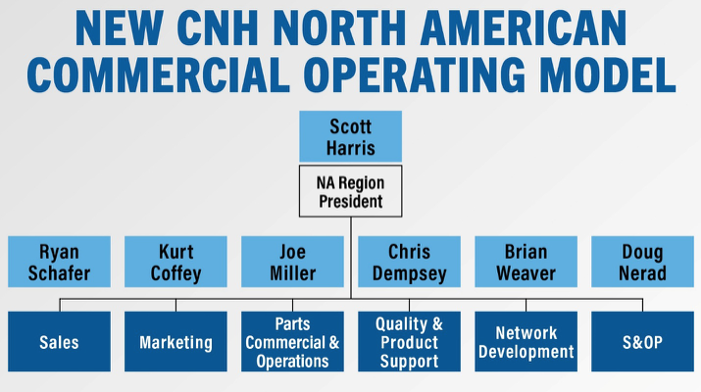
Several executives attending the May 19-20, 2026 Ag Equipment Intelligence Executive Summit in Chicago described CNH’s breaking news as a “purpling” of the organization known for its New Holland (blue) and Case IH (red) colors. Key leadership appointments included Scott Harris, North American Region President; Ryan Shafer, Sales; Kurt Coffey, Marketing; Joe Miller, Parts & Commercial Operations; Chris Dempsey, Quality & Product Support; Brian Weaver, Network Development; and Doug Nerad, S&OP.
Who is the Winner?
Many dealers say the only real winner here is CNH and its shareholders and, possibly, their largest top tier dealer groups. One expressed that CNH brass may never again come to see the likes of his company.
“The dealers that are dual-branded will have the most to gain because they aren’t plotting a New Holland rep against the Case IH rep or vice versa,” says Glen Vetter, Vetter Equipment, a 12-store Case IH dealer in Iowa. “Someday, as a Case IH dealer, when there is open territory, it may be advantageous to have the New Holland franchise just for the parts availability.”
Fred Titensor, Valley Implement, a four-store dual-branded CNH dealer in Utah and Idaho, calls the move a “great one for the brand that needed to happen 27 years ago.
“Ultimately, it gives this brand a fighting chance against other players that gained ground market share over the last 20 years. As red and blue have been fighting, other brands have grabbed share. This positions them in a great position to take back share.”
CNH corporate, says Benson, is the winner. “They dumped a bunch of salaries and reduced corporate vehicle requirements while attempting to maintain or grow sales. But dealers rarely score a win; there will be new mandates on market share and sales to achieve volume bonus.
“If CNH plays it correctly,” Benson continues, “it could be a good thing as long as they realize each brand has segments that could make great market share gains. For example, New Holland is the hay tool brand, period. Selling the same item painted red has always been more difficult and the resale value of New Holland hay tools is always more than Case IH – even though they are exactly the same. Another example is Steiger – the name for 4WD tractors. They should use that to their advantage and not mess with what works, but capitalize on it.
“Ultimately, as a dealer,” Benson admits, “we don’t have a voice or option on staffing by CNH.”
More Questions That Need Answering
Craig Lee, Director of North America Sales at harvesting equipment OEM Geringhoff, posed two questions following the news.
- Will there be differentiation in product features and capabilities of the two product lines other than just different colors and trademarking? AGCO has done a much better job of segmenting their brands and making sense of them than CNH.
- Will market share be calculated for each brand, or just a cumulative CNH market share? If separate, how will dual-branded dealers not cancel their own market share selling the same size tractor-built in the same factory – simply two different colors.
Meanwhile, Brian Osterndorff, CEO of Roberts Equipment, a 6-store Ontario New Holland dealer, added several more questions he believes will sharpen the conversation and push dealers to think beyond simply reacting to the news.
- How will overlapping Case IH and New Holland territories be reconciled, and how much input will dealers have in those decisions versus being informed after the fact?
- What's the risk of alienating multi-generational “red” and “blue” loyalists, and how does CNH preserve the distinct engineering DNA that built each brand's following?
- Do the recent layoffs signal CNH's read on the 2026–2027 ag economy, and are dealers being asked to carry more risk while CNH leans itself out?
- With Deere pressing on precision ag and AGCO building Fendt momentum, does this reorganization actually accelerate CNH's competitive response or consume internal energy at the wrong moment?
- What is CNH prepared to invest in the dealer network as part of this transformation – not just what efficiencies they expect to gain from it?
The small New Holland dealer said that if CNH can end up with very strong financially-secure dealers with loyal customers, they could get coverage in a lot of New Holland’s vacant areas. The New Holland combine market share in Canada is a good example of what comes with great dealers, loyal customers and great products, which New Holland has. But if this plan sputters, Deere will be smiling.”
Bud Lowe of Lowe Farm, a single-store Case IH location in Oklahoma, called “the competition” the real winner here. Funke added that anytime they take away services to the dealer it becomes more difficult to retain top-notch service.
Like other large dealers, Foster is positive about the changes. “Overall, my view is that these changes will tremendously benefit both CNH and the dealers moving forward. As of now, there is more work to be done, however the plan is now in motion to greatly benefit the company, with a big upside to the dealer network in the years ahead.”
He adds that each brand will need to be positioned correctly in each market. “If the approach evolves into a color discussion vs. a feature/benefit differentiation it will cause confusion for dealers and customers.”
Johnson, whose company just opened a greenfield New Holland store in Baldwin, Wis., agrees that things become simpler for companies that represent both brands. “Those that were purely one brand or the other may see a loss of focus as CNH drives toward less overlapping geography of Case-IH and New Holland dealers.”
Olson believes the dealer can emerge stronger. “CNH is trying to strengthen their dealer network by facilitating dealers in certain areas to carry both brands. They don’t seem to have a preference which is the buyer or seller as long as it is a good dealer. This should make the dealer stronger and able to focus on the true competition.”
Randy Robinson, KanEquip, a 14-store New Holland and Case IH group in Kansas and Nebraska, sees the upside – for “most” of the industry. “If done correctly, it should benefit everyone involved – except the small 1- or 2-store dealerships that are one color. I believe the big complexes will end up absorbing small stores, but it needs to be a gradual change as the typical farmer is not one to accept overnight change, especially when it affects their livelihoods. Whether that occurs over 6-12 months, it will be a big change for those who grew up only with red or blue.
“We are already working on both colors, but just selling new red. From the parts and service aspect, it will help the dealer who is working on both brands but has trouble getting support from the brand other than that contracted with. I also hope it will streamline CNH production and make ordering to delivery times shrink.”
The Competition
The “other-colored” independent dealers calling in East Moline, Ill., Duluth, Ga., or Grapevine, Tex. may also end up claiming victory. “A lot of people will be on the losing end of this,” says Lowe.
“Producers still have some brand loyalty and they value a relationship with the dealerships who have served them through the years, both in good and bad times. Confusion over continued customer support will be questions that will surface. The competition will take advantage.”
What do you anticipate with these changes? Post a comment below ...
Updated June 1, 2026
The recent move by CNH to further align the Case IH and New Holland organizations—often referred to as the "purpling" of the brands—has generated significant discussion throughout the dealer network. While many details remain unclear, NAEDA sees both opportunities and challenges associated with this strategy. Read more from NAEDA in their guest post »
Updated June 5, 2026
CNH "Purpling": Case IH & New Holland Merge Sales Efforts By Tractor Mike