
“Mom, it’s too hard … my 3-year-old grand-niece is known to say to her parents as they voice the household expectations of she and her little sister.
In reply, her mom (my niece, Molly Luchangco) asks a question that prompts her daughter to recall the family motto.
“I know,” the toddler nods, reciting what she’s long been taught about her family surname. “The Luchangcos do hard things.”
I heard her say those words again just days before she went to pre-school for the first time. I’m proud of how my niece and her husband are raising their girls; it’s a breath of fresh air. These toddlers – still in diapers – are learning what so many others have failed to learn.
That is, not to give up or retreat when the going gets tough. ”It’s too hard” … “I’m too anxious” … I just can’t do this” … “I have to talk to my parents – or my therapist.”
You know what I’m talking about. No one was ever promised an easy life, but lacking any practice of dealing with it only makes it harder.
And this, ladies and gentlemen, is why we have major universities like the Univ. of Michigan eliminating letter grades to minimize "pressures" on freshmen. And other social safety nets are indoctrinating students to a cared-for, socialistic world at a record pace – by making unnecessary comforts ubiquitous and free (they aren’t free, of course).
America’s institutions, built to prepare Americans for life, are increasingly raising a generation that our grandparents would barely recognize.
The Fault is Ours…
The current state of humans is the fault of its elders, says Bryan Arzani, who gave two presentations at the 2026 Farm Equipment Dealership Minds Summit in Springfield, Ill. His keynote centered on re-instilling the lost skill of critical thinking in business, and he spent a few minutes talking about how we got where we are today.
(By the way, Arzani is not your traditional “talking head” consultant. He’s fast-paced, straight-talker whose vocabulary includes words like "wuss" and "sissy," and armed to quickly break down a situation. We’ve made his entire video available for you at the link at bottom.)
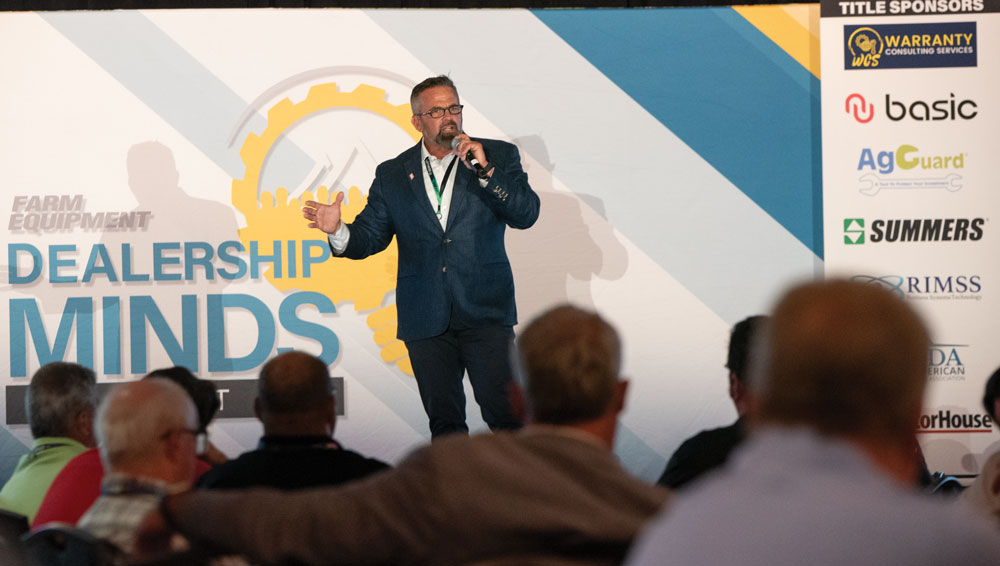
Bryan Arzani addresses attendees during his the 2026 Dealership Minds Summit keynote presentation.
Arzani explained that well-meaning social sciences movements of a generation ago ushered new norms that overvalue positive self-esteem – at the expense of what once prepared those equipped to take on the world and whatever came its way.
In a quest for perfection and good grades, which got increasingly handed out like cups of water, a whole generation failed to internalize the grit that’s taught by struggle. Soft-hearted parents worked to remove obstacles from their kids' paths, and called teachers, coaches and even employers to ease little Jenny and Johnny’s way…
Absent of enduring the struggle of life and learning from it, a generation did not learn critical thinking.
The Problem is Real
You can read almost daily about socialism’s gain and how it speaks to those who “just want to be rescued” – from an unfair economy, their anxieties, and having to pay for health care, education, housing and food. Grit, bootstrapping and perseverance are apparently such foreign concepts that they don’t enter into conversations as answers to the same problems that the welfare state is purporting to wish away.
“He explained that well-meaning social sciences movements of a generation ago ushered new norms that overvalue positive self-esteem – at the expense of what once prepared those equipped to take on the world and whatever came its way.…”
Entrepreneur Emil Barr recently told his story of emigrating with his mother to the U.S. at age 3. He started successful businesses as a teen, attained an education and amassed a $20 million worth before turning 23. He wasn’t accomplished because someone or some government handed him a check. Instead, he says, it was because America “gave me room to try.”
Today’s Wall Street Journal reports America has never been better for the “can-do, make your future” entrepreneurial types. For the first time, 2025 saw more Gen Z entrepreneurial start-ups than did the Baby Boomers. Perhaps the dichotomy of and chasm between the two schools of thought will be greater than ever before seen.
Hard Doesn’t Mean Wrong
An “Into the Unknown” series going on right now at my church offers weekly stories of the ultimate courage from the likes of Peter, Moses, Jonah and Paul. Each's impulse, we've learned, included doubt and an initial avoidance.
”Just because a path is hard doesn’t mean it's the wrong path,” Pastor Matt Morton reminded the congregation during this weekend’s review of Paul in the book of Acts. “The hard path might just be the one you're destined to be on.”
“Just because a path is hard doesn’t mean it's the wrong path. The hard path might just be the one you're destined to be on.…”
He went on to add how those closest to you are often, ironically, the same ones counseling you to give up in search of an easier way. That is, to avoid risk, calm your anxieties or find safe harbors when the waters are a bit uncertain.
Our culture points to how safety and comfort matters above all else. He adds, however, that trials don’t mean going through it alone either.
Storms That Teach
With a fair share of storms in a 35-year small business career, the benefit of time has even left me grateful for some of them.
I’m glad I didn’t give up before putting in my 10,000 hours to test myself at my chosen craft, or leave my post when greener pastures called. Our experiences prepare us for what’s next; they battle-test us. It’s irresponsible to deny their lessons.
Viewed this way, experiences are a gift, and those who never rise up to meet them fail to receive the growth opportunity they grant to us.
At the onset of one of the deepest valleys of my professional career (a real $!#@-storm, by the way) a guy, later recognized as a mentor, actually congratulated me on the hard chapter ahead. I should consider myself lucky, he said, to gain the experience coming my way at a young age.
I was not exactly receptive and scoffed at a sentiment I was not yet mature enough to comprehend. But he was right. Once you've run the gauntlet, and survive to talk about it, certain problems can be put into perspective, and you can draw upon the experience to figure out what’s next.
The Problem Can Be Fixed
Arzani maintains that the lack of critical thinking (among other byproducts of a new generation) stems from a wiring issue, not laziness. And it can be fixed, he says.
I hope he’s right.
But I do know it’s time to start working on it, not just tolerating lower expectations. It'll include explaining to a not-always-receptive group how the real world works. And then, standing alongside them through an apprenticeship that prepares all parties (including customers and other teammates) for the retirements ahead.
“Arzani maintains that the lack of critical thinking stems from a wiring issue, not laziness. And it can be fixed …”
It isn’t appealing to most of us to try and get a generation that often lacks responsibility beyond self to pull the earbuds and listen up about attaining the grit that’ll be good for them.
Many of us were taught to rest up on the weekends and to show up for teammates even if we had a sniffle or bad night’s sleep. Knowing you were making others carry the water for you was more troubling than personally trudging through a bad day. For many, this principle needs to be taught and learned – perhaps for the first time.
Avoid the Rescue
Arzani offers practical solutions that do not perpetuate weakness through rescue. He teaches managers how to go about it. It’s simple but not easy; and requires a deep breath and patience.
We can’t jump to dictate obvious solutions to the exasperated. Even more, we must recognize and reward those walking through the fires, who don’t sidestep troubles or ask someone else to take their place. The hard slog itself needs to be celebrated as much, or more so, than the outcome.
Muscle, as Arzani says, expands only when it’s first tested to the point of failure. We must get them in the game and under controlled stress.
Arzani says it well, so I’d encourage you to watch the full video of his session here. And maybe you’ll view it in a shared session like we’re doing with our management team.
I’ll make you a deal. Email me (mlessiter@lessitermedia.com) some feedback and practical observations, and I’ll share any worthwhile thoughts from our managers back with you…
RELATED CONTENT
- Part 1: 2 Time-Proven Traits for Human Capital Success from 2026 Dealership Minds Summit Presenter
- General Session: How to Unlock the Power of Critical Thinking in Equipment Dealerships
- How to Identify Your ‘Code of Success’
- VIDEO: Bryan Arzani's Dealership Minds Summit Keynote on "Awakening Critical Thinking int he Workforce We Are Inheriting"