We are getting this episode to you a little late, as we spent Friday making family memories and joining 750,000 of our closest friends at the Brewers Championship parade. In this edition of On the Record, brought to you by Associated Equipment Distributors, we share an economic outlook on the ag equipment industry from Patrick Luce and Jeremy Bess, principal economists with Stantec. In the Technology Corner, Noah Newman spent a day in the cab with Ryan Lynch, ag technology sales specialist for Ziegler Ag in Altoona, Iowa. Also in this episode, a look at the regional sales results for AGCO’s third quarter and Acuita Ag CEO and Founder Chris Hunsaker shares the 4 paths he sees emerging for AI and autonomy in ag equipment and machinery.

This episode of On the Record is brought to you by Associated Equipment Distributors — the leading association in North America for the equipment distribution industry.
Ready to connect with industry leaders, discover new opportunities and prepare your dealership for what’s ahead? Join the Associated Equipment Distributors (AED) January 25–27 at the 2027 AED Summit at the Rosen Shingle Creek Resort in Orlando. The Summit brings equipment dealers, manufacturers, and industry partners together for three days of networking, education, business insights and relationship-building. Attendees can explore the latest products and services in CONDEX, connect one-on-one with manufacturers and peers, and gain valuable perspectives on the issues impacting equipment distribution. Don’t miss the opportunity to grow your business network, gain new ideas and help shape the future of the industry. Make plans to join AED in Orlando for the 2027 AED Summit! Learn more and register at www.aedsummit.com.
TRANSCRIPT
Jump to a section or scroll for the full episode...
- ‘Muted Growth’ Expected for Farm Equipment Manufacturing in 2027
- Dealers on the Move
- Precision Specialist Enjoys Unpredictable Nature of New Role
- Commodity Ticker
- AGCO 3Q Net Sales Down 9%
- 4 Paths Emerge for AI in Ag
- DataPoint: Foreign-Held Agricultural Land Reaches 47.24 Million Acres
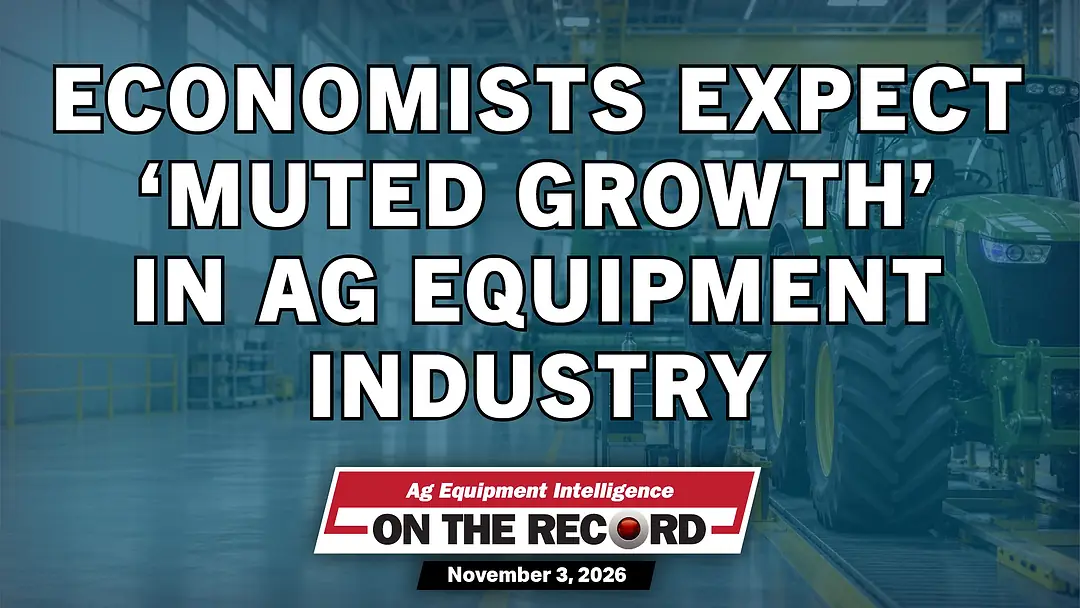
‘Muted Growth’ Expected for Farm Equipment Manufacturing in 2027
During the Farm Equipment Manufacturers Association Fall Convention in New Orleans, Patrick Luce and Jeremy Bess, principal economists with Stantec, provided an economic outlook for 2027, breaking down some of the trends they are seeing in markets that impact the farm equipment manufacturing industry.
They are calling for “muted growth” in the year ahead.
Jeremy Bess: “This is kind of how the economic trend goes about. I know some folks are looking at this and we're going, "Okay, yeah, but that's broad manufacturing. What's the industry doing?" On this line, black line, I'm now looking at farm equipment manufacturing. Once again, it's a volume-based metric on a year-over-year basis. Well, just like the overall manufacturing trends in the US, we are in expansion, we're in the green phase, right? 9.2%, but I do not want us to look at this and say, "Oh man, next year's going to be fantastic." No, I'm giving you insights right now that if I do that same kind of strategy where I take the interest rates, move them forward by 24 months, flip it up on its axis, what is it suggesting? It's suggesting, again, some muted levels of growth in the industry. I will be very clear, generally speaking, we peak and we come down.”
“We don't just move flat for that long. So likely what it means is as we head into 2027, just like broader manufacturing trends, we're going to be experiencing decelerating growth. Everyone, it is still growth. I just want us to keep in mind if you're starting to plan for next year, what you did this year might not be the opportunity for next year. It still means growth. Patrick's talking about making investments in your business. Absolutely. If you don't, you're going to miss any level of growth. We still want to look at this and say, "Okay, put it in context. It just means downside pressure. It's not the great recession timeframe." Give us a little bit more of that evidence though.”
Patrick Lewis: “Yeah. We need to also think about the demand for farm growth. We need to think about your customers, and there's some great survey data that comes out of Purdue and CME group on the ag side that measures the sentiment of the agricultural climate and environment. We have two speedometers there. The orange one, that is the farm capital investment index, meaning do farmers, do your buyers expect or think right now is a good time to be making capital investments? Anytime that number is below 100, it means they don't. Anytime it's above 100, they do. But look at the other barometer, the one in black, that is just the broader perspective on agricultural production. Anytime that barometer is above 100, that means there's positive sentiment about agricultural production. There's this kind of triangulation that happens here that says, "Well, gosh, farmers aren't keen on making investments right now.”
“They don't think it's the right time to invest in it, but they do think that we're going to have to produce more next year." We can talk about things like corn prices and soybean prices, which are actually in acceleration right now. Those have a lead of about three months to the farm equipment manufacturing. But if we look at the index on the left, that farm capital investment index, and I know this is one of those charts where we are just spraying a whole fire hose, but the orange line is that index over time in comparison to the farm equipment volume, that production that Jeremy was talking about in the black line. That has about an eight month lead time that is suggesting an upcoming peak in farm equipment production. I want to be very clear about this transition to more of a decelerated growth environment for the industry, but that's just not the end all be all, right?”
Dealers on the Move
This week’s Dealer on the Move is Wright Implement is Wright Implement. The John Deere dealership group added 8 locations in Kentucky through the acquisition of Meade Tractor. This brings Wright Implement’s total locations up to 23.
Precision Specialist Enjoys Unpredictable Nature of New Role
I had the chance to spend a day in the cab with Ryan Lynch, ag technology sales specialist for Ziegler Ag in Altoona, Iowa. Ryan worked as a service advisor and sales support rep for the dealership for several years before taking on this new role about 6 months ago. On our way to an installation job, I asked the lifelong farmer — “What do you like most about your new role?”
“The reason I enjoy this job so much is being out and about. I just went to a new farm today that I’ve never been on. You get the chance every day to potentially meet someone new and see a new farm, get to know them and see how they operate. With farming being a passion of mine, it’s intriguing to me, and it’s what makes me want to come to work every day — to be out in the field directly involved with the farmers.”
“My schedule can change. I can have something we’re going to do tomorrow and by 6 or 7 p.m. that can change. It all depends on the weather and the customer. You might have a plan to go install a system and they decide they need to use the tractor, which changes your whole plan. You’ve got to pivot. I don’t mind that too much. I like to have a schedule, but at the same time I like to get up every day knowing that more times than not I get to do something different. It keeps things interesting.”
Stay tuned for a full recap from my visit with Ryan in the upcoming edition of Day in the Cab on PrecisionFarmingDealer.com.
Commodity Ticker
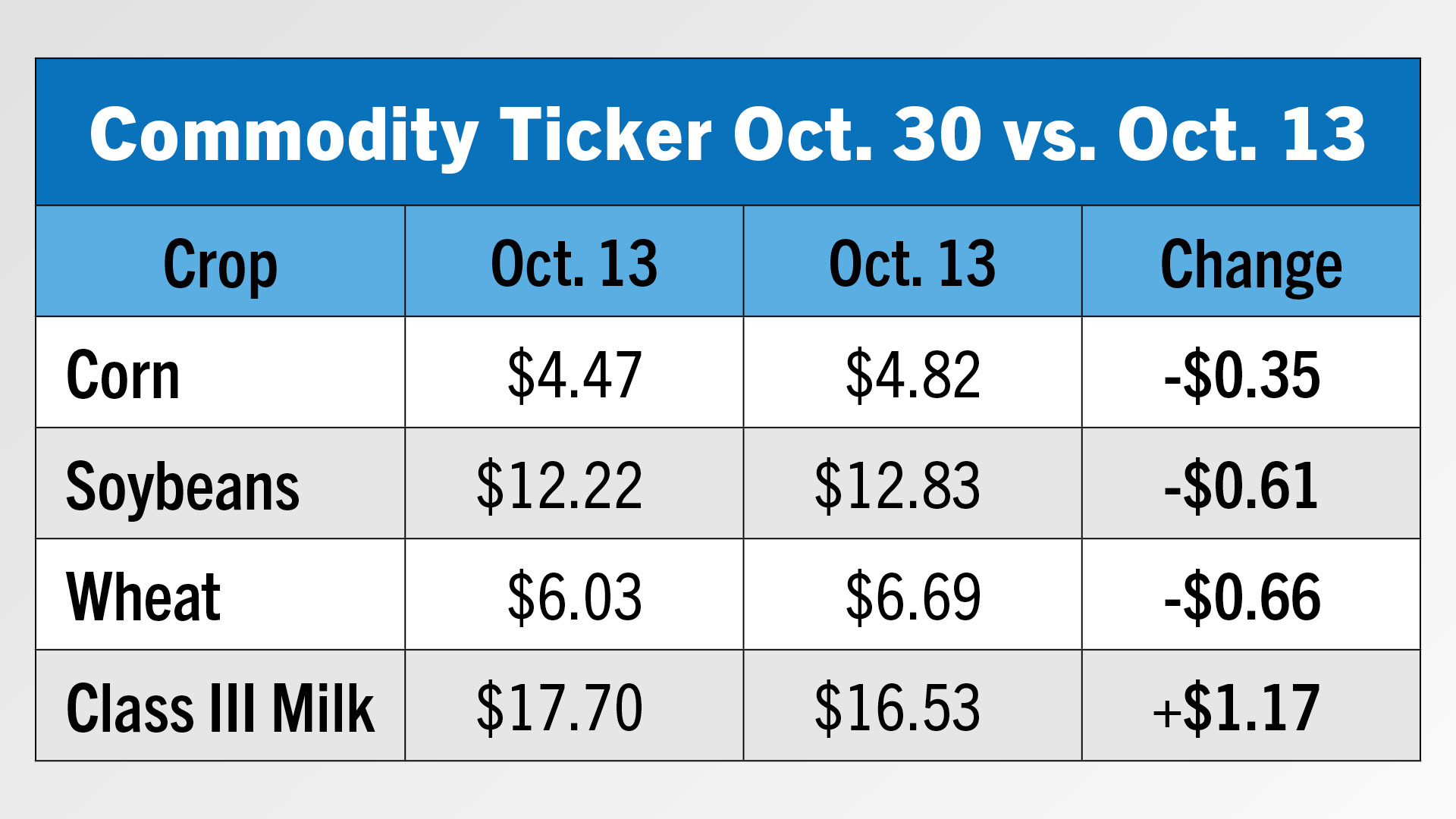
As of October 30, corn prices were $4.47 down 35 cents from our last episode. Soybeans closed at $12.22, down 61 cents. Wheat closed at $6.03, down 66 cents and Class III milk prices closed at $17.70, up $1.17.
AGCO 3Q Net Sales Down 9%
AGCO reported its third quarter results on Oct. 29. Net sales for the quarter were $2.3 billion, down 8.6% vs. the same period last year. For the first 9 months, net sales were up just shy of 1% to $7.2 billion.
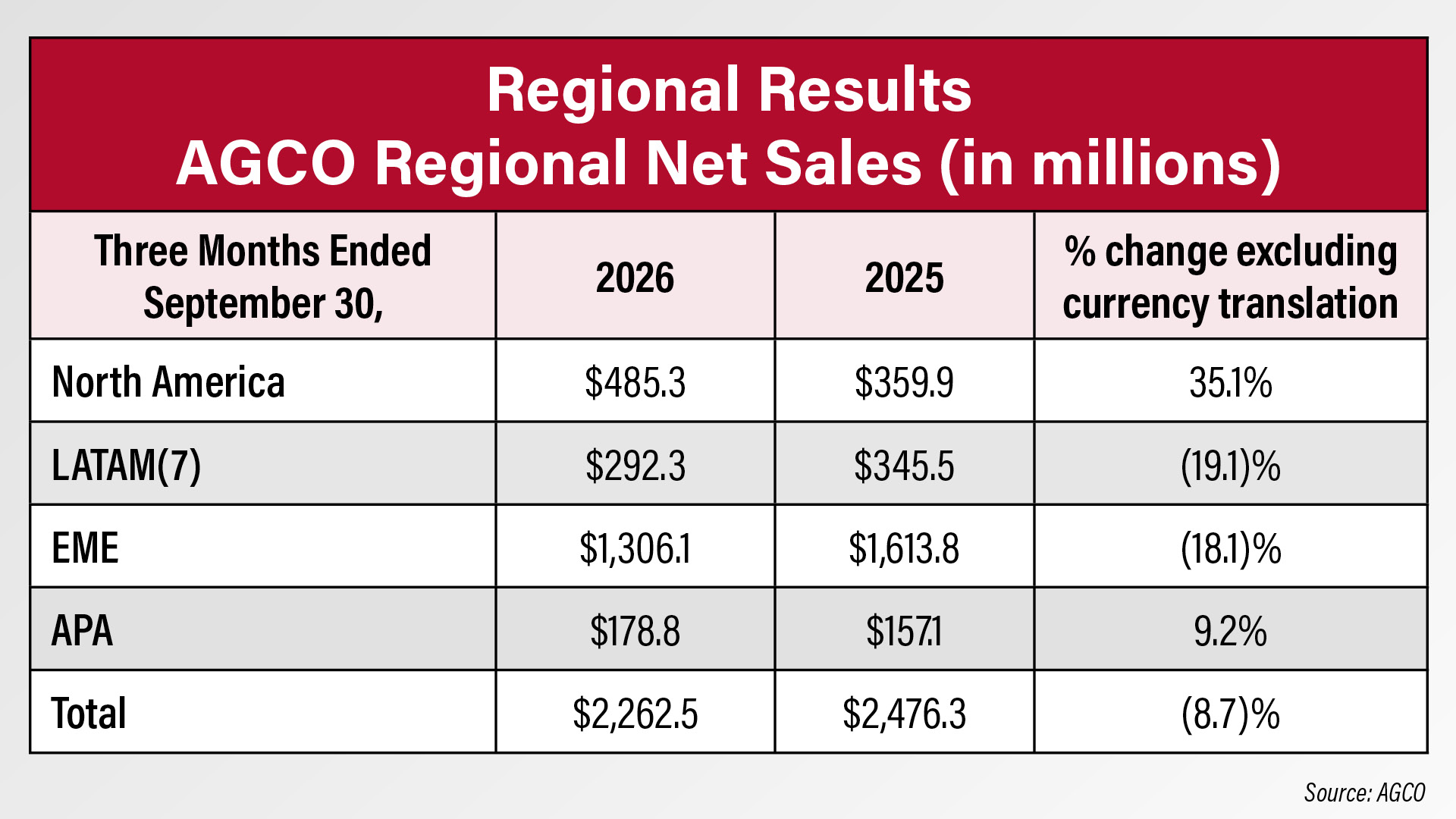
North American region net sales increased 35.1% during the third quarter of 2026 compared to the same period last year, excluding the impact of unfavorable currency translation. Higher unit sales across most equipment categories, particularly high-horsepower and mid-range tractors and parts, supported the increase in sales. Income from operations for the third quarter of 2026 was $13.8 million compared to a loss from operations of $42.0 million in the same period in 2025, primarily due to higher sales and production volumes and the benefit of approximately $13.0 million of certain IEEPA tariff refunds recognized during the period.
In Latin America, net sales decreased 19.1% during the third quarter of 2026 compared to the same period last year, excluding the impact of favorable currency translation.
Net sales in the Europe/Middle East region decreased 18.1% during the quarter compared to the third quarter of 2025, excluding the impact of unfavorable currency translation. Sales declines were primarily driven by weaker industry demand, with the most pronounced decreases in Germany, France, Italy and Spain.
In the Asia/Pacific/Africa region, net sales increased 9.2% during the third quarter of 2026 compared to the third quarter of 2025, excluding favorable currency translation impacts. Higher sales in Australia were partially offset by lower sales across many of the Asian and African markets.
4 Paths Emerge for AI in Ag
During the Farm Equipment Manufacturers Association Fall Convention in New Orleans, Chris Hunsaker, CEO and founder of Acuitus Ag, shared an outlook for autonomy and AI in ag. He says there are 4 pathways emerging as ag companies look to apply AI into their machinery and equipment.
“So there are a lot of ways that AI applies in ag, and in particular, we see four paths emerging as companies inside the industry are looking for ways to apply AI into their machinery and equipment. And it's tied with automation. And so we see the OEMs, the major OEMs investing in their own end-to-end solutions. So purpose built for their machines. So like a John Deere, for example, they have an autonomous solution that puts cameras on the tractors and will put some sensors on the tillage equipment and the system is fully autonomous. So that's one path that people are starting to go down, but there are others as well, where in some cases the OEMs will partner with other companies and they'll bring some things to market. So in that case, one example is Kubota and Bobcat partnering with a company called Agtonomy. Agtonomy is a startup and Agtonomy has the intelligence behind the automation, but the hardware and things are actually integrated by the OEM.”
“And that's how they bring the fully autonomous solution for the tractor to market and also some implement capabilities there too. Those are primarily driven by cameras as well as some other sensors. You can have LiDAR, you can have radar. Depending on what the use case is, there's a lot of choices that have to be made. The third path is a third party actually coming in with the whole solution. So one example is Kingman out of California. They have an autonomy kit that goes on the tractor that will also have some implementation or integration as well with it. And the OEMs don't necessarily have anything, any involvement in that. It's a retrofittable kit that's provided by the company, the startup. And then the final path is we're seeing a lot of purpose built. So ground up, the whole machine is different. And IGEN is a good example of this.”
“They're a startup that is based in Seattle and they have a mechanical weeder that, if you look at it, looks like an engineering drafting table because it has a big solar panel on the top. It's driven with electric motors, weighs about 200 pounds and it's capable of hoeing in between the rows and also in the row. And it can see the difference between weeds and the crop and it knows what it's supposed to remove. It can run in the light, it can run in the dark, but it's a very purpose designed solution that the form factor is totally different. So interesting things are happening and it's going to be really interesting to see how it kind of converges as time goes on too.”
Hunsaker will also be speaking at the Precision Farming Dealer Summit in Indianapolis, Jan 11-12. To learn more about the event and to register, visit PrecisionSummit.com.
DataPoint: Foreign-Held Agricultural Land Reaches 47.24 Million Acres
This week’s DataPoint is brought to you by the Precision Farming Dealer Summit, coming to Indianapolis, January 11-12. To download the program and to register, visit precisionsummit.com.
According to USDA's 2024 Agricultural Foreign Investment Disclosure Act report, foreign investors held interests in approximately 47.24 million acres of U.S. agricultural land, an increase of roughly 2.34 million acres compared to 44.9 million acres in 2023. This represents an increase of approximately 3% over the previous year.
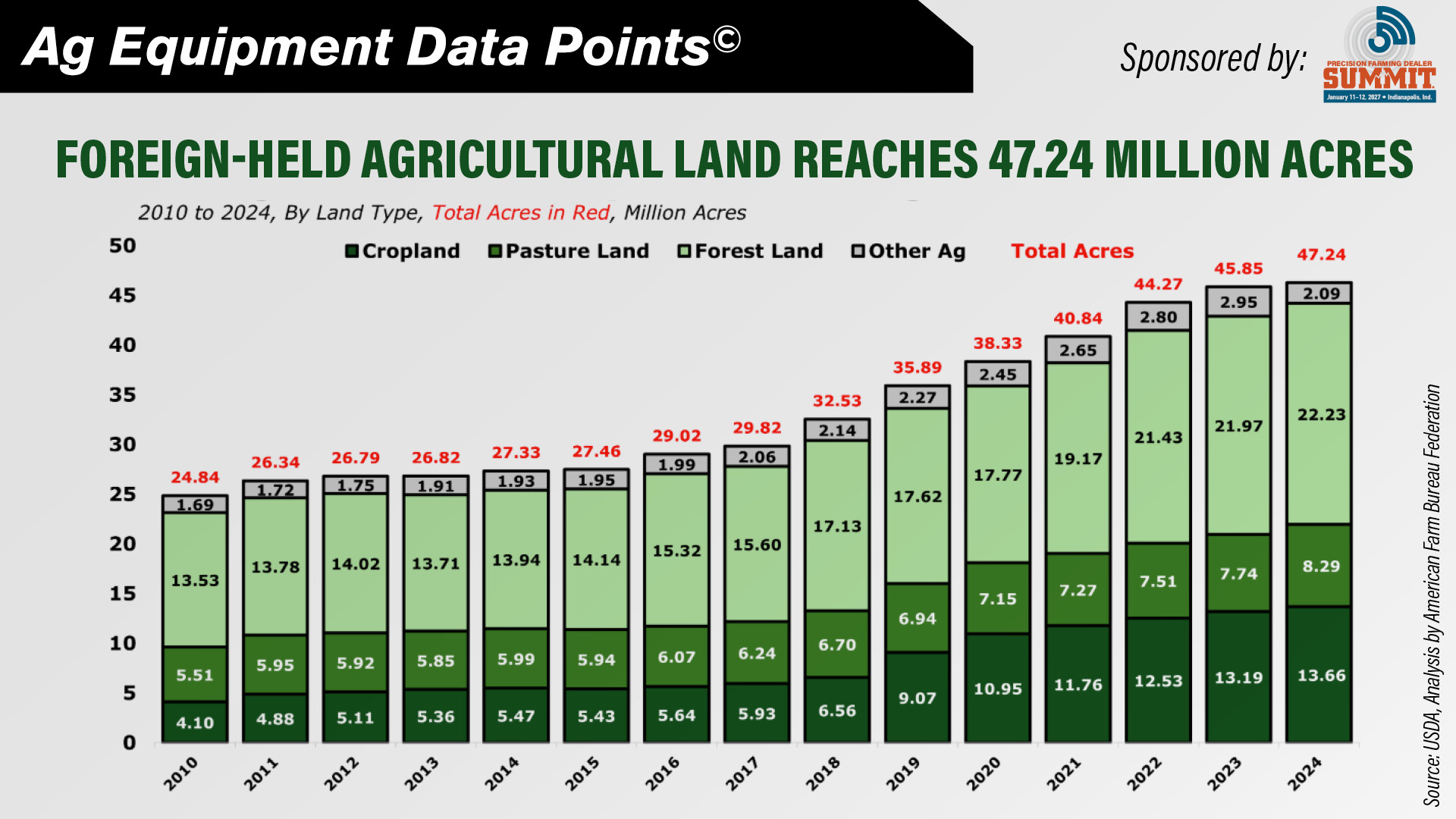
Foreign-held acreage has increased substantially since 2010, when foreign investors held approximately 24.8 million acres. The 2024 total represents an increase of approximately 22 million acres, or 90%, over that period.
Land use remains an important distinction. Forestland accounted for approximately 22.2 million acres of foreign holdings in 2024, nearly half of the reported acreage. Cropland accounted for approximately 13.7 million acres, with the remainder consisting largely of pastureland and other agricultural land.
The large share of forestland reflects substantial investment by foreign-owned timber and forest products companies. It also underscores why foreign agricultural land holdings should not be interpreted exclusively as foreign purchases of actively cultivated farmland.
On the Record is now available as a podcast! We encourage you to subscribe in iTunes, the Google Play Store, Soundcloud, Stitcher Radio and TuneIn Radio. Or if you have another app you use for listening to podcasts, let us know and we’ll make an effort to get it listed there as well.
We’re interested in getting your feedback. Please feel free to send along any suggestions or story ideas. You can send comments to kschmidt@lessitermedia.com.