Farm Equipment‘s Shortline Legends video series is brought to you by FEMA.

For 75 years, FEMA members bring choice, value and Innovation to Agriculture. Shortline manufactures offer preferred brands at better margins, First to the market with innovation and dealers are more profitable with shortline manufacturers. For 75 years, customers prefer equipment from FEMA shortline manufacturers. Learn more at www.farmequip.org.
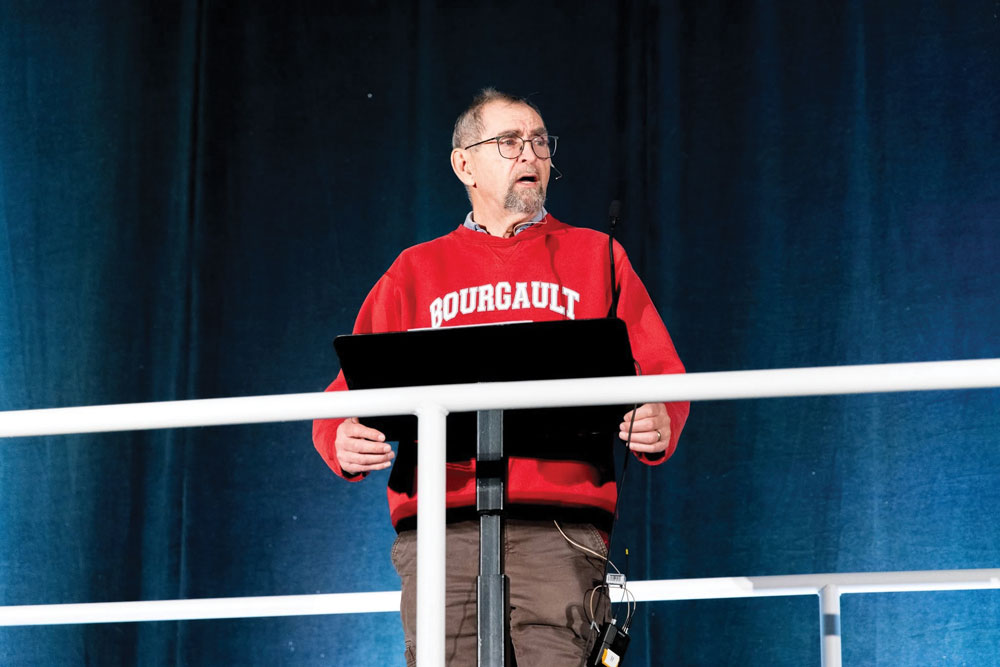
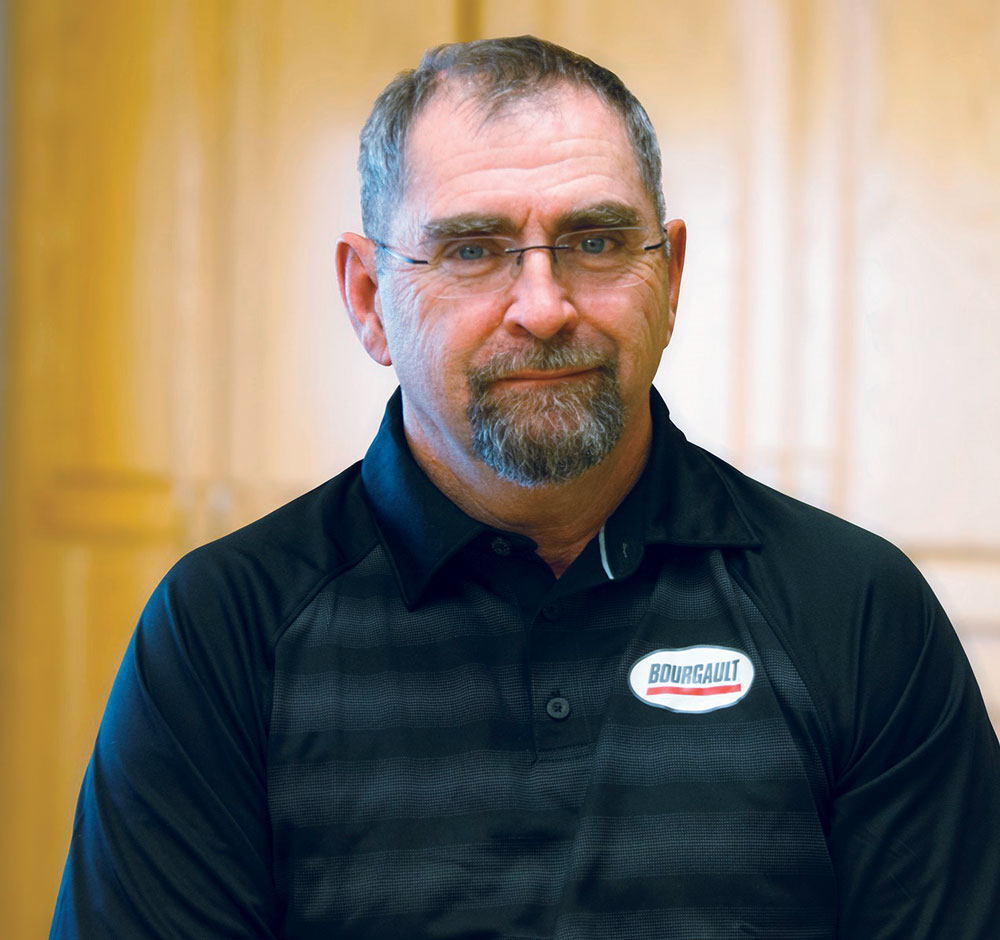
Gerry Bourgault’s first taste of innovation was working with his dad, Frank, in 1970 before he went off to Univ. of Saskatchewan and 4 years before the elder Bourgault formally established Bourgault Industries. That summer, with the help of his son, Frank put together his first complete prototype 16-foot cultivator that could do the job of both a field cultivator and a chisel plow in many circumstances. Four years later, the first assembly operations were completed.
In 2024, Bourgault Industries celebrated 50 years in business. That same year, the business was acquired by Linamar Corp., joining MacDon and Salford in the company’s Agriculture Division. The acquisition included Bourgault’s Highline Manufacturing division which produces hay handling and livestock feeding equipment, as well as roto-moulding producer Free Form Plastics.
Today, with approximately 500,000 square feet of manufacturing and office area, Bourgault markets its product around the world. Not only does the company design and manufacture equipment, it operates its own research farm to develop and validate new design concepts that will raise the bar in terms of producing better crops, more efficiently, the company says.
Before dipping his toe in manufacturing, Frank was farming and working with his brothers-in-law at their dealership Coquet and Bourgault Implements, a Massey Ferguson dealership originally founded by Frank's father-in-law, Pierre Coquet, as a Massey Harris dealership.
“He got exposed to both farming and various pieces of farm equipment,” Gerry said on Bourgault Industries’ Equipped Agronomy podcast. “And he got interested in building what he thought was a better cultivator to prepare the fields for seeding.”
Gerry says his father’s goal was to design a machine that could prepare the soil for seeding in fewer passes. “But his main purpose was to provide employment opportunities to people in the community. My dad was very community minded,” Gerry says.
That community mindset didn’t go unnoticed.
“My father knew Gerry’s father, Frank, well,” says John Schmeiser, the retired dealer association executive whose family’s dealership was 40 miles away from St. Brieux. “Our dealership was one of the early Bourgault dealers when Frank introduced his cultivator in the early 1970s. Later, when I worked in the dealership, I made many trips to Bourgault’s headquarters to pick up product, cultivator shovels, air seeder parts or whatever else we needed to keep customers running.
“Those experiences gave me an early appreciation for what made Bourgault different. It was an innovative manufacturer, certainly, but it was also a company that understood dealers, farmers and rural communities.”
Schmeiser says Gerry carried that philosophy forward.
“Under Gerry’s leadership, the company experienced an extraordinary period of growth,” he says. “Bourgault became one of the great success stories in all of Canadian agricultural manufacturing — proving a company headquartered in a small Saskatchewan community could innovate, manufacture and compete on a global scale.”
Gerry joined the business officially in 1975 after graduating. He became general manager in 1977 and eventually president of the company in 1989 following his father’s death.
Gerry says his dad taught him there was always a better way to do things.
“Gerry was much more than an innovator. He believed that lasting success came through people. Guided by curiosity, courage and a rational perspective, he challenged existing assumptions and encouraged those around him to think differently. He knew there was no shortcut to developing a strong team and dedicated himself to the long-term development of leaders throughout the company. While many remember the products and innovations he helped create, his greatest legacy may be the culture of leadership, learning and continuous improvement that continues to influence Bourgault Industries today…” – Trevor Schaab, Vice President, Manufacturing Operations, Bourgault Industries
“You can come up with a good idea but no else agrees with it,” he says. “If you believe it is a good idea and envisioned how to go forward with it, the naysayers be damned; you just go forward.”
When asked who helped shape the way he led the business, Gerry paused. “If you're willing to listen, the market speaks to you loudly. Our approach was to listen to what problems that farmers, our customers, were being challenged with. Listen to the dealer's challenges and just try to come up with either the products or the policies that tried to ensure a win-win-win strategy.
“We always tried to keep in mind that win-lose strategies aren’t effective in the long run. You may win a prize here and there. But our goal is always try to just create these win-win-win scenarios.”
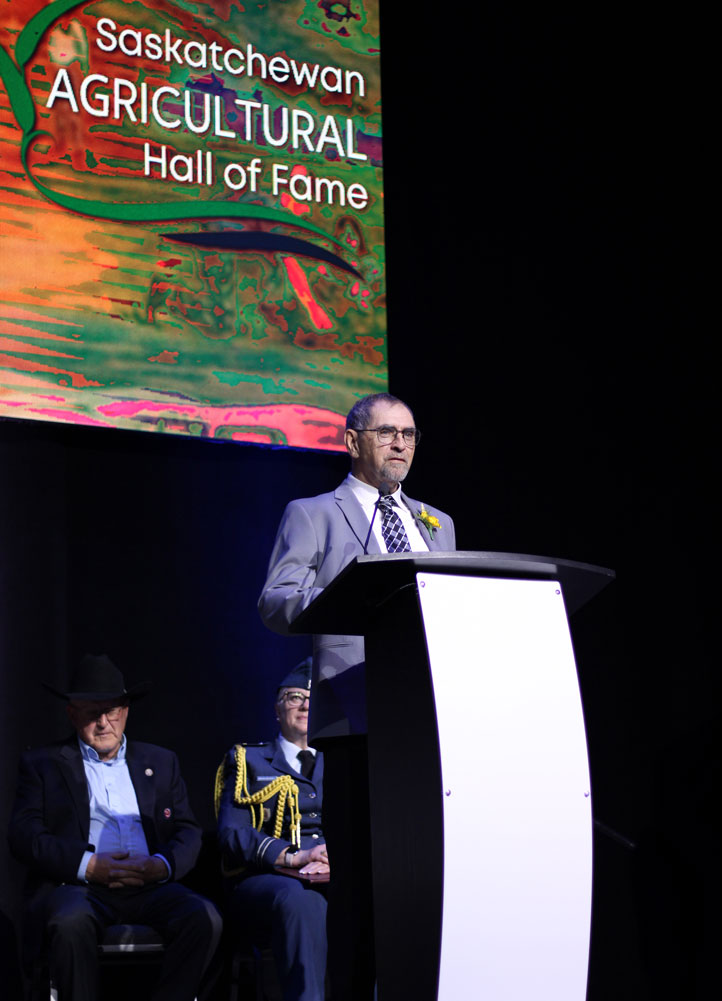
In 2025, Gerry along with his father were inducted into the Saskatchewan Agricultural Hall of Fame.
Product Innovations
In the fall of 1977, Frank agreed to license a seeder metering patent held by Jerome Bechard, an inventive farmer from near Regina, Sask. In the fall of 1980, Bourgault Industries Ltd. released the world’s first tow behind, 138-bushel air seeder cart that was mated to its Dual-Purpose line of cultivators. This proved to be a historic development for the company as the air seeding business has been at the core of Bourgault’s business ever since its entry into the market.
Bourgault Tillage Tools Ltd. – ground engaging tools – was started in 1988 with the introduction of the first Bourgault Parallel Wing sweeps in 1988 and would soon be producing tillage tools for other OEMs.
Among the most significant equipment developments in Bourgault’s history was its coulter Mid Row Bander (MRB) system, which was introduced in 1996. The system, which utilizes a coulter opener between every second seed-row to apply nitrogen fertilizer, allows farmers to apply any form of nitrogen fertilizer, in a one-pass seeding operation, while eliminating the possibility of seed burn while minimizing seedbed disruption.
Dealer Tim Young Meets Hall of Famer Gerry Bourgault
I first met Gerry in 1991 when my uncle Bill, a farmer and partner in Young’s Equipment, called me and said he heard that the dealer who had the Bourgault contract had given it up. My instructions were to immediately climb into my truck and find Gerry in St. Brieux. And then to ask for the contract, and beg and plead if necessary to gain that contract. It might have been the best piece of advice he ever gave me.
We made a deal and we have proudly represented Bourgault Industries ever since. What made my uncle so sure of this company was his own experience as a customer. In the early years they were known for their durability and quality.
Bourgault had an advertising campaign where they showed pictures of customers who had cultivators that had covered 100,000 acres. A brilliant testimonial showing farmers from all over the prairies with these reliable tillage tools.
Gerry joined Bourgault industries in 1975 and became President after his father’s death in 1989. He had a very strong engineering background as evidenced by graduating from the University of Saskatchewan with Great Distinction.
Gerry was an innovator first, he loved the details of designing, building, testing and seeing an idea reach the stage where it was ready to go into production. He learned well as he still owns the original land that was the inspiration for the world’s toughest tillage products. You could almost walk across the field by jumping from rock to rock without touching the soil. It is the definition of a torture test. Only the best passed to get to production and to the marketplace. He is an educator just because he is always discussing products and agriculture and finding ways to improve. He was a quiet leader, not through rousing speeches or motivational practices. Gerry is that rare leader who leads by example. If you are around Gerry, you always put your best foot forward. His work ethic is so inspirational, you give your best to try and follow his example.
Gerry is one of the most intelligent people I’ve ever met and any time you get with him is well spent. You will learn something, view your life through a different lens and be energized as to your own tasks. This is a better industry for having his talents dedicated to agriculture.
— Tim Young, general manager, Young’s Equipment
By doing their own agronomic research using the MRB, Bourgault’s agronomists were able to determine that splitting the phosphate between the seed row and mid row provided for faster emergence and higher plant stands than placing all of the phosphate with the seed.
“Prior to systems such as the MRB, growers wanting to apply higher rates of nitrogen and sulfur had to either make separate fertilizer passes or place more fertilizer in or near the seed row, increasing the risk of seedling damage, poor emergence, and stand reduction,” says Trevor Schaab, Vice President, Manufacturing Operations, Bourgault. “It has been a game-changer.”
It took some work to ultimately get to the MRB system, though. On the podcast, Gerry says the company started with a dual shoot knife as their first foray into dealing with the problem and trying to allow farmers to put all their fertilizer down with the seed in one pass.
“We designed a double chute opener comparable to some of the other ones that were in the market,” he said on the podcast. “And we compared the performance of ours against the other ones on the market. We put different openers on shanks and go out in the field and see how they perform. But we found our opener along with the other openers that were on the market at the time didn't do a good job placing the seed and didn't do a good job of maintaining separation in the drier clay soil conditions.”
The game changer, he says, was when they decided to try an MRB. “Initially we thought that we would put the MRBs on a separate bar either ahead of the cultivator or air drill. But we were approached by Gary Meier, who had been doing a lot of work helping farmers deal with the agronomic problems. This is a learning curve for everybody. And OK, how come my crop isn't coming up here? So he'd go and investigate. And he came to the conclusion that yeah, there's probably a better way of doing this. He encouraged us to try to find a way to put the MRBs on the cultivator or drill itself and holy smoke — it was a real challenge.” Gerry says it took a lot of design work but eventually the team landed on the MRB system after extensive testing in the field.
AE50 Award Honors
Over the years, the American Society of Agricultural and Biological Engineers (ASABE) has recognized Bourgault Industries with multiple AE50 Awards, which recognize the most innovative advancements in engineering in the areas of agriculture, food and biological systems. The Products selected save producers time and reduce cost and labor, all while improving safety.
- Bourgault Intelligent Control (BiC) - 2026
- 6700ST Air Seeder - 2008
- 750 Smart Cart - 2003
Tim Young, general manager of Young's Equipment (a Bourgault dealer for 35 years), says Gerry was an innovator first. “He loves the details of designing, building, testing and seeing an idea reach the stage where it was ready to go into production.”
But with all of his product designs and innovations, Schaab stresses that Gerry’s innovations weren’t driven by technology “for technology’s sake.” Rather, he says, that seemed to annoy Gerry.
“Alternatively, Gerry went to great lengths to gain a deep understanding of the challenges farmers faced every day,” Schaab says. “Because he remained closely connected to the industry, he understood what customers needed, often before they could clearly articulate it themselves.”
Dedication to the Dealers
What makes Gerry unique among equipment suppliers, says Young, is his commitment to dealers. Young has worked with many over his long career as an OEM and dealer executive.
“His support went beyond being reasonable; it was always very fair,” Young says. “He understood the costs required to provide exceptional customer service and he wanted the experience between supplier and dealer to be exceptional.”
Young says this in turn incentivized dealers to provide the same “exceptional service” to the end user.
Schmeiser says his greatest respect for Gerry comes from something that happened away from the factory floor.
Hall of Fame Digital Extras
“When I began working for the dealers’ association in 1996, Gerry always had an open door for me,” Schmeiser recalls. “He made time to talk about the industry, and when dealers needed someone from the manufacturing community to stand with them, Gerry was there. During our efforts to secure stronger dealer protection legislation in Saskatchewan, Gerry attended meetings with legislators and made the issue very simple.
“He told them: ‘If dealers are forced to abandon shortlines, Saskatchewan loses its manufacturing base.’ That statement carried enormous weight.”
Schmeiser adds Gerry understood that healthy dealers and healthy manufacturers do not have to be mutually exclusive interests. “He understood the bigger picture: protecting the independent dealer network also helped protect Saskatchewan's remarkable shortline manufacturing industry,” he says.
Schmeiser adds, “While we pursued dealer protection legislation, Gerry's presence gave our arguments credibility, seriousness and urgency. That experience taught me a great deal about him.”
Bourgault has consistently ranked among the highest-scored manufacturers in the North American Equipment Dealers Assn.’s Dealer-Manufacturer Relations surveys. The company understood what sometimes gets lost in a large corporate world: the farm equipment business is still a relationship business,” Schmeiser notes. “Gerry never forgot that.”
Since NAEDA started the Dealer-Manufacturer Relations survey in 2013, Bourgault has received the Dealers Choice Award 5 times (2017, 2018, 2021, 2024 and 2025) and has been recognized a Gold Level honor 5 times (2016, 2019, 2020, 2022 and 2023).
“We monitored the surveys and we looked at the feedback,” Gerry says. “We looked at where we were weak, where we got the lowest scores. Wherever we were the weakest, we would say, ‘What the heck are we doing wrong there? Or what can we do better?’”
During a 2017 Farm Equipment interview on what sets Bourgault apart following its Dealer’s Choice Award, Gerry said that perhaps the company has a different philosophy than others.
“I think we understand dealers and what they and their customers need to be successful,” he said in 2017. “The causal chain here is that if farmers and dealers are successful with our products, the dealers will be motivated to promote them, and customers will be repeat customers.”
He realizes dealers have choices (Bourgault competes against majors John Deere and Case IH, and shortline equipment manufacturers SeedHawk, Vaderstad, Morris and Seedmaster) and Bourgault knows dealers have to be motivated for the attention they can reasonably give to their products.
Gerry Bourgault — A Critical Ally
One thing that often gets lost in the story of dealer protection legislation is just how important Saskatchewan is — not just to Canadian agriculture, but to the entire global farm equipment landscape. For decades, Saskatchewan carried an unofficial but well-earned title: the shortline farm equipment manufacturing capital of the world.
When I traveled across the U.S. for dealer meetings with our dealers' associations, I would share that I grew up right in the heart of the ag equipment manufacturing sector. If you took a 250-mile radius of central Saskatchewan, you wouldn't find a higher concentration of farm equipment manufacturing anywhere else in the world.
Companies such as AGI, Bourgault, Brandt, Buhler, Degelman, Doepker, Elmer's, Ezee-On, Flexi-Coil, Friggstad, Highline, HoneyBee, K-Hart, Leon's, MacDon, Meridian, Morris, Pro-Grain, REM, Riteway, Rock-o-Matic, Schulte, Seed Hawk, Seed Master, Wheatheart — to name a few — were all established within that 250-mile radius.
These companies who dotted the prairies, employed thousands were innovators who looked at a problem and said: “There has to be a better way."
In fact, some of the most important innovations in modern agriculture were born in Saskatchewan farm shops — air seeding systems, vertical tillage tools, high-capacity grain carts, windrowers that could stand up to anything the prairies threw at them.
These weren't corporate boardroom ideas.
That's why the dealer purity battles of the late 1990s and early 2000s were so dangerous. Purity policies were a direct threat to all these companies. When companies like John Deere and New Holland pushed dealers to drop their shortlines, they weren't just asking them to rearrange the showroom floor. They were threatening an entire provincial manufacturing sector — one that employed thousands, contributed billions to the economy, and put Saskatchewan on the global map for agricultural innovation.
Throughout our legislative efforts on this in all three provinces, one voice carried enormous weight: Gerry Bourgault, president of Bourgault Industries.
He understood exactly what was happening: purity enforcement by major manufacturers didn't just threaten dealers- it threatened the entire short-line manufacturing sector, especially in Saskatchewan.
Gerry joined the meeting we had with Terry Scott, the Saskatchewan Deputy Minister of Agriculture.
It was so important that he was there, as we could provide a unified front - dealers and Saskatchewan-based manufacturers coming together with one ask.
When he joined us for meetings with MLAs, they didn't just see a business owner - they saw a symbol of what Saskatchewan could be.
Gerry did an excellent job of articulating how purity provisions could decimate his company.
He told legislators plainly:
"If dealers are forced to abandon shortlines, Saskatchewan loses its manufacturing base."
His presence in meetings added credibility, seriousness, and urgency. He was invaluable. Even though the new rules on contract termination would now apply to Bourgault in both Manitoba and Alberta, Gerry clearly stated that as a short-line manufacturer he understood their intent and was comfortable with them.
That's why so many MLAs - NDP and Saskatchewan Party — leaned in when we told them what was happening. This wasn't just about contracts. It was about protecting an industry that had grown from prairie ingenuity into global prominence.
And that — more than anything — helped fuel the political will that made Saskatchewan the first province in North America to pass such dealer protection legislation.
To this day, Bourgault continues to be a first-class company; one that always received top marks in NAEDA's Dealer Manufacturer Survey. In 2025, both Bourgault founder Frank Bourgault and his son Gerry were inducted into the Saskatchewan Agricultural Hall of Fame, a remarkable and never-before achievement for a father and a son.
Frank and my dad knew each other well. We were one of the first Bourgault dealers when Frank invented the 4 Row Series Multi-Purpose Cultivator back in the early 1970s.
When I was in the dealership, I made many trips to Bourgault's headquarters in St. Brieux, SK only 40 miles away – to pick up cultivator shovels and air seeder parts.
When I started working for the dealers' association in 1996, I had an open invitation to visit with Gerry.
He always made time for me.
Shortline equipment manufacturers always understood this better than mainline manufacturers:
The equipment industry is run on relationships. Relationships that run deep.
Gerry says one thing he and the company have always done is listen. “That is one of the keys to being able to produce these win-win-win scenarios; you have to listen because it's a compromise. Trying to find the right compromise for all the stakeholders,” he says.
Schmeiser recalls that every time he would visit Gerry at Bourgault’s headquarters in St. Brieux, Sask., they would meet in the boardroom, where every NAEDA award sat prominently on the table.
“Gerry said he purposely places them on his boardroom table, so his management team meets never forgets how important the relationship with dealers is,” Schmeiser says.
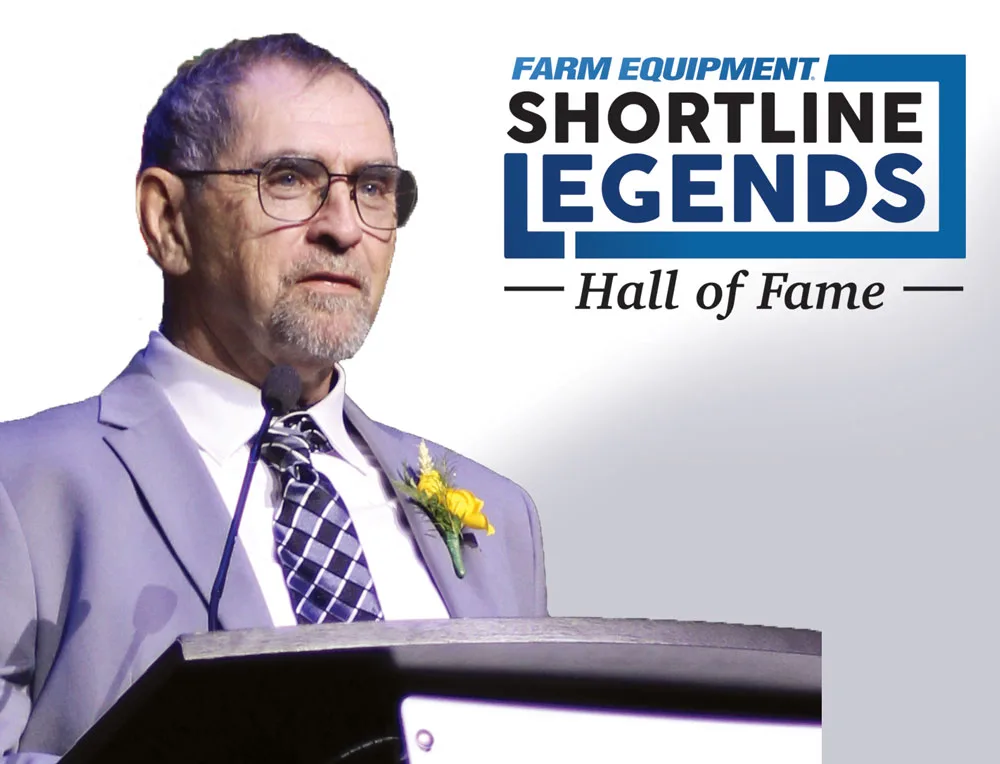
“His induction into the Shortline Hall of Fame is richly deserved,” Schmeiser says. “Gerry took the ingenuity that began with his father in a small Saskatchewan community and build it into an internationally respected agricultural equipment company. But just as importantly, he did it while maintaining the respect of farmers, dealers, employees and his community. That is a legacy worth celebrating.”
Schaab concludes, “If you asked the people around him, they would likely focus on Gerry’s endless pursuit of self-discovery and development that continues even today. I am not sure when he sleeps as he is constantly in pursuit of his next mission. And when he is in … he is ALL in.”