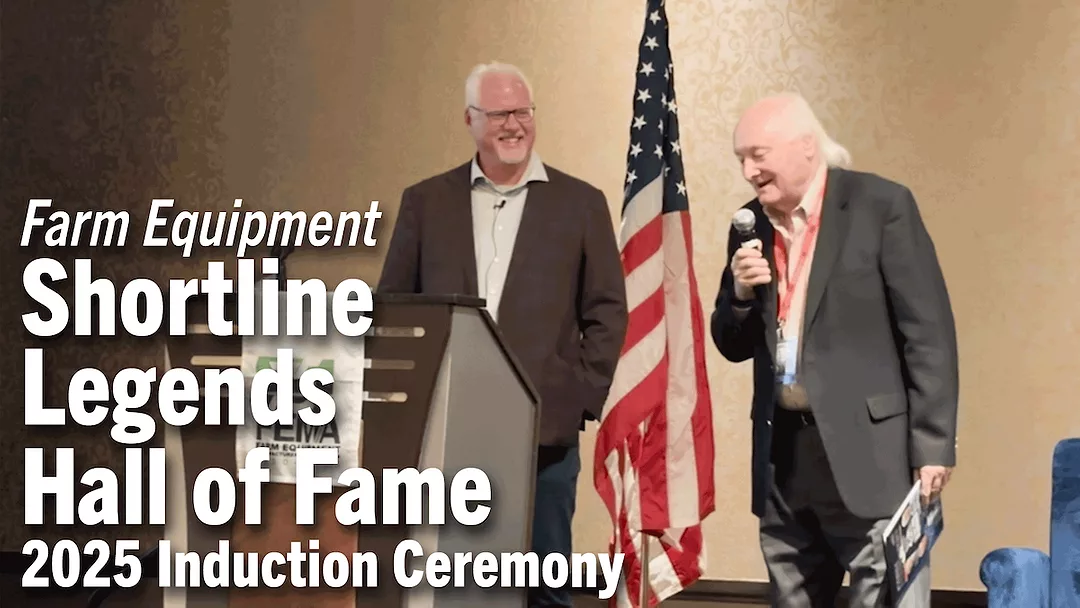
The 2025 inductees of the Shortline Legends Hall of Fame were recognized — in front of their peers — on Oct. 30 during a presentation at the Farm Equipment Manufacturers Assn.’s Marketing & Distribution Convention in Las Vegas.
The third class of inductees — 6 in total — each made a permanent dent in the ag equipment universe. Their Hall of Fame induction ensures their legacies will live on for generations to come. And for the first time in the award’s history, representatives from every one of the Hall of Famers were present to accept this high honor — and in front of the leader’s peers. This year’s inductees includes Tom Burenga, John M. Tye III, Norbert Beaujot, Stan McFarlane, Henry Danuser and Lyle Yost.
In 2023, as Farm Equipment magazine turned 55 years old, the editors announced the Shortline Legends Hall of Fame — a program that would forever give proper due to the achievements and influence of individuals from the INDEPENDENT ag equipment manufacturers — before their achievements are lost to the ages.
Stan McFarlane, McFarlane Mfg. Co.
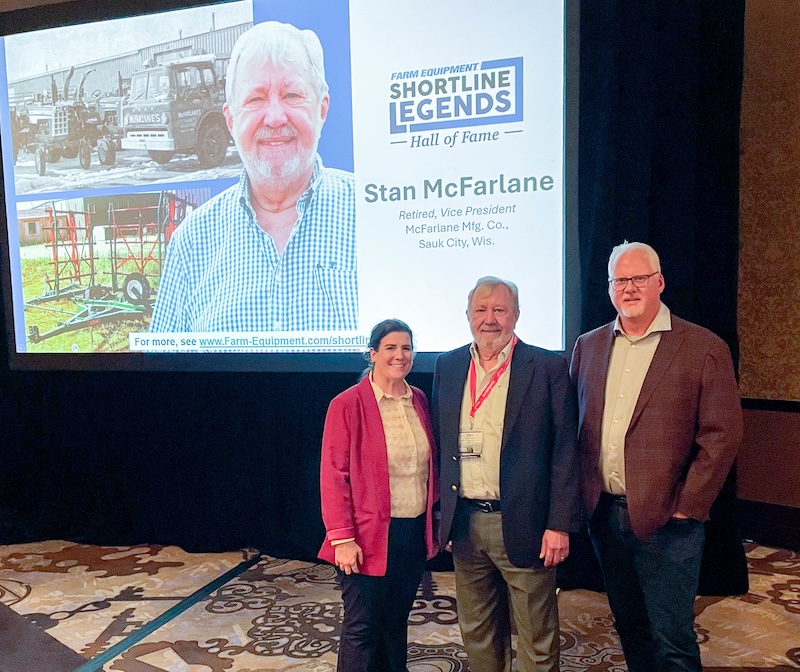
Stan McFarlane made an impressive impact on modern-day farming that extends well beyond just product innovations. Thanks to his leadership, widely-adopted reduced tillage tools from McFarlane Manufacturing Co. in Sauk City, Wis., have proved their effectiveness in improving soil health, managing residue and improving farm productivity.
After the University of Wisconsin, McFarlane worked his way up into the company and steadily modernized and improved the firm’s production processes. Taking over the business from his dad in the early 1980s when sales of any farm machinery was next to impossible, he steered the company through tough times while making essential changes in the company’s business approaches.
His broad impact on ag technology began in 1995 with the pioneering development of the vertical tillage tool. It involved limited tillage ahead of the planter opener to avoid stratification, a growing concern for many producers. This development allowed moisture and nutrients to move up and down within the soil profile, a key in removing stratification while improving soil density.
His next reduced tillage innovation came with the McFarlane Reel Disk in 2007, a groundbreaking tool that broke down crop residue while maintaining soil structure and reducing soil compaction.
Other innovations combined multiple tillage functions into one machine, offering farmers more flexibility in adjusting settings based on soil conditions and seasonal needs while allowing a quick shift between high-speed primary and secondary tillage.
With McFarlane’s dedication to engineering and zeroing in on farmer-focused needs, these game-changers played a key role in the tillage systems used today by many farmers. McFarlane served as president of FEMA from 2017-18.
Henry Danuser (1908-1975), Danuser Machine Co.
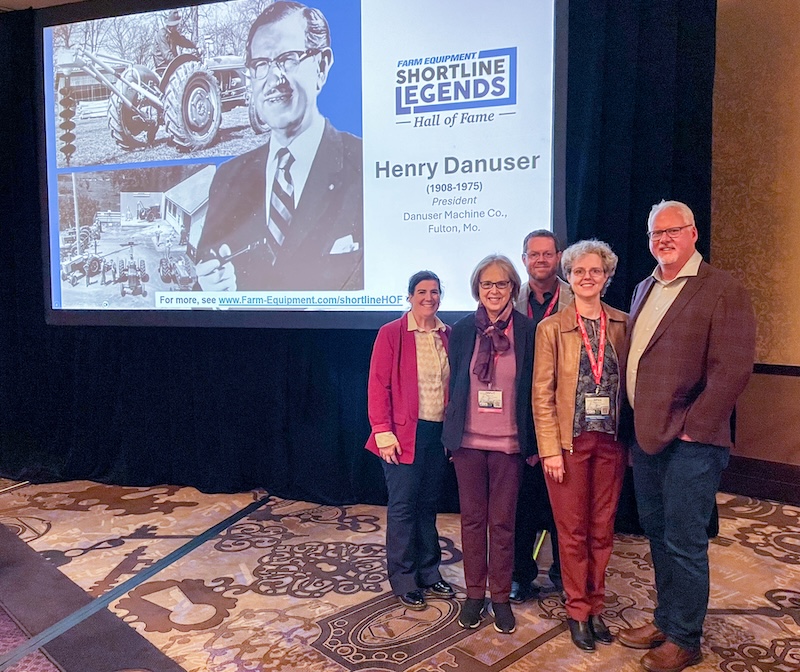
The story of Henry Danuser begins with his father, a Swiss immigrant who came to America in 1880 and formed the Danuser Machine Co. in Fulton, Missouri, in 1910. While early products included a tree-moving machine and a portable air compressor, he introduced a grain-threshing wagon.
Henry was born in 1908 and was blessed with his dad’s ingenuity. Henry introduced the first three-point hitch, rear-mounted tractor blade in 1945. That same year he introduced and mass-produced the nation’s first post-hole digger.
To get the Danuser name in front of prospective customers throughout the world, Danuser went to both Ford Dearborn and the J.I., Case Co.. Both farm machinery giants expected to label the blade with their own brands, but Henry demanded the Danuser name be part of it. Both OEMs eventually caved and agreed to co-brand the product; which permanently put the Danuser name in front of America‘s broader ag community.
Henry’s ability to mass-produce products led to more attachments designed for the ag and industrial markets, and the company expanded dramatically in the 1950s. It not only built blades and post-hole diggers, but added rakes, box blades, log splitters, hydraulic post-hole diggers, earth augers, pallet forks, earth augers, concrete breakers and material handling buckets.
His clever engineering mind brought many innovations drawn on restaurant napkins and notebook pages. He served in 1968 as chairman of the Farm & Industrial Equipment, which later became the AEM. He passed away in 1975 at the age of 68, leaving the company in the stead of son, Jerry, a FEMA fixture who passed away in 2024.
Henry was a firm believer in stellar customer service, a legacy that continues with grandchildren, Janea and Glenn, who run the company today.
Henry’s late son Jerry and granddaughter, Janea, both served as FEMA presidents, the third from the company to do so.
Norbert Beaujot, SeedMaster
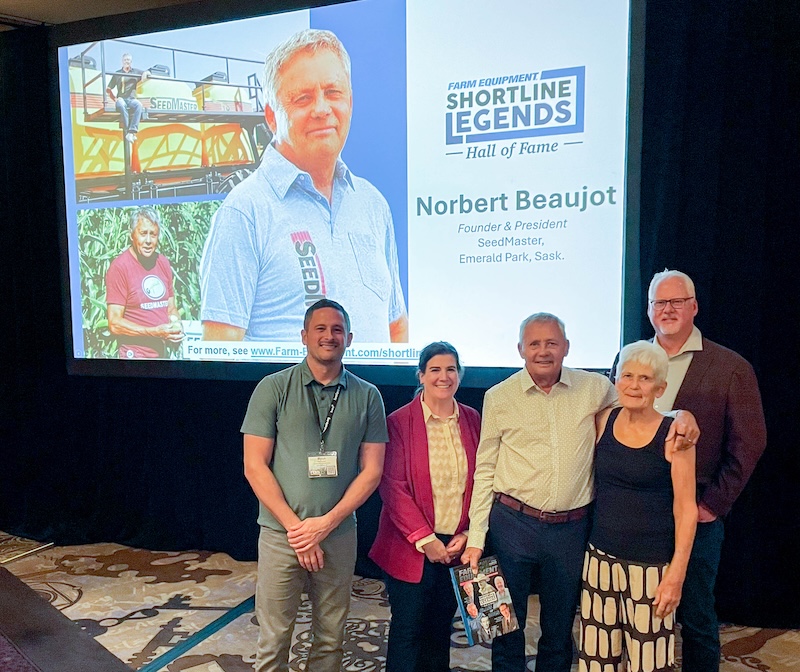
A “designer at heart,” Norbert Beaujot is the founder of the SeedMaster seeder and the autonomous DOT Power Platform. He has spent his career creating specialized farm equipment for Canada’s Western Prairies. Headquartered in Saskatchewan, much of his success boils down to not being afraid to fail.
Growing up on an 800-acre farm in Saskatchewan, Beaujot developed an early passion for farming by improving soil health. This soon led to a keen interest in helping no-till, which became the tool of choice among western Canadian growers.
By the early 1990s, western Canadian wheat growers were not only enjoying reaping the benefits of conservation ag practices, but also seeing the value of adding canola to their rotations. Norbert saw that seed-opening designs at the time were unsuitable for the new canola crop that was extremely sensitive to seed depth. Plus, storing valuable moisture near the soil surface could deliver higher yields.
Calling on his engineering background, he developed the world’s first active hydraulic ground-following individual row openers that minimized soil disturbance by seeding directly into the previous year’s stubble.
After testing the first hydraulic active opener prototype, he and his brother launched Seed Hawk. Replacing more traditional cultivator and disc-type seeding, their innovations featured a long arm with the gauge wheel located at the back that served as the packer wheel, which provided precise seed depth for each individual row unit.
Beaujot credits Saskatchewan equipment dealers with showing early interest in the Seed Hawk rigs and quickly recognizing the ability to hang a new innovation onto their existing seeding equipment business.
In addition to the Seed Hawk and SeedMaster opener, individual and bulk metering systems, Beaujot created the autonomous DOT Power Platform in 2017 – an audacious endeavor that autonomously powered a sprayer, land roller and grain cart. The innovation proved successful and the DOT platform concept was sold to Raven in 2020.
Tom Burenga, Worksaver
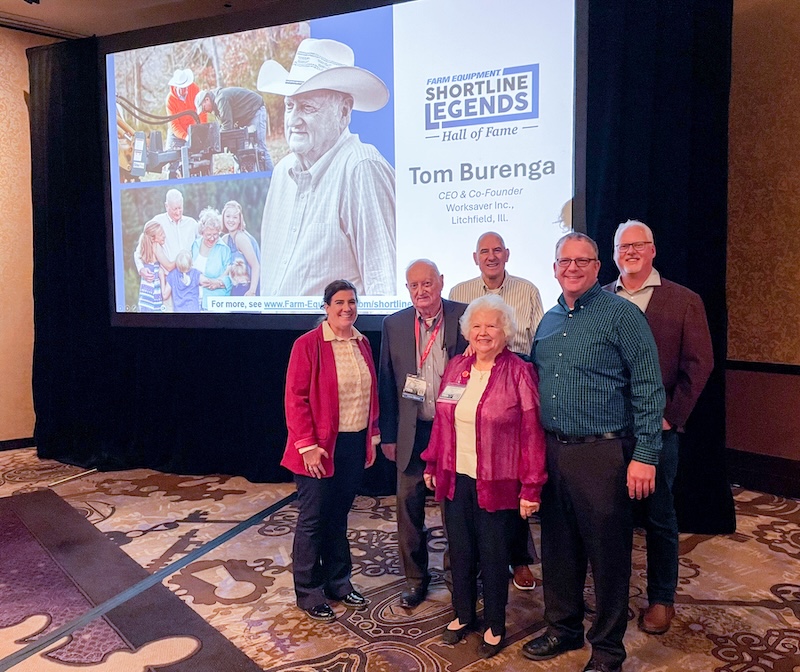
After engineering mechanical fruit and vegetable harvesters at FMC, working 10 years in manufacturing at Tractor Supply and taking on the challenge of turning around a small manufacturing business, Tom Burenga went on to co-found Worksaver from the ashes of Wikomi Manufacturing. Over the years, he built this company into what is now seen as one of the industry’s most respected attachment builders.
Formed in the early 1980s in Litchfield, Ill., the company survived the start of a decade that encompassed depressing times in the ag economy. Just a few years later, a customer bankruptcy – comprising the majority of their business – crippled Burenga’s business. Recovery was painful and it would take nearly a decade to dig out.
But that didn’t deter Burenga from pursuing a niche in what would be called the “rural lifestyle” market. In search of the margin needed to compete, he scraped together the funds to invest in modern machinery.
With savvy engineering skills, Burenga’s first product was a rear-mounted tractor blade, quickly followed with the design of an innovative post-hole digger and other products designed to meet specific customer needs.
What started as a post-hole digger and rear blade company has blossomed into a diverse business that includes material handling, fencing, land management, snow removal, trash raking and bale handling attachments for tractors, skid-steer, ATVs and much more.
Tom is a hands-on leader who always preferred to be out in the shop working side-by-side making things happen with his crew. No time to clean the desk, as I’ve seen first hand.
He embraced challenge with grit, ingenuity and an unrivaled love for producing specialized ag equipment. Tom continues to drive the company alongside Mike Kloster, president, and son, Tim, vice president, both of whom were FEMA presidents and with Tom, were the fourth in the company’s lineage to do so.
Lyle Yost (1913-2012), Hesston Corp.

Like other Shortline Legends, Lyle Yost’s impact on the industry started with a simple desire to find a better way. During his fourth season of custom harvesting in the Great Plains in 1947, he found himself in a race against Mother Nature to finish before the rains stopped his crew in its tracks.
That experience eventually led to the first “on-the-go” unloading auger for combines, a breakthrough in unloading freshly-cut wheat that opened up as much as three hours per day to actual grain harvest.
With the help of a blacksmith, Yost designed and built the auger. Sales to area farmers soon led to other orders, including building augers for all the majors with combines.
In 1949, Yost incorporated Hesston Manufacturing Co. in his hometown of Hesston, Kan. While the company started with the auger, it was the firm’s self-propelled swather that put Hesston on the map. Yost bought the rights to the swather and pioneered the novel one-man hay handling concept.
Yost had to convince farmers that hay would dry and cure more properly with the use of his self-propelled swather. After a slow start, he was soon producing swathers Hesston for several major equipment players in the hay market.
Another key innovation was the Hesston StakHand, a unique machine that created large stacks of hay and corn stover, which grew popular with cattle producers in the 1970s. Building stacks 20 feet wide and 8 feet tall, allowed easier transport from the field to advance productivity.
His small shop would become the nation’s 7th-ranked manufacturer of farm machinery. But the company hit tough times and merged with Italy’s Fiat farming operation in 1977. In 2002, AGCO bought the company.
Besides building a giant ag equipment enterprise in his home town, Yost was passionate about the community, a legacy that remains today
Yost died in April 2012 at the age of 99. His daughter, Susan, and son, Cameron, were on hand for the recognition.
John M. Tye III, Formerly of Tye Co., AgEquipment Group
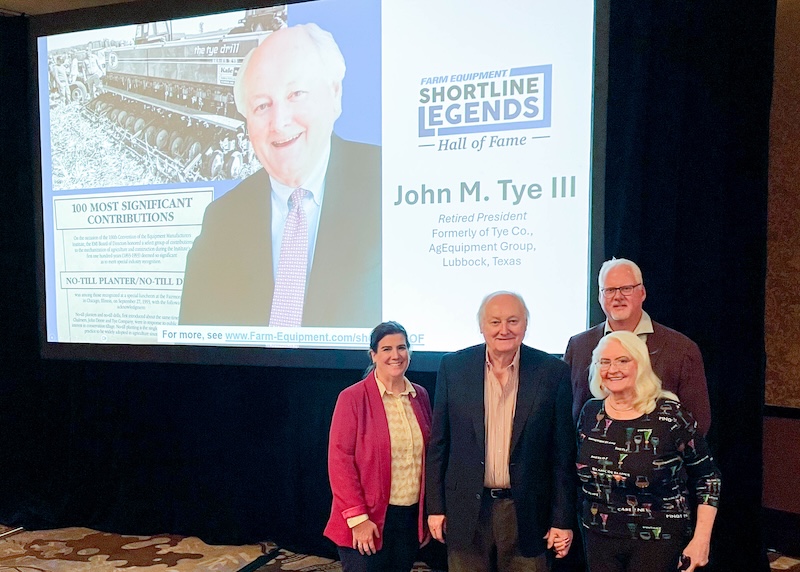
John M. Tye III grew up as the son of a southwestern Texas sharecropper. His engineering degrees led him to the Allis-Chalmers’ power generation business. But the cold Milwaukee weather convinced him to take a job in a warmer climate to run operations for a sporting goods company. He does cite 1 positive byproduct of his time in Milwaukee, his future bride, Vel.
While working in California, Arkansas and managing a 300-man factory in Connecticut, he gained a reputation as a turnaround expert.
Back home in Texas, his dad had ventured into the farm equipment dealership business and soon found himself modifying equipment for planting cotton under furrow irrigation. Soon after, his dad sold the dealership to concentrate on designing and manufacturing a drill that could do triple duty by seeding cotton, grain sorghum and wheat.
Son John, then working for a $100 million firm, agreed to take over the small manufacturing business so his dad could return to farming, his first love.
Besides building the cotton seeders, Tye’s engineering skills soon led to designing disc bedders for cotton growers who needed better soil conditions for speedier planting. But his big product breakthrough came in equipment to seed soybeans growers to plant in narrower rows, which also led to an expansion of double-cropped soybeans seeded into wheat stubble.
A new design for the Tye drill propelled Tye the no-till, especially in the Corn Belt. After this early success, cattle producers asked for a better way to renovate pastures. The introduction of the “Pasture Pleaser” was big in those days before Roundup arrived.
In 1990, Tye merged his firm with Farmland and Glencoe to offer a broad product line for minimum tillage, grinder mixers, front-end loaders, farmstead equipment and more. After buying out his partner, Tye operated the newly christened AgEquipment Group until AGCO bought it in 1995. This sale left Tye with Bigham Brothers, a cotton tillage firm that he had rescued from financial trouble in the mid-1980s and sold in 2013.
While he’s been out of wholegoods manufacturing business for some time, Tye and Sandy Kimball remain the owners of Lubbock Fastener Supply and also co-own a compact tractor dealership..
Tye remains a fixture FEMA and is known as one of the most influential past presidents in the association’s history. Some of his most important FEMA work was a decades-long devotion to finding novel ways that small manufacturers could afford product liability coverage. He still serves on the association’s Risk Management Committee.
Nominations are now open for the 2026 class of inductees at Farm-Equipment.com/shortlineHOF.

Farm Equipment‘s Shortline Legends video series is brought to you by FEMA.
For 75 years, FEMA members bring choice, value and Innovation to Agriculture. Shortline manufactures offer preferred brands at better margins, First to the market with innovation and dealers are more profitable with shortline manufacturers. For 75 years, customers prefer equipment from FEMA shortline manufacturers. Learn more at www.farmequip.org.