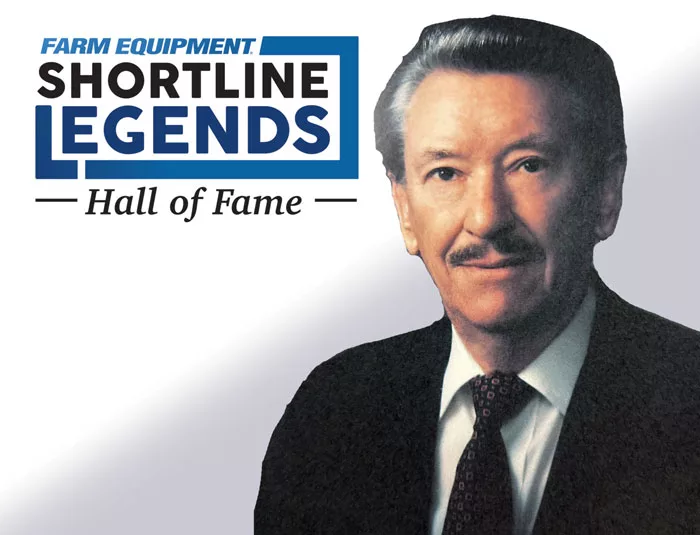
Shortline Legends Hall of Fame Recognized at FEMA's 2025 Convention
The 2025 inductees of the Shortline Legends Hall of Fame were recognized — in front of their peers — on October 30, 2025 during a presentation at the Farm Equipment Manufacturers Assn.’s Marketing & Distribution Convention in Las Vegas. Watch Lyle Yost's featured segment.
Farm Equipment‘s Shortline Legends video series is brought to you by FEMA.

For 75 years, FEMA members bring choice, value and Innovation to Agriculture. Shortline manufactures offer preferred brands at better margins, First to the market with innovation and dealers are more profitable with shortline manufacturers. For 75 years, customers prefer equipment from FEMA shortline manufacturers. Learn more at www.farmequip.org.
Like many of the previous Shortline Legends and likely those still to be named, Lyle Yost’s impact on the industry began with a simple desire — to find a better way.
During his 4th season of custom harvesting wheat, a looming July rain storm in 1947 started a race against the clock and Mother Nature to get the fields harvested before rain stopped his crew in its tracks.
At the time, harvesting involved a routine that divided wheat harvest into 2 separate functions — cutting and unloading. The combine cut and collected wheat in a built-in storage bin, but had to stop to transfer it into an awaiting truck. This made harvesting slow and inefficient.
“As weather conditions worsened, his apprehension quickened, and he began measuring the time consumed as combines and trucks rendezvoused, positioned themselves and transferred the grain,” writes Billy M. Jones in Factory on the Plains. “Assessing the time lost by each combine, he estimated more than 3 hours would be consumed that day by this unloading process — precision cutting time which easily could mean the difference between success and ruin to his client.”
As the story goes, once the season ended he committed to developing a method that would allow the transfer of freshly cut grain between moving vehicles, during the actual cutting cycle, according to Jones. “Central to this commitment was the perfection of what would become known as the unloading auger, a simple combine attachment that had already occupied Lyle’s thoughts for several months.”
But the idea of Hesston Corp. was planted in his mind much earlier, says daughter Susan Yost. “As young as 14 and as soon as Dad learned how to drive, he would take the truck out into the countryside and look for abandoned farm equipment,” says Susan in “Uncovering the Hesston Story” on MyFarmLife.com. “Not only did Dad learn how to build and rebuild farm equipment, but he got acquainted with farmers. He learned from them and found out what they needed. The idea of Hesston Corp. was planted when he was a teenager. I don’t think he knew the direction, but he knew that he had a calling, which was to help farmers.”
“He took advantage of every opportunity to discuss his ideas with farmers, combiners and machinists, hoping to discover that someone else had fashioned a simplified (and hopefully automated) transfer system…”
Upon returning to Hesston, following the harvest in 1947, Yost and blacksmith Adin Holdeman got to work on the combine unloading auger design. It didn’t take long for the market to confirm their efforts. They made 5 augers in a month and sent Earl Burner, Yost’s cousin, out to sell them, according to My Farm Life. “He got back in 3 hours and said he needed 10 more,” Susan says.
Yost, Holdeman and Elmer Berner (Yost’s uncle and a retired farm equipment dealer) formed a small company to produce and sell augers with sufficient modifications to fit the combines of all the major OEMs, according to Jones. In the first 2 years of business, every product they made was sold by the time it left the assembly line. By 1948, to accommodate growth, Yost leased out his custom combining operation. Then in 1949, the trio reorganized and incorporated as the Hesston Manufacturing Co. and added expanded shop capacity.
In those early years, the company introduced numerous new product lines, acquired contracts to manufacturer components for some of the major OEMs and recruited “a small number of skilled individuals to oversee appropriate portions of the expanded operations,” writes Jones.
He describes what Yost and his partners did as a textbook example of classical business development. They shepherded “the movement of a company from its startup moorings to a more efficient type of organization without losing any of its entrepreneurial fervor.”
The Next Step in Innovation
While Yost and the other leaders of Hesston built “a million-dollar corporation by producing attachments that made (someone else’s) combines better,” writes Jones, it was the company’s development of the self-propelled swather that brought “the greatest pleasure.”
“There simply was an understandable and great sense of pride derived from manufacturing and marketing a ‘whole product’ with the company logo emblazoned upon it,” Jones says. “And equally as significant, the development of one-man hay handling equipment helped elevate Hesston to a new status within the industry.”
For the first several years Hesston was in business, the full-line OEMs left much of the development and innovation of attachments to shortline companies like Hesston. However, that started to change in 1955, according to Jones, as the majors began to catch up to the pace of innovation in the industry and many of these products started to be manufactured by the majors as part of their standard lineup. Within 5 years of the unloading auger’s introduction, overall combine designs had reached a new stage of maturity and it was becoming more difficult to “conceive of new ways to improve upon them,” Jones says.
Yost concluded nearly every meeting and discussion about potential new products with what would become a company trademark — “Keep your eye out for new opportunities,” Jones says.
Corporate Changes
In 1968 Lyle Yost and his partners took the company public. In 1977, a majority of the voting stock in the Hesston Corp. passed to Fiat Trattori of Turin, Italy. Writing about the shift, Jones says, “Hesston was not spared the effects of a prolonged agricultural recession that has forced almost ruinous retrenchment upon all farm equipment manufacturers since 1976, but Yost and Hesston officials were able to cushion most of the potentially damaging consequences they faced in 1977 by negotiating a friendly takeover with Fiat, a merger that brought a timely and much-needed infusion of capital into Hesston’s operations.”
During that time the company made some adjustments, which in the early 1980s helped return it to the sales levels that exceeded “even the high water mark achieved in 1975.” However, the ag recession of the 1980s prompted additional changes. In 1986, Fiat named Mario Chessa, a Fiat executive, as president and chief executive officer of Hesston.
Jones notes that for a decade there were few visible changes in the operation of the company other than a majority of the Hesston Board of Director seats were surrendered to “Fiat designees.”
In 1987, Fiat bought out the remainder of the company. In 1989, Case IH purchased 50% interest and renamed it Hay & Forage Industries (HFI). Then in 1991, AGCO purchased 50% of HFI, returning the Hesston brand to U.S. ownership, and in 2000 AGCO bought the remaining ownership and returned to the Hesston name. In 2007, AGCO re-branded the line as Hesston by Massey Ferguson.
1955 would prove to be a pivotal year for the Kansas manufacturer, with 2 new product lines that came to market that year. The first, the Row-Crop Saver, became known as the “head hunter.” It sought out grain sorghum heads that had been flattened to ground level by heavy winds and rains. Using prongs extended from a front-mounted attachment, it raised, cut and augered the heads into the combine’s processing cycle.
While Jones writes that it is unknown exactly when Yost and Hesston first became interested in developing the self-propelled swather, the “awareness of the need for improved hay processing equipment undoubtedly grew out of the company’s experience with the Straw Chopper.”
The first self-propelled swather design was created by Gordon Lawson, a Ford tractor dealer and owner of a small machine shop in Postville, Iowa. Yost and Allen White paid him a visit. “The machine, though constructed on a light frame, was well engineered and featured a unique two-lever steering mechanism which provided good maneuverability. However, its processing cycle was uncomplicated,” writes Jones.
Ultimately, Yost and White negotiated a buyout with Lawson for the design that called for immediate shipment of all machinery, tools, dies and inventories to Hesston. Lawson spent the summer months at Heston as an engineering and production advisor.
Lyle Yost Image Gallery

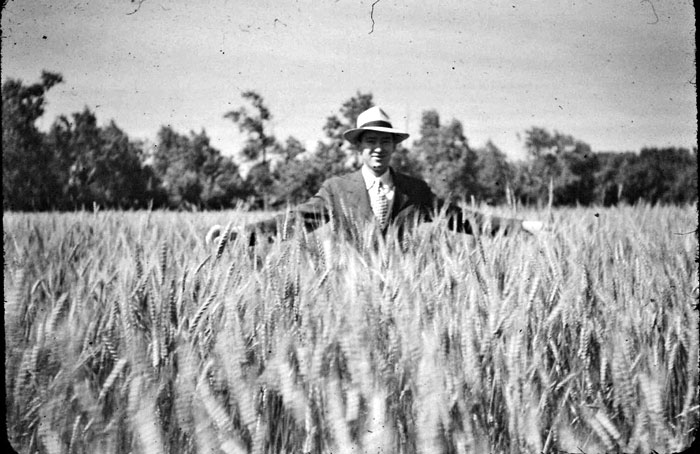
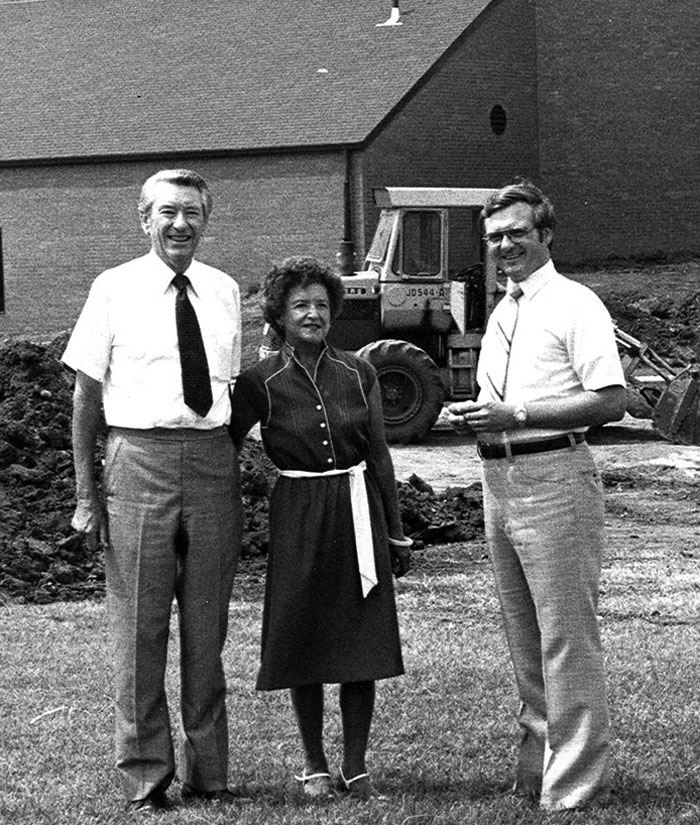
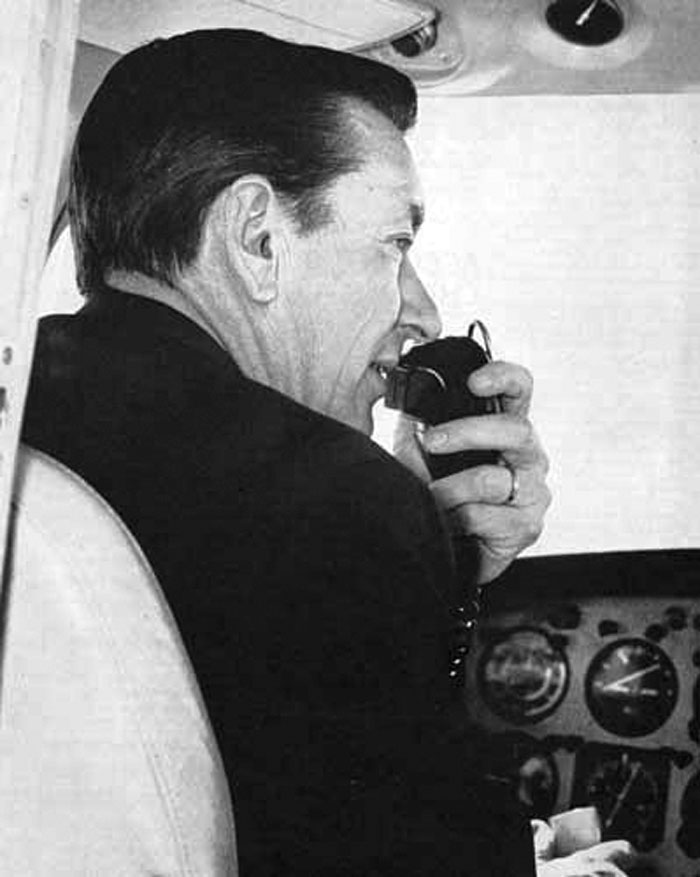
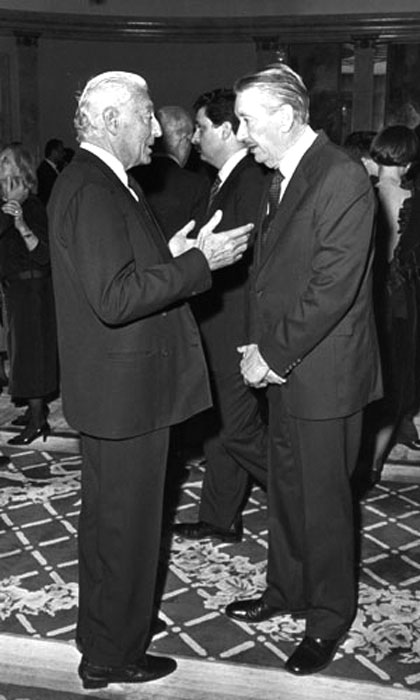
Jones writes: “Yost made the acquisition of the Lawson Swather an event of great moment for both company and town. He personally gave a public demonstration of the machine to a group of interested and excited Hesstonians. He drove it to a vacant lot adjacent to Harold Dyck’s home where the general sales manager, bedridden with mumps, watched its operation from a bedroom window. Factory personnel buzzed with equal excitement, for they knew Yost to be a person who wanted to see things happen. He did not disappoint them.”
At Yost’s insistence, the swather was rushed into production. The reason? “Producing even a limited number of machines in the short time span remaining actually would allow Hesston to gain a full year in getting the swather to market, and it would serve notice to the agricultural community, especially dealers, that Hesston was projecting a future which included self-propelled machinery.”
A total of 14 Swathers — the HS100 — were manufactured and sold in 1955, adding $24,700 to the company's sales. However, convincing farmers that the hay would dry out and cure properly in the windrows proved challenging.
“The development of the swather market came slowly, but the HS200 proved itself with consistent, outstanding performances on all types of crops — from alfalfa to Sudan grass and clover — and within 18 months, market resistance had softened dramatically,” according to Jones.
Ultimately, Hesston was able to sell the swather to other OEMs for resale and distribution. These OEM contracts accounted for $860,411 of total swather sales of $1.3 million during 1957.
Jones writes that “It was a significant ‘second beginning’ for Hesston. The firm’s spirit of opportunism and innovation — and Yost’s entrepreneurial zeal and aggressive leadership style — again had combined to ‘find a need and fill it’ with a superior product. The swather, like the unloading auger, was destined to make a worldwide impact on agricultural processes.”
Another key innovation of Yost’s was the Hesston StackHand, a hay stacking machine that created large stacks of hay or corn stover that became a popular haying system in the 1970s. It offered a faster method than traditional baling, especially for corn stover. At the time, it was the first loose hay stacker commercially available. According to an article from Farm Progress, the 6-ton capacity StackHand 60 made a stack that was 8 feet by 20 feet by 11 feet. The year the StackHand was introduced — 1972 — marked the first year Hesston Corp. sales exceeded $50 million, according to Heritage Iron Magazine.
“He always said when hiring someone, to always look for someone that can do it better than you,” Yost’s daughter Susan told the McPherson Sentinel following his death in 2012.
According to Mary Hess’ Anatomy of a Town, Hesston, Kansas, “near the end of his career as president of Hesston Corp., he wrote, ‘I tell managers that my success with this company has been in bringing in the right people, people who know more about their specialty than I do, and I depend on them.’”
Growing the Community. Not only did Yost’s ingenuity build a business and a better way to farm, it had a significant impact on the town of Hesston.
“Between the introduction of the unloading auger in 1947 and the peak years of production in the mid-1970s, the company grew from a small machine shop to a multi-million dollar conglomerate that achieved distinction as Kansas’ seventh-leading industry, as well as the nation’s seventh-ranked manufacturer of agricultural machinery. The firm at one time employed more workers than the city of Hesston had residents.”
His contributions went beyond just being among the largest employers in town, noted David Kauffman, former mayor of Hesston, following Yost’s death. “Lyle meant so much to the community,” he said. “More than any other individual, he contributed so much. Not only did he start the corporation and build it into a large employer, but he was also very philanthropic. It was something we were able to build our community on for a number of years.”
A 2013 article in The Mennonite noted Yost became president of Hesston’s first Chamber of Commerce and used his influence to ‘insist that all the streets be curbed and guttered,’” Susan is quoted as saying. “He wanted the city to be ‘tidied up.’”
The article also notes when a new public high school replaced Hesston Academy (where Yost had attended), the students chose the Hesston Swather as “their unique mascot.” By the mid-1960s Hesston Corp. had become an important part of the city’s identity and prosperity.
Yost died in April 2012 at the age of 99. He received a number of awards during his life marking his achievements in business and in the community. He was featured in more than 100 magazines including: Forbes, Farm Journal, Agri Marketing, Wall Street Journal, Progressive Farmer, Mennonite Weekly Review, High Plains Journal, Business Week, Christian Science Monitor, Dow Digest, Flying Farmer, Capper’s Weekly, Farm & Country, Wichita Business Journal and Implement and Tractor.