Takeaways
- Infrastructure investment requires patience and the right people. Salem’s $1.6 million shop expansion didn’t pay off immediately. An increase in job volume and having the right people in place helped the team fully realize the expansion benefits.
- Employee retention directly impacts your bottom line. A 20% annual turnover rate in parts departments drops absorption rates by 0.75% — a measurable hit to profitability.
- Small expense reductions compound over time. While revenue expansion gets attention, Salem’s disciplined vendor reviews and changes delivered steady improvements.
- Acquisition benefits diminish with scale. Salem’s first acquisition (Columbia Tractor in 2018) boosted absorption by 15%, but subsequent acquisitions showed decreasing returns — only 3% for the second acquisition.
Salem Farm Supply (2015 Dealership of the Year) has a story most dealers want to hear — increasing its absorption rate by 30 points in under a decade, transforming from a vulnerable operation to one that could weather any downturn.
Absorption is one of the most critical metrics in the dealership business. It measures how well a dealership’s parts and service departments can cover total operating expenses independent of whole goods sales — essentially, how much of your overhead you can pay for without selling a single piece of equipment.
“A strong absorption rate allows the business to remain profitable even during downturns, helping to stabilize cashflow when equipment demand falls,” explains Sam Ives, an analyst for the 5-store Case IH and Kubota dealership based in Salem, N.Y. “Consistently higher net profits don’t just protect the business — they create the financial flexibility needed to reinvest in facilities, people and future growth.”
“When absorption is high, you are better prepared for the downturns and better positioned for the next opportunity…”
Salem Farm Supply’s journey wasn’t built on a single breakthrough moment. Instead, it was the result of a methodical, 3-pronged approach which other dealerships can replicate: expanding revenue capacity, improving margins and strategically reducing expenses.
The Big Bet: Doubling Down on Service Capacity
The most significant driver of Salem’s transformation came from a $1.6 million gamble in 2016, doubling its service capacity by expanding from 6 to 12 bays at their Salem, N.Y., location. But as Ives candidly admitted, the payoff didn’t come as quickly as expected.
“2017 did not see a noticeable change in our gross profit, nor did 2018, nor 2019, and nor did 2020,” he says. “In 2021, we saw a modest 5% bump in our gross profit, but then things really started to kick off in 2022, where we had 3 consecutive years of averaging 21% gross profit growth.”
What finally resulted in this jump? “Job volume increased, and we were able to find the right people to meet that higher demand.” Ives says. The lesson is crucial: infrastructure investments pay dividends when you can find the skilled workforce to utilize that capacity.
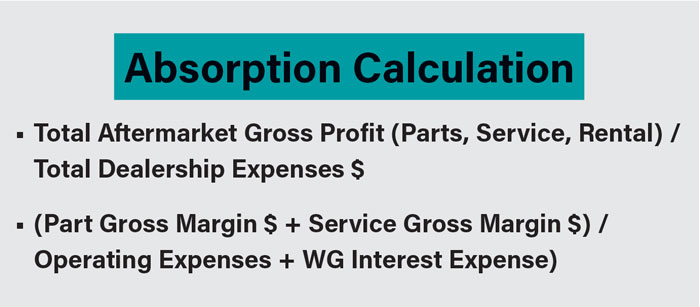
Absorption tracks how well a dealership’s parts and service departments can cover total operating expenses independent of wholegood sales. Ives uses the formulas above to track Salem Farm Supply’s absorption rate. Sam Ives
When the stars finally aligned and increased job volume met adequate staffing, the numbers validated the investment. Using Salem’s metrics of 1,350 billable hours per technician per year in 2024, combined with its labor gross profit of $94 per hour and parts gross profit of $27 per hour billed, each new bay generated approximately $163,000 in added gross profit annually. Multiply that by 6 new bays, and the expansion delivered nearly $1 million in additional annual gross profit.
The dealership also invested in its mobile service capacity, purchasing new trucks in 2017, 2022 and 2023. Ives shares examples of fictional dealerships to illustrate how adding mobile service trucks can affect gross profit and internal absorption on dealerships of different sizes. Through these examples, Ives notes an interesting scaling effect: the absorption rate benefit diminished as dealership size increased. In his hypothetical examples, a smaller 3-store operation would see a 1.73% absorption boost from adding one service truck, while a 15-store operation would see only a 0.38% improvement.
The Human Factor: Why Retention Drives Margin
While capacity expansion grabbed attention, Salem Farm Supply’s focus on employee retention proved equally valuable for margin improvement. The dealership boasts 6 or 7 employees at its Salem store with over 20 years of tenure, including a salesman who recently retired after 54 years of service.
Ives provides hard numbers on the impact of employee retention. A 20% turnover rate in the parts department (meaning one person leaving annually from a 5-person team) drops absorption by approximately 0.75%. The calculation factors in reduced productivity during a new hire’s 3-4 month learning curve, plus onboarding and training costs. Ives notes that while 0.75% may not seem like a groundbreaking amount, those small changes can add up in the long run.
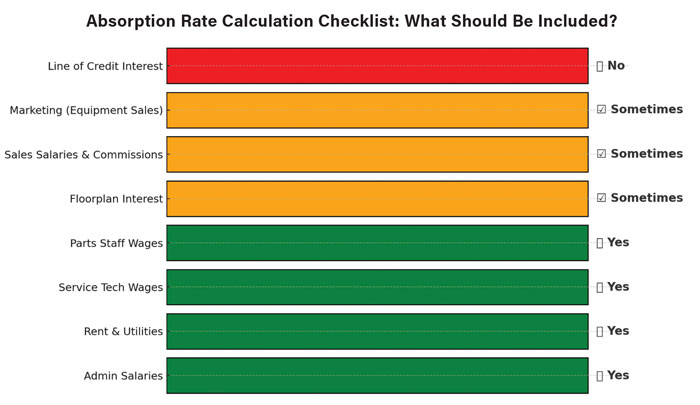
Ives shares this checklist of what should and shouldn’t be included in the absorption rate calculation. Ives says he doesn’t include line of credit interest because it relates to financing and isn’t part of the day-to-day dealer operations. Sam Ives
“You get higher productivity for longer tenured employees — these folks know what they’re doing. They make fewer mistakes, have fewer reworks and a quicker time to completion,” he says. “Longer tenured employees have built up relationships with customers. They could be friends outside of work. The employees know the machine. This leads to familiarity, faster parts look-ups, etc. On the flip side, short staffing can lead to burnout, missed sales and lower gross profit per employee.”
Salem Farm Supply’s retention strategy focuses on 3 key areas: maintaining a competitive benefits package, conducting annual benefits reviews to ensure value and continuously investing in facilities. Their commitment to infrastructure extends beyond the Salem shop, as their Claverack, N.Y., location just completed its own shop addition.
Strategic Expense Management: The Overlooked Opportunity
While revenue expansion captures headlines, Salem Farm Supply’s disciplined approach to expense management provided steady, measurable improvements. The dealership conducts vendor reviews every other year, recently switching uniform suppliers after issues with missing uniforms and overbilling, saving $25,000 annually. A healthcare provider change saved an additional $10,000 per year, with larger savings expected as healthcare costs continue rising in rural upstate New York.
“Longer tenured employees have built up relationships with customers. This leads to familiarity, faster parts look-ups, etc…”
As with employee retention, these might seem like modest improvements, but they add up. Ives calculates that effective vendor reviews can improve absorption rates by 0.3 to 0.4 percentage points annually, which is meaningful progress toward the 100% goal.
External Headwinds: When Interest Rates Attack
Not every factor in Salem Farm Supply’s absorption story was within its control. Rising interest rates delivered a significant blow, with the dealership’s interest expense tripling from 2023 to 2024. Based on Ives’ calculations, elevated rates knocked the dealership’s absorption rate back approximately 2%.
Learn More
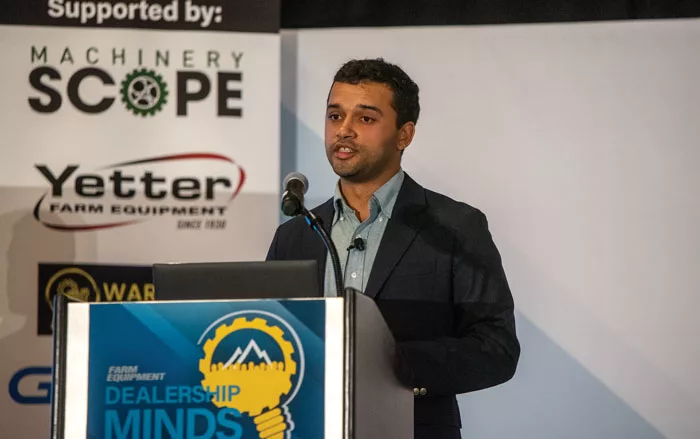
Sam Ives, analyst with Salem Farm Supply, in his talk “Diagnosing Dealership Success — Boosting Absorption by 30 Points in 10 Years,” details which factors can correlate to a higher absorption rate using historical and empirical data. Click here or visit Farm-Equipment.com/1025 to watch this video and other absorption-related presentations from the 2025 Dealership Minds Summit, courtesy of Toolhub by Canam Solutions.
To push back on the hit taken due to interest rates, the dealership has tried various strategies. To combat aging inventory, a sales performance incentive fund (SPIFF) was launched that was equal to 1.5 times the monthly interest payment. Targeted marketing campaigns were also tried for specific units. Results were mixed, as Ives notes, “Our aging units were specialty items, high-dollar amounts with unique specs, which were hard to move.”
The Acquisition Advantage: Growth Through Strategic Purchases
Salem Farm Supply’s acquisition strategy provided dramatic absorption improvements, though with diminishing returns. The 2018 purchase of Columbia Tractor delivered a 15% absorption rate jump in the following year, combining added revenue with operational efficiencies. However, subsequent acquisitions showed smaller impacts — the 2024 Randall Implements purchase increased absorption by only 3%, while the 2025 acquisition of 2 Emerich Sales & Service stores is expected to have minimal absorption impact due to offsetting factors like interest expenses.
Putting It All Together: A Framework for Success
Salem Farm Supply’s 30-point absorption improvement didn’t happen overnight, and it wasn’t built on radical strategies. Instead, it demonstrates the power of consistent execution across multiple fronts:
- Strategic Infrastructure Investment: The shop expansion and mobile service trucks provided the capacity foundation, though patience was required for workforce development to catch up.
- Human Capital Focus: Employee retention strategies directly translate to operational efficiency and customer satisfaction, creating a virtuous cycle of improved margins.
- Operational Discipline: Regular vendor reviews and expense management provide steady, cumulative improvements that compound over time.
- Strategic Growth: Acquisitions can provide improvements in absorption, though the benefits typically diminish with each subsequent purchase.
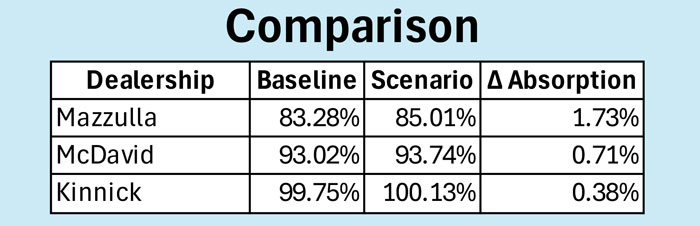
Ives notes that dealerships with more stores experienced a diminished benefit on the absorption rate boost when adding a new mobile service truck. Sam Ives
Ives message was clear: “When absorption is high, you are better prepared for the downturns and better positioned for the next opportunity.” In an industry known for cyclical swings and tight margins, Salem Farm Supply’s transformation provides a roadmap for building resilience through operational excellence.
The 30-point improvement didn’t require revolutionary thinking. It demanded disciplined execution of proven strategies, patience during implementation phases and recognition that small improvements compound into transformational change.
More on Parts and Service Absorption
Working Toward a Fully Absorbed Dealer
Increasing Absorption Rate & Attracting Repeat Business
Journey to Successful Absorption Rate Looks Different for Every Dealership
Centralized Support: United Ag & Turf’s Smarter Service
The 30-Point Jump: How Salem Farm Supply Transformed Absorption