Takeaways
- Don’t compare absorption rates from previous companies, as the math works differently from place to place.
- The journey to success with absorption should be viewed as a mindset, not a metric.
- Strong and thorough inspection programs can help lead the way.
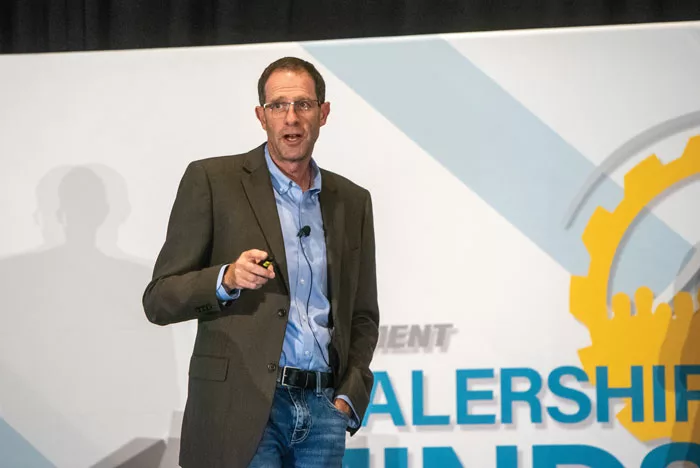
Titan Machinery’s Brad Meyer has been director of service operations since 2022, but he’s been in the dealership world for more than 20 years. And while those 20 years have included multiple dealerships and switching between selling different colors of machinery, Meyer says there’s one moment in his career that has been more pivotal than any other.
“Transitioning from an engineer to a manager has made me take a hard look at myself and what we do,” Meyer says.
As an engineer, Meyer says he learned exceptional problem solving skills. But his managerial experience has given him more familiarity with absorption — something he believes should be much higher up on the forefront of everyone’s mind at a dealership.
“Throughout my career I’ve had experience working closely in dealerships that have ranged in absorption from 40-140%,” Meyer says. “I won’t take credit for any of the 140s. I may take blame for some of the 40s, but it’s about trying to understand the correlation between machine performance and absorption. I’d love to get all of our employees to take absorption as seriously as they’d take a broken-down tractor.”
Starting Strong
One of the most crucial protocols to introduce from the beginning, Meyer says, is the strong and thorough inspection programs.
“Those programs, among several other things, have been key to Titan Machinery’s journey to where we are at today,” Meyer says.
Other important details Meyer says contributed to Titan’s success have included the implementation of general managers at individual locations back in 2017, which allowed for stronger customer and employee relationships at a local level, as well as Titan’s apprentice program. That program, according to Meyer, has been instrumental in building a healthy and cohesive mindset at Titan Machinery, which he says has directly contributed to success with absorption.
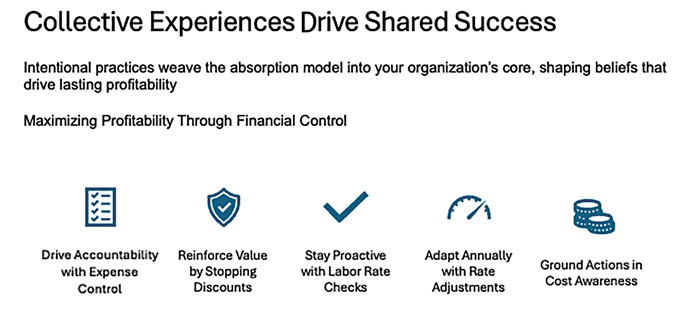
According to Meyer, this “tactical playbook” includes the levers that are most crucial for building the right culture that can lead to better absorption at a dealership — from expense management to technician productivity and warranty growth. Brad Meyer
“Being able to bring in people who have work ethic, and then being able to train them into our culture has been a big difference for us,” Meyer says. “The journey to success with absorption really moves from a metric to a mindset. Every new employee you bring in, you need to spend some time trying to get them to understand how we define it, but then we really need to embed it and apply it. The absorption journey really takes off when it becomes a culture, and when we’re actually living it.”
Meyer also warns those who have worked at multiple dealerships not to compare absorption rates to previous companies.
“That math works differently from place to place and it’s up to you how you define it,” Meyer says. “Even the OEMs have their own definition. Make sure you know how you define it and your people understand it, because there are a lot of different variables.”
Intentional Practices
Meyer emphasizes that collective experiences are a way to drive shared success and implementing specific, intentional practices can help to weave the absorption model into the core of an organization.
“Cost controls really drive accountability and we spend a lot of time focusing on that and making sure we have a very robust budgeting process,” Meyer says. “We understand where we were, where we’re going and where we need to be.”
Meyer also says it’s important to take a close look at whether discounts are actually helping or hurting the bottom line.
Learn More
Brad Meyer, director of service operations for Titan Machinery, highlights the impactful steps the 69-store Case IH dealership group has taken over the last decade to transform absorption from a metric into a deeply ingrained culture, in his 2025 Dealership Minds Summit presentation, “Titan Machinery’s Journey to a ‘Fully Absorbed Culture.’” Click here to watch this video and other absorption-related presentations from the 2025 Dealership Minds Summit, courtesy of Toolhub by Canam Solutions.
“The value of stopping discounts — it’s really easy to try to get a deal by discounting parts and service, but think about the amount of incremental sales you need to get that back,” Meyer says. “We need to make sure we understand that we have a value, and not just a part or an hour of labor.”
Taking a close look at labor rates and how they vary from region to region, and also by the type of work being done, is another key component to focus on according to Meyer. He says it should not be something that is discussed only in the back office. Instead, dealerships as a whole should adapt annually with rate adjustments. Every time dealerships deal with late rate adjustments, there’s a level of heartache that comes with that with customers, and especially with employees. But Meyer says when this occurs it is crucial to understand cost.
Counting Costs
Most dealerships will agree that when it comes to specialized shop tools, you can never have enough of them. There’s always more useful tools to have and to be added in that space.
“For example, how many people have a Shop Dog? And I’m not talking about labradors, we’re talking about that specialized tool — it helps the shop a lot, it really does,” Meyer says. “But how do we charge for that? It’s a value-add for us to not have to find a tractor to go out, to get that started, to then not get complaints from sales on why we’re using their tractor. Tools like that are very beneficial, but when I look at tools, I’ve never seen where adding a tool made a low-absorption shop into a high-absorption shop, it just helped those that already were making it happen do it better.”
With those factors as well as additional operating cost, and when looking into labor rates, Meyer says response time is key.
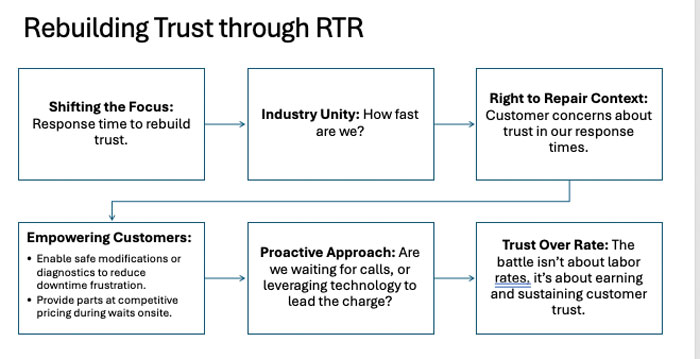
Meyer says dealerships should look at the Right to Repair issue as an opportunity to rebuild trust within their customer base. “Stores with high absorption always have quicker response times because they’ve got all of the other levers pulled and customers know that,” he says. “But have we done a good job of emphasizing that to our customers? When they can trust our repair and our response times, we build that trust.” Brad Meyer
“When we’ve got our customers running their planters next spring, that planter will plant $60,000 worth of corn an hour,” Meyer says. “Does that customer care if our shop rate is $180 or $200 if we’re out there in a half hour? The only thing that mattered was that response time to get out there, to get them going and to fix it right the first time. There’s really 3 factors that drove that repair, none of which was the labor rate. If the response time drives our value, why do we always continue to doubt our rates?”
Building the Team
While selling more products and being efficient with time on the clock both help lead to a better absorption rate, Meyer says none of the other factors will happen without first building a strong team that cares about doing good work.
He says it’s better to grow a high-performing team from the ground up and invest in them rather than trying to “steal talent” from elsewhere. But it’s what you do with that team and how you treat them that makes the biggest difference, according to Meyer.
“The absorption journey really takes off when it becomes a culture, and when we’re actually living it…”
“When you get that high-performing team and you’re building that, our good technicians find value and recognition in the bill,” Meyer says. “If you’re billing for their time, you’re billing 120% because they did it faster, and they see that and they know that. That’s recognition for them.”
Meyer says if your technicians understand their own value, it’s imperative for you to understand it too and show them.
“If you are not charging for their time, if you’re just billing their time at 100% and nothing over, what message did you just send them? You’re telling them that they’re nothing special, nothing over what it would normally take,” Meyer says. “If that’s the message you’re sending them, they’re going to ask themselves why they should work harder for the next one. As you’re building a high-performance team, you have to recognize that it’s not fair to your techs not to charge for their technical value.
“How do we measure all this? What does a high-performing team get you? The theme is absorption.”
Learning Lessons
Meyer also points out that while all of these tips might sound good on paper, being able to implement them is crucial, and learning from mistakes or from challenging periods will ultimately help a dealership sink or swim on its way to a better absorption rate. He says that a former employer and coach/mentor, Amity Technology’s Howard Dahl, helped him understand how important it is to learn from mistakes.
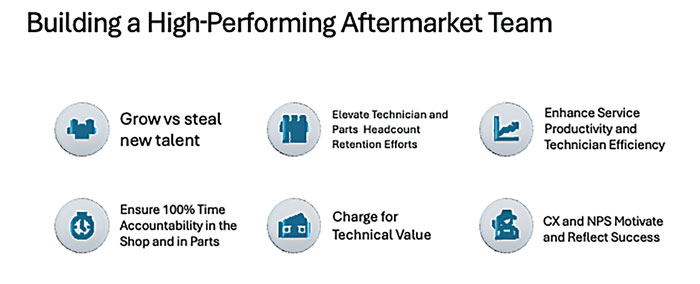
Meyer says building (not stealing) a high-performing aftermarket team is one of, if not the single most important, part of achieving a better absorption rate. Brad Meyer
“Every time something didn’t go right, he would pull his glasses down and say, ‘Brad, what have we learned from this?’ And it was always meaningful to me,” Meyer says. “Instead of being critical, he always just asked, ‘What have we learned?’ And one thing I’ve certainly learned is that absorption is not guaranteed.”
The age-old adage is that in a down cycle people will just fix and buy more parts — but Meyer says he’s not sure if he agrees with that sentiment. He believes customers have evolved into businessmen especially when working through a down cycle, but he warns not to count on that — especially when many dealerships end up developing bad habits of their own during those down cycles.
“We’ve probably done some damage by not calling customers back or responding in time but we have to remember that we can’t expect to get that business in a down cycle,” Meyer says. “We’ve got to make sure we’re following up with that phone call even in the busy times and that we are keeping those good habits. Bad habits are made in good times. Good habits are made in bad times. And for those of us who have been through some good times, I know I’ve formed a lot of bad habits.”
More on Parts and Service Absorption
Working Toward a Fully Absorbed Dealer
Increasing Absorption Rate & Attracting Repeat Business
Journey to Successful Absorption Rate Looks Different for Every Dealership
Centralized Support: United Ag & Turf’s Smarter Service
The 30-Point Jump: How Salem Farm Supply Transformed Absorption