Takeaways
- Balance sheet decisions drive what’s going on the income statement and influence absorption. Take the perspective of making more than you spend to encourage a sales mentality.
- A general guideline is 70% of sales should be complete goods, 20% should be parts, and 10% should be service.
- Calculate margins by part, rather than using the same margin for all parts. The same goes for the service department’s labor rates. Use fair and reasonable pricing to ensure profitability.
- Consider how to control employee benefits that turn into expenses, such as work trucks and distractions that reduce productivity.
- Encourage a team-first mentality to facilitate good communication among departments, standardized processes, fewer frustrations and increased efficiency.
Stan Vardell, vice president of parts operations at John Deere dealer Greenway Equipment, remembers when he first learned how much customer service plays a role in the parts department’s success.
He was 17 years old working at the parts counter at his father’s dealership in southwest Arkansas. A customer with a 70-horsepower John Deere 2640 tractor came in and asked for bearings for the front wheel. Vardell pulled out the parts book, found the spindle and its parts number, wrote down the part number and went to the back to pick the parts.
When he returned, the customer asked for bearing cups because he was replacing the bearings. Vardell again found the part number and fetched the part. The next time he returned, the customer asked for another part, and the back and forth continued for several more parts as the customer thought through what he’d need to complete the job. Vardell was frustrated by the end of the interaction.
“When he got out the door, I turned to the parts manager and said, ‘He didn’t have a clue what he wanted,’” Vardell says. “The manager looked at me and said, ‘He just taught you what your job is. You were just going to give him what he asked for. You weren’t going to give him the parts that he needed to complete the job.’ That really stuck with me that there’s more to our business than most people understand outside of our industry.”
Prioritizing the customer experience stuck with Vardell as his career continued. He worked for Deere for 20 years and then joined Greenway Equipment in 2009. The 30-store dealer, with locations in Arkansas and Missouri, had a 92% absorption rate as of May 2025, nearly 20% higher than the average North American dealer.
When it comes to absorption, Deere’s manual only considers the fixed expenses of the dealership, according to Vardell. Usually, absorption is calculated as the total parts and service gross profit divided by the total dealership fixed expenses. The absorption equation Greenway uses is sales minus the cost of sales less variable expenses of the department divided by fixed expenses of the total dealership. It doesn’t cover sales-variable expenses, such as commissions, rate buy-downs and other things necessary to make a sale.
“John Deere, having to be different, has absorption at 100%,” Vardell says. “It goes back to that formula. When we take variable expenses out, parts and service is probably going to have a higher goal than the other departments. Deere says it’s 45-55% for each department.”
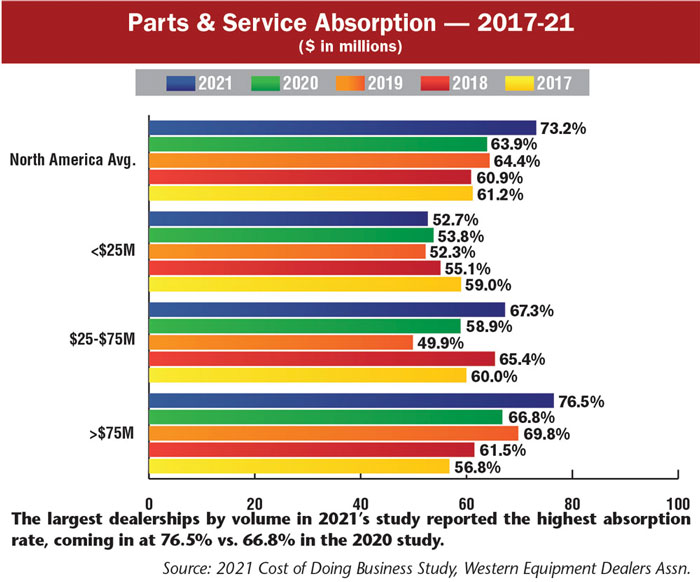
Figure 1. The average absorption rate for North American dealers was 73.2%. Stan Vardell says the current 12-month absorption rate for U.S. John Deere dealers is 85%, and Greenway’s rate is 92%.
Vardell says the average North American dealer had a 73% absorption rate in 2021 (Figure 1), while the North American Equipment Dealers Association’s guideline is 80% or greater. As of May 2025, the average U.S. Deere dealer is at 85%, according to Vardell. The Deere dealers in the top 25% of revenue in the U.S. average 87%.
“At the end of May, Greenway was about 92%,” Vardell says. “We have been over 100%. Again, it’s the measurement of taking the variable expenses out from the sales side.”
Considering Expenses
Absorption is good on income statements, but Vardell says a lot of dealers’ balance sheet decisions drive what’s going on the income statement. People, facilities, vehicles, general asset maintenance, business systems, new revenue streams, policies, processes and expense management all influence the balance sheet and absorption.
For example, Greenway built a new facility to replace a building with unsafe working conditions, which swapped repair expenses for the old building with a higher cost for land. Maintenance for shop tools, overhead cranes and more adds expenses.
Policies also play a role. If a customer owes interest on a past-due bill but comes in at the end of the year to only pay the balance, dealers will often write off the interest, creating an expense due to policy.
Some dealers also sell items outside their core competencies, such as high-end coolers and grills. Although it doesn’t sound like a lot, Vardell cautions dealers to seriously consider the investment.
Learn More
Stan Vardell, vice president of parts operations at 30-store John Deere dealer Greenway Equipment, shares more on how the dealership maximizes its parts and service operations in his 2025 Mark Kreps and Steve Connelly Memorial Lecture, “Controlling What You Can Control.” Click here or visit Farm-Equipment.com/1025 to watch this video and other absorption-related presentations from the 2025 Dealership Minds Summit, courtesy of Toolhub by Canam Solutions.
“In too many cases, it becomes a gift for customers buying wholegoods,” Vardell says. “We try to stay away from those, but we carry hunting supplies like blinds. It’s just something to keep activity in our stores in the winter and gives our parts people something to be excited about.”
Vardell takes a sales perspective when managing expenses — the other investment affecting the balance sheet. Greenway works hard to design programs to engage employees with customers and continue to increase the dealership’s growth.
“You either make more than you spend or you spend less than you make,” Vardell says. “Make more than you spend is a sales mentality.
“When we say we’ve got to spend less than we make, we start seeing our salesmen, our parts departments, our service managers, our location managers sitting back waiting for somebody to tell them what to do. That’s not the culture that we do well in. We can’t save ourselves to profit. We have to grow.”
Balancing Sales, Parts, Service
Vardell says 78-80% of a dealership’s total net sales comes from wholegoods, whether that be new, used, leased or rentals. However, 70% of the total gross margin comes from the parts and service departments — along with the rental department. A general guideline is 70% of sales should be complete goods, 20% should be parts and 10% should be service.
“You’ve really got to balance your sales of equipment with your parts and service,” Vardell says.
When he was working for Deere, Vardell recalls a dealer who told him that he didn’t want to sell equipment more than 15 miles from the dealership. Vardell, who wanted him to grow his market share, was puzzled. The dealer told him that he had enough machines in that 15-mile radius to keep his technicians busy and going out any farther would compromise the dealership’s customer service.
“I’ve always heard that used equipment will limit sales,” Vardell says. “I had not heard that your parts and service departments could limit sales. But if you don’t have the capacity to serve the machines you’re putting out there, you’re going to end up with a really happy manufacturer because your market share’s up, but your profitability’s going to be way down because everybody’s so frustrated and finding somewhere else to get to work.”
Role of Budgeting
Location managers at Greenway receive daily budget reports to achieve the dealership’s projected growth. Vardell says the dealership budgets for a typical expected price increase plus true growth on top of that number.
“It may only be 3%, but we try to make it reasonable, attainable and also enough that everybody knows what it is,” Vardell says. “I believe everybody who works at a dealership, particularly your parts and service managers and location and regional managers, can impact sales. You ought to be reaching for reasonable growth.”
Fair and reasonable pricing factors into the budget. Some parts have a margin of 20%, while others have a margin of 50% or more. Vardell says it’s reasonable to calculate margins by part, rather than using the same margin for all parts. The same goes for the service department’s labor rates.
Vardell takes a strategic approach to using promotions because discounts eat away at profit margin. While he doesn’t think dealers should do away with discounts, he advises using rebates and programs offered by the manufacturer first, and then building the dealership’s own promotions. Dealers can use financing in place of discounts, too.
“We’ve all heard that it may cost 3-4% using the Case IH, John Deere or AGCO aftermarket programs,” Vardell says. “All those financing options are out there. You can offer customers terms so they have more flexibility. A lot of times, that’s what they need more than they need an actual discount. That’s something that you’ve really got to work with your team to tell them, ‘We’ve got a program that’s 120 days all year round. Use it.’”
“The service of the parts and service department is what sells the second, third and fourth machines…”
A popular approach over the years has been discounting parts and labor for reconditioning. Vardell says Greenway doesn’t do that because the dealership works on margin for parts and service but on cost for the sales department.
“When sales is marking up 4% on a large piece, we’re going to make 3.3%,” Vardell says. “If we take a compact tractor that we traded in, we should be able to make a 10% margin on that. Tell a salesman that. If you haven’t educated him, he’s going to take the cost of that machine and multiply it by 1.1, and that’s now his sales price that he’s going to offer the customer.”
There’s also an opportunity cost to discounting parts and labor for reconditioning. There’s a missed opportunity to sell the customer on the parts over the counter and sell the labor to install them on the customer’s machine. Vardell takes this into consideration for service needed on the dealership’s trucks, forklifts and other machines.
“We might as well be spending our $150-160 an hour working on a machine for a customer who’s going to return, rather than working on our own machines,” Vardell says. “We outsource it. It also builds a relationship for better deals down the road.”
Vardell also looks to build relationships with shortlines — but only if their products perform better or are cheaper than the manufacturer’s offerings.
“If it’s not something that’s doing more for the customer, there’s no reason for me to take up the inventory space and do the training just to have our employees sell both the OEM and something that is similar,” Vardell says.
Considering Expenses
The average Deere dealer has 80% fixed expenses, according to Vardell, and they fall into the buckets of people and facilities. In the people bucket, Vardell identifies 2 benefits to employees that have turned into bigger expenses than intended. The norm in his area of Arkansas is that technicians get their own trucks and they drive them home every night. Vardell says Greenway intends to start closely managing that expense in 2026.
The second benefit turned expense is branded stools at the parts counter, purchased as a marketing tool for Greenway stores to have out for customers. However, Vardell says his parts manager reached out to him recently saying the parts employees started bringing the stools behind the counters, sitting down and spending a lot more time on their phones.
“I said, ‘You got 2 guys that ought to be doing cycle counts right now, so y’all double up your cycle counts, and then tell them it’s because they’re not proactively calling, they’re not taking care of their texts, they’re not taking care of the business,’” Vardell says. “Use this as an opportunity to teach and work with them.”
Should Customers Pay Freight?
Stan Vardell, vice president of parts operations at Greenway Equipment, says he’s heard for decades that customers hate paying freight. Many dealers will add freight to the price of the part to recoup the cost. However, today’s customers can easily search the part online and find the manufacturer’s list price, leading them to get frustrated with the dealership for having a higher price.
Greenway carries a line of ditchers that doesn’t have a list price from the manufacturer. The manufacturer always comes to the Memphis Gin Show, right down the road from a Greenway store, and displays the product. Often, customers will tell him that Greenway has a much higher price than what the manufacturer’s rep quotes them, but if the customer wants to buy, they have to go through Greenway, not the manufacturer.
“This happened 2 years in a row,” Vardell says. “First time, I went to bat. I tried to figure out what we were doing, and I kind of had an idea. The second year, he called and we had the same conversation, and I said, ‘Look, are you adding the freight charge to ship that to that customer?’ He says, ‘No.’ I said, ‘What are you figuring your list price is?’ And he said, ‘20%.’
“I said, ‘So you’re telling me I’m making a margin of 20%, and I’m covering the freight to meet your price that you’re presenting to customers that you won’t sell to? I’m really struggling with this concept. One of us needs to either raise our prices and be more fair and reasonable to the dealer, or one of us needs to quit carrying the product.’”
The product was good, so Vardell said the dealership kept it, “unfortunately, but the point is, you’ve got to figure out how that freight is figured in.” In general, Greenway tries to be freight neutral, meaning inbound freight costs on emergency orders go back to the customer.
Vardell also cautions dealers about creating habits in good times that lead to losses in down times. He says if a dealer sets expense levels based on continued growth, having used equipment under control and other factors, it’s going to be difficult to break expense habits if the business slows down.
Along the same lines, if a dealer says yes to every donation, coupon book or other local sponsorship request during the good times, it’s easy to suddenly be sponsoring everything. Vardell says he knows a dealer who moved donation decision-making to its corporate office, which created a form that requires the requester to explain how the request is related to agriculture. If it’s not, the management team can easily deny the donation, citing that it doesn’t fit the company’s business model.
“We still say yes on a lot of things,” Vardell says, “but we’re focused on the right things and the customers who are actually doing business with us.”
Regularly reviewing expenses is also important. Vardell says dealers should know what is normal for expenses and adjust from there — without the expectation to eliminate any expenses entirely. That may mean comparing vendor pricing every time a contract comes up for renewal or looking at reducing specific line items, such as the number of uniforms each employee has.
Repeat Sales
Vardell aims to have what he calls parts integrity — having parts in stock, a high fill rate and an understanding of the inventory. Doing cycle counts and making sure online inventory matches what’s on the shelf drives a strong customer experience, according to Vardell, along with service done right the first time.
“I believe a salesman makes the first sale, but the service of the parts and service department is what sells the second, third and fourth machines,” Vardell says.
Having a safe working environment and proper training for employees will keep them showing up to work, safe and in better spirits, Vardell says. Greenway has a safety coordinator, a safety team at each location and a monthly safety meeting. He says the focus on safety has helped in recruiting new talent to the dealership.
Good communication among departments and standardized processes help reduce frustrations and increase efficiency. Vardell says it also encourages a team-first mentality. Greenway is considering how to pay a service manager on parts profit and a parts manager on service profit. While Vardell says the dealership isn’t there yet, he hopes to set up a structure that motivates the parts and service departments to want each other to grow and that breaks down communication barriers. Facilitating positive attitudes promotes better energy for employees and customers.
“You can feel it when employees don’t want to be there,” Vardell says. “Everybody has some control over growing good morale and helping people want to be part of the solution.” for our customers.”
More on Parts and Service Absorption
Working Toward a Fully Absorbed Dealer
Increasing Absorption Rate & Attracting Repeat Business
Journey to Successful Absorption Rate Looks Different for Every Dealership
Centralized Support: United Ag & Turf’s Smarter Service
The 30-Point Jump: How Salem Farm Supply Transformed Absorption