
By DIS Corp
The conversation around artificial intelligence in the equipment dealer world has shifted.
In a 2025 DIS survey of farm and heavy equipment dealers across North America, 49% said they hadn’t adopted AI, while 28% were already using it and 23% had plans to. If anything, the pace has only accelerated since, but the core challenge remains the same: knowing where AI actually helps and where it doesn’t.
That’s a distinction worth getting right. Dealers don’t need more tools. They need the right ones.
Where AI Is Delivering Real Value Today
The equipment dealers seeing tangible returns from AI aren’t deploying it everywhere. They’re applying it to specific pain points where the technology’s strengths: speed, pattern recognition, and data processing, create measurable operational improvements.
Eliminating Low-Value Repetitive Work
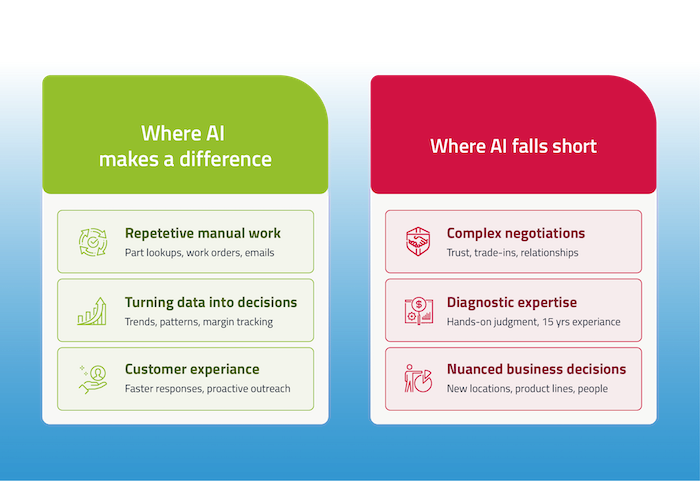
Consider how much time a dealership’s team spends on tasks that are necessary but not particularly productive: looking up part numbers, pulling customer service histories before phone calls, building work orders from scratch, drafting follow-up emails after quotes. These tasks add up to hours every week across a multi-location operation.
AI can surface the right information in seconds instead of minutes. It can auto-populate fields from historical data, draft routine communications and flag items that need attention before someone has to go looking. The technician, service writer or parts counter employee still owns the work, they just spend less of their day on the busywork that surrounds it.
Turning Dealer Data into Actionable Decisions
Most dealerships sit on a remarkable amount of daily operational data: transaction histories, service patterns, parts velocity, customer buying behavior. The challenge has never been collecting data. It’s been doing something useful with it.
AI can identify trends and patterns that would be nearly impossible for a person to spot manually.
- Which equipment units are approaching service intervals?
- Which parts are moving faster than usual and may need reordering ahead of schedule?
- Where is gross margin trending compared to the same quarter last year?
These are questions AI can answer in real time, provided it’s connected to the right data, which is why the depth and integration of a dealer’s management system matters more than ever.
Raising the Bar on Customer Experience
Customers today expect faster, more personalized interactions. AI enables proactive outreach based on a customer’s actual equipment fleet and service history — not a generic marketing blast. It shortens response times, surfaces relevant recommendations and helps dealership teams show up to every conversation better prepared. In a competitive market, that kind of attentiveness is a differentiator.
Where AI Still Falls Short
For all its capability, AI is not a replacement for the skills, judgment and relationships that have always defined great equipment dealerships. Recognizing those boundaries is just as important as recognizing AI’s strengths.
The Handshake that’s 20 Years in the Making
Buying a piece of heavy equipment is not an e-commerce transaction. It involves trust built over decades, trade-in evaluations that require market knowledge and negotiation skill, financing conversations that account for a customer’s full financial picture and a relationship where looking someone in the eye still matters.
AI can help a salesperson walk into that conversation fully prepared. But the relationship itself? That’s human. That’s irreplaceable.
The Sound a Seasoned Technician Hears
A veteran technician who has worked on a specific equipment line for 15 years carries diagnostic knowledge that no algorithm can replicate. They hear something in a hydraulic system, feel a vibration pattern and know what’s wrong, based on experience built across thousands of hours in the shop.
AI can assist by pulling service history, identifying common failure patterns and suggesting probable causes based on data. But the final diagnostic call, and the repair itself, belong to the technician.
The Decisions that Define the Business
Should the dealership take on a new product line? Is it time to expand to a second location? How do you retain a key employee who’s weighing other options? These decisions require context, industry intuition and strategic judgment that comes from years of running a business in a specific market.
AI provides supporting data: financial trends, benchmarks, market comparisons. But the decision itself? That’s the dealer principals to make.
Not All AI Is Created Equal
Understanding what AI can and can’t do is only half the equation. The other half is understanding that different AI approaches deliver very different levels of value.
General-Purpose AI Tools
Tools like ChatGPT are impressive in their versatility. They can draft emails, summarize documents and answer broad questions. But they have no awareness of a dealership’s parts catalog, customer history, service pipeline or financial position. Every time a dealer uses one, the burden of providing context falls entirely on the user.
Third-Party AI Integrations
A more relevant category includes AI platforms built specifically for the equipment dealer space that connect to existing systems through API integrations. These tools bring real, industry-specific value.
But the integration architecture itself introduces limitations: data access is only as complete as the API allows, synchronization can be delayed, the AI works with a partial picture rather than the full operational dataset, and the tool typically requires a separate point of access outside the dealer’s primary workflow. As AI technology evolves toward more intelligent, agent-based data interfaces, tools relying on traditional API connections may find it harder to keep pace.
AI Native to the Dealer Management System
The third approach, and the one gaining traction across the industry, is AI built directly into the DMS itself. Native AI doesn’t connect to dealership data through an intermediary. It has direct, real-time access to every work order, every parts record, every customer file and every accounting entry. There’s no sync delay, no partial data and no extra login. Because it’s embedded in the system dealership teams already use daily, adoption friction is minimal.
DIS Corp recently launched Dex (Dealer Expert) is one example of this approach. Built within DIS Analytics platform and designed exclusively for equipment dealers, Dex transforms reporting from static dashboards into dynamic, conversational intelligence. Dealers can ask questions and receive expert-level answers grounded in their own operational data, not generic AI outputs.
What Dealers Should Look For
The pace of AI development guarantees that today’s capabilities will look modest compared to what’s coming in 12-18 months. But the principles for evaluating AI tools are durable. Dealers weighing their options should consider three criteria:
- Is it built for equipment dealerships?
- Is it trained on the right tasks?
- Is it native to the DMS?
The Bottom Line
AI will not replace the relationships, expertise, and judgment that define great equipment dealerships. But it is already proving its value as a tool that makes good teams faster, better informed, and more productive.
The dealers who will lead through this market aren’t the ones adopting AI for the sake of it. They’re the ones choosing the right approach.
The technology conversation in this industry is just getting started. The dealers who engage with it thoughtfully, rather than reactively, will be the ones best positioned when the market turns.
ABOUT DIS CORP
Dealer Information Systems (DIS) Corp is a leading dealership management software provider serving agriculture, lift truck, construction, and truck refrigeration dealers across North America. With more than 2,000 locations served since 1980, DIS provides integrated business systems that connect every department of a dealership. Learn more at www.discorp.com or call 1-800-426-8870.