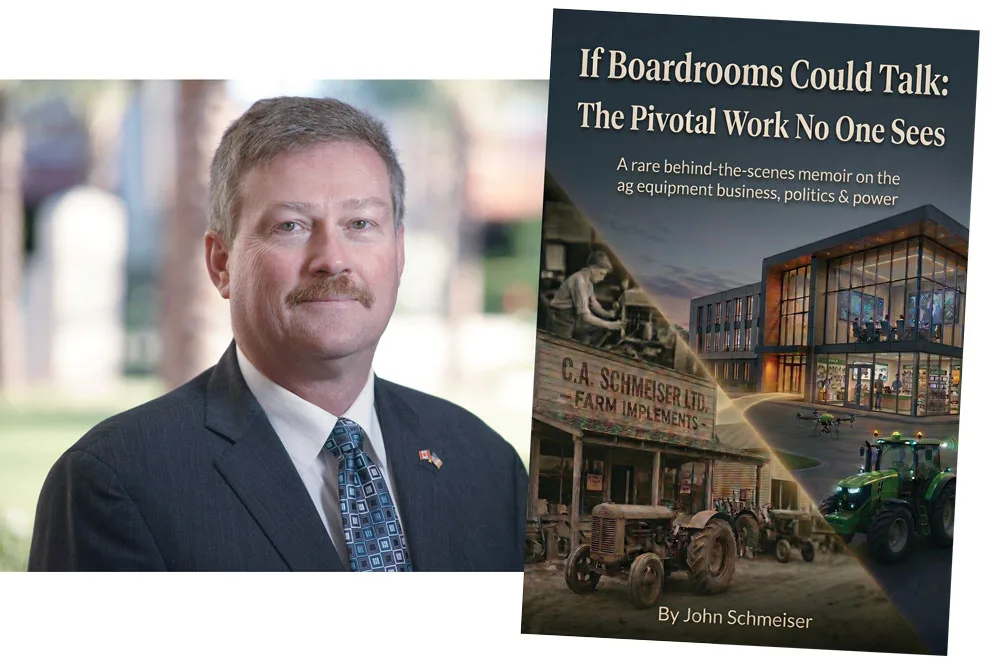
Editor’s Note: After reading John Schmeiser’s candid new memoir, If Boardrooms Could Talk: The Pivotal Work No One Sees in just two sittings, Farm Equipment requested permission to share an excerpt of the book’s content with its subscribers. What follows is Chapter 17 from Schmeiser’s newly released book in its entirety and in his own words. The 428-page book is available for sale for Kindle, hardcover or paperback via Amazon.
The first time I sat across the table from senior OEM executives in their boardroom in 2004, I remember thinking one thing very clearly: this feels a lot like politics.
Not because there were cameras or reporters outside the door. There weren’t. Not because anyone was running for office. They weren’t.
But because the room had that same energy — that mix of tension and courtesy, smiles that didn’t always match the body language, and the unspoken understanding that every sentence mattered.
We were sitting in a boardroom that could have belonged to any global corporation: polished table, perfectly staged chairs, coffee ready to be poured, and in this setting, pictures of their farm equipment on the walls. Add a couple of people in the room wondering whether this meeting was really worth their time.
We weren’t there for NAEDA. We weren’t there as spectators. We were there on behalf of the equipment dealers we represented — real dealers who took real risks. People who owned stores, employed people, carried inventory, fought weather, fought cash flow, fought customers who wanted miracle fixes in half an hour, and fought manufacturers who sometimes forgot that dealers were the ones carrying the brand on their backs.
“We need to start talking. More. And privately. And seriously. Because we both need to acknowledge that if we air our disputes in front of legislators, we all lose...” – Jerry Parkin, head of state government affairs for John Deere, in 1998
And there we were — dealer representatives — showing up with real-world issues like: warranty reimbursement that didn’t cover actual costs, dealer agreement language that was basically a contract of adhesion, parts supply problems, product quality issues, policies that seemed written by someone who had never signed the front of a check, and the latest ratings from NAEDA’s Dealer-Manufacturer Relations Survey.
I was still relatively new to Canada West and manufacturer relations issues when I attended my first such meeting. NAEDA didn’t let just anyone into those early sessions — only the most experienced and respected managers. For good reason.
When I was in the family dealership (Schmeiser’s Garage, which I grew up around from 1968-1988), there didn’t seem to be much tension between us and our major manufacturers — White, Massey Ferguson or New Holland at the time. Maybe there was, but it wasn’t noticeable to me. When the “blockman” showed up, he stayed for dinner. White had gone through two bankruptcies. Massey Ferguson needed a government bailout. My perception then was that the manufacturer needed us as much as we needed them.
That stuck with me.
When I did get invited to my first manufacturer meeting after joining Canada West, I did what I always did in unfamiliar rooms: I sat quietly, listened, and tried not to look like I didn’t belong.
That’s when it hit me: this wasn’t just association work.
This was relationship management at the highest level. And if you get it wrong, you don’t just lose a meeting.
You lose trust.
You lose stability.
You lose access.
You lose the ability to solve problems before they become lawsuits, legislation or public fights.
Or even worse — you lose the confidence of your dealer members that their association can make a difference.
The Awakening: Texas & the Warranty Bill
Whether I was inside government or on the outside, I always believed that once a problem reaches a legislature, something along the way failed.
Our dealer protection laws in Alberta, Saskatchewan and Manitoba were like that. They happened because major manufacturers thought they could drive down onerous contract terms or punitive purity policies with no pushback.
The issue that moved the needle — the one that made manufacturers sit down with dealer association leaders formally and regularly — was warranty reimbursement.
And that defining moment became the spark for one of NAEDA’s most important contributions to the industry: the Industry Relations Task Force (IRTF).
Most people outside the industry assume warranty work is simple: a product breaks, the dealer fixes it, the manufacturer covers it, the dealer gets paid, everyone moves on.
That’s how it works in the auto industry. In fact, car dealers often like warranty work because it can be profitable. Flat-rate times are predictable, repairs are standardized, and the jobs move through the shop efficiently. If your car needs a repair, you drive it to the dealership, and it gets handled.
The Irony: NAEDA’s Best Work Was Often Its Best-Kept Secret
One of the most frustrating parts of this work was how often it went unnoticed — sometimes intentionally.
We would never issue press releases saying:
Some did.
Some didn’t.
Sometimes because they were busy. Sometimes because they didn’t understand the value. And sometimes — let’s be honest — because they didn’t want NAEDA to look effective.
I once explained this to a large multi-store John Deere dealer. He hadn’t renewed his NAEDA membership after the 2022 merger. Why? Because his regional manager told him there was no value.
I walked him through all the contract and policy updates we had reviewed with John Deere over the previous 5 years.
Seven in total.
And I shared some of the suggestions that were made on his behalf, and of every other John Deere dealer.
His response: “I had no idea NAEDA was doing that. Why haven’t I heard about it?”
And that put me in an awkward spot.
Because the answer was they should have. But in some cases, the regional association didn’t pass it on.
And in a few cases, the regional manager would take NAEDA’s contract review work, put their name on it and distribute it as if they had done it.
Which is like stealing someone’s homework … and then criticizing them for not doing their homework.
It was frustrating.
But it also reinforced why NAEDA mattered.
Because regardless of politics, dealers still deserve representation.
Farm equipment isn’t like that.
Farm equipment is complicated. It’s varied. It’s sophisticated. It runs from early morning until late at night. It’s massive. And it operates in unpredictable conditions. When it fails in the field, it often can’t be moved.
And unlike the auto industry, the dirty little secret in farm equipment was this: mainline manufacturers often did not reimburse dealers for their actual labor costs on warranty repairs.
They reimbursed based on preset flat-rate times that were … let’s call them “optimistic.” Ask any dealer — unrealistic is probably the better word.
If a manufacturer thought a repair should take 3 hours, and the real-world repair took 6, the dealer ate the difference.
Shortline manufacturers weren’t much better. Many reimbursed dealers at a percentage of their posted shop rate — often 85%. In their view, that seemed fair.
And dealers ate that gap every day too.
During our debates on warranty, I would argue that because the OEMs were shortchanging dealers on warranty reimbursement, dealers had to charge the customer more on non-warranty work to make up the shortfall. That just didn’t seem right.
Then Texas dealers decided they weren’t going to keep eating it.
Groundbreaking Warranty Reimbursement Bill
In 1998, the Southwest Equipment Dealers Assn. got a warranty reimbursement bill passed in Texas that was groundbreaking from a dealer perspective. It quietly changed the balance of power in equipment warranty work by adopting what dealers came to call “fair warranty” protections.
The law introduced statutory standards that treated warranty work as legitimate, compensable business activity — not a discretionary manufacturer program.
It focused on three principles: timeliness, fair compensation and accountability.
Suppliers were required to act on warranty claims within defined timeframes. Reimbursement was tied to dealer retail (advertised) labor rates and actual parts cost plus 15%. Post-payment chargebacks were limited to legitimate causes. Dealers were protected when submitting claims after termination for work already performed, while manufacturers retained responsibility when equipment could not be made usable.
The result wasn’t friction-free warranty work. But it became more predictable, enforceable and economically honest for dealers.
Most importantly, the Texas approach recognized something simple: warranty is not the dealer’s promise. It’s the manufacturer’s obligation — delivered through the dealer’s service department.
For dealers in Texas, it was a landmark victory. For manufacturers, it was a shockwave.
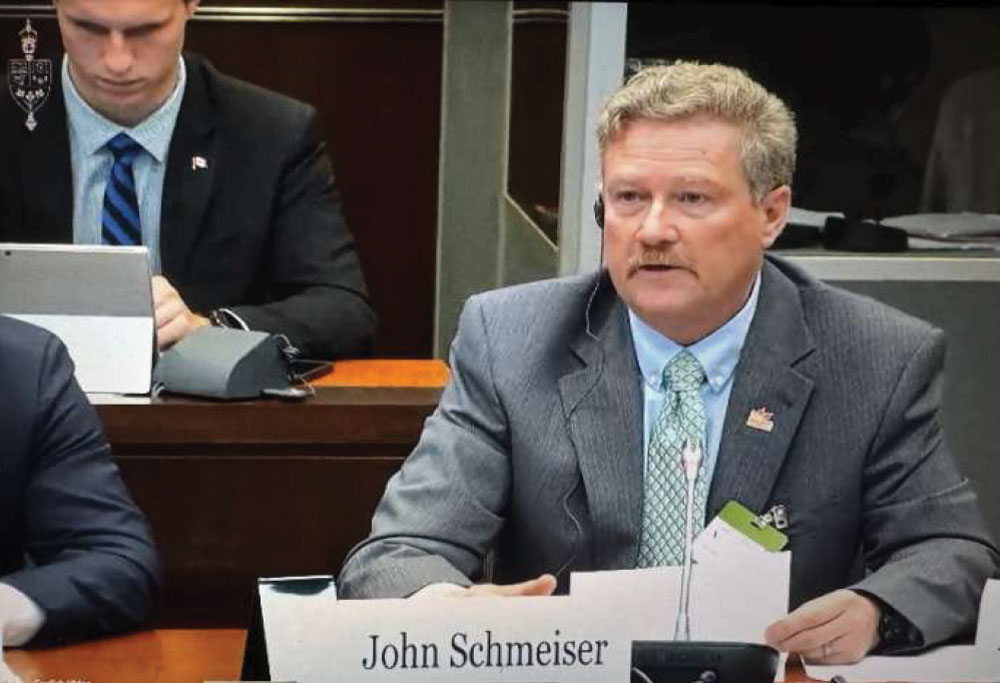
Advocacy in action. One of my many appearances before a Federal Standing Committee in Ottawa. This one was the Standing Committee on Industry & Technology in November 2022, where I testified on Bill C-244 – Amending the Canadian Copyright Act.
They argued it went too far — that it interfered with the contractual business environment they had with their dealer channel.
But the bill didn’t just change the math.
It changed the power dynamic. It sent a message that if we can’t solve this as partners, we’ll solve it in a legislature.
And getting legislation passed is brutal work. You need dealer support. You need language. You need lawyers. You need sponsors. You need to leverage every relationship dealers have. You need testimony. You need dealers to appear at committee hearings. You need the votes. Sometimes you need lobbyists. Then you still need a governor’s signature.
But regional associations proved they could do it — in state and provincial capitals. That was their job.
Manufacturers never wanted the message of shortchanging dealers on warranty work delivered publicly. Their fear was simple: every state would follow Texas.
And that was the moment the manufacturers — through their trade association and key leaders — approached dealer association leaders.
The first call came from Jerry Parkin, head of state government affairs for John Deere, in 1998.
And he said, in plain language: “We need to start talking. More. And privately. And seriously. Because we both need to acknowledge that if we air our disputes in front of legislators, we all lose.”
What the Industry Relations Task Force Did
The IRTF was formed in 1999 with a simple goal: “to explore areas of mutual interest which could lead to a cessation of initiatives to have state legislatures defining dealer/manufacturer contractual relationships.”
That purpose was clearly stated when I looked back at the March 5, 1999, agenda — the first meeting of concerned manufacturers and dealer association representatives.
You can tell the purpose was written by the manufacturers. And so was the agenda.
It was clear that we needed to talk to stop all legislation.
That sounds simple on paper.
But in reality, the process they created was revolutionary.
Because prior to that, manufacturer relations looked like this:
- Manufacturers made decisions.
- Dealers reacted.
- Associations got involved.
- And when nobody could resolve it, legislation may become a hammer.
The IRTF flipped that script.
It created an annual, formal process where dealer association representatives — not dealers, but association leaders — could sit down directly with senior executives of major manufacturers.
Not to complain.
Not to grandstand.
Not to threaten.
But in a roundabout way, use dealer input to tell them how to run their business … without telling them how to run their business.
The goal was to solve problems.
And we were there for one reason: to represent the equipment dealers we served.
Even though most manufacturers had dealer advisory councils, the prevailing view was that dealers didn’t have enough voice at corporate headquarters. This IRTF process was set up not to replace these respective dealer councils. It was set up to complement them.
But there was always a risk of a divide-and-conquer approach. If one dealer stuck their neck out too far, it would be noticed. And that could trigger retribution — subtle, direct or indirect.
I learned how serious this can be at my first Canada West convention in 1997. We typically had line meetings at our conference, and prior to one brand’s line meeting, the dealers from that brand met in advance to discuss their concerns about product programming, availability and quality. A respected dealer, who was also on our board, was designated as the spokesperson for the group.
NAEDA’s Most Important Responsibility
When NAEDA is functioning at its best, it is not a conference organizer. It is not a magazine publisher. It is not a dues collector.
It is the structure that allows dealers and manufacturers to work like partners — not enemies.
The IRTF was proof of that.
The contract review process was proof of that.
The Dealer-Manufacturer Relations Survey was proof of that.
And years later, when Right to Repair became a legislative wildfire, the reason we could build coalitions and respond quickly wasn’t because we suddenly got organized.
It was because the foundation already existed.
The relationships existed. The trust existed. The process existed. And it all started because Texas passed a warranty bill that woke everyone up.
Sometimes the best industry progress doesn’t come from a brilliant plan. It comes from a crisis that forces people to finally talk.
And what we built in manufacturer relations was exactly that:
A way to talk — privately, honestly, and with enough structure to keep the dealer-manufacturer ecosystem from turning into a public war.
Because once it turns into a public war, the only people who really win are lawyers and lobbyists.
When he raised the issues in the line meeting, the OEM executive asked the room “if anyone else felt the same way.”
No one spoke up. The dealer was hung out to dry. Then the executive responded: “Well, I guess that’s the end of that.”
The message was clear: this manufacturer did not appreciate dealers meeting without them. Soon after, the spokesperson’s dealership faced subtle repercussions—limited inventory availability and reduced discretionary support.
The dealer told me it took nearly 10 years, and a change in the OEM’s leadership, before the incident was forgotten. It was a clear reminder that if a dealer stuck their neck out too far, there could be consequences — which is why dealer associations had to carry the message on behalf of dealers.
That first IRTF meeting brought a who’s who from the Assn. of Equipment Manufacturers, then known as the Equipment Manufacturers Institute. Representatives included Gehl, Komatsu, Case IH, AGCO, Ingersoll-Rand, John Deere and Caterpillar. The Farm Equipment Manufacturers Assn. representing shortlines — was also there.
And 5 association leaders.
What Dealers Really Wanted
If you asked most people what an equipment dealer association does, they’d probably say government relations, services, training, conferences and dealer programs.
And yes — all of that matters. Those things are visible. They’re easy to explain.
But survey after survey, and conversation after conversation, told us something far blunter. The number one thing dealers wanted from their association was strong manufacturer relations.
Not as a bonus. Not as a “nice to have.” As the core responsibility.
We heard this in 1999. Again in 2013 and 2019.
With good reason. The business was changing fast. Expectations from manufacturers were rising. More risk was being placed on dealers.
The dealer-manufacturer relationship is the operating system of the industry. If it’s healthy, dealers can focus on customers, sales, service, and building profitable businesses. If it’s broken, dealers spend their lives managing friction: policy changes, market share demands, ordering requirements, parts problems, product availability, pricing issues, and conflicts that never should have existed in the first place.
“If one dealer stuck their neck out too far, it would be noticed. And that could trigger retribution…”
And here’s the part nobody outside the association world understands: manufacturer relations isn’t a side project. It’s a full-time responsibility.
For association CEOs and senior staff, it takes massive time because every OEM policy change creates ripple effects across a dealer network.
Every dealer call requires getting the facts and speaking to the right contact at the OEM. Every contract update triggers legal and operational consequences. Every “initiative” dreamed up at headquarters becomes a real-world burden for dealers if it isn’t thought through.
If associations aren’t involved, dealers end up dealing with it alone.
And when dealers are left alone long enough, they don’t just complain.
They get angry. They call legislators.
I’ve seen it happen. They call a representative they know — sometimes a friend, sometimes there’s a donor relationship — and suddenly what could have been handled quietly becomes a public fight.
That’s why the IRTF became essential. Not as a PR win for NAEDA — but as one of the few mechanisms that kept the industry functioning like a partnership instead of a battlefield.
It also became NAEDA’s reason for being.
The Contract Review Process & Why It Mattered
One of the best outcomes of the IRTF was something that, at the time, almost felt too good to be true. In 2000, OEMs started providing dealer associations advance copies of contract changes and major policy updates before they were distributed to dealers.
John Deere started this process, and credit goes to Jerry Parkin for believing it could work.
Now, to be clear, NAEDA could not “negotiate” dealer agreements. Antitrust laws make that dangerous territory.
But NAEDA could do something just as valuable. We could review, identify concerns, explain consequences, and warn manufacturers when language was likely to create dealer outrage — or legislative backlash.
In other words, we weren’t rewriting agreements. We were trying to prevent future legislative fights.
The people who became central to this work were first Jack Selzer and then Lance Formwalt of Seigfreid Bingham, a Kansas City, Mo., law firm.
Both were engaged by NAEDA, and they also represented regional associations — including ours.
Lance’s firm handled 12–15 dealership transactions a year — mergers, acquisitions, buyouts, restructurings. He was respected by dealers because he understood dealership reality. He could explain changes in agreements in plain language.
If Boardrooms Could Talk: The Pivotal Work No One Sees: A rare behind-the-scenes memoir on the ag equipment business, politics and power
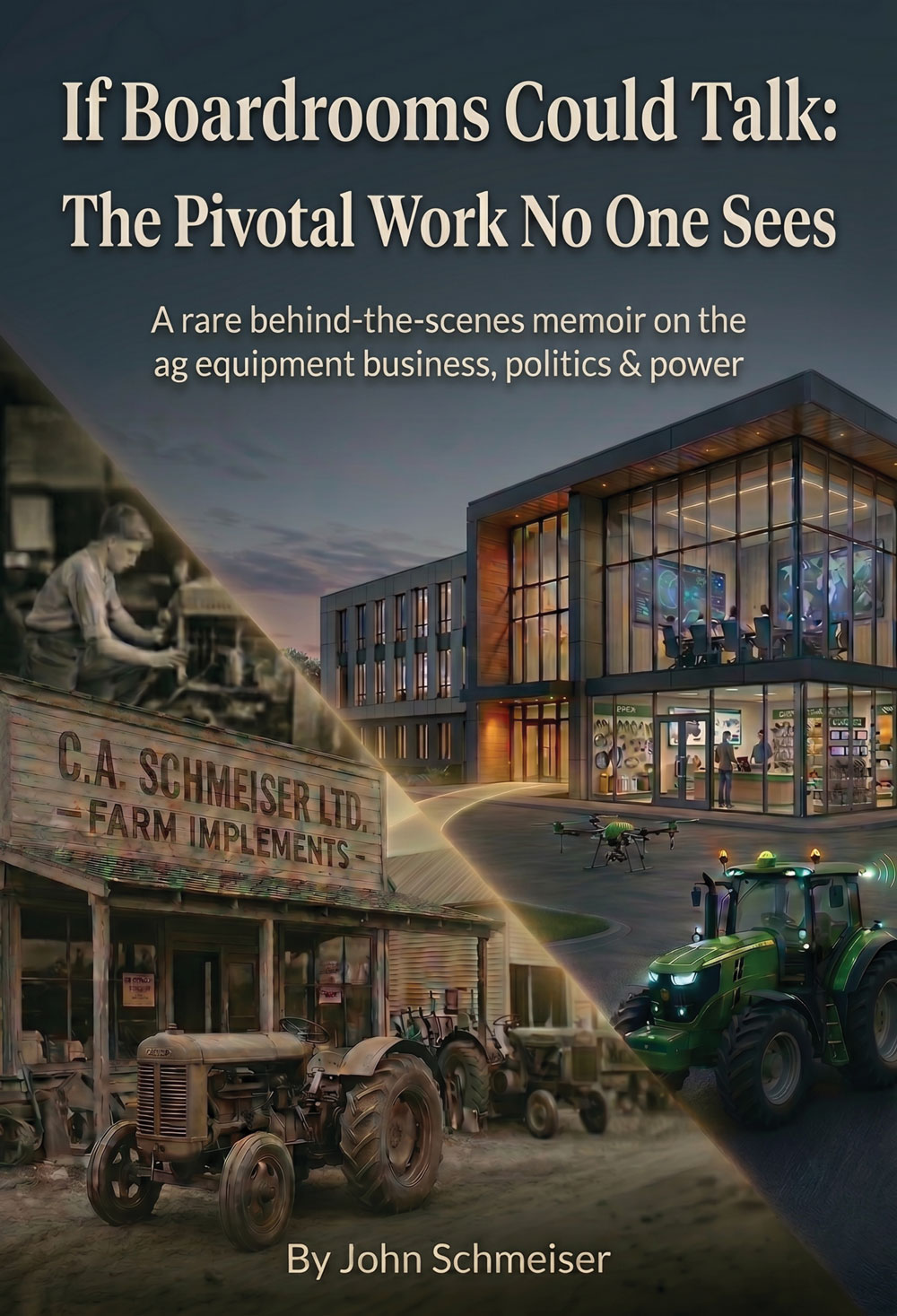
From the parts counter of a small-town Saskatchewan dealership to the halls of provincial politics and the boardrooms of North America’s most influential equipment dealer associations, John Schmeiser’s story is one of service, resilience and leadership under pressure.
In this candid and deeply personal memoir, Schmeiser traces his roots in a farming family shaped by hard work, community duty and entrepreneurship. He takes readers inside the equipment dealership world — an industry built on trust, relationships and the unseen work of keeping farmers running when everything is on the line. Along the way, he reveals the battles dealers faced with manufacturers, the fight to create some of the strongest dealer protection laws in North America and the years spent helping unify a fragmented equipment dealer association system.
But this is much more than an industry story. It is also a family story. Schmeiser writes with honesty and heart about politics, ambition, setbacks, lifelong friendships and the perspective that came from raising his daughter Rachel, whose special needs reshaped his understanding of success, sacrifice and joy.
Rich with behind-the-scenes insight, memorable characters, and lessons forged through conflict, this book is for anyone interested in leadership, politics, business, agriculture, or the power of steady work done far from the spotlight. It is a story about what holds industries together, what holds families together, and why the work nobody sees often matters most.
The book is available for purchase on Amazon here.
And he was respected by manufacturers because he was never performative, never confrontational, never ideological.
He was factual. He would outline what proposed changes would do to dealer rights and obligations, and how they would be received in the real world.
It was the closest thing to “soft negotiation” you could do without crossing legal lines.
Sometimes manufacturers adopted every one of Lance’s recommendations. Sometimes some. Sometimes none.
That was their right.
But the value of the process was enormous because it kept relationships functional.
The value of this process to a dealer member was even greater. It justified their annual dues by an order of magnitude.
It also gave manufacturers a benefit. They could tell dealers — truthfully — that their association had reviewed and provided input before the agreement was issued.
Dealers might not love every clause, but they knew someone who had their back had been in the room.
And that mattered.
And it was NAEDA.
Kubota: Proof Positive
At Kubota’s Dealer Connect conference in 2023, it announced to dealers that it would update the dealer agreement in 2025. Kubota has an internal policy to update agreements every 10 years. The last update was in 2015.
What impressed me was that it laid out the process publicly.
First, internal review by Kubota’s legal team. Then senior executive review. Then dealer advisory board input. Then the draft agreement would be sent to NAEDA for review and comment.
Then Kubota would consider NAEDA’s comments before issuing the final version to dealers.
Kubota didn’t have to publicly say that. But they did. They wanted their dealers to know NAEDA’s role in their process.
And that was proof that the process had become culture — the same culture adopted by John Deere, CNH, AGCO, and many shortlines.
That contract review process built trust with dealers too.
I once got a call from Harold Chapman Jr., President and CEO of Crown Power & Equipment Co.— a good friend but also a respected Case IH and Kubota dealer in Missouri.
He asked me one question:
“Did NAEDA and Lance get to review this policy change before Case IH sent it out?”
I told him yes, and that a memo detailing the changes was coming out soon.
And Chapman said: “That’s good enough for me.”
That’s not just trust in NAEDA.
That’s trust in the process.
20 Years at the Table
The IRTF started in 1999, and I was asked to join it in 2004.
I stayed on it right up until my final day at NAEDA in 2024.
That’s 20 years.
Which means I spent 2 decades sitting in rooms with senior manufacturer leadership, having conversations most dealers never see — and most people outside our industry don’t even know is happening.
As strange as it sounds, that IRTF assignment was one of the most important responsibilities I had in my entire career.
It was also, in many ways, a plum assignment — a front-row seat to the real dynamics of the industry.
But the funny part is how I got there. I was asked almost by default. Because there was no Canadian representation.
And by the early 2000s, that didn’t make sense anymore.
The market was integrated. Policies, contract language and warranty practices crossed the border. And in some cases, problems crossed the border faster than a finance company rep doing a floorplan audit.
If NAEDA claimed to represent dealer interests in North America, Canada needed a seat at the table.
Not for special treatment. Because most of the issues weren’t “Canadian” or “U.S.” anymore. But issues from Canadian dealers didn’t have a Canadian advocate at the table.
That privilege came to me.
And I took that seriously from the beginning.
Notes Weren't Just Notes
Right from my first meeting, I became the person who was taking the notes.
Which sounds boring, but it isn’t.
Because in those rooms, the notes became the official record.
They became proof the conversation happened.
They became the communication back to dealers that said: your issue was heard, your concern was raised and here’s how the manufacturer responded.
And they became a subtle form of accountability. Because once something is in writing, it’s harder for anyone to pretend it never happened.
Taking notes meant walking a fine line. You captured what mattered. You protected what needed to stay confidential. You didn’t editorialize. You didn’t spin.
You recorded reality.
And in an industry filled with rumors, assumptions, and second-guessing, that kind of clarity was priceless.
The Work Nobody Sees
Here’s the part most dealers never really see.
They don’t see the hours spent on manufacturer relations. They see the outcome — the policy that changed, the contract language that softened or the issue that somehow disappeared before it became a fight.
What they don’t see are the five conversations that happened beforehand to keep a bad idea from ever leaving headquarters in the first place.
They don’t see the late-day calls or emails that start with, “Off the record…” The quiet back-channel conversations where an OEM executive asks, “What’s going on with this dealer?”
Because yes — that happened. More often than people would expect.
Sometimes the dealer was right. Sometimes they weren’t. Sometimes they were right about the issue and wrong about how they handled it. But what mattered wasn’t assigning blame — it was keeping the process alive, so problems didn’t turn into public explosions.
That was the real value of the quiet work that prevented chaos.
The Final Truth
When dealer-manufacturer relations are managed properly — by associations and by OEMs — the industry functions. Dealers focus on customers. Manufacturers focus on product and support. Everyone complains a little, but nobody reaches for a lawyer or a legislator.
When those relationships aren’t managed well, everything deteriorates.
Dealers live in constant frustration. Trust erodes. Communication shuts down. And every interaction starts to feel adversarial.
And when that happens, dealers don’t just get annoyed.
They get political.
That’s how you end up with warranty reimbursement bills, buyback laws, dealer protection laws and a long list of legislative messes nobody actually wants.
Manufacturer relations — done properly — prevent that.
It isn’t glamorous. It doesn’t make headlines. And most of the time, the best outcome is when nothing happens at all.
But without it, the industry doesn’t just struggle.
It breaks.