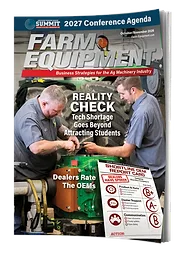
As reported previously, the April/May 2026 Farm Equipment delved into the sometimes sensitive dynamic between machinery dealers and their manufacturers. As was described to me early in my farm machinery reporting career, a love-hate relationship is often at play in this business.
That is, when the dealer is face to face with the customer and or in a competitive negotiation, he’d defend the brand to his dying breath. But minutes later, behind closed doors, the dealer and his exec at headquarters might be in an all-out verbal battle that could make even hardened sailors blush.
The latest Farm Equipment exercise attempted to report on things via a positive approach. Instead of asking what was wrong with current dynamics, we asked dealers to describe when things were working best. Most played it that way. But some, of course, complimented some old-timers in a way that also served to backslap others.
You can read what Farm Equipment subscribers had to say about the three best execs in their view, and also read additional context here – and in their own words.
A Trade Editor’s Turn
I’ve been the editor/publisher of Farm Equipment since our family business acquired the magazine in 2004. As a business scribe and small business owner, I’ll admit I’ve always been more interested in the people side of the business than in the iron itself, and have reported a great deal on management, succession, purity, market share, contracts and other programs and levers.
I suspect that Farm Equipment, under our ownership, paid closer attention to the manufacturer-dealer relations than did other ag and trade journalists. While many liked what was often bold coverage (we didn’t know any better), some of the major lines didn’t see it the same way.
The one setting the tone at the major-lines is of no small significance to the independent dealer. A bad or untrusting relationship can lead to sleepless nights. Dealers’ worlds – especially with regard to growth opportunities and contract approvals when it comes time to sell or transition the business – are largely in the fates of others.
A Tough Job
First, I’ll say that the job of managing an OEM’s dealer network ain’t easy. Any one who is universally loved at all times, by all stakeholders, isn’t doing their job.
They have to straddle many competing interests and, ultimately, motivate independent-minded dealers to do battle for them while at the same time trying to keep the “Mother Ship” reasonably happy.
Top 10 List
I’m offering 10 observations of the major-line OEM executives tasked with responsibility for the dealer networks that I’ve seen during my 2-plus decades.
- Sometimes the same individual could be simultaneously loved and vilified by the dealers they were there to manage.
- Some possessed a “we’re one of you” posture and some were more corporate-polished, cerebral types.
- Some “ate the camera” at farm shows and D.C. meetings, while others’ travel schedule was protected for field visits to dealers and farmers and the association gatherings.
- Some had such a high command of the operational numbers that dealers didn’t attempt to “BS” them. One was known to almost instantly identify why a dealer’s operation was falling short upon hearing a specific metric.
- Some were surely asked to carry out company policy they weren’t comfortable with or even believed in, acting like military personnel carrying out orders.
- I once saw a newcomer receive an outpouring of emotional affection from dealers only to be run out on a rail months later by a higher ranking multinational executive.
- Whether true or not, some were accused of playing favorites in areas like allocation, last-minute inventory “finds” and financing deals.
- Some obsessed over their (and their predecessors’) rankings as compiled annually by the dealer associations and knew how NOT to waste an opportunity to make a point.
- Relationships with trade media like Farm Equipment ranged from highly personal (entrusting editors with highly confidential information) to an arm-length’s distance, or an “arm” that might more accurately be described as a pole vault.
- Some “called it like they saw it” while others who were highly cautious men of few words, and/or only agreed to 1:1 conversations or email to carefully measure every word.
What are your memories and observations of the challenges, successes and war stories between the walls of the OEMs and also between the dealer and major? Use the comment field below, or email mlessiter@lessitermedia.com