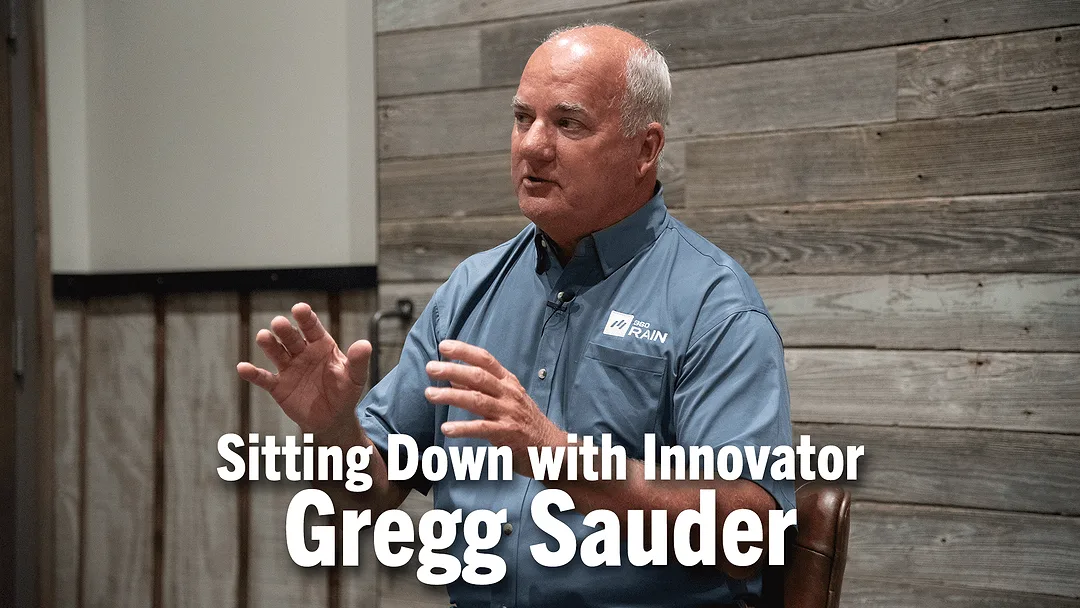
Last Friday, the Ag Equipment Intelligence editors were at the Morton-Illinois headquarters of 360 Yield with company founder and CEO Gregg Sauder.
Sauder, who sold his Precision Planting company in 2012 for $250 million to Monsanto, is seeing success with his new company, and namely his invention of the 360 Rain, an autonomous system to irrigate and bring manure nutrients to the root of the corn.
The technology has been a bright spot in a tough market and has been widely reported by the ag media this past year.
Sauder’s approach as an independent equipment innovator is in stark difference to what has angered farmers in the Right to Repair debate.
“We have to have an advantage and that doesn't mean that Case and Deere and AGCO are doing it wrong. We get more forgiveness from growers because we're on a cutting edge always.”
“Not saying they don't call in and they're not stressed, but they know that Greg and Cindy are going to 100% stand behind them. Whatever happens they're never at risk. So when you buy new technology from me, you realize the Rain units today that were 5 years ago are still being updated free of charge. New software, new components, new this at no charge to them. That's how you design an environment where the best farmers come to you and they come in and you develop. I mean, I got a large dairy in Ohio. I've never met a man like him. He's the most interesting, sharing, gifted individual I've met. He's got 15 Rain units and he just keeps adding them because he sees the value in 20,000 cow dairy and his manure bill used to be over $2 million and now he's doing it all in the field.”
“But when I make a mistake, yeah, we go out and we fix it and we arrive on the scene and we do it. I mean, I got a traveling team of young men and trucks and if we have a problem very long, I mean, we'll know if it's 24 hours of the machine that's it, we're there. And that's why people take a chance. You have to have trust in who they're working with. I'm really careful not to violate that if I can possibly help it. So you try to do the best you can always. Doesn't mean we don't make mistakes. After the mistake is made, it's how you respond. That's what sets the stage. My people understand that. I mean, I don't ask my engineers that it can never have a bug in software or whatever, but once that happens, all hands on deck till it's fixed.”
“Things happen that you didn't anticipate. It's how you react to that. That's what to me sets you apart.”
Sauder was asked about the motivation to start an entirely new company in a new segment, and where he thinks it can go, looking back over the last 10 years.
“I was under the impression that we can make this happen again pretty quick. And I had no idea how much energy and willpower it was going to take. And so we're what? We're 13 years old now, 12, 360, and the flywheel's rolling and you can sense it. Will 360 Rain be larger than precision? Possibly I think it can. It looks like it could pass anything that we've ever done in the past. But I was really surprised without talent, the right talent, you can only do so much in a day's time. Tim and I and our boys, I mean, you can do a lot, but nothing compared. You've got to surround yourself with innovative, free thinking people.”
“And that's what we've been blessed.”
Sauder also talked of autonomy and how it’s going to solve real problems that weren’t as evident just a few years ago. And also why his irrigation/manure system is a great application of it.
“So we probably have the most autonomous machines of anybody in the industry when you think about it worldwide.”
“I would've told you three years ago autonomous tractors and that and planners say really farms can find good talent to do that. I've changed my position some and I think Deer’s ahead of us when you se the labor challenges, finding the right labor. There's going to be farms that are going to struggle to get enough help or the right style of help. So I think autonomous can help there.”
“For us, it's a no-brainer. No one is going to ride a machine at a half mile an hour.”
“You saw that in the drag line industry for manure drag lines. They're running three quarters to a mile an hour and people just go literally crazy after 12 hours.”
“To me, it's got to make sense. It can't just be, oh, cool. It's autonomous. That doesn't mean anything to me. It's like it has a purpose because of autonomy and autonomous technology that really fits this, whatever it's doing has to line up. So the cool factor doesn't mean a lot to me. It's the fact that that's what makes it the best it can be. So I don't know.”
“I talk often in our operation. If I had a tractor out chiseled doing deep ripping and it gets done at 3:00 AM, that field's done.”
“Is Greg going to get up at three o'clock, go move it? Well, obviously I'm going to need somebody to come pick me up once I move the tractor. So I'm going to get two people up at 3:00 AM to move the tractor to start it in the next field.”
“Until equipment can move itself, which is a real challenge in our area. We got large equipment and a lot of traffic. So that's a unique paradigm in all itself. So I don't know how it would fit us personally because I have some really good talent on our farm team. I got six guys that are just really proud of. So I don't know if it would fit me, but I see exactly where it's going because there is going to be challenges of finding enough help.”
More on the award-winning innovator Gregg Sauder will be forthcoming in a special edition of Farm Equipment this September.
Watch the full version of this episode of On The Record