In this episode of On the Record, brought to you by Associated Equipment Distributors, we look at John Deere’s settlement with the FTC and whether it’s a win or a loss for the OEM and dealers more broadly. In the Technology Corner, Noah Newman visits with Greg Olson of the Sand County Foundation to learn how they’re using sensors to measure the impact of soil health management systems. Also in this episode, we sit down for a one-on-one with the innovative Gregg Sauder and take a closer look at Sabanto’s work to move autonomy forward.
.png)
This episode of On the Record is brought to you by Associated Equipment Distributors — the leading association in North America for the equipment distribution industry.
Power up your Q3 with AED’s must-attend lineup of leadership events, industry conferences, and hands-on training built to connect and elevate equipment professionals. From the high-impact Leadership Conference to the Women in Equipment Conference, plus expert-led seminars and certification programs, AED delivers real-world insights, skill-building, and unmatched networking opportunities that drive performance and growth. Whether you’re developing your team, staying ahead of industry trends, or building stronger relationships, AED’s Q3 programming gives you the edge to compete in today’s economic challenges. Learn more at www.aednet.org.
TRANSCRIPT
Jump to a section or scroll for the full episode...
- Deere’s FTC Settlement Not a ‘Decisive Loss’
- Commodity Ticker
- Using Sensors to Measure Impact of ‘Soil Health Management’ Systems
- Sitting Down with Innovator Gregg Sauder
- Sabanto Takes Autonomy ‘Leap’ with Bayer Investment
- DataPoint: Producers Rate High Input Costs as Top Limiting Factor for Financial Situation
Deere’s FTC Settlement Not a ‘Decisive Loss’
On July 8, 2026, just one week after the news of the opposition to the $99 million class action settlement against John Deere, the Federal Trade Commission (FTC) announced Deere & Co. has agreed to settle a lawsuit brought by the FTC and U.S. states for alleged violations of requiring farmers to use Deere’s authorized dealers for repairs instead of independent service providers or self-repair. Eric Hodson reports that a July 6, post on the UAW 450 Members Facebook page provided additional details as shared to their members.
The FTC’s stipulated order requires Deere — for the next 10 years under the supervision of the FTC and plaintiff states — to provide farmers and independent repair providers with the same equipment repair resources, including applicable software capabilities, that it currently provides to authorized Deere dealers.
According to retired dealer association executive John Schmeiser,
“From a strategic business perspective, this isn't a decisive loss for Deere but more of a negotiated compromise that limits legal risk while conceding broader access to repair tools.”
The R2R advocates, of course, will claim a huge victory and possible strength for the movement, he says.
Schmeiser goes on to say that
“Deere is smart though. The bigger win for Deere in this settlement formalizes practices Deere was already expanding, like Service Advisor and Operations Center Pro, and provides customers with greater flexibility in repair tools. My opinion is that Deere was already going to do this, and the Class Action Suit just gave them the confirmation that not only were they on the right track, but they were also ahead of the curve based on their competitors in providing support tools to the end user.”
Interestingly, most dealers were less concerned about the loss of service hours in the intermediate term. A sentiment shared by many is that farmers will get what they pay for – and will feel the absence of fully trained technicians with a bevy of resources behind them.
Another dealer notes “double repairs” will be racked up due to inexperienced techs, and the loss of warranty coverage from the sunk dollars.
Schmeiser says he thinks
“Deere quietly protected several elements that matter to dealers. Dealers still receive training, support and engineering relationships that the settlement doesn’t require Deere to replicate. The DTAC remains a dealer ecosystem; only published solutions must be shared.
“Overall, the settlement governs ‘repair capability,’ not the broader value proposition of being an authorized dealer. Deere did a really good job of preserving the structural and integrity of their dealer channel.
“But again, the R2R advocates will distort this settlement as a huge victory for R2R. It’s not.”
Brett Davis, CEO of the North American Equipment Dealers Association (NAEDA) agrees. He says,
“This settlement avoids the troublesome parts of several bills that were introduced that mandated dealers and OEMs must sell at costs to farmers. More clarity is needed for sure. We will still see state and provincial issues with right to repair legislation that will attempt to impair / disrupt the dealer business model, which is not acceptable.”
We’ve added a session to the Dealership Minds Summit Aug 4-5 on this topic to help dealers understand what it means both now and in the future for their business. The panel discussion will include Both Schmeiser and Davis as well as AED vice president of policy Eric Wareham.
Commodity Ticker
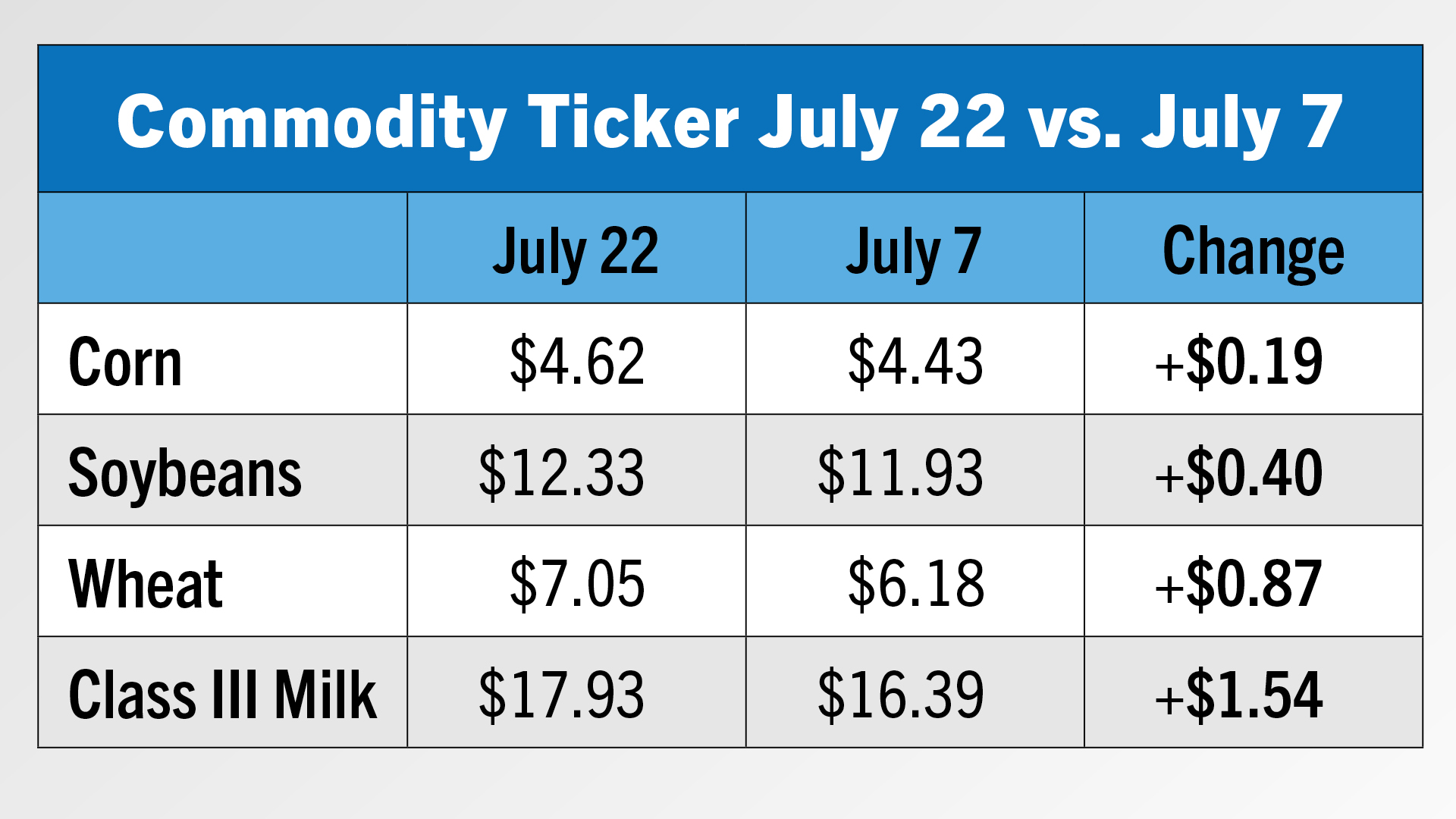
As of July 22, corn prices were $4.62, up 19 cents from our last episode. Soybeans closed at $12.33, up 40 cents. Wheat closed at $7.05 up 87 cents and Class III milk prices closed at $17.93, up $1.54.
Using Sensors to Measure Impact of ‘Soil Health Management’ Systems
Sand County Foundation, a national nonprofit conservation organization, is leveraging some cutting-edge precision technology to measure the true impacts of soil health management practices.
I had the chance to tag along with Greg Olson, field projects director, as he installed CropX sensors in Jackson, Wis., on a hot July morning. These sensors measure moisture and temperature at depths of 4-, 12- and 22-inches. They’re being installed on 24 fields across the Lake Michigan Basin. And the idea here is to compare data on fields where soil health management principles have been implemented with data from conventionally managed fields, to give farmers a better understanding of how each practice impacts water infiltration, leaching potential, aggregate stability and more.
“As a critical part of our data collection, we’re using these CropX soil moisture and temperature sensors. We put two in at each of the sites for comparison. When we install them at 4 inches and 12 inches, they’re reading both soil moisture and temperature, and then at 22 inches, they measure soil moisture and electroconductivity which helps calibrate the sensor to actually keep it reading correctly. When the antennas are installed, this all gets transmitted so you can look at it in relatively real time. It’s going to be a 3–6-hour delay, but basically you can look at what’s happening in any given day.”
Wisconsin farmers have dealt with spring hail, persistent rainfall and severe drought in recent years. The results from this project will address some of the growing management concerns in areas challenged by extreme precipitation events.
Sitting Down with Innovator Gregg Sauder
Last Friday, the Ag Equipment Intelligence editors were at the Morton-Illinois headquarters of 360 Yield with company founder and CEO Gregg Sauder.
Sauder, who sold his Precision Planting company in 2012 for $250 million to Monsanto, is seeing success with his new company, and namely his invention of the 360 Rain, an autonomous system to irrigate and bring manure nutrients to the root of the corn.
The technology has been a bright spot in a tough market and has been widely reported by the ag media this past year.
Sauder’s approach as an independent equipment innovator is in stark difference to what has angered farmers in the Right to Repair debate.
“We have to have an advantage and that doesn't mean that Case and Deere and AGCO are doing it wrong. We get more forgiveness from growers because we're on a cutting edge always.”
“Not saying they don't call in and they're not stressed, but they know that Greg and Cindy are going to 100% stand behind them. Whatever happens they're never at risk. So when you buy new technology from me, you realize the Rain units today that were 5 years ago are still being updated free of charge. New software, new components, new this at no charge to them. That's how you design an environment where the best farmers come to you and they come in and you develop. I mean, I got a large dairy in Ohio. I've never met a man like him. He's the most interesting, sharing, gifted individual I've met. He's got 15 Rain units and he just keeps adding them because he sees the value in 20,000 cow dairy and his manure bill used to be over $2 million and now he's doing it all in the field.”
“But when I make a mistake, yeah, we go out and we fix it and we arrive on the scene and we do it. I mean, I got a traveling team of young men and trucks and if we have a problem very long, I mean, we'll know if it's 24 hours of the machine that's it, we're there. And that's why people take a chance. You have to have trust in who they're working with. I'm really careful not to violate that if I can possibly help it. So you try to do the best you can always. Doesn't mean we don't make mistakes. After the mistake is made, it's how you respond. That's what sets the stage. My people understand that. I mean, I don't ask my engineers that it can never have a bug in software or whatever, but once that happens, all hands on deck till it's fixed.”
“Things happen that you didn't anticipate. It's how you react to that. That's what to me sets you apart.”
Sauder was asked about the motivation to start an entirely new company in a new segment, and where he thinks it can go, looking back over the last 10 years.
“I was under the impression that we can make this happen again pretty quick. And I had no idea how much energy and willpower it was going to take. And so we're what? We're 13 years old now, 12, 360, and the flywheel's rolling and you can sense it. Will 360 Rain be larger than precision? Possibly I think it can. It looks like it could pass anything that we've ever done in the past. But I was really surprised without talent, the right talent, you can only do so much in a day's time. Tim and I and our boys, I mean, you can do a lot, but nothing compared. You've got to surround yourself with innovative, free thinking people.”
“And that's what we've been blessed.”
Sauder also talked of autonomy and how it’s going to solve real problems that weren’t as evident just a few years ago. And also why his irrigation/manure system is a great application of it.
“So we probably have the most autonomous machines of anybody in the industry when you think about it worldwide.”
“I would've told you three years ago autonomous tractors and that and planners say really farms can find good talent to do that. I've changed my position some and I think Deer’s ahead of us when you se the labor challenges, finding the right labor. There's going to be farms that are going to struggle to get enough help or the right style of help. So I think autonomous can help there.”
“For us, it's a no-brainer. No one is going to ride a machine at a half mile an hour.”
“You saw that in the drag line industry for manure drag lines. They're running three quarters to a mile an hour and people just go literally crazy after 12 hours.”
“To me, it's got to make sense. It can't just be, oh, cool. It's autonomous. That doesn't mean anything to me. It's like it has a purpose because of autonomy and autonomous technology that really fits this, whatever it's doing has to line up. So the cool factor doesn't mean a lot to me. It's the fact that that's what makes it the best it can be. So I don't know.”
“I talk often in our operation. If I had a tractor out chiseled doing deep ripping and it gets done at 3:00 AM, that field's done.”
“Is Greg going to get up at three o'clock, go move it? Well, obviously I'm going to need somebody to come pick me up once I move the tractor. So I'm going to get two people up at 3:00 AM to move the tractor to start it in the next field.”
“Until equipment can move itself, which is a real challenge in our area. We got large equipment and a lot of traffic. So that's a unique paradigm in all itself. So I don't know how it would fit us personally because I have some really good talent on our farm team. I got six guys that are just really proud of. So I don't know if it would fit me, but I see exactly where it's going because there is going to be challenges of finding enough help.”
More on the award-winning innovator Gregg Sauder will be forthcoming in a special edition of Farm Equipment this September.
Sabanto Takes Autonomy ‘Leap’ with Bayer Investment
Big news in the precision technology world. Sabanto takes another leap in its quest for widespread autonomy after receiving a big funding round from Leaps by Bayer, which is the strategic investment unit of Bayer.
Sabanto’s goal is to expand its dealer network and increase the production and deployment of its retrofit kits in row crop operations. The kits essentially transform tractors into fully autonomous machines with a cloud-connected communications system, multiple GNSS receivers, obstacle-detecting sensors, cameras and AI.
A couple weeks ago, we shared the story of Quint Pottinger, who used the Sabanto kit to autonomously plant over 800 corn acres, many of which were no-tilled into thick cereal rye.
Sabanto CEO and founder Craig Rupp tells us other farmers have saved big money on labor and equipment costs with autonomy, and 3 years from now, the technology is going to be everywhere.
“It’s going to be mainstream. And the future I see is multiple smaller systems versus one large system. It makes complete sense to me. You go out with a 400-horsepower machine versus four smaller 100-horsepower machines. When you unleash a 400-horespower tractor into a field and the field gets done in two hours, you’re going to be spending the day chasing the tractor, moving it from one to the other. Whereas smaller systems, they’re going to take a little bit longer and you have redundancy. It’s more scalable. I get more acres. I can just get one smaller system as opposed to spending $2 million for a large system. They’re easier to work on. They’re less complicated. They’re more fuel efficient. And that’s the future I see three years from now. You know what? If I go back three years and if I said there’s going to be a day when a farmer’s going to farm all his corn acres autonomously, everyone would’ve laughed at me. If I would’ve said it a year ago, they would’ve said, ‘No, it’s not going to happen.’ It happened already. Quint (Pottinger).”
Rupp formed a farmer advisory board of about 24 farmers. They meet with COO Corey Spaetti once a month to receive updates on the technology, and give their feedback on how it can be improved.
DataPoint: Producers Rate High Input Costs as Top Limiting Factor for Financial Situation
This week’s DataPoint is brought to you by the Dealership Minds Summit, coming to Springfield, Illinois Aug 4-5. Learn more and register at Dealershipmindssummit.com.
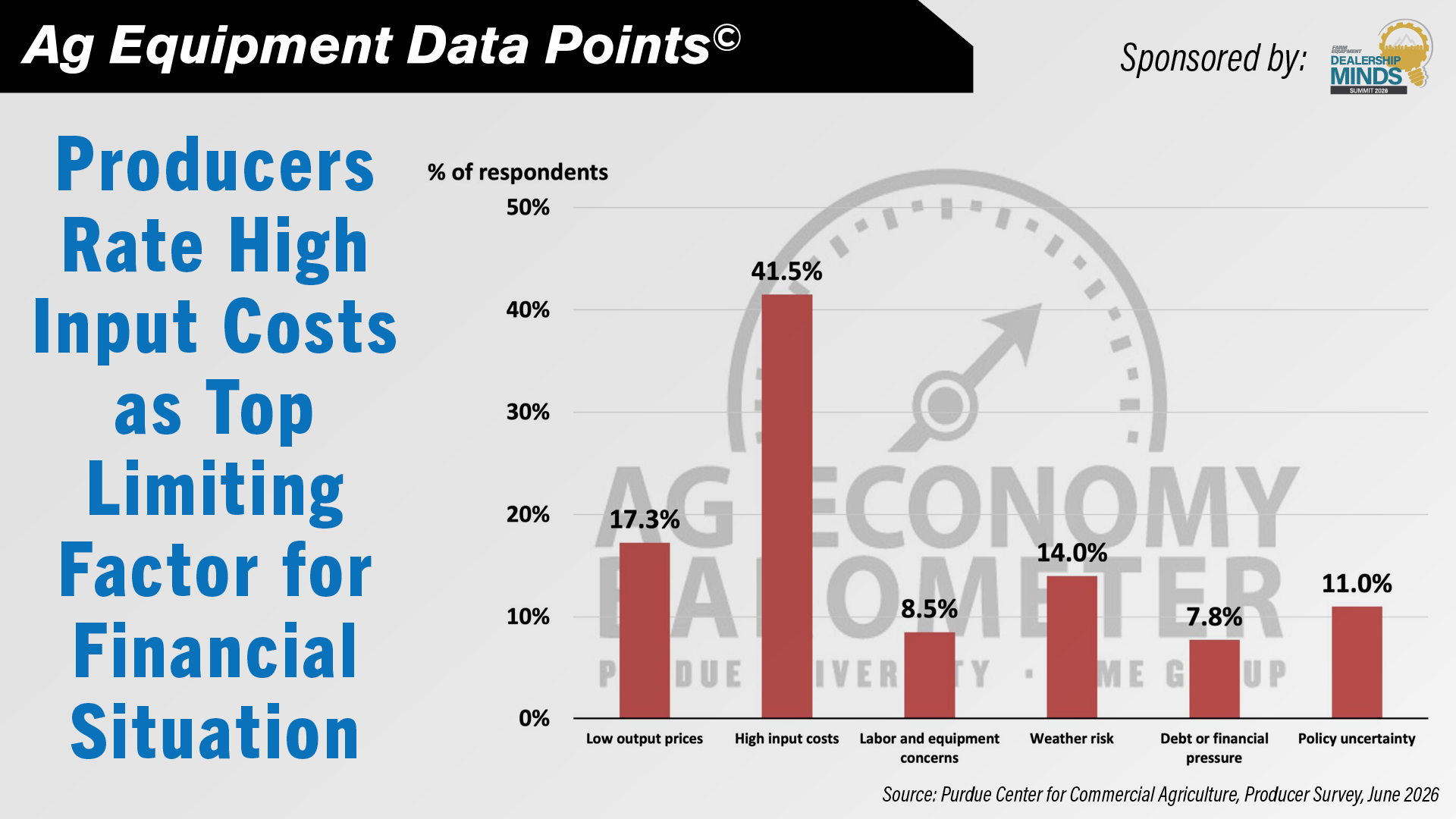
According to Purdue University’s July Ag Economy Barometer, high input costs were by far the most frequently cited constraint, selected by 42% of respondents. Low output prices ranked second at 17%, followed by weather risk at 14%, policy uncertainty at 11%, labor and equipment concerns at 9%, and debt or financial pressure at 8%.
On the Record is now available as a podcast! We encourage you to subscribe in iTunes, the Google Play Store, Soundcloud, Stitcher Radio and TuneIn Radio. Or if you have another app you use for listening to podcasts, let us know and we’ll make an effort to get it listed there as well.
We’re interested in getting your feedback. Please feel free to send along any suggestions or story ideas. You can send comments to kschmidt@lessitermedia.com.