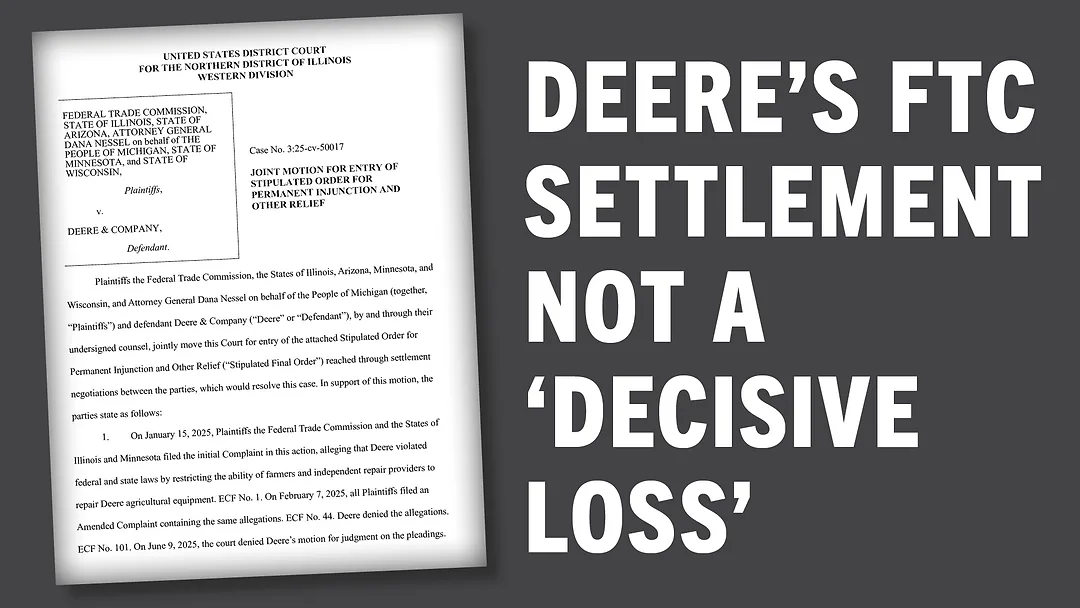
On July 8, 2026, just one week after the news of the opposition to the $99 million class action settlement against John Deere, the Federal Trade Commission (FTC) announced Deere & Co. has agreed to settle a lawsuit brought by the FTC and U.S. states for alleged violations of requiring farmers to use Deere’s authorized dealers for repairs instead of independent service providers or self-repair. Eric Hodson reports that a July 6, post on the UAW 450 Members Facebook page provided additional details as shared to their members.
The FTC’s stipulated order requires Deere — for the next 10 years under the supervision of the FTC and plaintiff states — to provide farmers and independent repair providers with the same equipment repair resources, including applicable software capabilities, that it currently provides to authorized Deere dealers.
According to retired dealer association executive John Schmeiser,
“From a strategic business perspective, this isn't a decisive loss for Deere but more of a negotiated compromise that limits legal risk while conceding broader access to repair tools.”
The R2R advocates, of course, will claim a huge victory and possible strength for the movement, he says.
Schmeiser goes on to say that
“Deere is smart though. The bigger win for Deere in this settlement formalizes practices Deere was already expanding, like Service Advisor and Operations Center Pro, and provides customers with greater flexibility in repair tools. My opinion is that Deere was already going to do this, and the Class Action Suit just gave them the confirmation that not only were they on the right track, but they were also ahead of the curve based on their competitors in providing support tools to the end user.”
Interestingly, most dealers were less concerned about the loss of service hours in the intermediate term. A sentiment shared by many is that farmers will get what they pay for – and will feel the absence of fully trained technicians with a bevy of resources behind them.
Another dealer notes “double repairs” will be racked up due to inexperienced techs, and the loss of warranty coverage from the sunk dollars.
Schmeiser says he thinks
“Deere quietly protected several elements that matter to dealers. Dealers still receive training, support and engineering relationships that the settlement doesn’t require Deere to replicate. The DTAC remains a dealer ecosystem; only published solutions must be shared.
“Overall, the settlement governs ‘repair capability,’ not the broader value proposition of being an authorized dealer. Deere did a really good job of preserving the structural and integrity of their dealer channel.
“But again, the R2R advocates will distort this settlement as a huge victory for R2R. It’s not.”
Brett Davis, CEO of the North American Equipment Dealers Association (NAEDA) agrees. He says,
“This settlement avoids the troublesome parts of several bills that were introduced that mandated dealers and OEMs must sell at costs to farmers. More clarity is needed for sure. We will still see state and provincial issues with right to repair legislation that will attempt to impair / disrupt the dealer business model, which is not acceptable.”
We’ve added a session to the Dealership Minds Summit Aug 4-5 on this topic to help dealers understand what it means both now and in the future for their business. The panel discussion will include Both Schmeiser and Davis as well as AED vice president of policy Eric Wareham.
Watch the full version of this episode of On The Record