
Quentin Overbeck, manager of Remington Farms in Remington, Ind., had been using Hagie front boom sprayers for 15 years when he reached a tipping point.
“We’d been doing a lot of custom application for a local seed company, so we needed a high-clearance sprayer,” Overbeck says. “Our only real options were Hagie, Miller and New Holland.”
Overbeck had always been content with how the Hagies performed. He was especially fond of the price point his local dealer offered. That said, reliability and service were becoming a little hit or miss. Then, after Deere purchased a majority stake in Hagie in 2016, the price point advantage began to erode. By 2018, Overbeck was ready to start shopping around.
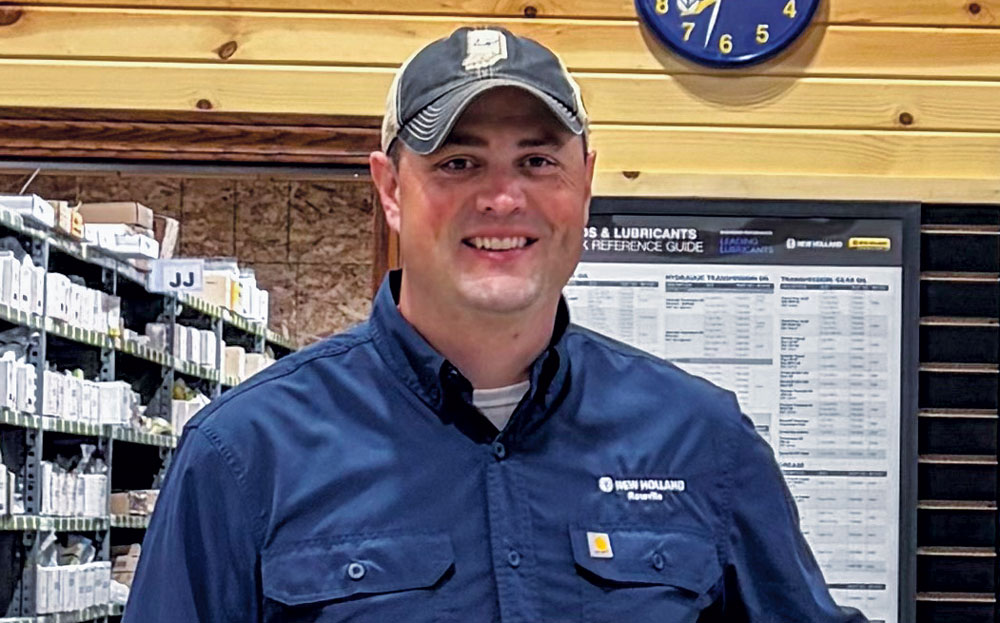
Neil Fausset, store manager at New Holland Rossville in Rossville, Ind.
New Holland Rossville Inc.
Rossville, Indiana
Major Line: New Holland & Kubota
Stores: 7 (Rochester, Logansport, Rossville, Bluffton, Richmond, Greentown, Ag Technologies Inc., Rochester)
Shortlines: Kinze, Kuhn-Krause, Woods, Grasshopper, AgLeader, Art’s Way, Danuser, Enoagricola Rossi (Enorossi) Haybuster, Horst Wagons, Loftness, McFarlane, Meyer’s, Miller, Remlinger, PTxTrimble, Richiger, Spariboldi, Strobel Manufacturing, Tubeline, Unverferth
Founded: 1983
Owner: Straeter Family
Customer Base: Row-crop farmers, lawn & landscape and contractors
Neil Fausset, store manager at New Holland Rossville in Rossville, Ind., had known Overbeck since they attended Purdue Univ. together in the early 2000s. Fausset had a few jobs out of college before landing at the dealership in 2016. Overbeck was not a customer of the dealership at that time.
“Quentin and I had always stayed in touch after college,” Fausset says. “I had been at the dealership a couple years when he reached out to me. He asked if I would come to his farm to talk. But Quentin jokingly warned me that he’d never want a blue sprayer on his farm.”
Fausset joked back that he could sell Overbeck a red Miller sprayer. But in all honesty, Fausset says Overbeck is too sharp of a businessman to be that hung up on color.
Fausset made the 45-mile trip to Remington Farms. After some discussions and a demo, Overbeck decided on a New Holland Guardian SP310F Front Boom Sprayer. He liked how the sprayer performed, really liked the price, and decided that blue didn’t look too bad after all.
That initial sprayer purchase led to 7 more over a several-year period. Overbeck runs 2 at a time in his operation, 1 for corn and 1 for soybeans. He also likes to replace his sprayers every 2 years.
But that’s not all. Overbeck also started buying New Holland tractors a few years after that first sprayer purchase. That led to combines, skid steers and other products. “I think I’ve sold Quentin every piece of equipment I can, aside from a mini-excavator,” Fausset says.
Right Tractors, Right Time
Overbeck noticed something right off the bat when beginning his conversion to New Holland.
“The thing we found with CNH that we hadn’t experienced previously was that they asked our opinion about the product,” Overbeck relates. “When farmers like us suggest changes, they take them seriously. When they changed their propulsion system, for example, we were part of a group of farmers they pitched it to.”
Overbeck also noticed something about working with Fausset and his team at New Holland Rossville.
“I already had a good relationship with Neil,” Overbeck says. “But I also noticed that he seemed to have a lot of backing with his team at the dealership, as well as CNH as a company. Having that access and support is really what has made our partnership work so well.”
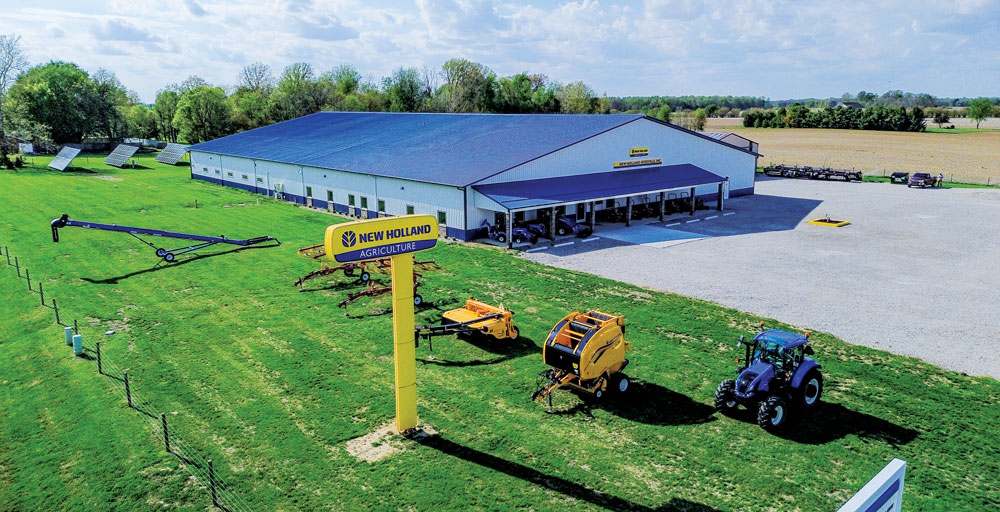
Pictured is the New Holland Rossville dealership that has facilitated Quentin Overbeck’s conversion to New Holland equipment. The conversion started with a sprayer purchase but has now included several tractors and other equipment. Remington Farms
Overbeck and his 13 employees farm over 12,600 acres, a combination of corn, soybeans and popcorn, along with seed corn and seed soybeans. They also do some custom spraying, and custom harvest around 10,000 acres for a local seed corn company. Given that massive amount of work, their tractors are even more important than their sprayers. Remington Farms’ tractor conversion started in 2021.
“Quentin was still running all John Deere equipment at that time, aside from the New Holland sprayers I’d been selling him and his custom-built Harvest International planters,” Fausset says. “But he called me saying he wanted to start turning his tractors more frequently and wanted to see how we could help. If our tractors could do what he needed them to do with his planter setup, he was ready to talk about doing more business with us.”
Since Overbeck does a lot of seed corn, he has adopted a unique planting method. He uses 3 16-row planters, 2 of which are mounted on the rear end of the tractor. “That’s a lot of weight for a front wheel assist tractor to pick up,” Fausset points out.
As Fausset recalls, he went to Remington Farms to talk with Overbeck. Fausset explained how a longer wheelbase would help with weight distribution. He also explained how a configuration with rear tracks and front wheels would help improve traction and stability without tearing into the ground while turning.
“I took a New Holland T8.435 tractor out to Quentin’s farm,” Fausset recalls. “We played around with the planter, and that tractor handled everything beautifully.”
“People still buy from people. Quentin and I have been friends for a long time…”
“That tractor had a slight advantage in 3-point lift capacity compared to what we’d been using,” Overbeck adds. “I really liked how the 2-track system eliminated pinch rows. Additionally, their front suspension is able to lock at low speeds, allowing the axle to help balance the 3-point load. The brake assist turning helps immensely, and the track/tire combination allows us to turn in tight scenarios where there are no turn rows in our seed fields. I also believed that a tracked tractor would follow the RTK line more closely without the wandering I see in other growers’ wheel set-ups.”
As optimistic as Overbeck was about his new tractor, he was still a bit nervous about helping his employees through the transition. This was part of the expectation he’d established with Fausset from the outset.
“I’m good at explaining things I’m familiar with,” Overbeck relates. “Reeducating myself and my employees at the same time was my biggest fear. If someone called me with a question, how was I supposed to know what to tell them when I was just learning the equipment myself? The dealership was really good about helping with training.”
Overbeck and Fausset then established how they would work together so Overbeck could maintain his aggressive equipment replacement cycle, which was another key aspect of Overbeck’s high expectation.
Maintaining a Fresh Fleet
As mentioned earlier, Overbeck likes to replace his sprayers every 2 years. He wanted to start doing the same thing with his tractors. But as Fausset points out, the timing has to be right for both Overbeck and the dealership.
“I’m usually comfortable trading whenever Neil has a secondary customer lined up,” Overbeck says. “I have an idea of what I think the depreciation should be on the new equipment, so we work that out. The hardest part is speculating when my new machine can arrive and how quickly we can get it into service. That’s a big part of the planning Neil and I do together.”
Another factor in Overbeck’s equipment fleet planning is the current state of the used equipment market. Does Fausset have customers looking to make used equipment purchases? How much are they looking to spend, and what exactly are they looking to spend it on?
“The used market is important to consider,” Overbeck says. “If we’re going to put enough hours on our tractors to justify trading them every couple of years, I want to make sure we aren’t buying things that will have no value for anybody else.”
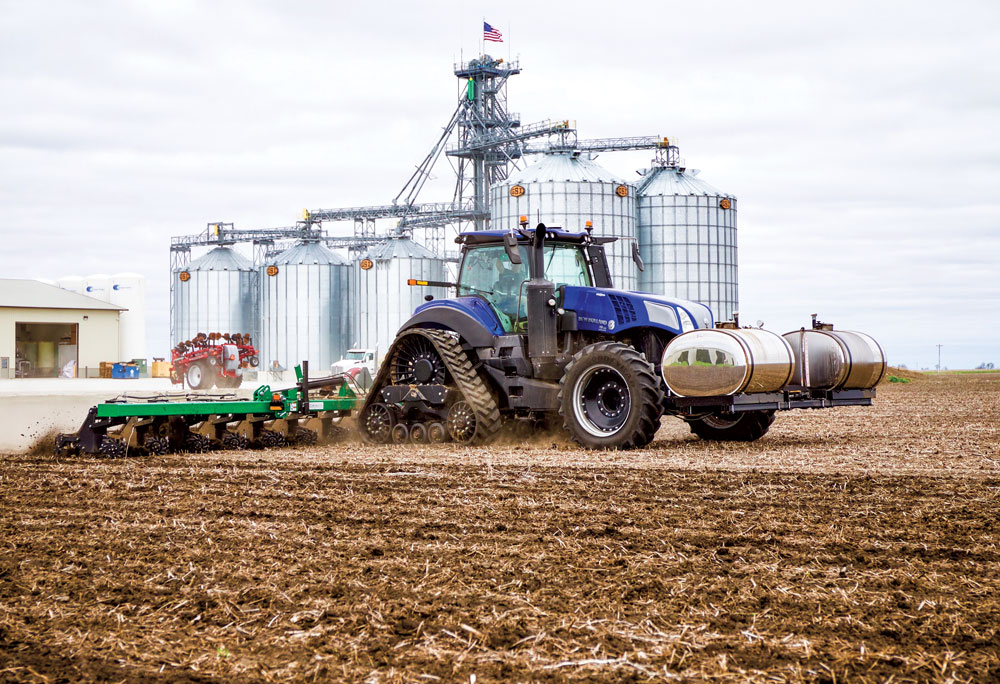
Since 2021, Remington Farms has purchased more than 15 tractors from Neil Fausset and New Holland Rossville. Remington Farms
For example, Overbeck says he’d developed a preference for a 100-foot sprayer, simply due to the unique planter sets and row spacing he uses for his seed corn.
“It’s really easy to teach an employee how to spray with a 100-foot sprayer because they’ll always have a male row on the outside of the wheels,” Overbeck explains. “But not every grower does it this way. Neil educated me on that and recommended we have some 120-foot sprayers because that’s more the norm.”
Overbeck also takes the used market into consideration when spec’ing tractors. He has his ideal setup, but has also identified other setups that will work within his operation.
For example, Overbeck prefers a high-horsepower T8.435 with rear tracks and front wheels. But he realizes not all growers need a tractor that large. Conversely, Overbeck’s operation isn’t best served by a smaller 4WD tractor, but there’s a strong used market for that type of machine. So he does keep one in his fleet, running it with a 60-foot bean planter. Overbeck’s tractor fleet also includes a T8.380 wheeled tractor, 2 T8.410 wheeled tractors, a wide-belt T8.410 with rear tracks, and a narrow-belt T8.410 with rear tracks.
“Reeducating myself and my employees at the same time was my biggest fear…”
“With that kind of variety, I’m not flooding the used market with the same tractor over and over,” Overbeck says. “Then Neil has enough variety to go to their used equipment customers and provide some different options.”
The strategy has worked well thus far. Overbeck has purchased 15-20 tractors over the past 5 years. Overbeck and Fausset have each lost count off the top of their heads because they’ve made so many deals.
“The thing is, people still buy from people,” Fausset says. “Quentin and I have been friends a long time. Now we’re to the point where I feel like I’m part of Quentin’s farm, and he feels like he’s part of our business at the dealership. And he’s right.”
Strategize to Standardize
After having such success with New Holland sprayers and tractors, Overbeck expanded his conversion to include combines, starting with the CR8.90 model. His latest purchase was the new CR10 in fall 2025. He’s been happy with the grain quality and how easy the machine is to clean out. He also appreciates that the number of grease points has been greatly reduced. He has another CR10 scheduled for delivery later this summer.
Overbeck does prefer to standardize equipment as much as possible. This goes back to the days when his farm was primarily green.

More from the Color Conversions Series
To read the previous articles in this series and view video interviews visit: Farm-Equipment.com/ColorConversions
“Every manufacturer has some kind of multi-unit discounting structure,” Overbeck says. “I’ve always believed it’s better to try and run all one brand, from both a financial standpoint and a technology one.”
To that point, you will now see New Holland skid steers, compact tractors and backhoes buzzing around Remington Farms.
“I’d rather buy everything from one dealer that’s on my team and more interested in my business and employees than just trying to sell me a tractor,” Overbeck says. “Neil and his team are interested in how we’re using our equipment, and they’re interested in our success.”
When a grower can say that about their dealer, color doesn’t matter much anymore.