International Society of Precision Agriculture
The International Society of Precision Agriculture (ISPA) is a scientific organization that was initially conceived by what the organization reports are the founders of the precision farming idea in Minnesota in the early 90’s. The first International Conference on Precision Agriculture (ICPA) was held in 1992 and was heavily attended by scientists from around the world. Similarly, the European Conference on Precision Agriculture (ECPA) began in 1997 in Europe.
The 2 events worked together to ensure that each year a conference focused on Precision Agriculture took place. After several years, the discussion turned to forming a new society that would support those interested in precision agriculture. This society would not only help promote precision agriculture globally but also bring scientists and others together. In July, 2008, during the 9th International Conference on Precision Agriculture, a global panel of precision agriculture representatives formed the International Society of Precision Agriculture with ISPA officially registered as a society in June 2010. Its board provides input from around the globe on the future direction of ISPA.
In 2018, ISPA began the process of creating a Precision Agriculture (PA) definition. Led by then ISPA President Nicolas Tremblay, then Board Secretary Viacheslav Adamchuk, and ISPA member Alex Escolá, with feedback from the ISPA membership and a panel of 46 PA experts, worked to come up with the first official Precision Agriculture definition of the International Society of Precision Agriculture. In 2023 the ISPA Board, led by Dr. John Fulton, of The Ohio State University, determined it was time to expand upon the PA definition and ensure it could be applied to all areas of agriculture. Again, the ISPA membership provided feedback on revisions, and in January 2024 the updated PA definition was approved.
Assn. of Equipment Manufacturers
Among a wide range of initiatives, the Association of Equipment Manufacturers’ (AEM) Workforce Development Committee meets regularly on industry education opportunities, facilitate sharing of member best practices and provide and steward industry partnerships. Its leadership is also focused on providing workforce development education through webinars and at its annual conference. AEM provides a Workforce Toolkit which helps members find effective tools others have shared to connect them to new recruitment and retention ideas and tactics.
In helping industry employers attract and retain talent, AEM also provides comprehensive Workforce Resources which include the following: the most current Resource List from Dept. of Labor (most recently updated January 2025); a Grant and Training Incentive Program Guide – detailing what funding each state has available to support skills training and apprentice programs; and access to its Job Board Guide to help employers better understand how to connect with the talent pool and leverage best practices for job postings.
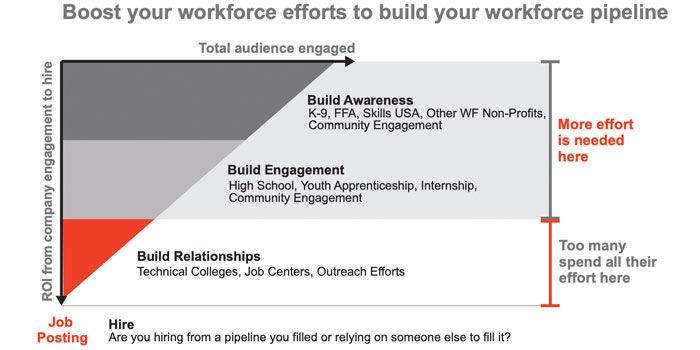
AEM provides its members with resources and strategies to support their workforce recruitment and retention efforts. In the above example, the case is made for more engagement with high schools, youth programs and non-profits. Courtesy AEM
According to a Sept. 15, 2025 update from AEM, governors and state representatives are continuing to offer up opportunities “to install impactful policies for equipment manufacturers.” Noting that economies and political arenas may vary, it reports that workforce issues are among the top themes worth exploring. This includes policies outlining apprenticeships, careers in technical education (CTE), and grants driven by the Workforce Innovation Opportunity Act (WIOA);
They summarized recent efforts. Pennsylvania is benefitting from a proposed increase in funding for vocational education, apprenticeships, and advanced-manufacturing workforce grants; equipment manufacturers could also see scaled tech training. Workforce pipeline investments that improve access to skilled operators/technicians and job retention credits for site expansions are being prioritized in the budget proposal also. The budget process currently lies with the General Assembly awaiting votes for final passage.
In Maryland, reports AEM, the budget maintained refundable manufacturing wage credits like the More Jobs for Marylanders program, and Innovation Tax Credits while reviewing manufacturing tax-break expansions.
“States are increasingly coupling direct equipment grants and tax credits with workforce funds to increase effectiveness of capital investments,” notes the update, which adds, “This creates the need to engage state economic-development agencies, follow budget and bond bills closely to monitor fund availability, and prioritize participation in both equipment-purchase grants and workforce partnerships.”
Agricultural Retailers Assn.
The Agricultural Retailers Assn. (ARA) offers programs and services designed to keep agricultural retailers on top of critical issues that impact profitability. The landscape for crop input practices, technology developments and government regulations is constantly changing. This Washington, D.C.-based 501(c)(6) non-profit trade association that represents the interests of agricultural retailers and distributors across the U.S. on legislative and regulatory issues.
More from this Report
Earning Power of Precision Ag Careers
NAEDA Compensation Report Reveals Options & Opportunities
Case Studies in Precision Career Success
Behind-the-Scenes Background on Ag Leader Precision Pair
Add Depth Through Recruiting, Retention & Advancement
Who’s Teaching & Training on Precision Sales & Service?
Emerging Tech Curriculum Paves Pathway Way to Digital Precision Careers
Associations Rise to the Challenge
Industry Leader Insights on Compensation & Career-Building