
What’s important to know now about precision ag education?
Fulton: We spend a lot of time asking ourselves how we can expand our offering and educational experiences here at Ohio State — what we call Precision Ag or Digital Ag. New on our frontier is that we’ve been working to develop what are now 5 courses that deal with Precision or Digital Ag. These include anything from fairly introductory type, bringing awareness and exposure to the technologies and data science and analytical pieces that we’re starting to see to the actual hardware and field application type implementation of all those. Those 5 courses are quite comprehensive and give students a solid background within a 4-year degree.
Then we intertwine that curriculum and encourage students to do internships, which would be typically during 3 months of summer term. We see that this has really grown in the past 5-6 years. Students going out — whether that be with a large corporation or a local dealership or service provider — taking on these internships where a lot of times, those have precision ag emphasis on them. Additionally, we’re continuing to work to grow continuing education type opportunities both for students or those already in industry, as well. It’s a pretty hot topic and it’s growing. We try to also offer the Precision Ag CCA type content or actually continue learning type, whether that’s a 1-hour webinar or a multi-hour/half day, full-day type experience in education for those already involved but needing to keep up with new technology and data applications in their working environment.
How do you characterize the growing focus on digital agriculture and emerging technology?
Fulton: Traditionally, over the last 30 years, we’ve tended to focus on precision agriculture. The way I differentiate precision vs. digital is that precision is really the hardware and the basic type services that you see offered — like precision soil sampling, some basic mapping, creating crop production reports or prescriptions, those kinds of things. That’s precision. What we got into was trying to differentiate some of the newer type analytical aspects to it. We now have both faculty and then research that’s going into the analytics, which includes artificial intelligence (AI), but really doing the data analysis and bringing new learnings as we collect this large volume of data coming off of farms and fields today, bringing that in. Thinking about the data being more in the digital arena, that is how we see precision ag under the digital ag umbrella. That all falls under the umbrella, including the analytical aspects of having predictability within these systems or modeling. All of that falls under digital ag. As part of the new coursework, we have this year added a new introductory digital agriculture course.
On a global level, how are organizations helping meet the needs of precision ag focused students?
Fulton: At the society level, the International Society of Precision Ag (ISPA) for several years has been getting a lot of inquiries because more and more universities, colleges and even industry have asked us about teaching precision ag and digital ag topics. To try and help facilitate people, give them resources to be able to create content or a course, we’ve been trying to put all of that information together. We just built a database that our members can access. We basically had asked all the members, and non-members as well, to fill out a form detailing the course. We also asked whether instructors or lecturers were willing to submit the syllabus.
That way, we had this database available so that if someone was looking to start a new course or wanted to see what others were teaching, you could go to that database and use that as a tool in that development work. That has been very positively received. We see a lot of universities and young or new faculty using that as a tool to help them develop new coursework at their particular institution. We, as a society, look at not only are we trying to promote precision ag and digital ag, but we want to make sure that education in this is very important. Obviously, that could be at the ground level to student level to even professional level.
Today, we’re getting a lot of questions because even folks working in industry who may come over and work in the technology division may not have a background in precision ag. They want a quick course where they can ask, “What is precision ag? Tell me about some of the technologies, how it’s being used, what value it brings to farmers.” We’re trying to promote and encourage that amongst our membership and continually trying to be that facilitator through the society for that education.
Considering emerging technologies and expanding collaboration on curriculum — for both new students and those already in the industry — what’s the outlook for precision ag careers?
Fulton: For Ohio State, the outlook is positive. We have had students graduate and be plugged right into a precision ag dealer or service providers at different levels. Those levels could mean someone going directly into an equipment dealership or an input supplier, retailer co-op or a large company. The prospects are very positive. A lot of the jobs that are put out there, our students are able to obtain. We’re getting very good placement today out of our program. The job opportunities have still remained fairly strong, even through this challenging farm economy, we’re still seeing students get hired on, especially in these technology positions.
The technology front is changing very rapidly. We’re seeing a lot of new technologies come, and it’s exciting to see what’s still coming. We’ve got to be ready for it, too, and support those efforts to bring it both to current students and those putting it into practice who need to continue to learn how to best leverage the technology.
Help Wanted: Dealers Address Challenges of Building the Skills, Will & Work Ethic
During roundtable discussions, educational sessions and networking opportunities during industry events — including the Dealership Minds Summit and Precision Farming Dealer Summit — discussions with precision specialists and dealership owners from around the continent regularly focus on a long-standing hot topic: the workforce. Specific topics range from skills training, work ethic, retention and recruitment strategies to compensation and education of emerging technologies, to name a few.
Dealers report that they are seeing increased outreach, and consistently making efforts to learn from and leverage those resources. Commentary also includes the struggle dealers have when finding “new recruits” to take the place of technicians who are looking to retire.
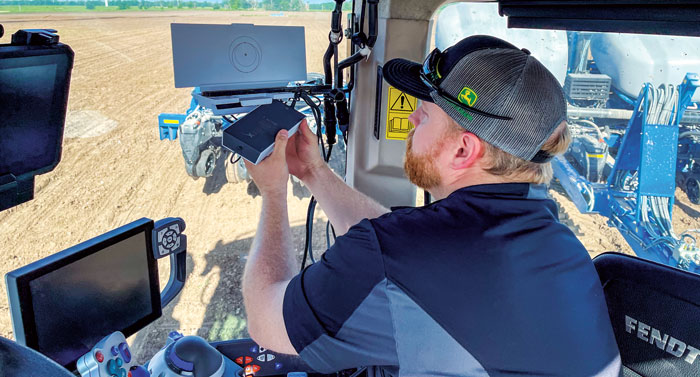
Jonathan Born, regional product support specialist for PrairieLand Partners, works on the JDLink Boost activation process from inside the cab of his customer’s Fendt tractor. Noah Newman
“Maintaining a pipeline of technicians — for traditional iron — is not something we’ve been able to do,” according to a precision manager with one midwest, multi-location dealer. He notes the continued dearth of incoming technicians while increasing focus on connecting with community colleges and technical schools to assist with recruitment.
Over the past year, many note that the farmer’s challenges are forcing farmers to hold onto their equipment longer, which calls for technicians to brush up on and better understand the mechanics behind older equipment. At the same time, as discussed by precision specialists during a recent Dealership Minds Summit (DMS) roundtable, the continued emergence of precision technologies necessitates that technicians understand the complexities of various systems to meet customer needs for precision tools that support efficient, sustainable and economically beneficial farming, as well.
Titan Machinery Senior Talent Acquisition Manager, Sarah Kenz, offers insight on the ways the largest Case IH dealership group on the continent is addressing its future workforce needs.
“Titan Machinery is driving long-term impact in the equipment industry by investing in the next generation of talent,” said Kenz. “Starting as early as 9th grade, our Summer Camps and EDGE career awareness program introduce students to industry opportunities and spark early interest in equipment careers. After high school, we continue to support career growth through specialized training and development programs for diesel mechanics and sales professionals.” Kenz emphasizes the core of the company’s efforts, and adds, “By building awareness and creating clear career pathways, we’re strengthening the pipeline of skilled talent needed to serve our customers and sustain the industry for years to come.”
More from this Report
Earning Power of Precision Ag Careers
NAEDA Compensation Report Reveals Options & Opportunities
Case Studies in Precision Career Success
Behind-the-Scenes Background on Ag Leader Precision Pair
Add Depth Through Recruiting, Retention & Advancement
Who’s Teaching & Training on Precision Sales & Service?
Emerging Tech Curriculum Paves Pathway Way to Digital Precision Careers
Associations Rise to the Challenge
Industry Leader Insights on Compensation & Career-Building