
In this episode of On the Record, brought to you by Associated Equipment Distributors, we look at President Trump's tariff reduction on ag equipment, the latest dealer sales forecasts, and how high input costs are keeping farmer sentiment down. In the Technology Corner, Noah Newman visits with Stotz Equipment precision specialist Jake Nordenberg. Also in this episode, coverage on the legal considerations for CNH's reorganization of its Case IH and New Holland dealer network management and the cancellation of a John Deere dealer merger in Manitoba.
.png)
This episode of On the Record is brought to you by Associated Equipment Distributors — the leading association in North America for the equipment distribution industry.
Get ready for a powerful start to the year with AED’s packed lineup of Q1 and Q2 events designed to connect, educate, and energize industry professionals. From high-impact conferences and hands-on training sessions to exclusive member gatherings and strategic leadership programs, AED is bringing together top experts and forward-thinking dealers to share insights that drive growth. Whether you’re looking to sharpen your team’s skills, stay ahead of emerging trends, or expand your network, our first-half-of-the-year events deliver unmatched opportunities to elevate your business and strengthen your competitive edge. Visit www.aednet.org/ for more information.
TRANSCRIPT
Jump to a section or scroll for the full episode...
- Dealers, Manufacturers Need to Consider Law in CNH Reorg
- Dealers on the Move
- Thinking Outside the Box to Implement Precision Tech in Challenging Fields
- Commodity Ticker
- Ag Equipment Tariff Cut Down to 15%
- Dealers Forecasting 2026 Sales Revenue Down 4%
- High Input Costs Keep Farmer Sentiment Down
- DataPoint: U.S. Ethanol Exports Continue to Grow
Dealers, Manufacturers Need to Consider Law in CNH Reorg
As we reported last time, On May 11, 2026, Ag Equipment Intelligence learned of CNH’s layoffs and a reorganization for a combined management authority over BOTH the New Holland and Case IH dealer networks.
As part of the on-going coverage, Ag Equipment Intelligence contacted Matthew Larsgaard for context on the CNH announcements. Larsgaard is the President and CEO of Pioneer Equipment Dealers Association AND the Automobile Dealers Association of North Dakota.
He drew upon the consolidation trends that he’s seen in the auto space since he started in 2006, which included General Motors’ rationing of the Saturn, Pontiac, Oldsmobile and Buick brands.
As this change brings about additional consolidation, he says that he has not seen buyouts in the farm machinery industry as he has in the auto space, and this is also why dealer protection laws are so important in the equipment space.
“...Some states have dealer protection laws and transfer provisions which require the manufacturer to approve the transfer of a dealership from one entity to another provided the proposed buyer meets the manufacturer's financial qualifications and business experience. If a state does not have transfer provisions, ultimately it may be the manufacturer that controls whether the dealer agreement may be transferred to another dealer.”
He suggests that the smaller stores get with their local associations and brush up on the transfer provisions in their state so they understand what is ahead.
“Let’s say you've got a new Holland dealer on one side of town and you've got a Case IH dealer on the other side of town and they're owned by different people. If you combine these into one brand, is the manufacturer going to run afoul of a dealer protection law? Some states’ laws prohibit manufacturers from changing the competitive circumstances of a dealer. So the manufacturer is going to need to look hard at the different states’ laws and reconcile those laws to their business objectives to determine if they align or if there's tension.”
Dealers on the Move
The merger of Manitoba’s two largest John Deere dealers has been called off, according to a RealAgriculture report. Greenvalley Equipment and Enns Brothers announced a plan to join forces in January, but the arrangement has been cancelled as the two companies encountered considerable roadblocks and delays by the Competition Bureau.
Thinking Outside the Box to Implement Precision Tech in Challenging Fields
I got my first taste of precision ag in the desert the other week during my visit with Jake Nordenberg, who works as a precision specialist for 24-store John Deere dealer Stotz Equipment in Buckeye, Ariz. It was interesting to see how creative Nordenberg and his team are when it comes to helping farmers use precision technology in unique environments.
“A lot of Deere’s technology is tailored more towards the Midwest. They don’t have borders (on their fields in the Midwest). Every 90 feet we have a border through a field. We run into obstacles. We have to get creative. One of the ways we did it, like with See & Spray, they don’t have anything for hay yet. We take this DJI mapping drone, and we fly it, we use Pix4D to stitch everything together. Once we stitch it, we have these high-resolution pictures of the field, and we can pinpoint where the weed pressure is. We can mark those up and make a target application map and send that to the ground rig. When the ground rig goes over those, it will just hit where those weeds are from the map. So, that’s one way of getting a little bit creative down here on how to implement technology.”
We’ll have much more from Jake during the upcoming Day in the Cab Summer feature on PrecisionFarmingDealer.com.
Commodity Ticker
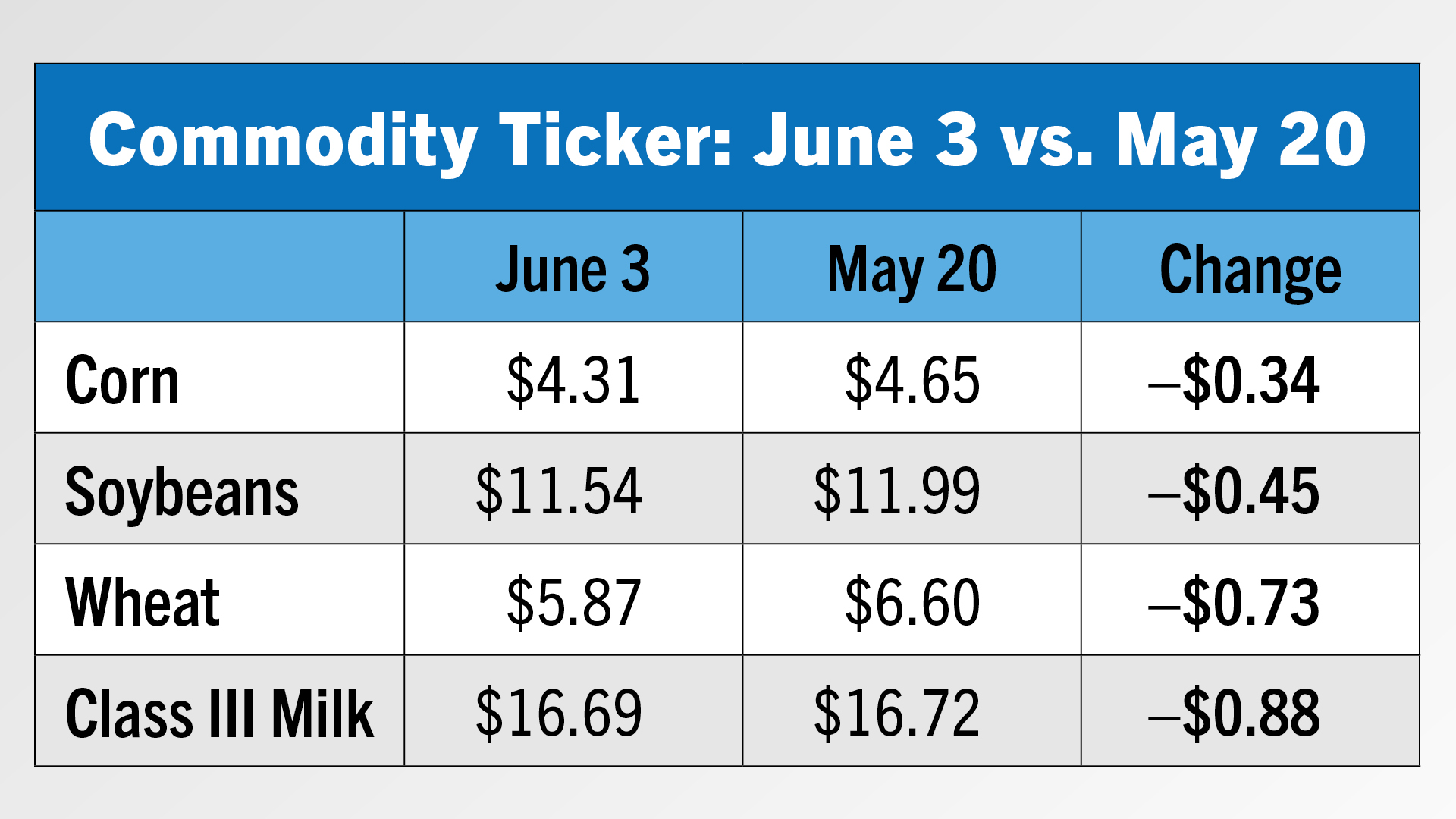
As of June 3, corn prices were $4.31 down 34 cents from our last episode. Soybeans closed at $11.54, down 45 cents. Wheat closed at $5.87, down 73 cents and Class III milk prices closed at $16.69, down 88 cents.
Ag Equipment Tariff Cut Down to 15%
On June 1, President Trump moved to reduce tariffs on certain heavy industrial and agricultural equipment to 15%. Those tariffs, imposed on steel, aluminum and copper goods, previously stood at 25%.
In addition, the president also lowered tariffs to 10% on products that are made in another country but consist of at least 85% U.S. steel, aluminum or copper, measured by weight.
Wall Street Journal’s Gavin Bade reported that “The move is the latest by the Trump administration to limit the collateral damage of its trade wars, which have raised the prices for many inputs used in manufacturing, as well as equipment for farmers, construction companies and consumers.”
The changes are scheduled to take effect June 8 and would run through the end of 2027.
In response to the proclamation, AEM Senior Vice President of Government and Industry Relations Kip Eidberg, said in a statement:
“AEM welcomes President Trump’s proclamation to reduce tariffs on agricultural and construction equipment. Especially at a time when our nation’s farmers are under increasing pressure, this action represents an important step towards lowering input costs, strengthening supply chains, and supporting American farmers and manufacturers.”
"This proclamation is an encouraging sign that the Trump administration recognizes both the complexity of reshoring production and the need to provide manufacturers with the runway to expand domestic capacity.”
While encouraging news, Baird analyst Mig Dobre notes that the move will have little impact on lowering the cost of equipment and affordability for U.S. farmers.
He says, “2026 pricing is already set, 2027 is unlikely to be impacted by what is clearly a temporary relief measure all while OEMs were experiencing input cost inflation they were increasingly unable to pass through to the end user. Lower tariffs do help OEM margins in the near term, that’s as good as it gets.”
The American Soybean Association president and Ohio soybean farmer Scott Metzger says, “Lowering costs on critical equipment and parts is a positive step for soybean farmers and all of agriculture at a time when producers continue to face significant financial pressure from rising input costs and tight margins.”
FarmFuture’s Andy Castillo says, “for the second half of 2026, experts predict the ag machinery industry will stabilize as farmers who have delayed purchases replace their aging fleets. That’s starting to happen, according to the Association of Equipment Manufacturers latest ag machinery industry report. Combine sales ticked up 3.4% year over year in April, while tractor sales fell by about 1%.”
Dealers Forecasting 2026 Sales Revenue Down 4%
According to the latest Dealer Sentiments survey, dealers sales forecast for 2026 improved month-over-month. Dealers are expecting sales to be down 4% year-over-year, an improvement from the month before when they were forecasting a 7% decline.
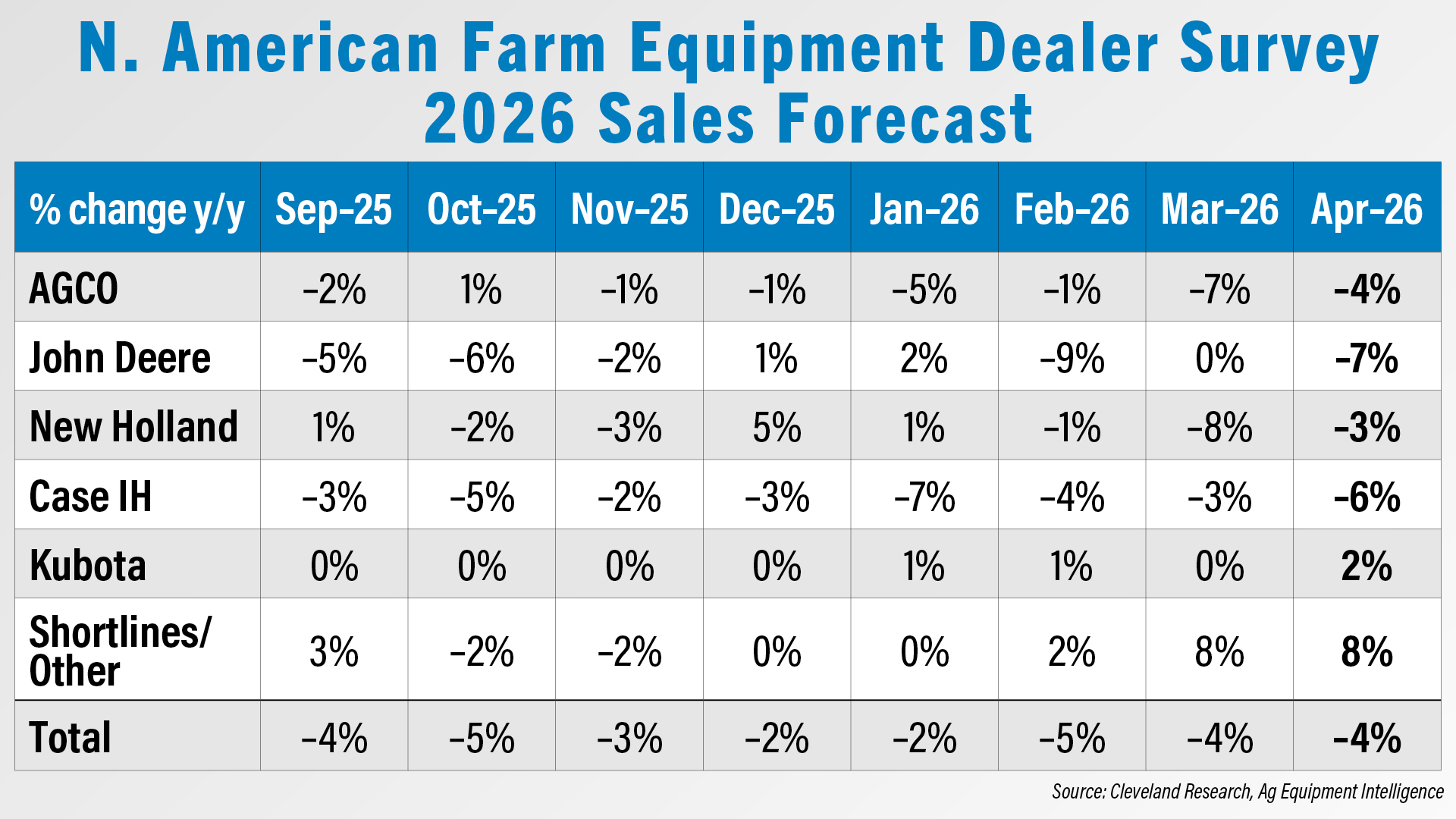
John Deere dealers are forecasting the largest decline at down 7% compared to flat the previous month. Case IH dealers are forecasting a drop of 6% compared to down 3% the month prior.
Kubota and shortline-only dealers are the only 2 groups forecasting sales growth in 2026. Shortline dealers are expecting sales to be up 8%, while Kubota dealers predict sales to be up 2%.
High Input Costs Keep Farmer Sentiment Down
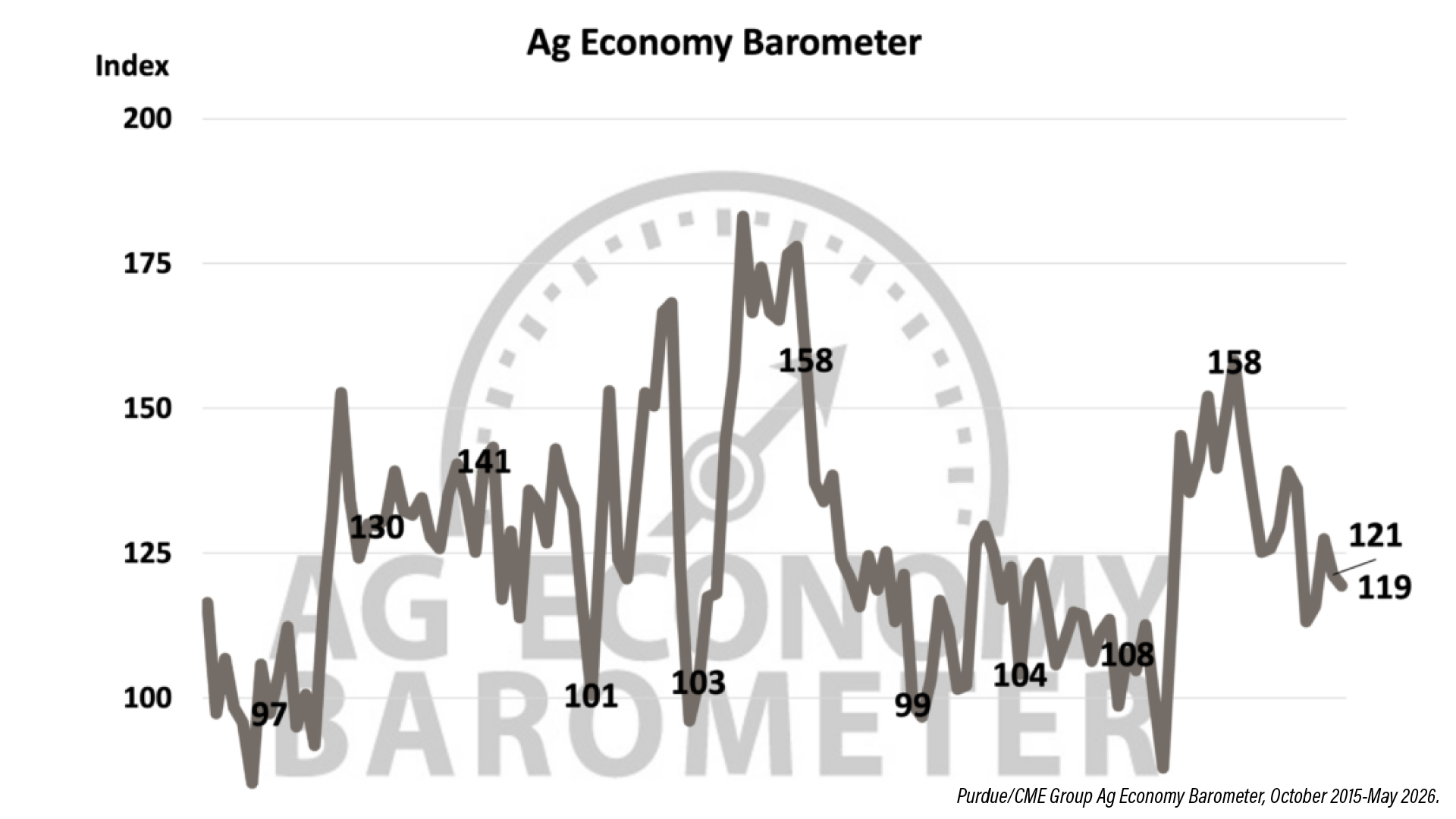
Farmer sentiment dropped again in May, with the Purdue University-CME Group Ag Economy Barometer Index dropping 2 points to 119.
This month’s Current Conditions Index was 21 points below last year’s December index, reaching its lowest level since December 2024.
The percentage of respondents who listed high input costs as their biggest concern was 51% in May, reaching a new high. In a related question, 46% of respondents indicated that high input costs are limiting improvements in their financial position this year.
The percentage of respondents who think the U.S. is headed in the “right direction” declined from 57% in April to 52% in May, the lowest percentage since we started asking this question in July 2025.
Michael Langemeier says caution is also showing up in investment behavior.
“The Farm Capital Investment Index declined to 41 in May its lowest level since September of 2024. This index measures producers' willingness to make large investments such as machinery, equipment, or buildings. A continued decline in this index signals increasing hesitation towards major capital purchases likely reflecting tighter margins, elevated borrowing costs, and ongoing uncertainty surrounding profitability.”
“Questions related to the IRAN conflict were included again in this month's survey, particularly regarding its impact on input costs and profitability. Approximately two thirds of producers expect the conflict to negatively impact their farm's income in 2026. And remember, we have both crop and livestock producers in the survey. Among producers who planted corn in 2025, expectations for higher breakeven prices remained widespread. About half of respondents expect corn break even prices to increase up to 6%. 17% expect increases between six and 9% while nearly one third expect breakeven prices to rise by 10% or more.”
Respondents were also asked whether artificial intelligence (AI) tools would improve their current labor and equipment situation. Approximately 59% indicated that it would not improve their situation, while 37% indicated that it would help some, and 4% indicated that it would help a lot.
DataPoint: U.S. Ethanol Exports Continue to Grow
This week’s DataPoint is brought to you by the Dealership Minds Summit, Aug 4-5 in Springfield, Ill. Visit DealeshipMindsSummit.com to learn more and to register.
Fuel ethanol has grown into a major U.S. agricultural export commodity since the early 2000s. The United States exported a record 2.13 billion gallons of fuel ethanol during the 2024/25 (September–August) corn marketing year, surpassing the record set a year earlier by nearly 400 million gallons, or roughly 23 percent. In the last decade, export volumes and destinations have shifted. Brazil was once the top destination for U.S. fuel ethanol, but as Brazil’s ethanol production has increased, its imports of U.S. fuel ethanol have declined.
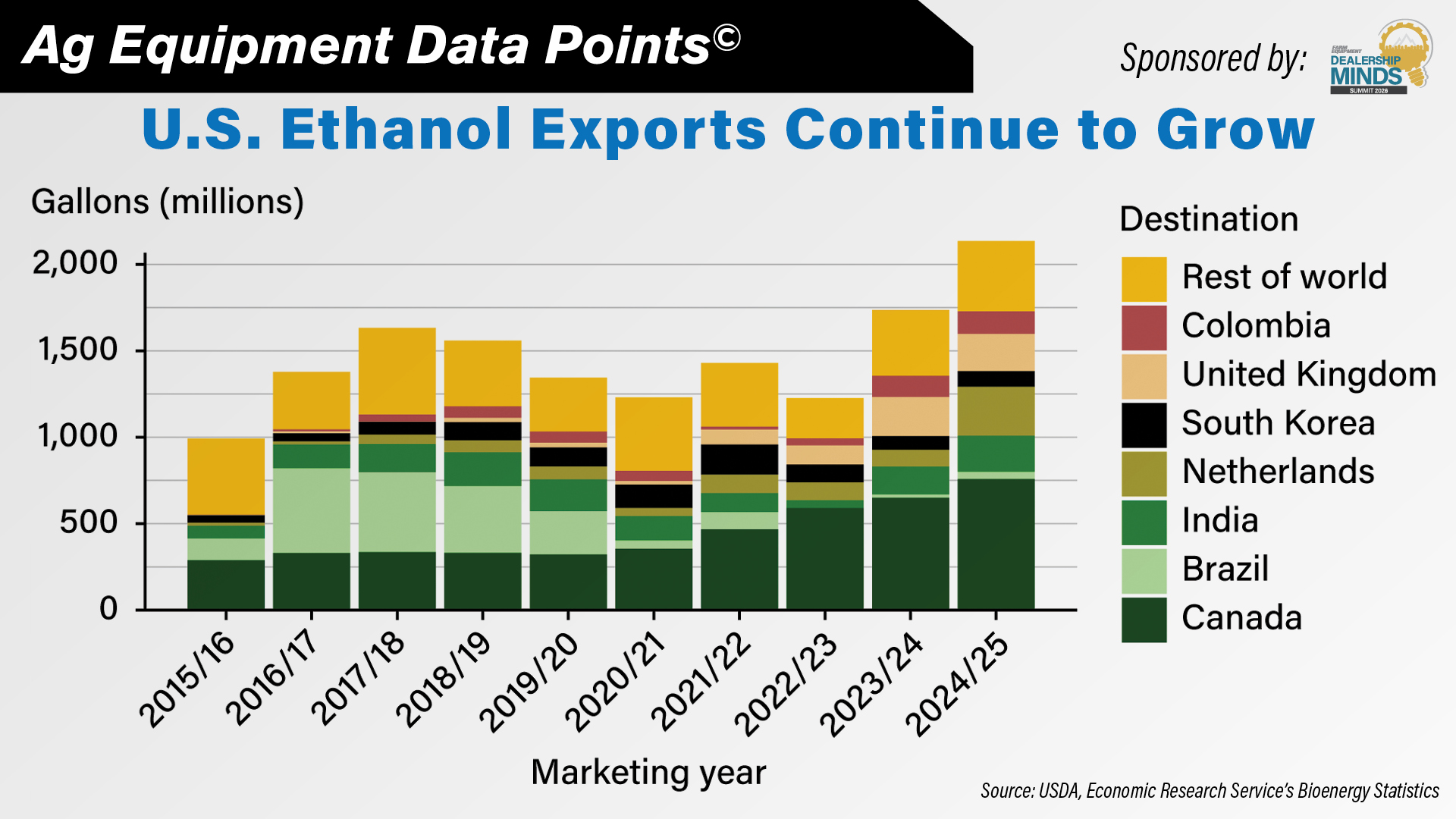
Reduced U.S. sales to Brazil, however, have been more than offset by expanding exports elsewhere. Exports to Canada, for example, grew from 322 million gallons in 2019/20 to 758 million gallons in 2024/25.
On the Record is now available as a podcast! We encourage you to subscribe in iTunes, the Google Play Store, Soundcloud, Stitcher Radio and TuneIn Radio. Or if you have another app you use for listening to podcasts, let us know and we’ll make an effort to get it listed there as well.
We’re interested in getting your feedback. Please feel free to send along any suggestions or story ideas. You can send comments to kschmidt@lessitermedia.com.