
Takeaways
-
Set clear expectations and hold everyone accountable: A strong performance starts with establishing clear standards and holding everyone equally accountable to them, regardless of their status or experience.
-
Build strong relationships to support tough feedback: Investing in relationships with your team creates the trust needed to deliver difficult corrections and make tough calls when standards aren't met.
-
Balance accountability with genuine care: Effective leadership requires both enforcing standards and showing deep support for your team members, even — and especially — when they are challenging to manage.
To outsiders, the Milwaukee Brewers’ 2026 World Series Championship might have seemed straight out of left field, but Milwaukeeans have watched the moment building since Pat Murphy took over as the team’s skipper in 2024.
Murphy was essentially a no-name manager when he took over for big-money manager Craig Counsell who left for the Chicago Cubs. That same year, the Brewers cut their payroll by nearly $16 million and lost key players. Despite the challenges, Murphy was named National League manager of the year and would go on to earn the honor 3 years in row — something that had never been done before.
While most of us aren’t leading baseball teams beyond our kids’ Little League teams, we can learn a lot from Murphy on what it means to be a leader — and to demand a strong performance from your team. A strong performance starts with setting expectations, and holding everyone equally accountable to those expectations and standards.
When Murphy joined the Brewers in 2016 as a bench coach, he instituted “The Check Game.” Anyone — players, staff or even owner Mark Attanasio — would get a check on a white board whenever ego was exhibited over selflessness. Everyone — except the “check master” himself was fair game. And while the game brought some fun, Murphy’s point was ego always gets in the way of the greater good.
“The thing that I love about it is you get up every day with the opportunity to impact, the opportunity to learn from somebody, to have somebody impact you. You talk about athletics, team sports. There’s nothing better, man, than rowing the boat with other people in it,” Murphy said in an AP story published on Oct. 29, following the Brewer’s World Series win.
Since taking over as manager, Murphy has a 293-193 regular-season record and a 15-10 postseason record. No manager in Major League Baseball has posted a better regular-season record over that 3-year span.
The night the Brewers clinched the championship, I was in New Orleans for the FEMA and EMDA Fall Convention. As I was riding to the airport that Thursday, I saw that the parade was going to be held on Friday and that school had been canceled as a result. I made plans to take my son downtown to help celebrate the Brewers historic win.
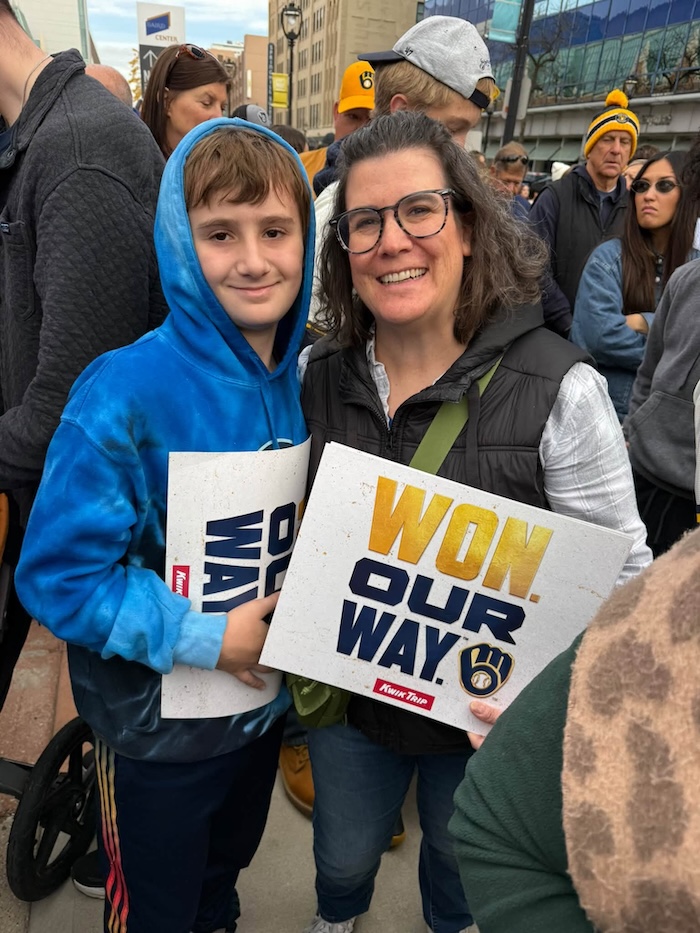 Executive Editor Kim Schmidt took her son to the championship parade on Oct. 30 to celebrate the Milwaukee Brewer's historic World Series win.
Watching the parade, it was clear Murphy has his own ego in check. The win wasn’t about him. While players and staff rode in double-decker buses through the streets, Murphy closed out the parade in a way only he could — sitting in a folding chair in the cab of a pick-up truck, his two young sons by his side.
We almost missed him because it seemed as if the parade had ended. Not only did he put the players and staff ahead of him, he also let former players get cheers and attention before himself.
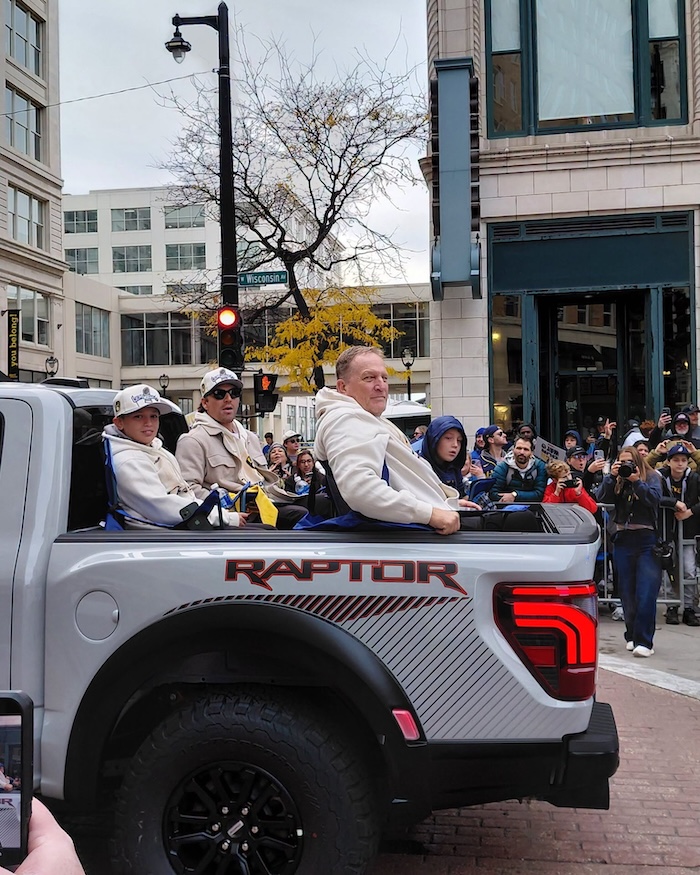 Milwaukee Brewer's manager Pat Murphy set his ego aside during the parade and closed out the celebration in a non-assuming pick-up truck with his sons. Photo credit: The Waukesha Freeman
Expectations & Accountability
The coverage of the Brewers’ historic run shows several instances when Murphy pulled players from a game when they didn’t meet his standard. And it’s not a move reserved for rookies; he pulled the veteran player too (or say your seasoned salesperson, or the tech with 20 years under his belt).
For example, both rookie sensation (and World Series record holder) Cooper Pratt and World Series MVP William Contreras were pulled, mid-game, for failing to run hard. One article noted that the relationships Murphy has invested in with his players are then strong enough to withstand the tough calls that the manager has to make, even if unpopular. .
But it’s not all tough love. He e knows his players and what they can take in terms of public correction and when they need to be built up.
“I’m not trying to be Johnny hard-ass here,” Murphy said in an Aug. 27 article in The Athletic. “You have to build habits.”
“Realizing that this position isn’t about you, it’s about others and it has to be or all bets are off. I don’t know if I’m any good. I just know I have to get better. I know I’m under construction, and I’ve enjoyed the construction project. It feels like it never gets done, though…”– Pat Murphy, Milwaukee Brewers Manager
Creating winning habits is about the most important thing a manager seeking excellence can do
Regardless of whether you are managing a World Series caliber MLB team, a department of service technicians or a group of ag media folks of varying degrees of experience and responsibilities, neither individual or team success doesn’t happen without winning habits.
In that same article on the quick hook of Pratt, pitcher Aaron Ashby shared, “It’s not like Murph doesn’t like Coop; he loves Coop. And this is going to be better for Coop. We all know that and can appreciate that. It’s a mutual respect thing.”
Murphy describes what he’s doing as ingraining the standard in the players and the expectation of it.
Standard- and expectation-setting doesn’t happen in the moments that the game is on the line. It’s set every day from when the pitchers and catchers report, through all of spring training, and the clubhouse, during drills and practices and team meetings. No secrets, no surprises and no negotiations or redefiinitions.
Just following the World Series win, I came across a video of Murphy in which he said, “The most important thing is to love the player. When you really find the good in that dude, that’s it. The guy that’s hardest to love, needs the love the most.”
That hit me loud and clear. I immediately identified with the sentiment and thought of a few individuals throughout my years as a manager who fit the bill to a T. Some tested my patience, some were exhausting and others seemed oblivious. When I succeed in getting through to them, it’s rewarding.
Managing and leading is tough work. It’s easy to just give all your attention to the people who are easy to manage (been there, done that) — they do good work, they listen, they go above and beyond, etc. We can’t ignore the ones who, as Murphy says, are hard to love (been there, done that, too).
We must put in the work, set the expectations and hold them accountable — from the get-go if you want the habit to do its intended work — and they can become “easy to love.” Showing up for your employees (or loving them) means both offering the encouraging word and enforcing the standard.
Murph, thanks for a fun October of Brewers wins and for some very important, although unexpected, leadership lessons along the way.
What are some of the unexpected leadership lessons you’ve learned along the way? Share them in the comments below or email me at kschmidt@lessiteremdia.com.
Frequently Asked Questions
Q: How does Brewers manager Pat Murphy establish and maintain high performance standards?
A: He sets clear expectations early and holds everyone equally accountable to them, regardless of a player's tenure or veteran status.
Q: Why are strong personal relationships critical to Pat Murphy's management style?
A: Building authentic relationships creates the foundation of trust required to deliver tough feedback or make difficult operational decisions without alienating team members.
Q: What is Pat Murhphy's "The Check Game" and how does it foster team culture?
A: It's an accountability exercise where team members receive a mark on a whiteboard whenever ego is prioritized over selflessness, reinforcing that individual ego hinders collective success.
Q: How do you balance tough love with supporting your team?
A: Effective leadership combines strict enforcement of standards with genuine care and encouragement—especially for individuals who are more challenging to manage.