In this episode of On the Record, brought to you by Associated Equipment Distributors, we have details on Deere agreeing to pay $99 million into a settlement fund for the right-to-repair class action lawsuit, and what this means for dealers as Eric Wareham discusses R2R legislation in states like Iowa. In the Technology Corner, Noah Newman talks with Alex Russomagno, senior manager, AGCO Venture, about her outlook on autonomy, drones and more. Also in this episode, the U.S. expansion of metals tariffs that imposes a new tiered tariff structure on Canadian exporters and report on the abrupt shutdown of Monarch Tractor.
.png)
This episode of On the Record is brought to you by Associated Equipment Distributors — the leading association in North America for the equipment distribution industry.
Get ready for a powerful start to the year with AED’s packed lineup of Q1 and Q2 events designed to connect, educate, and energize industry professionals. From high-impact conferences and hands-on training sessions to exclusive member gatherings and strategic leadership programs, AED is bringing together top experts and forward-thinking dealers to share insights that drive growth. Whether you’re looking to sharpen your team’s skills, stay ahead of emerging trends, or expand your network, our first-half-of-the-year events deliver unmatched opportunities to elevate your business and strengthen your competitive edge. Visit www.aednet.org/ for more information.
TRANSCRIPT
Jump to a section or scroll for the full episode...
- Deere to Pay $99 Million in R2R Lawsuit
- Commodity Ticker
- AGCO Ventures Manager Optimistic About Autonomy, Drones & More
- U.S. Expands Metals Tariffs
- Monarch Tractor Shuts the Doors
- DataPoint: Whole Milk Shares Rise Amid Long-Term Decline in Total Fluid Milk Sales
Deere to Pay $99 Million in R2R Lawsuit
Deere’s right-to-repair saga hit a new chapter this week. The OEM announced it has agreed to pay $99 million into a settlement fund for farms and farmers that are part of a multi-district class action lawsuit filed against Deere.
The funds will be distributed to class members pursuant to a Court-approved distribution plan and used to cover administrative and legal fees. Additionally, Deere will continue to support customers and other service providers with access to repair resources, including tools, manuals, and diagnostic software.
In a statement Denver Caldwell, Deere vice president of Aftermarket & Customer Support said: “As we continue to innovate industry leading equipment and technology solutions supported by our world-class dealer network, we are equally committed to providing customers and other service providers with access to repair resources. We’re pleased that this resolution allows us to move forward and remain focused on what matters most – serving our customers.”
We checked in with Eric Wareham, senior vice president of government affairs, to get some perspective on what this means for dealers and the wider right to repair impact for the industry.
“I think it's important to note first that that settlement was a no-fault settlement, and so it doesn't signify anything about what the industry is doing or not doing to support their customers.What we've seen is lately a lot of activity on right to repair, whether it's from the administration, litigation, or legislation. And there's a lot of smoke, but I think the reality is that there's really not a lot of fire because our industry is a leading example of one that supports customer self-repair. And I think that's why we've seen the resolution of these issues. A lot of legislation has been introduced over the years, but it has passed. The legislation that has passed, the trend is that there is a non-road exemption included. And so I think that legislators and people involved in this issue that look at it understand what we're doing to support customer repair and that there is a large distinction with a difference from farm equipment to household consumer electronics like iPhones and laptops and such.”
Right-to-repair legislation continues to be introduced at the state level, and Wareham says Iowa is an important state to watch right now.
“I think Iowa is interesting because it's a case study in how the politics have changed on this issue. As I mentioned, there's seven states that have passed right to repair with a non-road exemption, and that has been the trend that's soon to be eight. Kansas is going to pass a bill with an on- road exemption this year, or just did recently. However, with the pronouncements from the administration, it's given somewhat of a green light to Republicans around the country to pursue right to repair legislation. Whether that's misguided or misconceived, it's still, I think legislators are looking for something to do on behalf of farmers in this market.”
“And I think the reality also is that we can't legislate our way out of this. We need to find markets and right to repair type legislation that's divisive and misguided is not going to do anything to help anyone. At the end of the day, we all succeed together, and so we can't circle the wagons and shoot in. We need to be constructive. And so Iowa, with its death delete and parts at cost language, tools at cost, that really is not a constructive way to approach this issue. And I think it doesn't also recognize the leaps and bounds that the industry has made in being first in class supporting self-repair. And at the end of the day, I think we're going to move past this. I think Iowa, like many other states, the legislation is probably likely to fail, but we do need to find a resolution to this that gets past the talking point and the slogan of right to repair.”
Commodity Ticker
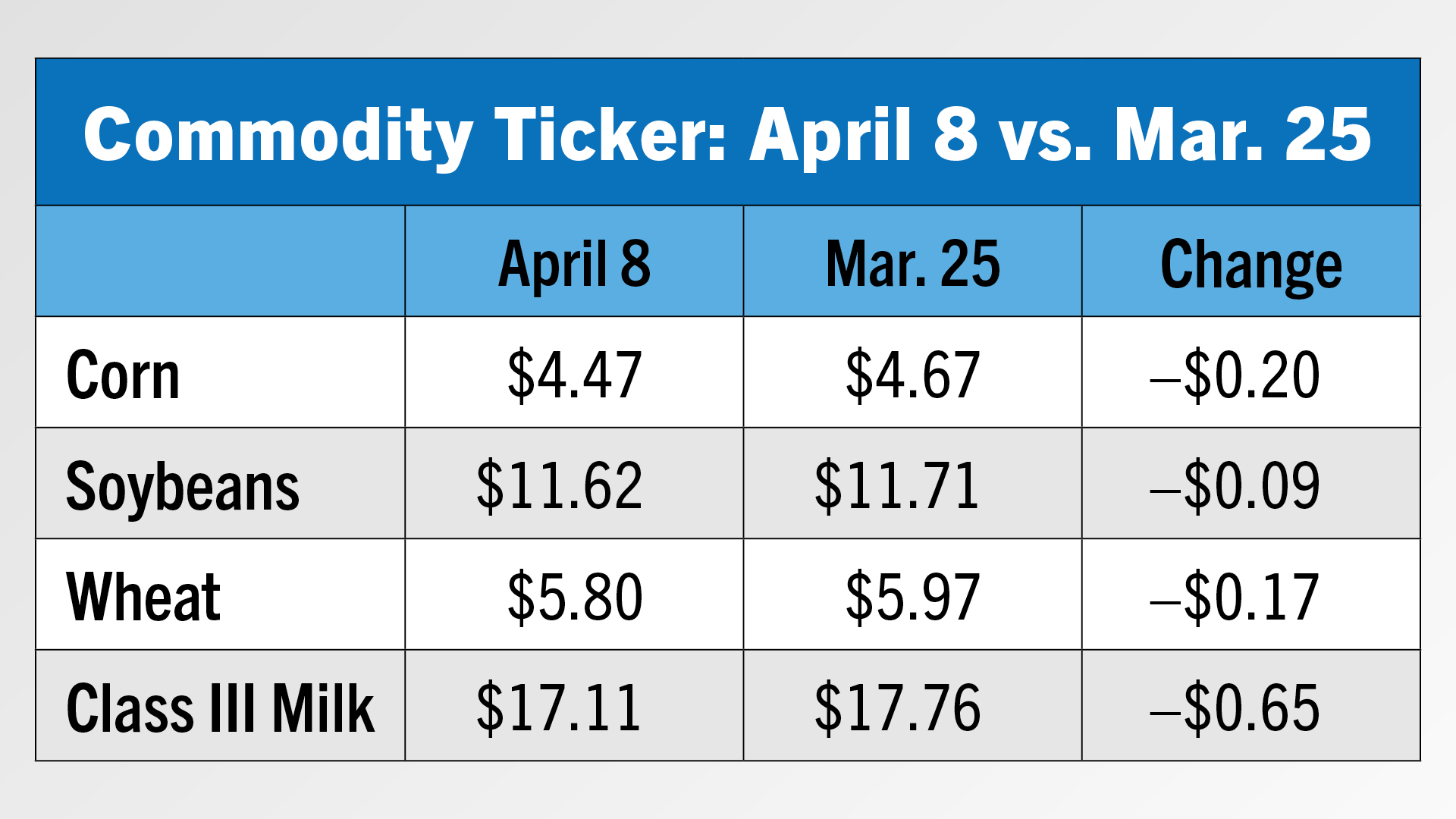
As of April 8, corn prices were $4.47 down 20 cents from our last episode. Soybeans closed at $11.62, down 9 cents. Wheat closed at $5.80, down 17 cents and Class III milk prices closed at $17.11, down 65 cents.
AGCO Ventures Manager Optimistic About Autonomy, Drones & More
We had the chance to catch up with Alex Russomagno, senior manager, AGCO Ventures, after her presentation at the FEMA Supply Summit and Showcase in San Antonio, Texas, a few weeks ago. Russomagno shined some light on the mission of AGCO Ventures and some emerging technologies her team’s really excited about.
“I manage AGCO Ventures, which is our corporate venture capital initiative. It’s responsible for sourcing and funding early-stage technologies that help us deliver on our strategic priorities in the company. That means they’re farmer first, sustainable, and help farmers across the crop cycle. ”
“A big reason we do this is to help us accelerate R&D. It’s just another tool in our toolkit in addition to partnering and acquisition. It helps us get earlier stage companies to talk to us, for us to learn together, and for us to find win-win structures to have a long-term, mutually beneficial relationship.”
“I think farm robotics, automation and autonomy are really important areas. AI and smart enabled hardware are not only important, but the technology is really starting to advance and companies are starting to generate revenue. But more importantly it’s helping support the adoption of autonomy through more exposure and solving big problems along the way. Autonomy, robotics, drones, UAVs are starting to take off in other industries, and I’m really excited to see how those innovations are going to make their way into agriculture.”
Catch more of our conversation with Alex, including why drones have piqued her interest, on PrecisionFarmingDealer.com.
U.S. Expands Metals Tariffs
As of April 6, 2026, the U.S. has implemented significant changes to Section 232 tariffs on steel, aluminum, and copper — introducing a new framework that will directly impact Canadian manufacturers exporting equipment and components into the U.S. market, according to Agricultural Manufacturers of Canada.
According to AMC, duties are now calculated on the entire value of a product — not just its metal content — substantially increasing potential costs for equipment and component exports.
There is also a new tiered tariff structure, which categorizes products based on metal composition:
- 50% - Products made almost entirely of steel, aluminum, or most copper
- 25% - Equipment and components substantially made of these metals
- 15% (Transitional) - Certain metal-intensive industrial and electrical equipment (through Dec.31, 2027)
- 10% - Products made entirely with U.S.-origin metal (documentation required)
Products containing 15% or less metal are now exempt — creating opportunities for certain components and assemblies.
AMC noted that preferential rates are being explored for certain trading partners (e.g., the UK), highlighting the evolving and negotiated nature of this framework. However, elevated tariffs remain in place for specific countries, reinforcing a broader industrial policy approach.
As it relates to what this means for Canadian manufacturers, the association says:
These changes introduce higher cost exposure, new compliance requirements, and increased uncertainty for Canadian exporters. For ag equipment manufacturers - where steel and aluminum are core inputs - this may affect pricing, supply chains, and competitiveness in the U.S. market.
Manufacturers should review product classifications, assess tariff exposure across their product lines, and evaluate opportunities to mitigate impact - particularly where design, sourcing, or documentation could influence applicable rates.
Monarch Tractor Shuts the Doors
According to several reports, Monarch Tractor vacated its Livermore, Calif., headquarters abruptly on April 3. This comes after the company laid off its workforce in late 2025, as we reported in our Nov. 27 episode.
A report from SFGATE about the company’s apparent failure includes details and a harsh review from California winemaker Patrick O’Connor, who says he’s been testing the tractor for 3 years on his vineyard.
In an interview with SFGATE, O’Connor said he couldn’t find any serious uses for the Monarch tractor. He also said it was dangerous when in self-driving mode.
He went on to say, “It was theoretically promising advancement in mechanical weed control over chemical weed control. But the hydraulics were finicky, the automated row follow didn’t pan out. It was hitting my vines. And it was never to a point where you could be driverless.”
In a LinedIn post, Jon Rossi, founder of Digital Iron, said “The winners in equipment tech won’t be the ones with the best AI. They’ll be the ones who solve service, uptime and integration into dealer ecosystems. Monarch tried to leapfrog the system.”
We’ll continue to watch what is happening with Monarch Tractor, along with the lawsuit filed against the OEM by Burks Tractor last year.
DataPoint: Whole Milk Shares Rise Amid Long-Term Decline in Total Fluid Milk Sales
This week’s DataPoint is brought to you by the Dealership Minds Summit, coming to Springfield, Illinois, August 4-5. The program is now available, to view it and to register visit www.DealershipmindsSummit.com.
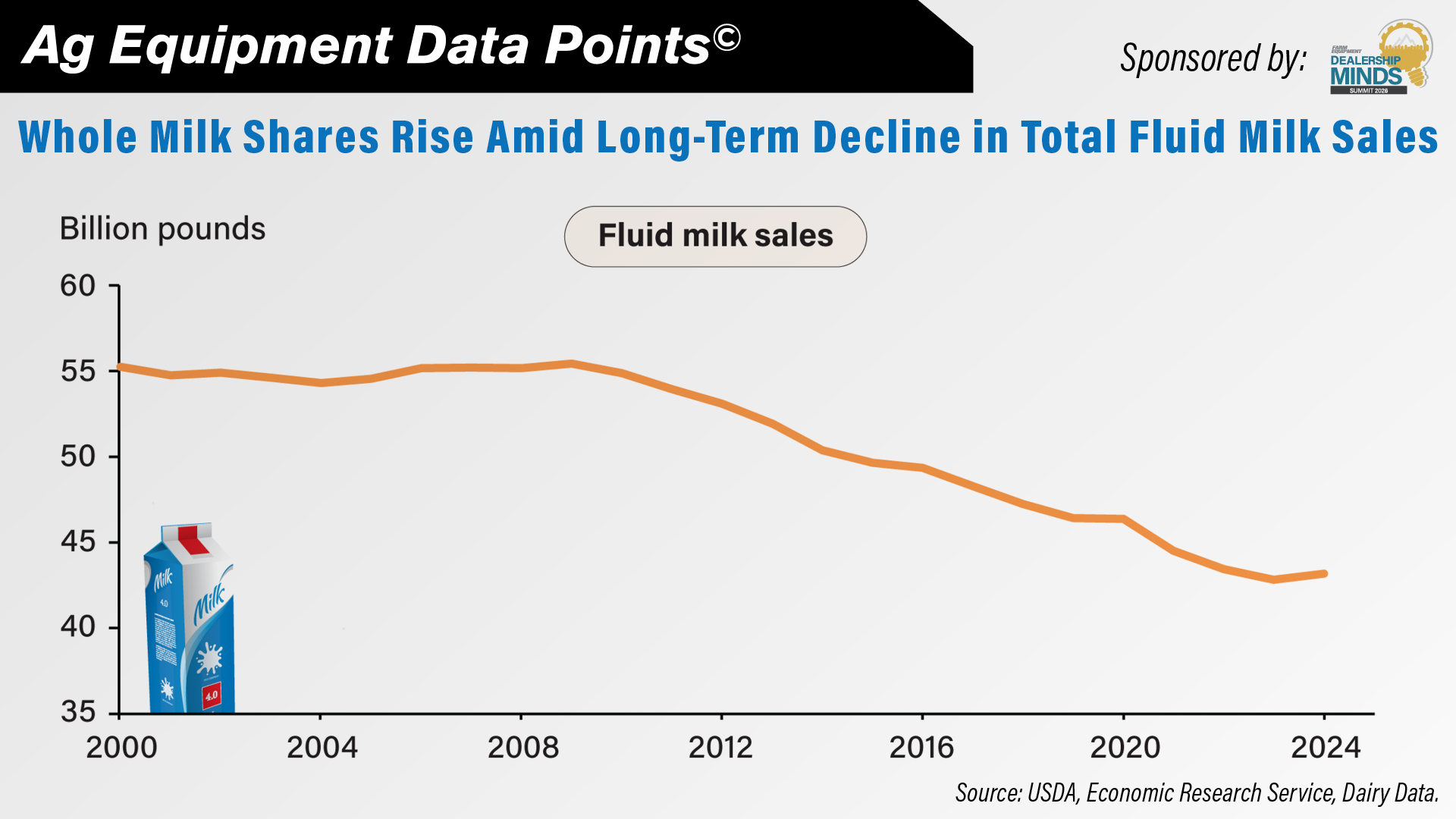
Total fluid milk sales have declined over the past 15 years, falling from a peak at about 55,433 million pounds in 2009 to 43,179 million pounds in 2024, according to data from USDA, Economic Research Service (ERS). This shift represents a 22-percent decrease, notwithstanding a modest increase from 2023 to 2024.
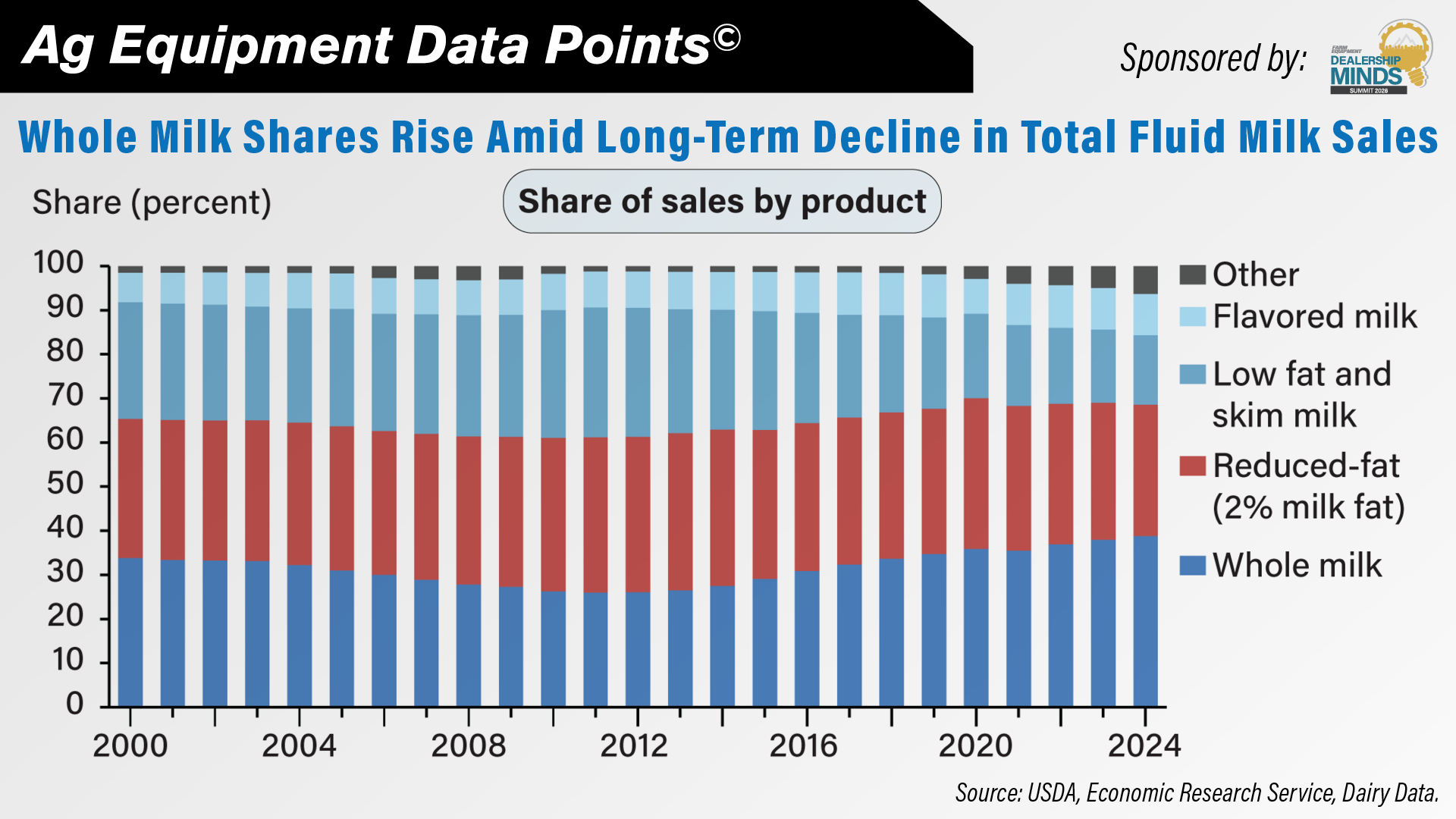
Despite the broader downward trend, whole milk’s share of the market has grown. After being the leading category in the early 2000s, its share dropped to a low of 26 percent in 2012 but has since risen to 39 percent in 2024.
On the Record is now available as a podcast! We encourage you to subscribe in iTunes, the Google Play Store, Soundcloud, Stitcher Radio and TuneIn Radio. Or if you have another app you use for listening to podcasts, let us know and we’ll make an effort to get it listed there as well.
We’re interested in getting your feedback. Please feel free to send along any suggestions or story ideas. You can send comments to kschmidt@lessitermedia.com.