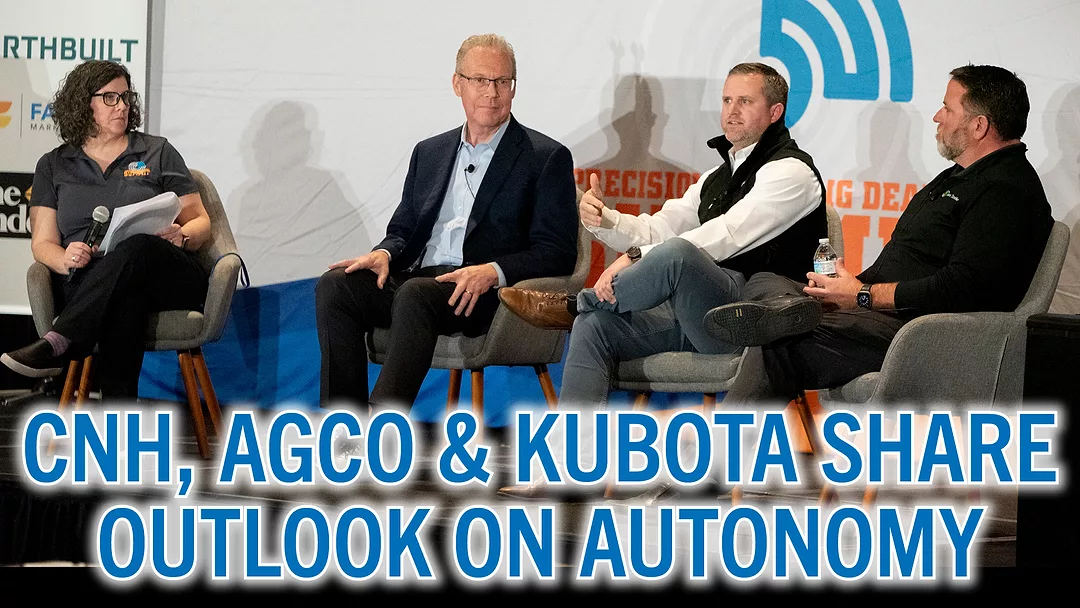
During the Precision Farming Dealer Summit, we had representatives from CNH, AGCO and Kubota on hand to share their insights on the precision side of their businesses and to share with dealers what’s on the horizon.
Autonomy has been a hot topic at the event the last few years, and it once again was an area that produced questions for the panel. To get the conversation going, the panel, which included Nathan Greuel, North American Product Marketing Manager for CNH, Jake Ridenour, Channel Sales Management with AGCO/PTx Trimble, and Joe Michaels, Senior Director of Kubota North America Product Portfolios, was asked what they thought the biggest development on the autonomy front was in the last year. Here’s what they had to say.
Nathan Greuel: "I think the word autonomy means different things to different people. It's almost like sustainability. It's one of those kind of vague words that we use. And even when it was introduced 10 years ago or five, 10 years ago, I think everyone kind of thought they're little robots and swarms of robots going out. Or are we just going to make our existing machines autonomous? And I always think about it as an adjective. It's an autonomous tractor, not necessarily a noun product of autonomy. A little bit different, I think, and that's my probably personal opinion, how you guys look at it. But there's really six stages. And where we're at in '25 and moving on, we introduced guidance 35 years ago. Connectivity came 15 years ago. Machine to machine communication came 10 years ago."
"We're now at the sensing and the acting. We've got to get really good on automating tasks. And when we can automate guidance and we can automate speed and we can automate turning, the machine just becomes autonomous. It almost just folds into autonomy naturally. And the biggest progression we've made in '25 has really been around the obstacle intelligence, obstacle detection, avoidance, all of that good stuff that I think is really the last step of making all of these tasks automated to have an autonomous machine."
As a follow up, we asked the panelists what strides they hope to make in autonomy over the next few years.
Jake Ridenour: "So moving into tillage commercially is next up. We're hoping to do that for the spring to make that commercially readily available. Also, platforms. Right now, we are limited to one or two different platform kits, to which piece of equipment and which model we can retrofit to. So we're hoping to expand that significantly."
"Also, specialty market. We want to take a look at what an orchard and vineyard need. We had gone down that path with Trimble Ag software and Trimble Agriculture at one time, and it's time to reinvigorate that strategy and take a look at that and try to find the needs as you all are trying to find opportunities in different markets that you may not have paid attention to before."
Nathan Greuel: "Same thing. Focus is on commercializing tillage first, looking at specialty orchard vineyards. And I should mention this too. One other thing is if you're taking somebody off of the machine or away from the machine, you're putting more management off board. And all of that digital, whether it's remote viewing of cameras, it has to be connected at all times."
"Information's got to be shared within seconds. We're working on a lot of that off board piece too, path planning, boundary management, remote viewing, alerts, all of that stuff that comes with the autonomous solution."
Joe Michaels: "And for Kubota, very similar in a lot of ways, but I'll go back to that work cycle that your customers are going through to assess the situation, analyze it, and then act. And a little bit of what Nathan was talking about there, you got to bring it all together. And that information through the telematics and everything not only helps manage, but it's the enabler to everything else, as we've been saying here."
"And for Kubota specifically, I've talked already about the autonomy project, a little startup company that we think really has an autonomous solution done well, and we are focusing on the specialty crop markets, those five different categories that the USDA identifies with our specialty crop tractors as our initial project here in 2026 for those autonomous tractors working in solutions of autonomous spraying, of course, very hazardous and we all know the opportunities there for cost savings as well as safety and everything else, but also something as mundane as mowing."
Watch the full version of this episode of On The Record