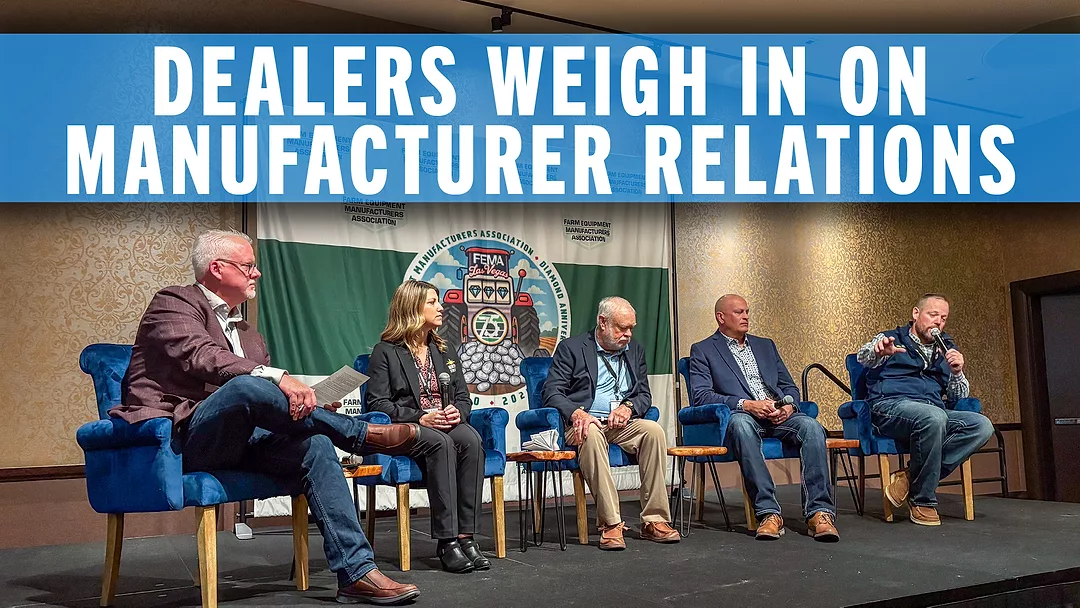
During the Farm Equipment Manufacturers Association Fall Convention in Las Vegas in October, four dealer executives took the stage to share their expectations of independent manufacturers. The discussion covered a number of topics from used equipment to the challenges they face from the major line OEMs as it relates to doing business with the shortline manufacturers.
Tim Brannon, president of AGCO dealership B&G Equipment in Tennessee, shared the cost impact some dealers are enduring on their used equipment inventory in a high interest environment.
“You can look at some of the Fastline, Machinery Pete, some of the machinery people, there's some dealers packing $300,000,000 and $400,000,000 of used equipment. They're paying interest on it. We figured out one of them, that was over $1,000 per day, per store, on 29 stores. Folks, that's unsustainable. In Kentucky, we have AgRev because Boyd Equipment called up AGCO and said, "We're no longer in the business", called up Claas, "We're no longer in the ag business."
Eric Retuerskiold, president of Wisconsin-based Case IH and Kubota dealer Johnson Tractor, highlighted some of the realities dealers face from their major manufacturers when as dealers they invest time, talent and dollars in shortlines. Here’s what he and Brannon had to say on the topic.
Eric Reuterskiold: “That's becoming a very, very big issue currently. Our majors have stated to us that they're only going to grow with dealers that don't have competing lines. So they want exclusive rights to your lots, to our stores. And while you can sign up anything, we can become a dealer for anybody, but they're saying if I want to buy another location today, they're not going to let me do it or sign me up if I have a competing line. So it's huge. And it's not just one manufacturer. We have a couple of different majors and they're each saying that."
Tim Brannon: “Every single dealer, every single location has its own special needs. You've got areas where certain products are hot and others where they really won't sell. And this again adds to the bottom line. Anything that adds to the bottom line as far as a product should be welcomed onto a dealer's life because it gets more customers in to look at the big three or four. Why would they want to take these guys off the lot and alienate those customers and send them to somebody else? It makes no sense."
“I've been there for a bunch of years. I was calling on dealers. And I saw a dealer that started selling my brand new tractor and losing out because he had a shortline. And people would come in buying his shortline, and all of a sudden, they started buying his tractors, my tractors."
Cami Erickson, president of North Star Ag in Tower City, N.D., joined the panel representing the shortline-only dealer perspective. Here’s what she had to say on how shortline-only dealers can find a greater position due to purity in mainline dealerships.
“So where we come into play and kind of how we started and ran our business over the last 16 years is that anybody that the mainlines don't want to, so they're saying purity and they're saying, "Hey, you have to service our stuff over the shortlines," that's where we kind of come into play. Sometimes they can buy them from a mainline but they don't get the service and the after sale. So then they'll come to us and say, "Hey, can you service this? Can you warranty this? Whatever problem we're having, we can't get them to come out and do it because they don't get the backing from the shortlines, maybe on the major side," where we're strictly that way. We know how to deal with it on that side of it."
“So I guess that's kind of where we come into play sometimes where we have competing things, or is when they let a mainline stock one particular product but they don't let us stock it because the mainline stocks it. Then we have issues with with like, "Hey, why can't we have the full line?" We want the full line of shortlines if it's accessible to our business and stuff like that. So we have certain manufacturers that won't allow us to stock X, but then they don't want to do business with their current mainline or their local mainline, they want to do it with us. So I guess they kind of have it on both sides of it. I understand only wanting to provide one product, but then for us it's kind of the opposite."
Watch the full version of this episode of On The Record