
In this episode of On the Record, brought to you by Associated Equipment Distributors, we get a market update from Curt Blades, senior vice president of AEM. In the Technology Corner, Noah Newman catches up with Paul Welbig, director of precision technology for New Holland, for a conversation about the latest outlook for autonomy in agriculture. Also in this episode, Tennessee dealer Tim Brannon sheds some light on how livestock customers are failing compared to their row-crop counterparts and the latest Ag Economy Barometer highlights how farmers may spend government payments.
.png)
This episode of On the Record is brought to you by Associated Equipment Distributors — the leading association in North America for the equipment distribution industry. Don’t miss the 2026 AED Summit – January 19–21 in Dallas, TX!
This is the premier event built exclusively for the equipment distribution industry. For three action-packed days, thousands of industry leaders come together to connect, collaborate, and unlock new opportunities. Discover hundreds of manufacturers actively seeking distribution and service partners across every area of dealership operations—from financing and software to insurance and beyond. It’s the only event designed by and for equipment dealers that has over 40 education sessions, 4 thought leadership keynote speakers, and over 200 exhibitors to meet with to shape the future of your business — and it’s your chance to be at the center of it all.
Learn more and register today at www.aedsummit.com. Interested in discounted registration options? Contact jcruthers@aednet.org to discover how you can get reduced registration rates to attend this event.
TRANSCRIPT
Jump to a section or scroll for the full episode...
- AEM’s Blades Provides Insight on Current Market
- Dealers on the Move
- An OEM’s Take on the Biggest Opportunity for Automation
- Tracking Crop Prices
- Dealer Highlights Differences Between Livestock & Row-Crop Markets
- Market Facilitation Payment Would Largely Go Toward Debt
- DataPoint: Indiana 2026 Net Farm Income Expected to Decrease
AEM’s Blades Provides Insight on Current Market
During the Farm Equipment Manufacturer Association’s Fall Convention in Las Vegas, I had the chance to talk with Curt Blades, senior vice president of the Association of Equipment Manufacturers, who was on hand to help FEMA celebrate its 75th Anniversary.
Blades offered some perspective on what AEM’s reports are showing for the overall ag equipment market, as well as some issues that are impacting manufacturer sentiment.
“Well, the ag economy in general is really facing some storm clouds, and that's reflected in the numbers that AEM puts out every month, the tractor and combine sales. For the last 18 months or so, we've kind of began to see some softness in the overall tractor market. And really, that started to accelerate in the last, say, 12 months for larger horsepower tractors, those that are representing those true farm tractors.”
“We did see a little bit of a turnaround in September with a slight uptick in sales, but I think we're still at this overall... The market's down about 20%, and it has been. If you talk to all of the manufacturers, they're all reporting that same story, that the equipment sales are soft right now, absolutely as a result of the ag economy being soft right now.”
When discussing the impact of tariffs, Blades pointed out that to manufacture equipment 3 things are needed — transportation, labor and steel.
“And we all know where the labor market has been tight for some time, coming before the pandemic, but then, as a result of the pandemic, we're still dealing with some of those labor challenges. Transportation, we know what the transportation situation looks like both domestically as well as around the world. And then steel, I mean, as much as we would love nothing more than to buy all of our steel from our neighbors and right here in the United States or in North America, the reality is that it's a global market and you source certain quality, certain specs from around the world, and those tariff prices impact the global market, whether it is sourced domestically or sourced internationally. So, steel tariffs are certainly part of it.”
“And then tariffs in general, knowing that machines oftentimes cross the border multiple times to become a complete machine, whether that's between US, Mexico, and Canada, or it's machines coming where parts are coming from Europe, a very strong ag production market and coming to the United States, that's absolutely affecting the market, and it's affecting the price of machines. Our manufacturers are paying very close attention to this and making sure that everything that we can possibly do to control those costs, so that the farmers are also recognizing that their margins are a little bit squeezed. We don't want to have to raise the prices if we don't have to, but we recognize that our costs have gone up somewhat sharply.”
Dealers on the Move
This week’s Dealer on the Move is Claas Farmpoint. Claas announced it will open 2 new full-service locations in Atlantic, Iowa, and Mitchell South Dakota in 2026.
The Atlantic location will serve combine customers who previously worked with Ziegler Ag, while the Mitchell location will expand support for combine customers previously served by Butler Machinery.
An OEM’s Take on the Biggest Opportunity for Automation
We had boots on the ground at the FIRA ag robotics conference in Woodland, Calif., a couple weeks ago. PFD associate editor Mackane Vogel caught up with Paul Welbig, director of precision technology for New Holland. Autonomy was a hot topic at the conference, and Welbig says it’s evolving quickly.
“Even just a few years ago when these terms first started to hit the industry — automation, AI, autonomy — we’ve come so far in a relatively short period of time. Here at New Holland, we’re always innovating and trying to leverage the latest technology. Now you’re just starting to see it baked into a lot of different solutions that we’re offering. From an automation perspective, it’s automating a lot of tasks that an operator would have to do, especially if they’re redundant tasks or mundane. The more replication there is in some sort of operation, the more opportunity there is to automate it.”
Catch our full conversation with Welbig on PrecisionFarmingDealer.com.
Tracking Crop Prices
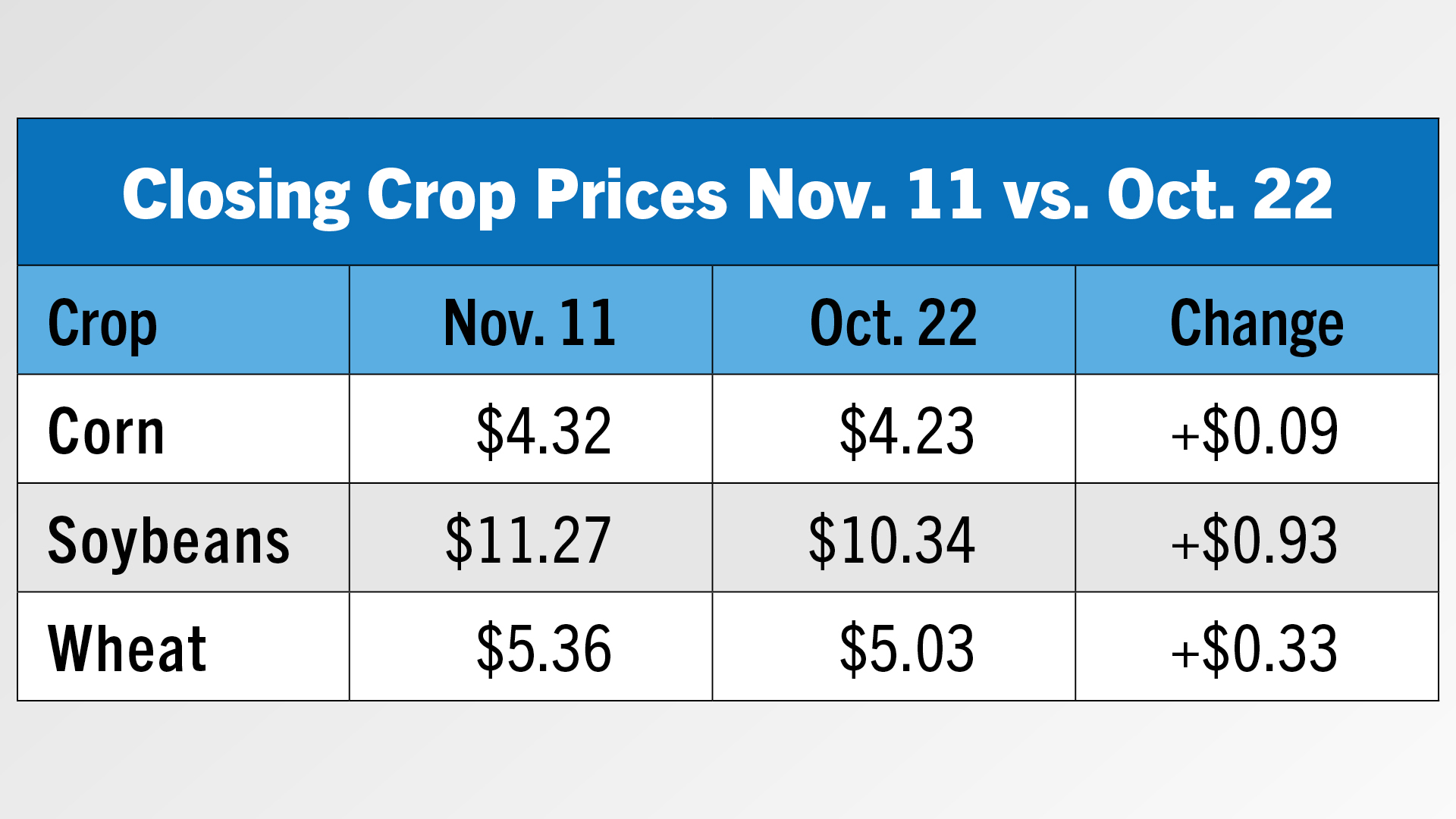
As of November 11, corn prices were $4.32, up 9 cents from our last episode. Soybeans closed at $11.27, up 93 cents. And wheat closed at $5.36, up 33 cents.
Dealer Highlights Differences Between Livestock & Row-Crop Markets
Tim Brannon, owner of B&G Equipment in Paris, Tenn., was one of 4 dealers who sat on a dealer panel during the FEMA Fall Convention in Las Vegas. Following his session, we caught up with Brannon to talk about his outlook on the ag market.
He stressed the current differences between the livestock and row-crop markets.
“If it has four legs or maybe two legs and eats the livestock industry, I think I see no bumps in the road. It's going to be a long-term success story and profitability in the livestock industry, especially the cattle market. On the other hand, the row crop, corn, wheat, soybeans, cotton, rice, I did check with Purdue and a couple other universities that put out cost of production on crops and most of them had a $50 return on land, which is really low, and they were all in negative numbers. I don't know that I've seen that. Now, are all farmers losing money? No, the average corn yield is 188 bushel, they say, so there's a lot of guys that made a lot more yield than that. But from the 200 bushel an acre down, if you're on your own land, 200 bushel is about to break even.”
“But what about those that make up the rest of those statistics? They're losing money big time. We check, and it's online, you can look the Mississippi State FSA or whatever it was. They had a panel and they sent a report to Washington that their farmers are losing money big time and it's worse than it was in the 1980s. The only difference is we're not looking at 18% interest. Arkansas did the same thing. Arkansas said that they may foreclose on a third. Geez, that's just unheard of. It hurts me to even think about that. So if you put all those together, there is an impending issue out there that may be cataclysmic. I hope and pray that that's not true. The thing that could change it would be China, but the president just got back from China and I checked this morning. There was a little bump in the soybean market. I hope it has taken off since I looked at it, but it was not enough to put us in the black.”
Market Facilitation Payment Would Largely Go Toward Debt
In previous Ag Economy Barometer surveys, producers overwhelmingly said they expected USDA to provide compensation for weak commodity prices, similar to the 2019 Market Facilitation Program, say Michael Langemeier and James Mintert who produce the monthly report for Purdue’s Center for Commercial Agriculture.
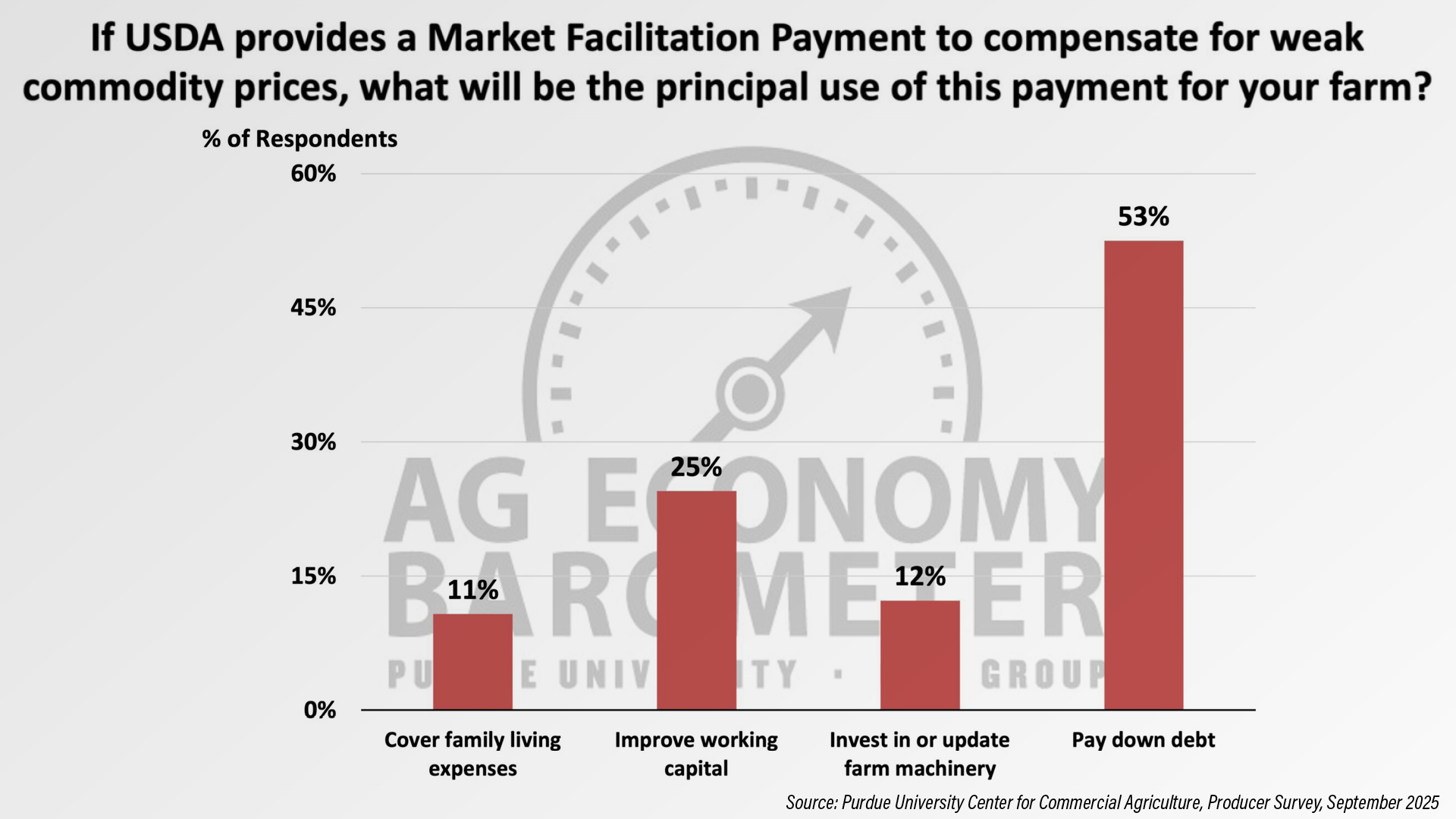
This month’s barometer survey asked producers how they planned to use a supplementary payment from the USDA on their farms. Over half of respondents (53%) said it would be used to pay down debt. Meanwhile 25% said it would be used to strengthen their farm’s working capital position. A small minority of farmers said they would use a payment from USDA to invest in farm machinery (12%) or to cover family living expenses (11%).
Farmer’s appraisal of current conditions on their farms continues to be a tale of two economies, Langemeier and Mintert say. Livestock producers remain very optimistic about conditions on their farms, fueled in part by record-high profitability in the beef sector. At the same time, poor profit margins across all major crop enterprises lead crop producers to provide a notably more pessimistic view of the current situation on their farms.
The October barometer survey took place from October 13-17, 2025.
DataPoint: Indiana 2026 Net Farm Income Expected to Decrease
This week’s DataPoint is brought to you by the Precision Farming Dealer Summit, Jan. 5-6. To view the program and to register, visit PrecisionSummit.com.
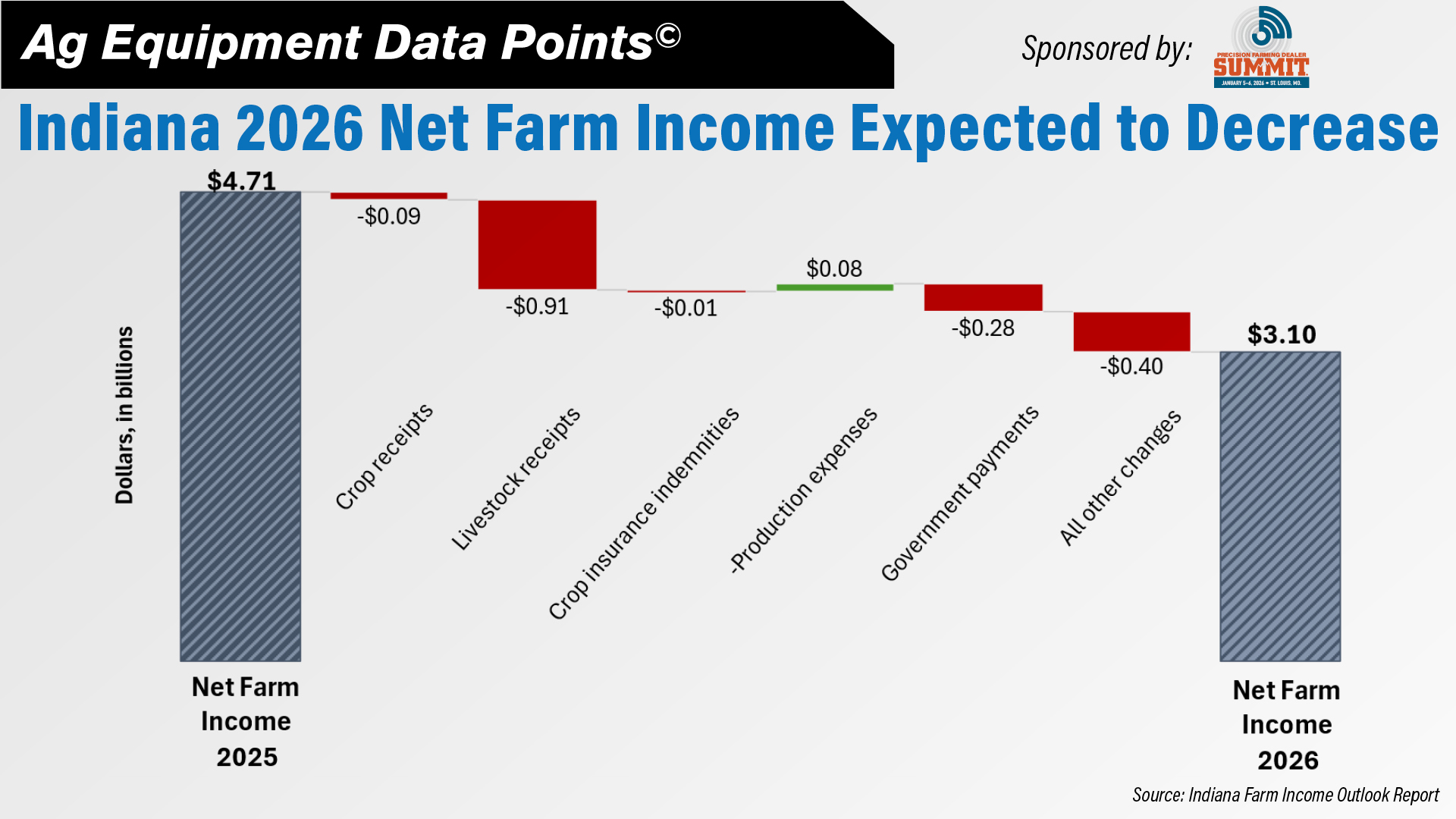
According to the Indiana Farm Income Outlook Report released November 12, net farm income for the state is projected to drop by 34% to $3.10 billion in 2026, as government payments decline by $280.6 million — a drop of 31% — and livestock cash receipts decline by $906.21 million — a drop of 13% — due to much lower egg prices. Net farm income is estimated to average $3.49 billion across the 10-year baseline projection, according to the report.
As always, we welcome your feedback. You can send comments and story suggestions to kschmidt@lessitermedia.com. Until next time, I’m Kim Schmidt, thanks for joining us.
On the Record is now available as a podcast! We encourage you to subscribe in iTunes, the Google Play Store, Soundcloud, Stitcher Radio and TuneIn Radio. Or if you have another app you use for listening to podcasts, let us know and we’ll make an effort to get it listed there as well.
We’re interested in getting your feedback. Please feel free to send along any suggestions or story ideas. You can send comments to kschmidt@lessitermedia.com.