Takeaways
- Centralized support reduces downtime while building trust and consistency across locations.
- Proactive (and remote) equipment monitoring prevents failures before they happen.
- Data-driven training accelerates technician development and team knowledge.
- Even small dealers can start small and scale over time.
As farm equipment grows more advanced, so do the expectations of the customers who run it. When a combine, sprayer or tractor goes down, today’s farmers expect fast, accurate solutions — and that pressure lands squarely on dealership service departments.
For dealers, this creates a perfect storm. Modern machines are outfitted with specialized electronics, telematics and automation systems that require advanced diagnostics and training. At the same time, the industry is facing a nationwide shortage of experienced technicians to handle these service needs.
Andrew Sullivan, technical support manager at United Ag & Turf (UAT), visually explains this gap with two lines on a graph (Figure 1). “The green line represents machine technology — constantly climbing higher,” he says. “The yellow line represents technician skills and dealer capabilities. That yellow line is going up too, but not nearly fast enough. The gap between those 2 lines is where our biggest problems live.”
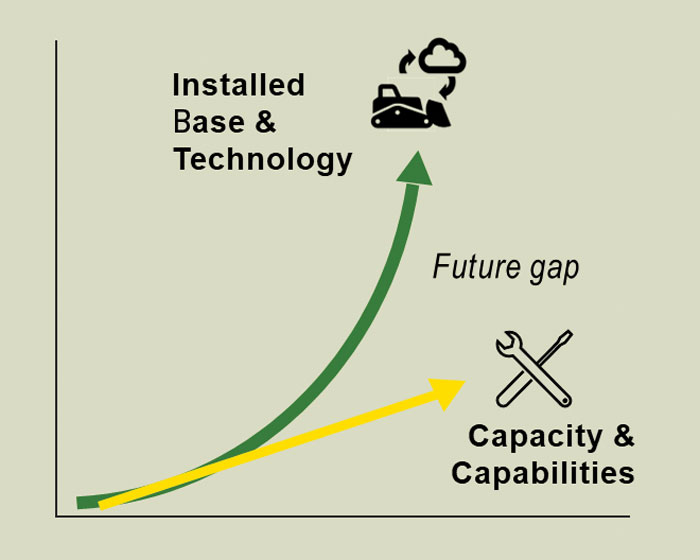
Figure 1. Andrew Sullivan
UAT’s answer to this problem has been bold and a has been a model to others. The company’s centralized service support system helps close that gap through shared resources, efficient processes and educated field teams — which are saving both parties time and money.
Today, this system supports 48 locations, 350 technicians, 70 field techs, 14,000 connected machines and roughly 3.5 million acres of customer farmland.
“Our centralized service model ensures not only individual accountability, but team agility, so we can deliver consistent support,” he explains. “It’s not just about faster support, it’s smarter.”
A Better Flow of Information (How It Works at UAT)
Most dealerships are familiar with the traditional process of solving problems. A tech runs into a challenging issue and taps another tech on the shoulder. If that doesn’t work, they track down the shop foreman or service manager, who’s already juggling multiple priorities. Sometimes a field tech gets pulled off a job to troubleshoot. When all else fails, the case is sent to the manufacturer, and often without all necessary information.
United Ag & Turf by the Numbers
- 48 locations
- 350 technicians
- 14,000 connected machines
- 70 field techs
- 3.5 million acres supported
Any dealer understands where that leads: downtime, frustration and inconsistent fixes, as well as a lot of distracted employees. This is a core issue UAT’s centralized approach was built around, and fixed by ensuring complete coverage for any product at any time. No matter the issue, Sullivan explains, someone is trained to provide a high level of expertise in that moment.
Here’s how a typical case moves through the UAT system.
1. Tech Connects with the Solutions Center
When a technician encounters or is presented with a problem from a customer, they reach out to the support center through one of several channels: a dedicated phone number (voice or text), a shared support email or an always-open Microsoft Teams call.
“It’s like a virtual shop floor,” Sullivan says of the online system. “Techs can call anytime and get help right away.”
Every call, text or email is logged into Zoho, UAT’s internal case management system. Emails automatically enter the system, while calls and Teams sessions are logged manually to ensure nothing slips through the cracks.
2. Case Triaged by a Technical Communicator
The first point of contact is a technical communicator, whose role is to gather equipment details, history and context, confirm all required information is complete and decide whether the issue can be solved internally or needs to be escalated to the manufacturer.
“Every single case is reviewed by our team before it ever goes to the OEM,” Sullivan says. “That alone saves time and frustration because we catch incomplete information before it causes delays.”
Remote diagnostics have made this stage so critical in today’s environment. Live data points allow communicators to see potential issues, maybe even fix them, and eliminate a field visit. Or, if a visit is necessary, diagnose the issue before a tech ever reaches the farm or field. (See more about UAT’s remote diagnostics online at Farm-Equipment.com/1025).
3. Collaboration & Specialization
Each case is then routed to the right internal expert. UAT’s 6-person team is strategically built around specialization. One person handles cotton equipment, sprayers and 9R tractors. Another team member focuses on skid steers, mini excavators and “yellow” iron. Sullivan himself covers golf course equipment and smaller utility tractors. Others specialize in hay tools and high-tech product lines.
This level of knowledge ensures that every issue gets the attention of someone who truly understands the equipment. If workload spikes or an issue crosses categories, other team members step in seamlessly. Shared systems and cross-training mean no case belongs to just one person.
“If one of us is buried, someone else jumps in,” Sullivan says. “It’s about team accountability, not silos.”
4. Field Tech Integration
When remote help isn’t enough, the Solutions Center packages everything into a ready-to-go job for a field tech or store team. That package includes identification of correct parts, diagnostic notes, as well as historical context if applicable. Sullivan explains that the goal is always first-visit resolution, avoiding wasted trips and customer frustration.
“We don’t want field techs showing up blind,” Sullivan says. “They should know exactly what they’re walking into before they ever leave the shop.”
5. Knowledge Feedback Loop
Each week, the team publishes a “Hot List” — a summary of recurring issues, trouble codes and recommended solutions. This keeps techs across all 48 locations informed on current concerns and prevents them from reinventing the wheel when it comes to trouble shooting.
“Instead of one-to-one support, we moved to one-to-many,” Sullivan explains. “Techs don’t have to guess who to call anymore. They have one number, one team and one process.”
The decision to physically house this team outside any individual store was deliberate. Their focus remains clear: serving every location equally and efficiently.
The Team Behind the Model
Centralization only works because of the right people in the right roles, and equipping them to do the job better, faster and smarter.
“At the end of the day, it’s the people that matter,” Sullivan says. “Technology helps us, but our team is what drives success.” He explained the individual roles on the team.
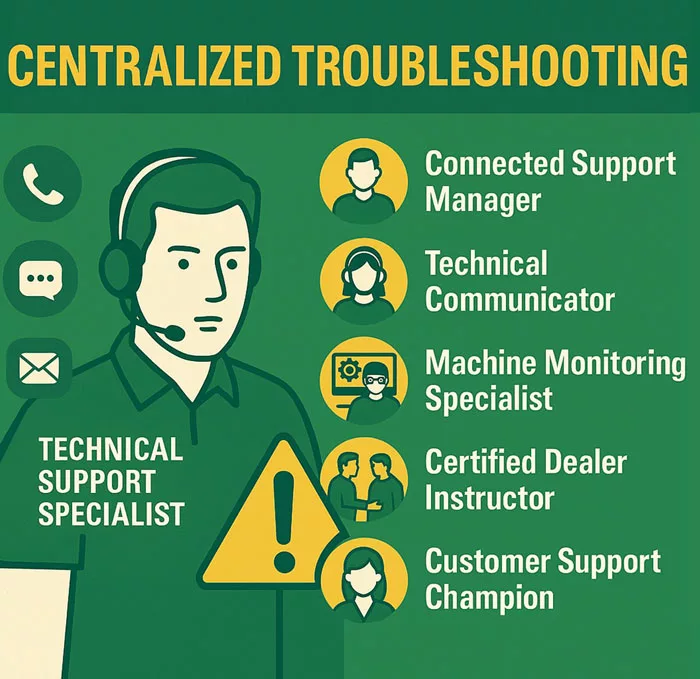
Technical Communicators are the first line of defense. They triage calls, gather data and ensure cases are complete before escalation. Sullivan notes, “Their work keeps everyone else focused. It protects field techs from bad information and keeps the manufacturer loop clean.”
“Don’t wait for perfect conditions. Just start. Even a basic system is better than no system at all…”
Machine Monitoring Specialists are the proactive “heartbeat” of the team. These specialists watch live data streams from connected machines, identifying issues before they become failures. They also reach out to customers first, often before the customer realizes there’s a problem.
Certified Dealer Instructors are dual-role specialists. They solve cases daily and also teach training classes. Because they’re in the trenches, their classes are based on real-world scenarios and highly relevant to techs.
Customer Success Champions focus on high-end, high-tech equipment, ensuring customers get the maximum value from new product lines.
UAT’s team of 6 Equipment Specialists brings more than 140 years of combined experience to the table. Each has a clearly defined role, but they work together to cover the entire territory, according to Sullivan.
Two team members work remotely, one positioned in the far west end of the dealership’s territory, one in the south territory, to cover UAT’s large footprint efficiently. The other 4 operate from the centralized facility, traveling as needed when hands-on help is required.
UAT uses a model based on the acronym MADE for its approach to centralized customer service and support:
M: Monitor
A: Analyze
D: Decide
E: Execute
Learn more about this way of operating online at Farm-Equipment.com/1025.
Training Done Right
How does management keep these members up to speed in such a fast-changing industry? Enter smart and effective training based on real-life situations and outcomes. Arguably, one of the most innovative aspects of UAT’s model is how it connects product troubleshooting with team growth.
Every support case becomes part of a database, called the internal knowledge center. The technical communicators helped create this, and keeps it up to date. Sullivan explains that they are looking for, and regularly see, patterns emerge, revealing which techs are struggling with specific systems, which problems keep recurring and the most concentrated equipment issues.
If a tech repeatedly asks for help with electrical diagnostics, the system automatically flags them.
Learn More
Find more content on United Ag & Turf’s Standalone Support & Solutions Center, visit Farm-Equipment.com/1025.
- Remote Diagnostics: Smarter Service
- UAT’s Proactive Approach Saves Time & Money
- Diversification & Focus: United Ag & Turf Aims to Maximize Performance in Both
“I’ve got a database that tells me exactly who needs which training,” Sullivan says. “If you’ve asked me 432 questions about electrical systems, guess what class you’re going to next? Training isn’t generic anymore. It’s personalized and practical, built from the real issues our techs face every day.”
Because certified dealer instructors also work daily cases as technical communicators, they design and deliver classes that directly address these gaps. This makes training highly relevant and instantly applicable — improving both technician skill and retention.
“Technicians are learning from the same people they already trust, which enables us to be highly targeted in our training,” Sullivan explains. “We can deliver tailor-based curriculum based on actual service data and not assumptions.”
More Lessons Learned
Building a centralized support system was not easy. United Ag & Turf’s team faced challenges in staffing, customer communication and internal processes. But along the way, they’ve gathered insights that other dealerships can apply at any scale, whether supporting 2 locations or 20.
Sullivan tells other dealers that this approach doesn’t require a massive budget or a perfect plan. Even having one or two dedicated people can make a significant difference if they’re focused on support and armed with the right tools.
“Don’t wait for perfect conditions,” he advises. “Just start. Even a basic system is better than no system at all.”
Another important lesson through this was at the billing level. UAT charges shop rate for any work performed by the centralized team, whether remote or on-site. Travel fees are not added, and there are no confusing line items on invoices.
“The customer just sees labor,” Sullivan shares. “Internally, we know exactly who did what, but for them, it’s seamless.”
Beyond billing, UAT learned a lot about people throughout this process, and continues to as it evolves. It became apparent that centralized support roles were a natural fit for experienced technicians nearing retirement or those who can no longer meet the physical demands of fieldwork. By moving them into support roles, UAT preserved valuable knowledge and gave those team members a meaningful new way to contribute.
UAT also has had to build customer trust gradually in this centralized approach. Early on, proactive calls about non-warranty issues were often declined. As customers began to see the benefits of fixing problems before they caused downtime, that changed. Today, United Ag & Turf’s service center is on the front line for each of the 48 locations, solving problems and dispatching techs from one central location.
“Bringing structure, strategy and shared resources to the technicians and customers makes a powerful difference for not only your techs, but your bottom line,” Sullivan concludes.
More on Parts and Service Absorption
Working Toward a Fully Absorbed Dealer
Increasing Absorption Rate & Attracting Repeat Business
Journey to Successful Absorption Rate Looks Different for Every Dealership
Centralized Support: United Ag & Turf’s Smarter Service
The 30-Point Jump: How Salem Farm Supply Transformed Absorption