In this episode of On the Record, brought to you by Associated Equipment Distributors, we take a look at dealers initial forecasters for 2026 and their latest forecast for 2025 sales. In the Technology Corner, Noah Newman visits with Clint Brauer, co-founder of Greenfield Robotics. Also in this episode, we check in with Kuhn North America during World Dairy Expo on how its dairy customers are fairing and an update on how European manufacturers are fairing amid tariffs and other economic challenges.
.png)
On the Record is brought to you by Associated Equipment Distributors — the leading association in North America for the equipment distribution industry.
Explore the 2025 AED Annual Education Seminars lineup which includes seminars on Parts Management, Service Management, and Branch/Store Management.
Additionally, don't miss the upcoming conferences, such as the Finance/HR Symposium, Leadership Conference, Women in Equipment Conference, and Policy Conference.
Contact us for more information about how you can register for these events.
TRANSCRIPT
Jump to a section or scroll for the full episode...
- Initial 2026 Forecast Calls for Continued Declines
- Dealers on the Move
- ‘These Robots are Getting Pretty Good’: Autonomy Showing up on More Farms
- Tracking Crop Prices
- European Equipment Manufacturers Battle Headwinds
- Dairy Customers Dealing with Challenges
- DataPoint: Farm Sector Profits Forecast to Grow in 2025
Initial 2026 Forecast Calls for Continued Declines
Our monthly Dealer Sentiments & Business Conditions survey has started asking dealers for their 2026 forecasts. The initial outlook is for sales to be down 10% year-over-year in 2026. Dealers latest forecast is for 2025 sales to be down 12% on average year-over-year.
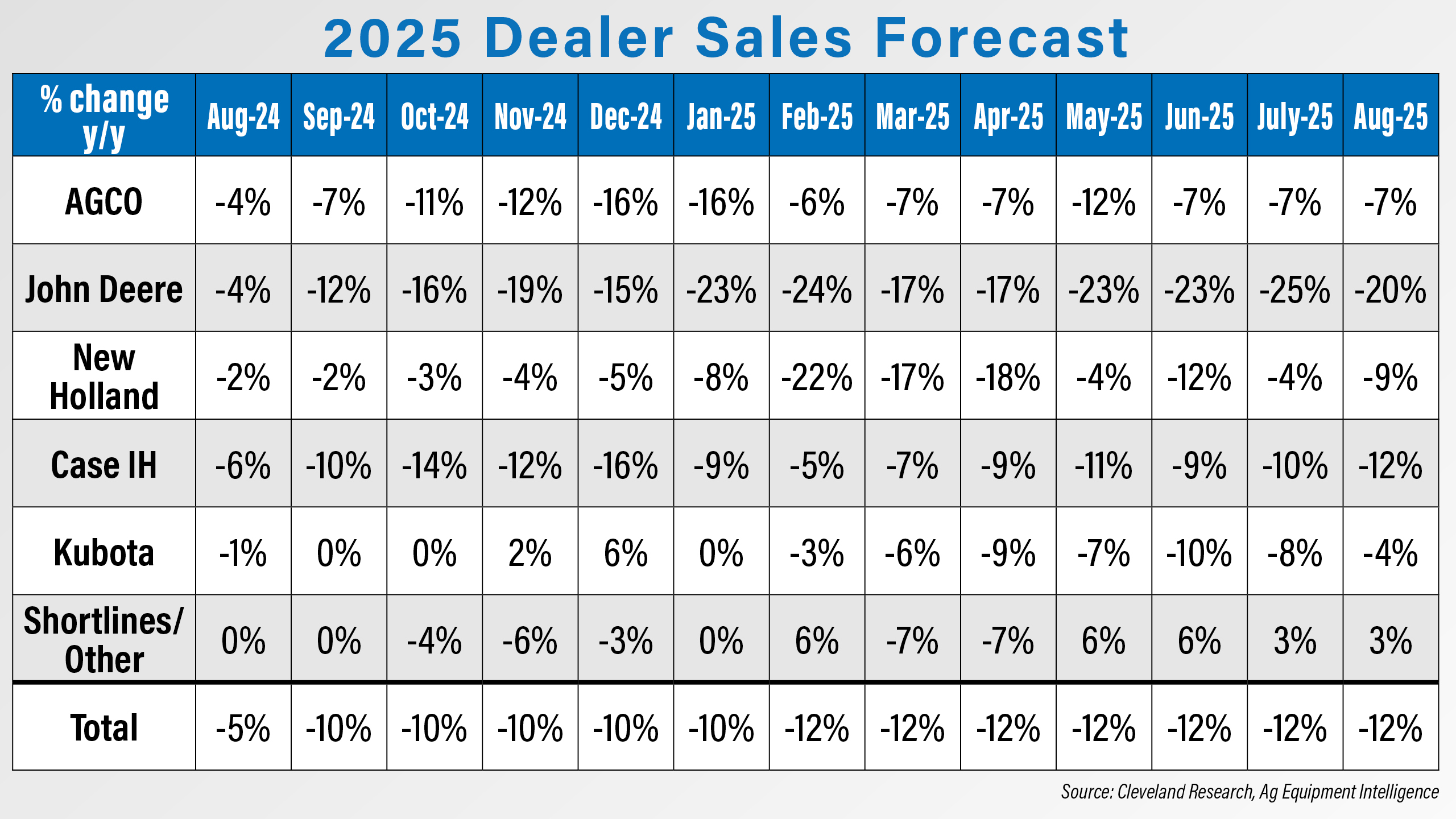
Looking at dealers by brand, Deere dealers are forecasting the largest year-over-year decline in 2025 at down 20%. Shortline-only dealers are the only group calling for sales growth, forecasting a 3% increase in 2025 sales.
One corn belt dealer said, “Quoting and purchasing activity has slowly worsened throughout the year. Customer sentiment remains depressed and we feel 2026 will be slightly worse than 2025.”
Another dealer noted that it seemed like customer sentiment took a “step back month-over-month,” adding that commodity prices and equipment prices are not encouraging.
Yet another dealer shared that while their dollar sales are up, their unit sales are down year-over-year and their margin is down more than 5 points vs. last year.
Dealers on the Move
This week’s Dealer on the Move is Messick Farm Equipment. The Pennsylvania-based New Holland dealer has acquired Reading Tractor and Equipment, a Kubota dealer in Leesport, Pennsylvania.
‘These Robots are Getting Pretty Good’: Autonomy Showing up on More Farms
I had the chance to catch up with Clint Brauer, the co-founder and head of innovation of Greenfield Robotics. The company’s autonomous bots are sold out for 2026. Brauer says the technology has grown by leaps and bounds over the last few years, and the goal is to inch even closer to the ag mainstream within the next 18 months.
Clint Brauer: “These robots are getting pretty good now. Every year they’re making big jumps. Two or 3 years ago, I was apologizing a lot. We wrote checks to farmers when we had damage or when things weren’t getting done right. Traditionally, we’d say here are 5 disasters we’re pretty sure are going to happen. But they don’t (happen). They don’t anymore. They just don’t.”
Noah Newman: “Do you think that autonomy and this kind of technology on the farm might be arriving in the mainstream quicker than we expect?”
Brauer: “I’ve been on the adoption curve my entire career. There are always early-stage adopters no matter what it is. Non-GMO, strip-till and organic are going to be the early adopters on a lot of these things, although we work with every kind of farm now. You always have slow adopters and it’s about money. If you want to go to the mass market, the financial argument has to be concise. It has to be perfect, and you must understand what you’re going to have to do to adopt that technology. We’re clearly in the early adopter market but the goal is to cross over that into the next 18 months to where anyone can look at the financials and say I think this makes some sense I’m going to give this a try.”
Click here to watch my full conversation with Brauer and learn more about how the Greenfield bots work.
Tracking Crop Prices
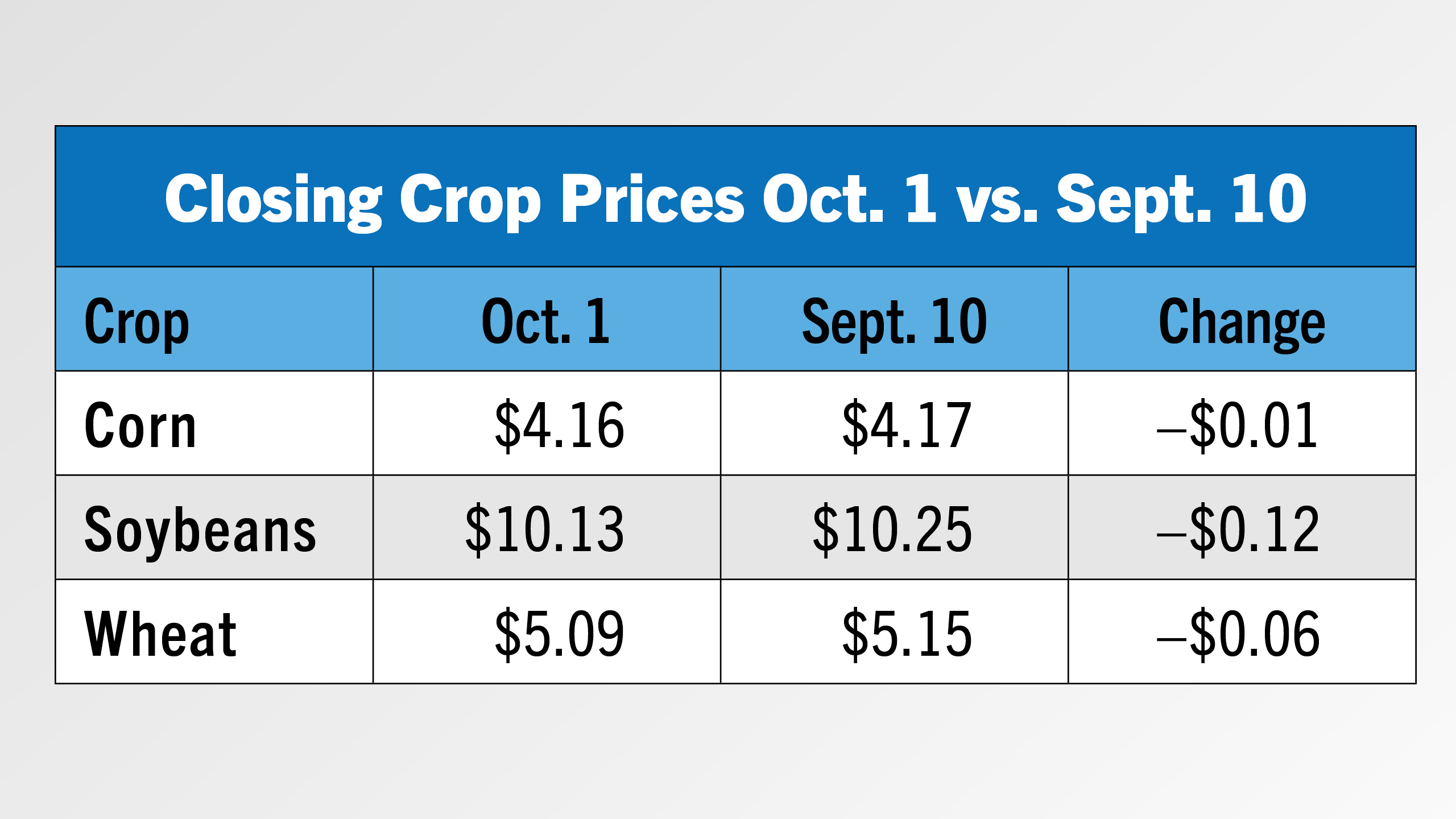
As of October 1, corn prices were $4.16, town a penny from our last episode. Soybeans closed at $10.13, down 12 cents. And wheat closed at $5.09, town 6 cents.
European Equipment Manufacturers Battle Headwinds
Speaking at a press event in preparation for Agritechnica, Dr. Tobias Ehrhard, managing director of the VDMA Agricultural Machinery Association, noted that European ag equipment manufacturers — much like their North American counterparts — are operating in a difficult market environment.
“Although order intake rose noticeably in numerous product segments in the first half of 2025, the sales situation remains unsatisfactory,” emphasizes Ehrhard. The industry-wide business climate index, which is based on a monthly survey of top managers in European industry, paints a similar picture. “An upturn has been expected for some time, but it is not really materializing at the moment,” says Ehrhard, explaining the continuing stagnation in the industry.
In view of aging machine fleets, he says ag machinery manufacturers expect demand for modern technology to rise again in the medium term. “We are confident that the agricultural machinery markets will normalize sooner or later,” emphasizes Ehrhard, saying that as soon as the economic engine really gets going again, a solid upturn is likely.
European manufacturers are feeling the pain of U.S. imposed tariffs.
“While the increased tariff rate in mechanical engineering affects an average of 30% of EU export volume, in agricultural machinery it is 70% on average,” explains Dr. Ehrhard. The VDMA's position on trade policy is clear: “We must move away from protectionism and toward open markets as quickly as possible. Where multilateral free trade agreements are not feasible, bilateral agreements must be concluded, as in the case of Mercosur,” summarizes the industry expert.
Dairy Customers Dealing with Challenges
While grain farmers dealing with a bumper crop and trade challenges are likely to lose money in 2025, the cattle business is the best it's been in decades, according to a Sept. 15 report in the Wall Street Journal.
Cattlemen are making a record profit of more than $700 per animal, up from $2 just 5 years ago, according to industry estimates. However, the picture isn’t necessarily as positive for dairy farmers.
We caught up with Chuck Walker from Kuhn North America this week at World Dairy Expo in Madison, Wis., and he said both their row-crop and dairy customers are facing challenges this year.
"We're both facing, both entities are facing some uncertainties, especially on the tariff side in the row crop. There's a lot of old storage of crop that needs to move and there's a bumper crop coming. So that is going to have to be moved. And will that be an uptick on sales of iron because they will need to buy? On the dairy side, milk is a little lower right now. They have to pay full for trucking, that used to be free. And so we're seeing a lot of the dairy side change that are keeping cows that should go to be culled, and they're keeping them for that expensive day old calf. So that has added more milk because that's a cow that would've been taken out of production. So yes, they're gaining, which they should be on the beef side with a calf, but then they're adding to a little bit of problem with maybe some overproduction."
DataPoint: Farm Sector Profits Forecast to Grow in 2025
This week’s DataPoint is brought to you by the Precision Farming Dealer Summit, coming to St. Louis Jan. 5-6. To learn more and register, visit PrecisionDealerSummit.com.
U.S. net cash farm income (NCFI), defined as gross cash income minus cash expenses, is forecast to increase by $36.5 billion (25.3T) from 2024 to $180.7 billion in 2025 in inflation adjusted dollars, according to USDA. U.S. net farm income (NFI) is forecast to increase by $48.8 billion (37.2%) to $179.8 billion in 2025.
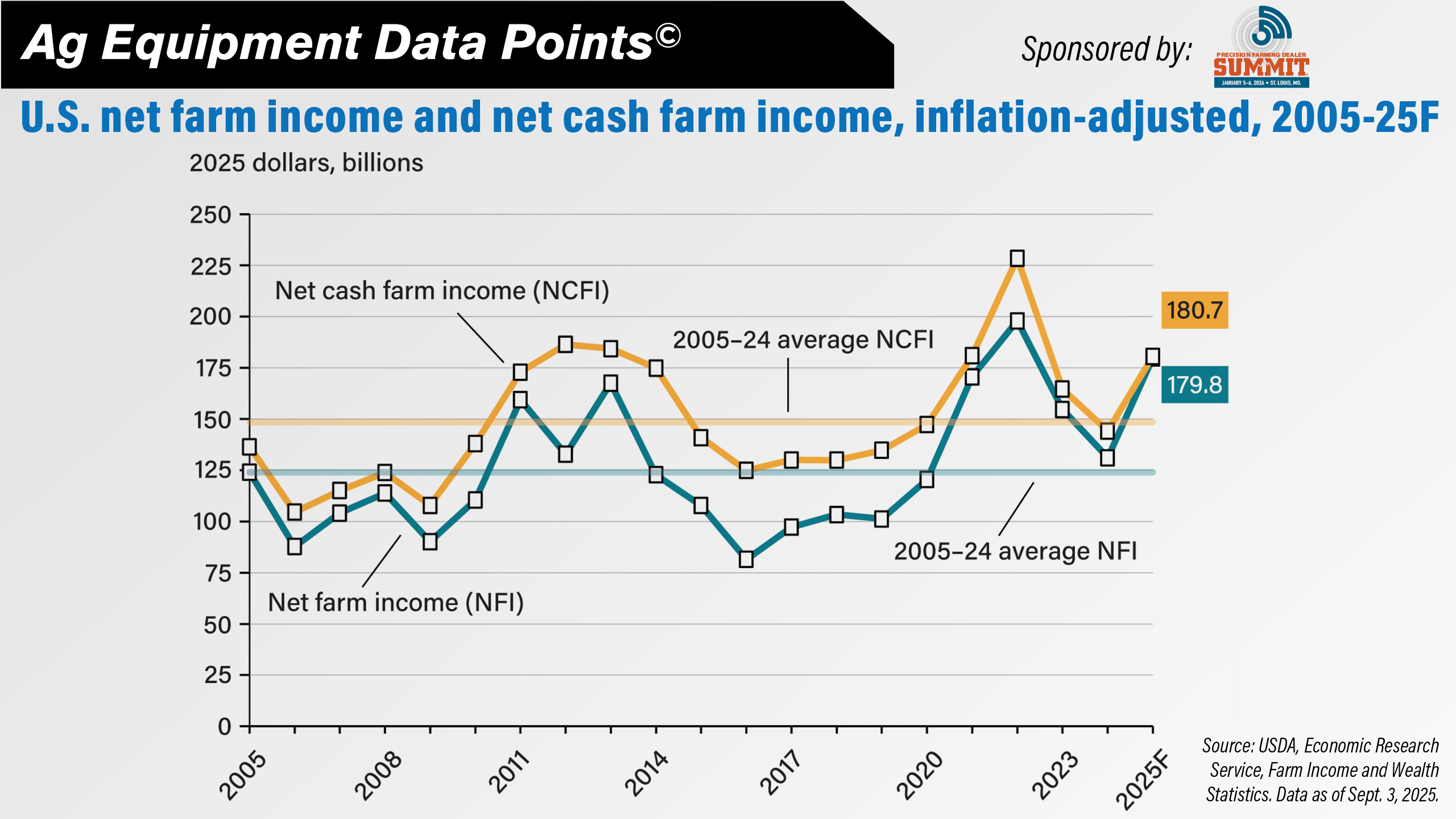
Net farm income is a broader measure of farm sector profitability that incorporates noncash items, including changes in inventories, economic depreciation and gross imputed rental income. Most of the projected increase in 2025 corresponds with higher direct Government payments to farmers, projected to increase from $10.4 billion in 2024 to $40.5 billion in 2025. This increase is expected largely because of supplemental and ad hoc disaster assistance to farmers and ranchers from the American Relief Act of 2025, which authorized economic assistance payments to producers and payments for losses in 2023 and 2024.
On the Record is now available as a podcast! We encourage you to subscribe in iTunes, the Google Play Store, Soundcloud, Stitcher Radio and TuneIn Radio. Or if you have another app you use for listening to podcasts, let us know and we’ll make an effort to get it listed there as well.
We’re interested in getting your feedback. Please feel free to send along any suggestions or story ideas. You can send comments to kschmidt@lessitermedia.com.