In this episode of On the Record, brought to you by Associated Equipment Distributors, we discuss how the National Defense Authorization Act could impact the right to repair movement. In the Technology Corner, Noah Newman checks in with New Holland and Oxbo on what precision technology products are gaining the most traction with customers. Also in this episode, retired dealer-principal Lee Rogness shares what sort of impact shortlines had on his dealership’s business and we take a look at how the shortlines owned by Linamar fared in this year’s NAEDA Deal-Manufacturer Relations survey.

On the Record is brought to you by Associated Equipment Distributors — the leading association in North America for the equipment distribution industry.
Explore the 2025 AED Annual Education Seminars lineup which includes seminars on Parts Management, Service Management, and Branch/Store Management.
Additionally, don't miss the upcoming conferences, such as the Finance/HR Symposium, Leadership Conference, Women in Equipment Conference, and Policy Conference.
Contact us for more information about how you can register for these events.
TRANSCRIPT
Jump to a section or scroll for the full episode...
- Keeping an Eye on Federal Right to Repair Action
- Dealers on the Move
- OEMs Weigh in on Precision Tech Gaining Most Traction with Customers
- Tracking Crop Prices
- Shortlines Play an Important Role for Dealers
- Linamar Owned Ag Companies Improve in Dealer Ratings
- DataPoint: Tractor Dealer Revenue Rises 2% in June
Keeping an Eye on Federal Right to Repair Action
The National Defense Authorization Act was passed out of the House Armed Services Committee on a 55-2 vote. The bill — HR 3838 — did not contain an amendment with Right to Repair language, and as a result the North American Equipment Dealers Association returned to neutral on the legislation.
The Senate also released its version of the NDAA, S. 2296, this week with updated language. While both bills aren’t directly related to the ag industry, there was potential to set precedent.
We checked in with NAEDA’s Director of Government Affairs Kipp McGuire for more details on the development.
“We appreciate that Congress is trying to address this accessibility and availability of tools, parts documentation for our nation's troops in harm's way. And the AG equipment industry especially, we've kind of already recognized that and solidified it as a premise of doing business or as a cornerstone of doing business in the AG industry with the MOUs between manufacturers and the Farm Bureau. And so we appreciate that.”
“We still think that it's got a lot of room for improvement. It's still kind of bad policy the way that they're going about it. Specifically, they're addressing a symptom, not necessarily the root cause in our analysis of it, which is very similar to what we see from the AG industry whenever this comes up at the state's level. A little different in the details. But at the federal level, Senator Warren cited in her press release a report from the Rand Company that is a very large think tank. And she cited it as some examples of why the DOD needed better right to repair and better access to parts and things of that nature. But she kind of cherry-picked some of the information out of that report. And their conclusion was that the real problem for DOD and not having the access and availability of parts and documentation and information was a lack of training and knowledge on government contract officers, and their ability to make sure the contracts between manufacturers and the government include the rights to that information and those parts and things. And so really it's a workforce issue for them.”
“And NEDA brought this up with the members of the Senate that we talked to. And so kind of analogous to that, we've been saying this for years on the AG equipment side of it's not about availability of parts and things. It's a workforce issue, is we are drastically short manned in qualified technicians to be able to do just the amount of work, and especially within the context of the complexity of equipment. And so both of these issues really, whether you're talking about right to repair in the AG industry or this right to repair at the DOD level or the federal level with the NDAA, the root problem is workforce issues. And the right for repair legislation that we see is just an easy fix for a symptom and not the real problem.”
Dealers on the Move
This week’s Dealer on the Move is Ziegler Ag Equipment. The AGCO dealer announced the opening of its newest facility in Emmetsburg, Iowa, marking the company’s 7th new location in 5 years.
OEMs Weigh in on Precision Tech Gaining Most Traction with Customers
We recently caught up with Ryan Schaefer, VP, New Holland North America, and Craig Harthoorn, retired president, OXBO Hay & Forage, during the AEI Executive Briefing Mid-Year Review. And we asked them, “What precision technology products are gaining the most traction with your customers right now?”
Ryan Schaeffer: “Really, anything that a farmer can see an immediate return on. We haven’t seen rapid adoption yet of some of the more advanced technologies, like this sense and apply technologies, or that type of things that have caught most of the media attention. Steve (Hunt, president H&R Agri-Power) mentioned earlier on that they’ve got a portfolio. Certainly, a lot of that comes from CNH, where their sales staff has had a really, really straightforward time justifying returns to the customer. When a customer sees that immediate return, those are the products that we’re seeing move the most, driving the most value for dealers or the products that are driving value for customers. Now, I think there will be some adoption rate for the more advanced technologies, but the stuff that’s really selling isn’t necessarily what you’re seeing a lot of press about right now.”
Craig Harthoorn: “For us on the OXBO side, right now, the technology that’s selling the best is on the application side of things, as far as trying to put down your material pounds per acre and so on. That’s where we’re seeing the best adoption as far as the technology. We’re trying to promote that on some of our larger spreaders. We’re working on some proprietary stuff on the hay and forage side, as far as windrow quality and so on.”
“We’ve gotten really nothing to compare to on that. For us, it’s just mainly on the application side. When you start talking larger spreaders that are upwards of a hundred thousand dollars or more, it’s easier to justify spending the money on the technology for measuring your pounds per acre.”
Hear much more from Craig and Ryan in the Mid-Year Review, which you can watch on PrecisionFarmingDealer.com.
Tracking Crop Prices
As of July 23, corn prices were $3.98 down 1 cent from our last episode. Soybeans closed at $10.05, down 4 cents. And Wheat closed at $5.40, down 7 cents.

Shortlines Play an Important Role for Dealers
Farm Equipment is working on a special project to mark the Farm Equipment Manufacturers Association's 75th year. We interviewed Lee Rogness, the retired dealer-principal of Interstate Inc. in Fergus Falls, Minn., who sold his dealership to RDO in 2008 and then created and managed the entire shortline division of RDO thereafter.
A dealership without shortlines is like a garden without carrots, he says, adding that if a dealership is going to service its customers to the fullest degree, it needs to have a product that fills the gap that their mainline manufacturer is not providing. Here’s Rogness with more on the importance of shortlines to the business.
“We always seen it, you know, when we started out when I started out in the business as a solo operator, and of course I had some partners to my brothers, but our whole idea was to meet the needs of the farmer and what he needed for equipment, and our major manufacturers. First of all, they just didn't build a forage line. They didn't build feed equipment, so we were. We had no choices, but to look to the outside of our major manufacturers for that, and it was quite natural, because they, some of those manufacturers, have been in business for years as long as the major manufacturer, for that matter. So that's how we built our product offering. Well, then, as time went by, you know, we found we were selling other compatible and not necessarily competing pieces of equipment to the farmers, and they needed it. They came to us, and it. It just gave us a complete product offering for our farmers, our local farmers.”
Not only did shortlines fill a product gap for the dealership, but Rogness recalls a story that highlights the foot traffic they brought.
“Well, I'll give you an example for an answer on that. How would that be? The Ji case company the dealer in this local town here the father that, or the person that owned it, lived to be an elderly person in his. The JI Case Company wanted a dealer, and they got the idea that before we were a John Deere dealer, they came over to us, and they'd have to wait to see me. And then when they come into my office, they say, ‘Goodness! We just can't believe all the people that walk into this place on it every time we're here. There's people in your store, and we just don't see that in our stores anywhere else.’
“Well, obviously they were coming in for more than just parts of our major lines. They were coming in for all these other short lines, and these were people that fed livestock and milk, cows and beef, cattle and poultry as well. They were all that was the farm scene at that time everybody had a little something and they saw the traffic so obviously. We had traffic.”
As we continue to work on the FEMA anniversary project, we invite you to share contributions, memories and anecdotes of what the shortline manufacturers or the association have meant to your business. You can email them to mlessiter@lessitermedia.com.
Linamar Owned Ag Companies Improve in Dealer Ratings
In our last episode we took a look at how the full line manufacturers performed in the North American Equipment Dealers Association’s annual Dealer-Manufacturer Relations survey. This time we are going to take a closer look at how some of the shortlines performed.
Linamar owns four of the shortlines rated by dealers — Bourgault, Salford, Highline and MacDon, and all of them showed improvement in their scores over last year.
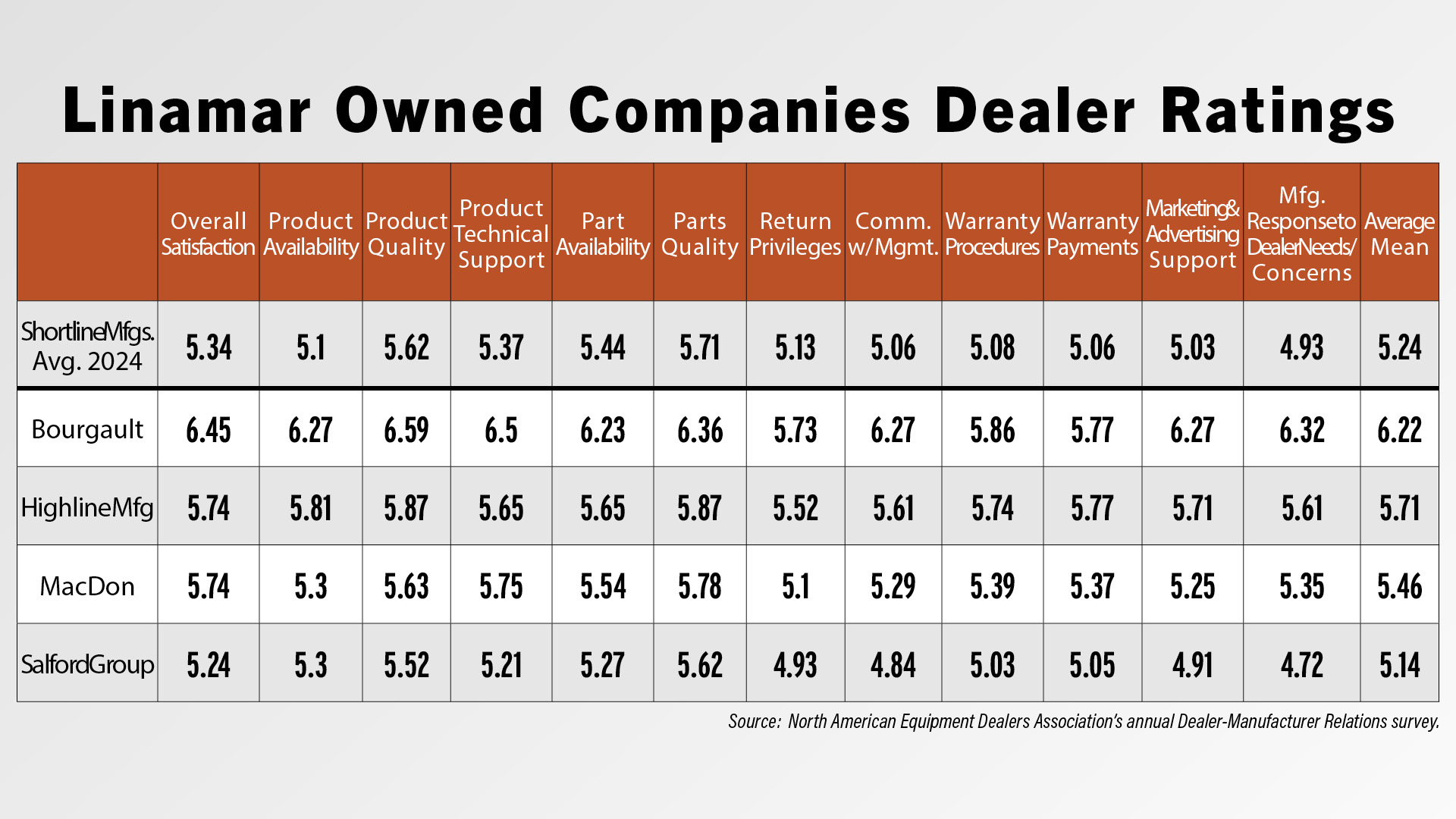
Dealers’ ratings for Bourgault were up in 11 categories, and the manufacturer had the highest average mean score of all the shortlines at 6.22 on a scale of 1 to 7. It also nabbed the highest score in 9 of the 12 categories — Overall Satisfaction, Product Availability, Product Quality, Product Technical Support, Parts Availability, Parts Quality, Communication with Management, Marketing & Advertising Support and Manufacturers Response to Dealer Needs/Concerns
Highline Manufacturing saw improvement in 7 of the categories, with its largest improvement coming in Marketing & Advertising Support. It had a strong average mean score of 5.71.
MacDon improved in all categories over 2024 and its largest improvement was in Product Availability. MacDon’s average mean score of 5.46 was up 8.32% over last year.
To be included in the report, manufacturers must receive enough dealers rating them. This year Salford was included for the first time. Its scores ranged from 4.72 to 6.62, with its highest rating being Parts Quality.
We will have a full analysis and breakdown of the shortline and tractor manufacturers in the September Shortline Edition of Farm Equipment.
DataPoint: Tractor Dealer Revenue Rises 2% in June
This week’s DataPoint is brought to you by the Dealership Minds Summit. There’s still time to register, visit DealershipMindsSummit.com to learn more.
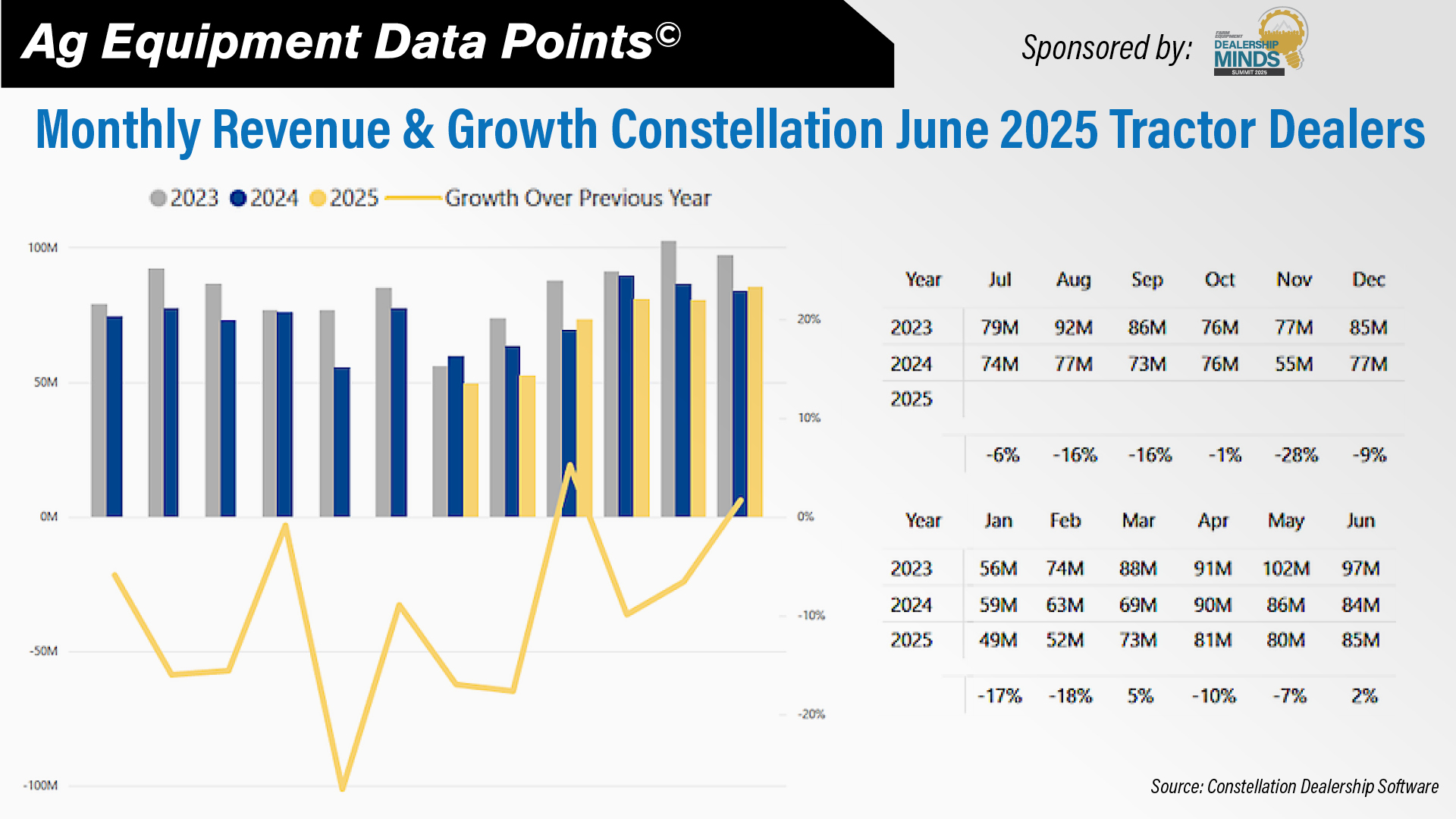
June revenue for tractor dealers increased 2% year-over-year, according to Constellation Dealership Software's latest monthly market update, which analyzes transactional sales data from a consistent group of 224 dealers reporting over the past three years.
The dealer count, wholegood unit sale count, and total sales numbers above show the actual number of dealers and total sales being analyzed. It represents combined sales of parts in all departments, wholegood sales and service repairs.
Dealers reported $85 million total sales in June 2025, up $1 million from 2024 and up $5 million from May 2025.
As always, we welcome your feedback. You can send comments and story suggestions to kschmidt@lessitermedia.com. Until next time, I’m Kim Schmidt, thanks for joining us.
On the Record is now available as a podcast! We encourage you to subscribe in iTunes, the Google Play Store, Soundcloud, Stitcher Radio and TuneIn Radio. Or if you have another app you use for listening to podcasts, let us know and we’ll make an effort to get it listed there as well.
We’re interested in getting your feedback. Please feel free to send along any suggestions or story ideas. You can send comments to kschmidt@lessitermedia.com.