
In this episode of On the Record, brought to you by Associated Equipment Distributors, USDA Deputy Secretary Stephen Vaden puts right-to-repair in the national spotlight. In the Technology Corner, Noah Newman highlights the decisions HTS Ag’s Adam Gittins says he might make differently based on what he’s learned. Also in this episode, dealers report precision was a bright spot for 2025 business and OEMs share their outlook for how dealers can use technology to help their high value crop customers.
.png)
This episode of On the Record is brought to you by Associated Equipment Distributors — the leading association in North America for the equipment distribution industry.
Get ready for a powerful start to the year with AED’s packed lineup of Q1 and Q2 events designed to connect, educate, and energize industry professionals. From high-impact conferences and hands-on training sessions to exclusive member gatherings and strategic leadership programs, AED is bringing together top experts and forward-thinking dealers to share insights that drive growth. Whether you’re looking to sharpen your team’s skills, stay ahead of emerging trends, or expand your network, our first-half-of-the-year events deliver unmatched opportunities to elevate your business and strengthen your competitive edge. Visit www.aednet.org/ for more information.
TRANSCRIPT
Jump to a section or scroll for the full episode...
- Deputy Ag Secretary Takes Aim at OEMs, Dealers over Right-to-Repair
- Dealers on the Move
- 20/20 Hindsight: Precision Decisions I’d Rethink & Why
- Tracking Crop Prices
- Dealers Report Improved Precision Sales & Service Numbers in 2025
- OEM’s Highlight Opportunities for Technology & Precision in High Value Crops
- DataPoint: No-Tillers Opt for Smaller Planters
Deputy Ag Secretary Takes Aim at OEMs, Dealers over Right-to-Repair
USDA Deputy Secretary Stephen Vaden came after farm equipment manufacturers during a webinar hosted by the National Ag Law Center last week, according to a report from AgWeb.
Vaden said, “‘This administration thinks farmers should be able to repair their own equipment, and the industry’s efforts to prevent them from doing so are illegal.”
He went on to say that is why the FTC is currently suing John Deere and other manufacturers, saying it is to quote “Stand up for American farmers’ rights to repair their own equipment and to not have to suffer under a system where, when their equipment breaks down in the field, they have to call a John Deere dealer, for example, and wait for them to send someone to fix a simple issue that the farmer can repair him or herself — costing them time, productivity and money.”
Vaden also said the Trump administration is looking into how manufacturers distribute and sell equipment. According to the report, they are calling into question dealers’ geography assignments and trade territories.
Vaden said, "If you should happen to pick any other dealer than the one they designate as your local dealer, they’ll charge you more for the same piece of equipment — the exact same piece equipment. There’s a financial penalty, which is prohibitive to you exercising choice over which dealer you use to buy your equipment — eliminating the ability to compete on the basis of price.”
In late July 2025, Deere launched a digital tool designed to enhance how equipment owners use, maintain, diagnose, repair, and protect their equipment.
Since the right-to-repair movement emerged over a decade ago, OEMs and dealers alike have maintained that they are not opposed to farmers repairing their own equipment but they are against modifying equipment that could disable safety and emissions controls.
We’ll continue to monitor this latest development and will have more coverage on Farm-Equipment.com.
Dealers on the Move
This week’s Dealers on the Move are Greenvalley Equipment and Enns Brothers. The Manitoba-based John Deere dealership announced their intention to merge. Greenvalley currently operates 4 locations while Enns Brothers operates 9. The expected closing is April 2026.
20/20 Hindsight: Precision Decisions I’d Rethink & Why
Dealers let their guard down and shared some big lessons learned at the Precision Farming Dealer Summit in St. Louis earlier this month. Adam Gittins, president of Harlan, Iowa-based HTS Ag, moderated a roundtable focusing on “Precision Decisions I’d Rethink and Why.” Gittins says everyone agreed that businesses often lose sight of their “bread and butter” and venture too far outside their wheelhouse.
“In hindsight we can all look back and see things that we would’ve done differently. It’s easy to see how we’ve gotten so spread out in our own business with so many different products. Having that focus and pulling back into our core competencies and understand that some of these other things are a distraction, not a benefit to our business.”
“The takeaway from the whole session is we have to be accepting of change. Change is the one constant in our business. The things we sold 20 years ago, aren’t the things we’re selling today. The things we’re selling today might not be the things we’re selling in the next 1, 2 or 5 years.”
Gittins appreciates the high level of authenticity you see during those roundtable discussions, as dealers are willing to share both failures and successes.
Tracking Crop Prices
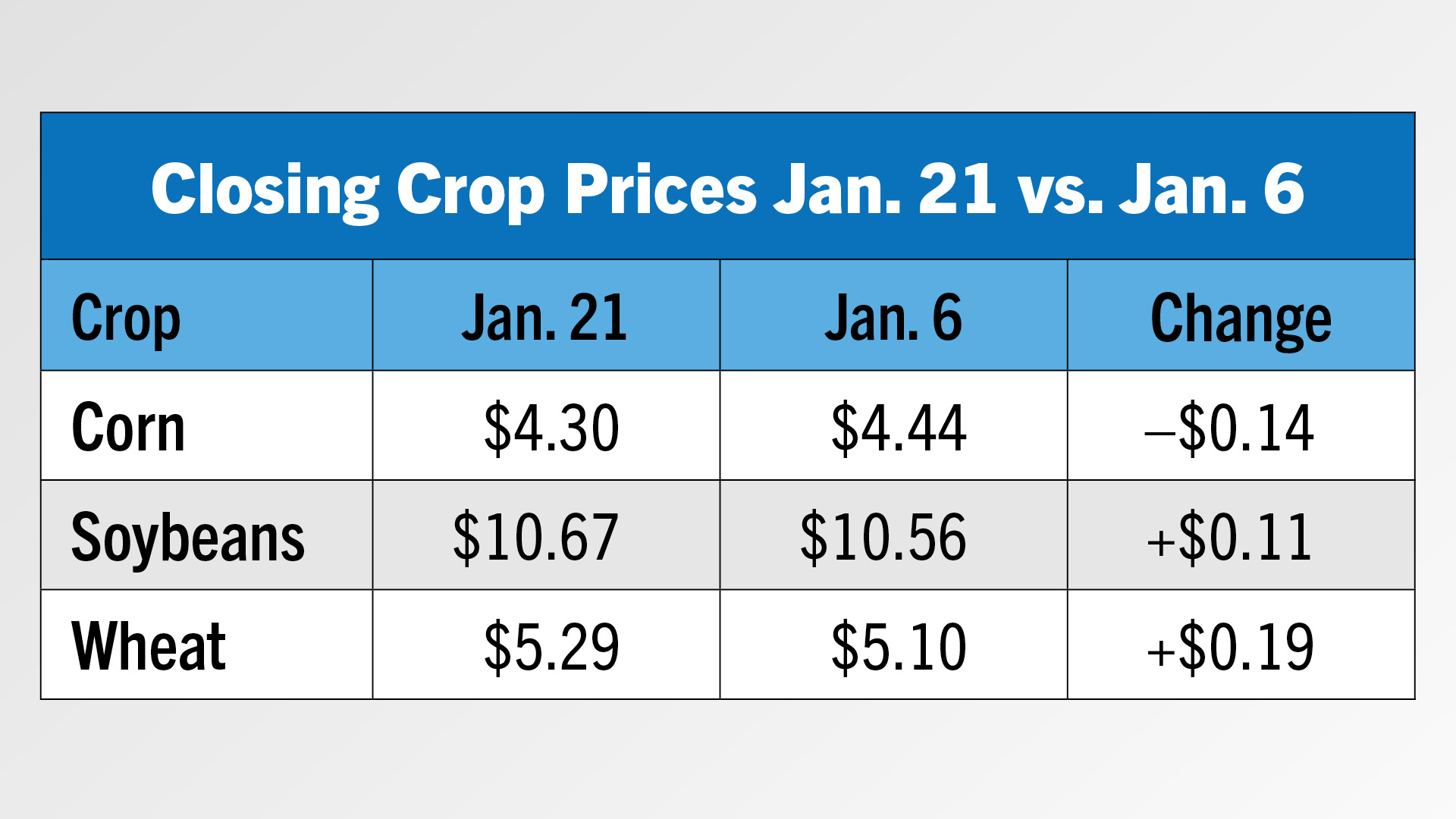
As of January 23, corn prices were $4.30, down 14 cents from our last episode. Soybeans closed at $10.67, up 11 cents. And wheat closed at $5.29, up 19 cents.
Dealers Report Improved Precision Sales & Service Numbers in 2025
Precision sales and service provided a silver lining for many farm equipment dealerships during a challenging 2025, according to the latest Precision Farming Dealer Benchmark Study.
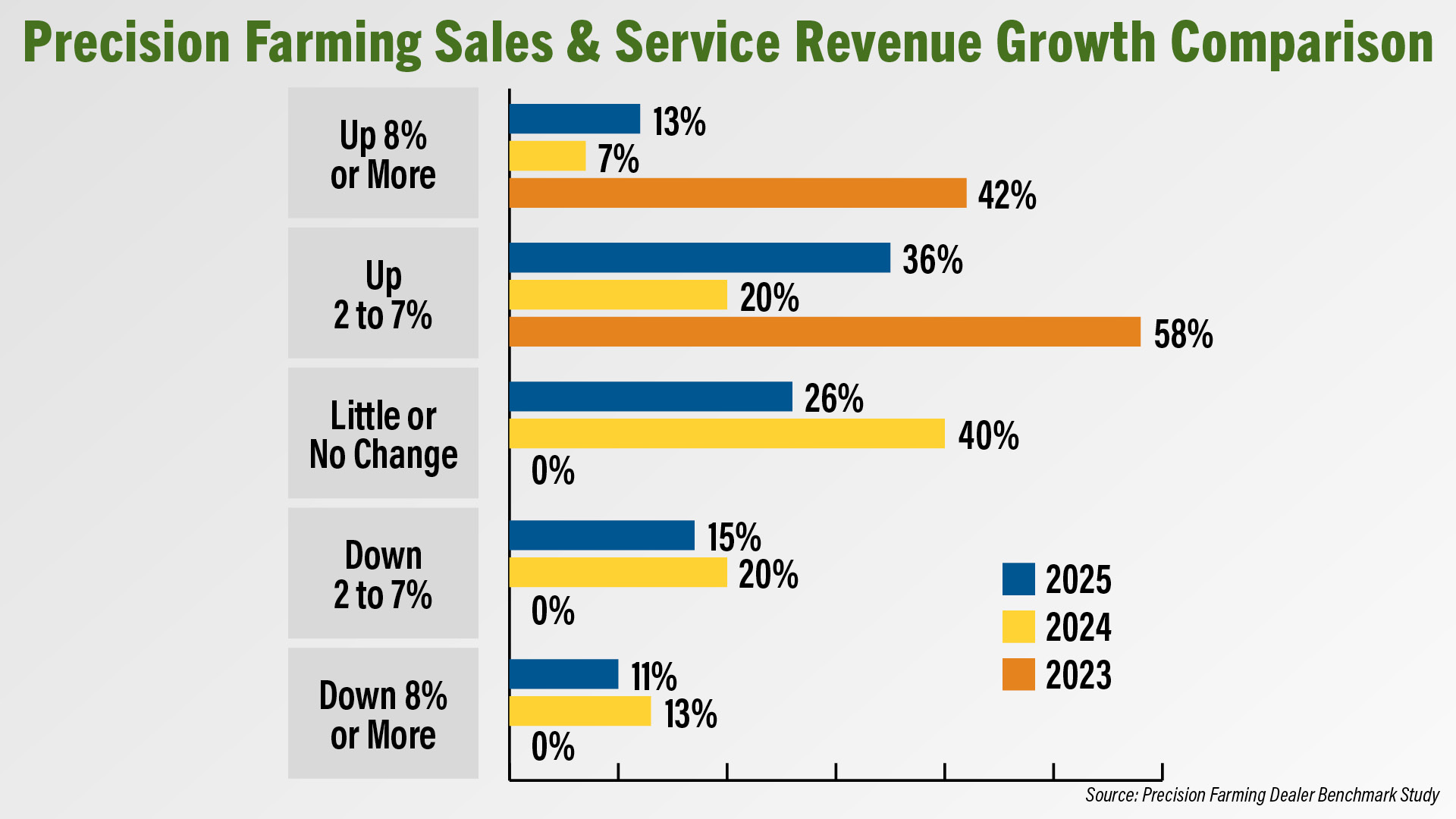
Over 49% of dealers surveyed reported an increase in total precision (sales and service) revenue in 2025, compared to only 27% who reported an increase the year before. Nearly 36% said their revenue was up 2-7%, while almost 13% said it was up 8% or more.
On the other side of the spectrum, about 26% of dealers reported a decline of at least 2% in total precision revenue in 2025, compared to 33% who reported a decline in 2024. Some 26% of dealers saw little or no change in their revenue in 2025.
Looking ahead to 2026, several dealers (42%) are optimistic that precision revenue will improve by at least 2-7%, but many (38%) are still hedging their bets with a forecast of little or no change. Almost 19% predict revenue will decline by at least 2-7%.
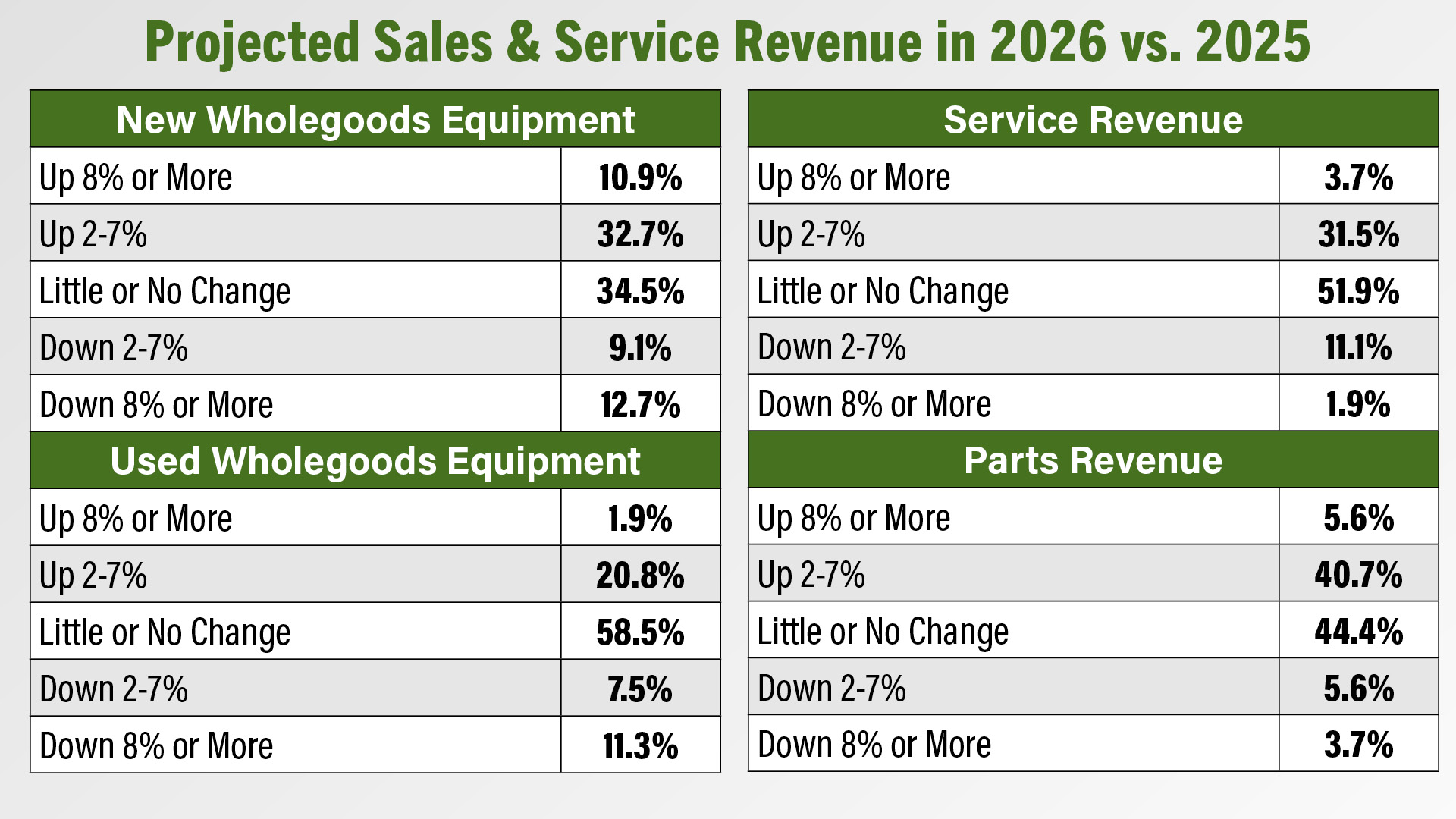
Digging deeper into the numbers, about 33% of dealers forecast new wholegoods equipment sales and service revenue will be up 2-7%, while about 21% expect it to drop at least 2% or more. About 44% forecast little or no change. The used wholegoods equipment outlook is slightly less optimistic, with almost 59% predicting little or no change and only 21% predicting an increase of 2-7%.
Almost 32% of dealers expect precision service revenue to increase 2-7%, while most (52%) forecast little or no change.
Almost half of the dealers surveyed forecast little or no change in parts revenue, while 36% are eyeing an increase of 2-7%.
Look for the complete report in the February issue of Precision Farming Dealer.
OEM’s Highlight Opportunities for Technology & Precision in High Value Crops
In our last episode we shared details from the OEM panel during the Precision Farming Dealer Summit on what CNH, Kubota and AGCO are looking forward to as it relates to autonomy in the ag equipment business.
While much of PFDS focused on technology for row crops like corn and soybeans, there was some focus on high value crops. One attendee asked the panel: “A lot of people in this room and a lot of the OEMs cater to more of the Midwestern U.S. and the corn, soybean markets. And we've seen panels here today or presentations about high value crops and the focus and the data and the precision they need and the amount of revenue those crops generate that we as dealers could capitalize on. What are each of you doing in that area to focus on helping us get that business?”
Nathan Greuel, North American Product Marketing Manager for CNH, said entry level telematics is a good entry point into high value crops, being able to connect the machines and getting data back into the FieldOps ecosystem.
“We do specifically work with a lot of high value crop farmers and producers that are out there,” he said. “We've got some things that are in the works, especially around, we'll call it Sense & Act that leads more toward that autonomy space. But you’ve got to be really good at automating tasks before you get to autonomy. But I would say for sure, things like entry level telematics is something that we focused on with connectivity in this specific high value crop area.”
Joe Michaels, senior director of Kubota North America product portfolios, noted Kubota's investments over the last 5 or 6 years and at the Consumer Electronics Show (CES) this month that for the third year in a row the OEM’s focus was on specialty crops, which he noted as an opportunity for Kubota and an area of focus.
“That's why we have invested in it. I think you've seen the acquisition a little over a year ago for Bloomfield Robotics, which has the sensing devices for vineyards, orchards,
Kubota also recently announced it will be working with another startup, Agronomy, to put a fleet of fully autonomous Kubota M5 narrow vineyard tractors into the field in the first half of 2026.
Jake Ridenour, channel sales management with AGCO/PTx Trimble, echoed much of what Michaels and Greuel said, adding that AGCO is taking parts of what it currently has and delivering it as a strategy into that specialty crop market.
“I cover the Western U.S. and Western Canada, so I've been pushing a lot of that over the last year,” he said. “The autonomy project that AGCO OutRun is also entering into that space as we will start working toward the specialty crop and orchard market with autonomy. And then specifically to the question, it would be spot spray technology as well as path planning in order to have a semi-autonomous solution in those locations.”
Look for additional coverage from this panel and other sessions on PrecisionFarmingDealer.com.
DataPoint: No-Tillers Opt for Smaller Planters
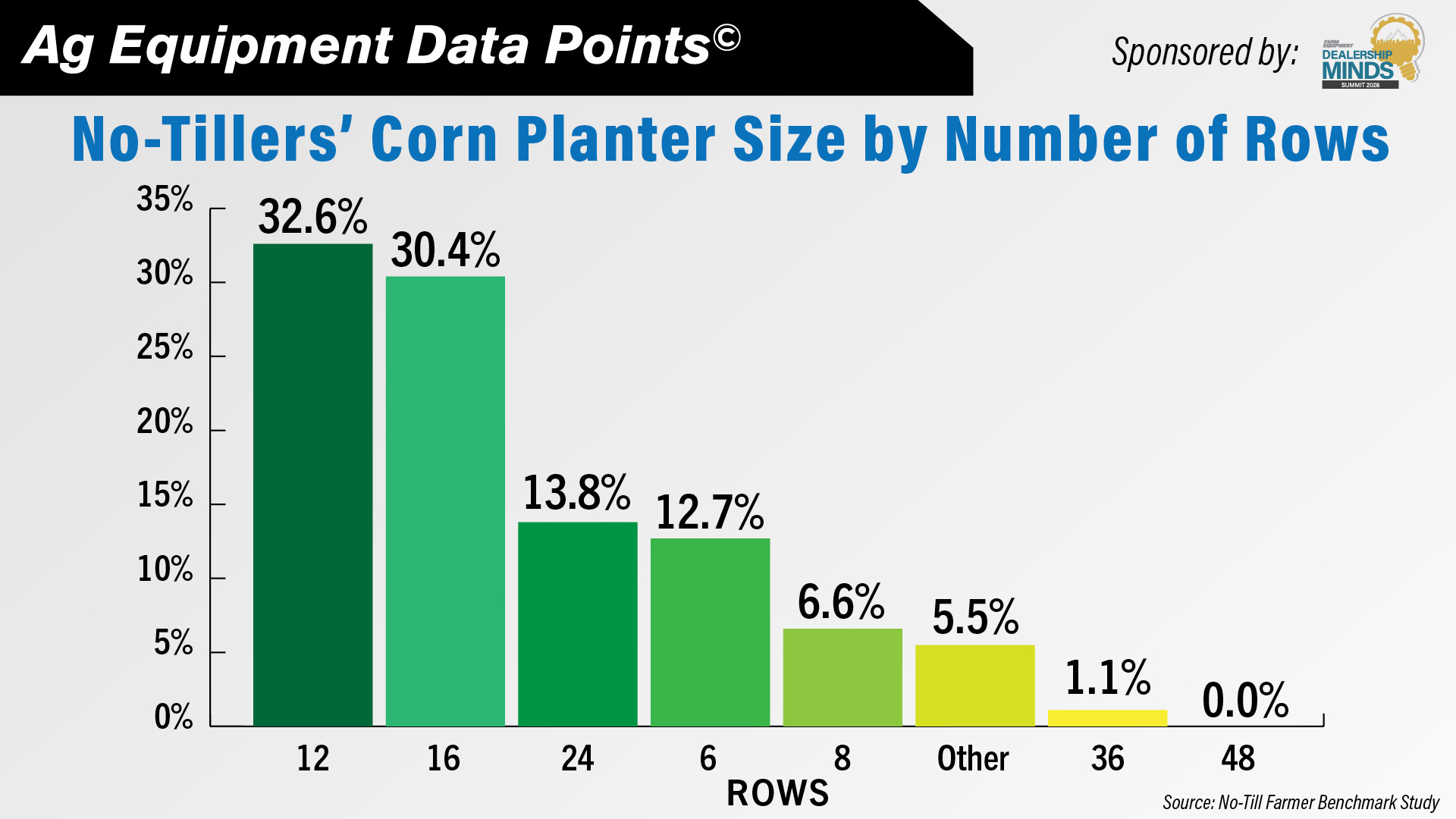
After seeing corn planter sizes grow from 2023 to 2024, the trend flipped in 2025, according to the latest No-Till Farmer Benchmark Study. While the percentage of those with 16-row planters remained roughly the same (30.4%), those running 24-row planters fell 4.4 points to 13.8%, and those using 12-row planters grew 8.9 points to 32.6%.The full benchmark report will be available from No-Till Farmer in February.
On the Record is now available as a podcast! We encourage you to subscribe in iTunes, the Google Play Store, Soundcloud, Stitcher Radio and TuneIn Radio. Or if you have another app you use for listening to podcasts, let us know and we’ll make an effort to get it listed there as well.
We’re interested in getting your feedback. Please feel free to send along any suggestions or story ideas. You can send comments to kschmidt@lessitermedia.com.