Takeaways
- Outside experience matters. It adds maturity, perspective and connections that translate directly back to your store network.
- Successful succession isn’t a handoff, it’s a hands-on process. As your business grows, don’t rely on tradition — build structure. Clear lanes and earned trust are what turn potential into leadership.
- Growth magnifies everything, including leadership gaps. As your business scales, the real work isn’t just strategy, it’s people. Prioritize communication, mentorship and role clarity as deliberately as you do sales targets.
- Don’t assume alignment just because the next generation shares your DNA. If you want your future leaders to work well together, help them lay the foundation early — with clear expectations, honest conversations, and space to build trust.
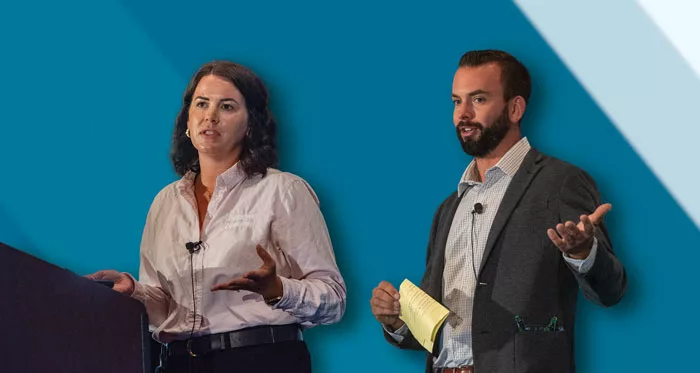
When Kathryn Hesebeck and Patrick Johnson spoke about succession at the 2024 Dealership Minds Summit, it was clear they had no assumption the family business would be handed to them. As third-generation leaders at Johnson Tractor — a now 11-store dealership group serving Wisconsin and Northern Illinois — they’re not just filling their fathers’ shoes, they’re bringing modern vision while learning from the family’s roots. Johnson Tractor was the 2012 Dealership of the Year and is on the Farm Equipment Dealer 100™.
And yes, they’re cousins. Not siblings. Which, as Hesebeck says, makes this even more interesting.
“We certainly do not consider ourselves experts in the industry,” she explains. “However, we are actively living through generational change and executing the Johnson Tractor succession plan. Regardless of the size of your dealership or family involvement, we all have the next generation of leaders coming through.”
She and Johnson didn’t come back to the dealership straight out of college. In fact, that’s a family rule. “You gotta leave to come back,” Hesebeck explains. Both spent years outside the business before professionally joining Johnson Tractor in their own time and unique ways.
Johnson Tractor Fast Facts
Founded: 1980 in Darien, Wis., when Ray Johnson and his son Leo bought Clinton Implement
Today: 11 stores, 200+ employees serving 40 counties in Wisconsin and Illinois
Major Lines: Case IH, New Holland, Kubota
Shortlines: Brandt, Briggs & Stratton, Brillion, Crary, Cub Cadet, Cummins, Drago, Enduraplas, eXmark, Geringhoff, Grasshopper, Great Plains, Hiniker, J&M, Kinze, Kohler, Land Pride, Landoll, M&W, MacDon, Simplicity, Stihl, Trimble, Unverferth, Woods
However, make no mistake — they’re not just here to run the family business. They’re here to grow it. And since 2020, this duo has helped take the company from 5 to 11 stores, added new brands and markets, and learned a few lessons the hard way — like how to manage sales veterans who once saw them in diapers and fix a leaky roof in the middle of a workday.
The Value of Outside Experience
For both Hesebeck and Johnson, returning to the family business began by leaving it. The family strongly encourages the next generation to get several years of outside experience. As Johnson explains, “We had a rough timeline of about 4 years.”
Hesebeck studied ag business at UW–Platteville, and though she grew up around the dealership, it was a college internship at Case IH that sparked her interest in farm equipment. After graduating, she joined Case IH’s Rotational Development Program, spending 2 years gaining and growing skills from a total of 8 departments, building a network on which she still relies.
“There aren’t a lot of women in this space,” Hesebeck says. “That experience gave me confidence — and connections I still use today.”
“There’s no playbook for scaling while learning how to lead. But structure forced us to define our roles and grow up fast…”
Her cousin took a different route and spent many years of his youth very involved with the dealership: stocking and delivering parts, driving forklifts and combines. He then received an economics degree from Yale. Unsure of his next step, Johnson joined Bunge, working in St. Louis, Miami and eventually Russia, where he managed a grain export terminal.
“They asked why I wanted to go from Miami to Moscow,” he says. “I told them nobody else wanted to. And they figured, well — at least he won’t break the Foreign Corrupt Practices Act.”
Working with international producers on deals involving millions of acres, Johnson learned fast — and on unfamiliar ground. That, he says, was the point.
“It was humbling, but I learned how to lead where nobody knew my last name.”
Building Leadership with Modern Vision
When they returned to Johnson Tractor, both he and Hesebeck brought confidence, maturity and an outside-in understanding of the business. Yet, they had to build credibility at the family business on their own, starting from the ground up.
“Coming back as an adult meant proving myself again — just in a different way,” Johnson says. “I always thought it was a fantastic way to grow up and I loved the time with my family at the dealership.” An opening was available in one of the Illinois stores, and that is where he started.
For her part, Hesebeck took a sales opportunity at a satellite location, and they each started being mentored by their dads and CEO/President Eric Reuterskiold.
That approach paid off when the business grew. In 2020, Johnson Tractor expanded from 5 to 9 locations, and the growth forced a shift from informal operations to a more defined leadership structure. Since then, 2 more stores have been added. With over 200 employees and a vastly larger footprint, Hesebeck and Johnson had to step into formal leadership — but with roles that made sense for who they were, not who their fathers had been.
Learn More Online
- [Video] Growing with the Business ... What the Next Generation Learned from Rapid Growth
- What If & What Was: Reflections on Our Journey ... Johnson Tractor
- Women Add a Different Perspective to the Sales Process
Access this exclusive content by visiting Farm-Equipment.com/0725
She now leads the sales team and sales processes, bringing structure, coaching and accountability to the multi-store operation. Meanwhile, he manages inventory, wholegoods and ordering, navigating supply chains across regions with vastly different farming profiles — from cash crop to dairy and hay.
“We’re not going to be exact replicas of our dads,” Hesebeck says. “We have our own shoes to fill.”
“There’s no playbook for scaling while learning how to lead,” Johnson adds. “But structure forced us to define our roles and grow up fast.”
Today, their complementary strengths, along with the guidance of Reuterskiold, allow them to lead confidently — on their own terms, and with the respect of their team. They report directly to him, and are grateful for the preparation they’ve been given while growing in knowledge of the day-to-day operations.
Growing & Building
Hesebeck and Johnson didn’t just grow into their leadership roles at Johnson Tractor, they grew into the responsibility of managing people across an 11-store operation. And like most owners/managers will tell you, the people part is the hardest part.
Johnson says he learned that lesson fast.
“One month in, someone came up and said, ‘Hey Patrick, the roof is leaking,’” he remembers. “I’m like, ‘What do I know about roofs?’ But they said, ‘Well … fix it.’”
He also faced tough calls when trying to fill technician roles.
“We went out on a limb for a few people we shouldn’t have. And not parting ways quickly enough was very dangerous,” he explains. “Another good lesson learned.”
For Hesebeck, the learning curve wasn’t so much in the systems, it was in the personalities.
“I lived through the teenage girl years,” she jokes, “but working with some of our employees can be even more challenging than that.”
Those Who Grew It
Leo Johnson: Co-Founder, Sales Director, and Patrick Johnson’s Father
Leo helped build Johnson Tractor from a single-store location into a regional player. He played a critical role in preparing the third generation to lead, retired in 2021 but remains a strong influence.
Eric Johnson: Second-Generation Leader and Kathryn Hesebeck’s Father
Eric worked closely with Leo through decades of growth, bringing operational continuity and deep dealership knowledge that helped shape Kathryn’s leadership path.
Eric Reuterskiold: President/CEO
Eric joined the ownership and leadership team prior to the third generation’s return. A key architect in the company’s expansion from 5 to 9 stores he brings expertise in parts and service operations, complementing their focus on sales and inventory.
As the company grew, their focus had to shift from pitching in everywhere to building teams, defining roles and strengthening communication across locations. In that process, they know one of their greatest assets was having access to experienced mentors — people like their fathers, Leo and Eric Johnson, as well as Reuterskiold.
“We can have a lot of honest conversations with great mentors,” Hesebeck says. “There’s really no such thing as a stupid question.”
“We report to Eric and fully support everything he’s doing,” Johnson adds. “By no means do we want to cut the legs out from under him by going around. That doesn’t further the goal of the company.”
The key to this all: communication.
“We’ve had to become much more deliberate about taking the time to sit down, shut phones off and get on the same page,” he says.
‘We Had to Figure It Out’
“We are not siblings, therefore we did not have the privilege of growing up in the same household or really having that sibling communication,” Hesebeck explains. “In fact, we probably didn’t have much communication throughout our college and post-college or initial careers.”
Knowing this, Leo Johnson (Patrick’s father) met with each of them individually before they rejoined the company. He asked what they wanted, what they expected from each other, and how they envisioned their future roles. That early groundwork helped avoid tension — and gave them space to be honest.
“That was the time that we really got to lay it out,” Hesebeck explains. “‘Hey, we want to grow. I expect XYZ,’ and if we’re going to be 50-50 partners in the future, we have to start establishing that groundwork.”
Still, transitioning into co-leadership took time. They were both highly driven. Both used to leading, and both with something to prove.
“I wish Patrick and I would’ve had more of a relationship coming into the business,” she adds. “Finding our groove took a little bit.”
Their alignment eventually came from a shared vision: growth, sustainability and a dealership culture built on trust — not family expectations or assumptions.
Together, they have grown to have the same level of transparency with the Johnson Tractor staff members too, openly sharing the ups and downs of this transition process. Johnson says they all spend so much time together, that alone makes a big difference. Plus, some of the long-time employees saw them in diapers, he says with a laugh.
“It’s a huge benefit for the company too,” Johnson notes. “We’re very transparent and always will be. We care deeply about the employees and want to make this successful. It’s those employees who have really helped us build to this point, and recognizing that is important.
Building a Lasting Legacy
The Johnson Tractor story isn’t just about keeping the business in the family. It’s about building and sustaining it — strategically, humbly and with a pulse on what really matters: people and purpose.
As Johnson puts it: “You only have to do 40 years of groundwork before the next generation looks like geniuses.”