Last fall, when the North American Equipment Dealers Association (NAEDA) and Associated Equipment Distributors (AED) announced their intention to work more closely together, I wrote in these pages that it represented an important step toward something our industry has needed for a long time: a stronger, more unified voice for equipment dealers.
At the time, I described that agreement as a starting point rather than a final destination.
We now have a clearer picture of where that road may lead.
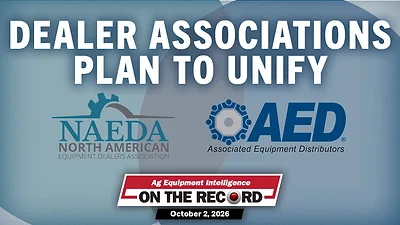
NAEDA and AED have announced in a press release that they plan to merge their operations and create a single organization serving agricultural and construction equipment dealers across North America. Subject to the considerable work still ahead, the combined organization would operate as Associated Equipment Dealers.
I believe this is a positive development for dealers and a natural evolution of what both organizations started last year.
But there is an important distinction that should not get lost in the announcement:
This is a merger. It is not a takeover of one over the other.
The objective is not to eliminate the strengths or priorities of one organization in favor of the other. It is to combine the best capabilities of both and build something stronger.
That is reflected in the proposed governance structure, with equal representation of agricultural and construction equipment dealers on the board.
It is also reflected in what each organization brings to the table.
NAEDA has built considerable expertise and credibility in manufacturer relations. Dealer agreements, OEM policies, warranty reimbursement, succession, market representation, right to repair and the many other issues defining the dealer-manufacturer relationship require specialized knowledge and strong relationships.
That work will continue — and importantly, can expand further into construction equipment dealer-OEM relationships.
AED brings another significant strength: policy development and government affairs. At a time when tariffs, trade policy, workforce challenges, taxation, regulation and rapidly changing technology can directly affect dealership profitability, having a sophisticated and well-resourced government affairs capability is increasingly important.
Put those two strengths together — manufacturer relations and government relations — and the potential becomes apparent.
I Have Seen This Movie Before
Perhaps I look at this announcement somewhat differently because I have been down this road before.
A significant part of my career in the dealer association world involved trying to answer a fairly simple question: Why should equipment dealers maintain multiple organizations, duplicate resources and sometimes speak with different voices when they share so many of the same challenges?
For many years, dealer representation was fragmented among regional associations. Each had its own history, board, staff, programs and identity. Those organizations did good work, but the structure increasingly did not reflect the industry itself.
Dealerships were becoming larger, multi-store and multi-state or multi-province. Manufacturers were operating nationally and globally. Government policies affecting dealers increasingly crossed borders.
Yet dealer representation remained largely regional.
The work of bringing those associations together — ultimately helping create today's NAEDA — was not always easy. Associations have histories and cultures, and people understandably become attached to names and structures.
But the objective was never consolidation for consolidation's sake.
The objective was to build a stronger organization for dealers.
The principle was straightforward: combine resources where it makes sense, eliminate unnecessary duplication, preserve what works and create enough scale to accomplish things individual organizations cannot do as effectively on their own.
In many ways, the proposed NAEDA-AED merger is the next evolution of that same idea.
The earlier consolidation brought regional dealer associations together into a stronger North American organization. This next step has the potential to bring agricultural and construction equipment dealers together under a broader umbrella while maintaining meaningful representation for both.
The industry has evolved. Dealer representation should evolve with it.
Scale With Purpose
Strong associations require resources.
Effective manufacturer relations require experienced people who understand OEM programs, dealer agreements and dealership economics. Government relations requires policy expertise and relationships with decision-makers. Training, workforce development, research, legal support and communications all require investment.
Two organizations maintaining separate infrastructures inevitably creates some duplication.
Combining their assets and capabilities creates an opportunity to redirect more resources toward activities that directly benefit dealers.
That doesn't mean bigger is automatically better. Size without purpose accomplishes little.
But scale with purpose can be powerful.
A combined organization should have greater capacity to invest in research, advocacy, manufacturer relations, education and dealer support. It should also bring greater weight to the table when dealing with an OEM or explaining an industry issue to policymakers.
There is strength in numbers, but there is even greater strength in speaking with a clear and consistent voice.
Agricultural and construction dealers also have more in common than we sometimes recognize. Both are capital-intensive businesses. Both depend upon productive OEM relationships. Both face technician and workforce shortages. Both manage increasingly expensive inventories. Both are navigating consolidation, new technology, data and artificial intelligence.
And government policy rarely respects the traditional boundaries between our sectors.
Trade policy, tariffs, taxation, emissions requirements, workforce regulation and right-to-repair legislation can affect agricultural and construction dealers simultaneously.
On those issues, dividing the dealer voice makes little sense.
The Work Is Not Finished
Many details still need to be worked through. Governance, staffing, finances, programs, member services and organizational structure will require careful consideration.
Dealers should ask questions and understand how their interests will be represented.
But we should also avoid judging the proposal simply by what name appears on the door.
The more important question is: Will the organization that emerges be more capable of serving dealers than the two organizations operating separately?
That was the test we applied when consolidating the regional associations that eventually became today's NAEDA. We weren't trying to build a bigger association. We were trying to build a better one.
The same test applies today.
Preserve NAEDA's strength in manufacturer relations and expand it into construction dealer-OEM issues. Preserve AED's strength in policy and government affairs. Give agricultural and construction dealers equal representation. Combine the resources of both organizations and direct them toward serving dealers.
Last fall, I wrote that dealers don't benefit from divided representation; they benefit when associations coordinate efforts, share resources and amplify one another's strengths.
This new effort takes that principle to its logical next level.
Years ago, we asked regional dealer associations to look beyond their individual histories and consider what we could build together. That process ultimately created a stronger NAEDA.
Today, NAEDA and AED are essentially asking the same question on a larger scale:
What can we build together that we cannot build separately?
For equipment dealers across North America, that is the right question to be asking.
This proposed merger is the next evolution of an idea that began years ago: dealers are stronger when their associations combine their strengths, concentrate their resources and speak with one voice.
If the final organization remains true to that principle, dealers — and the equipment industry as a whole — will be stronger because of it.
Related Content: NAEDA and AED Announce Merger to Create a Unified Voice for Equipment Dealers