The latest iteration of the familiar LASCO Lighting Weeder offers some significant upgrades to the design of machines the company has fielded since the 1980s. The refinements allow the LW-10 to electrocute more weeds more efficiently with working widths up to 44 feet. Plus, new digital controls make it easier to use and service.
The company introduced electric-shock weed control to North American farmers with its LW-5, a domestically-produced PTO-driven, pull-behind generator which energized a 24-foot transfer bar mounted on the front of the tractor to desiccate weeds. The new LW-10 now being produced at LASCO’s Ottertail, Minn., is a significant upgrade designed to better match the taller PTO shafts of higher-horsepower tractors common across North American farms today, plus its beefier components allow working widths up to 44 feet.
“The LW-10 requires at least 130-horsepower and because we’ve redesigned the on-board V-Belt transmission to utilize the power of larger tractors, the system can generate from 175 to 350 Volts,” says LASCO CEO Kevin Olson. “Through our patented electric discharge system (EDS) the generator’s output can be infinitely varied by the operator from 60-600 amps from the cab to match plant and canopy conditions for the best discharge through the weed – killing it instantly, stem to root, without chemicals or residues.”
The copper transfer bar generally passes current to the plant with up to 12 amps riding around 20,000 volts, instantly boiling water in the weed’s vascular system and rupturing the cell walls with steam pressure. The circuit is completed as the roots are grounded in the soil which is in contact with a pair of newly-designed grounding coulters trailing the generator platform. The swiveling grounding castors allow better grounding in uneven terrain than the older rigid system.
Depending upon field and crop conditions the LW-10 with a 30-foot transfer bar easily treats 15 acres per hour with effective speeds ranging from 1 to 5 miles per hour, Olson explains.
He says the redesign began several years ago when the manufacturers of the circuitry in the controller of the older machines decided to not update their obsolete products.
“That presented a perfect opportunity for us to redesign the whole system starting with a new digital Human Machine Interface (HMI) controller to make it easier to service and more capable at responding to implement-to-tractor data movement,” he explains. “The older machine had a single motherboard and if it failed, the entire controller circuitry had to be replaced. Now, we use a single programmable logic controller (PLC) and each function of the system – speed sensing, transfer bar orientation, generator output, EDS voltage, etc.-- has its own microchip.
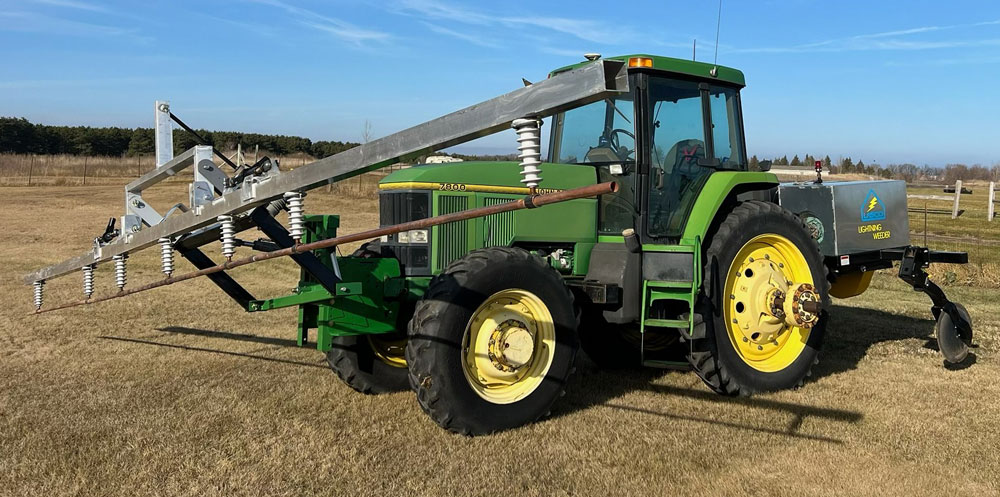
ARC LIGHT WEEDING – LASCO’s new LW-10 Lightning Weeder ends weeds with a chemical-free flash with new digital controls and an upgraded PTO driveline designed to match high-horsepower tractors. The redesign leads the way for a similar, smaller machine capable of working in 5-foot widths, catering to small farms and tight operating quarters such as vineyards and orchards. Photo by LASCO
“With the decentralized controller system, growers can easily swap chips in the shop or field if they fail,” Olson explains, noting to date, the system has proven resilient and trouble-free.
The new model also features an all-new aluminum shroud for easier service access.
Safety System
While inside the cab, the operator is not in danger of encountering the machine’s potential, and wears a tether to ensure the machine shuts down if he or she leaves the cab.
“We also have a big red strobe light on the back that flashes as soon as the machine is energized to warn bystanders; and for the system to energize, the machine must be down on its coulter blades and moving forward at least one-half mile per hour. We’ve done everything we can to isolate the operator from anything that could happen.”
Olson says the machines have been used on various vegetable crops and organic soybeans to control many weed species, including tough kochia and palmer amaranth. The Lightning Weeder is also useful behind other broad-acre crops where other weed control methods have allowed escapes.
For high-value crops like berries and grapes which are cultured in narrow rows on small-acreage farms, Olson says LASCO has prototypes of a machine under development capable of working within a 5-foot width. That design will enable a transfer bar up to 12-14 feet wide and require only a 40 horsepower tractor.
“These are for growers with 3-5-acre operations,” he says. “Many have annual returns of $250,000 or more from their physically smaller enterprises and face the same weed and labor problems as much bigger farmers,” Olson explains.
He says LASCO continues to develop a North American dealer network while also marketing the machines through the company’s website: lightningweeder.com