Takeaways
- Invest in ongoing employee training: Provide continuous seasonal training, cross-departmental experience and structured development for staff to build knowledge and capability at all levels.
- Transition to regional management structures: As a dealership grows, a shift toward regional structure and shared corporate resources can bring leadership closer to the team.
- Open-book management to create financial literacy: Sharing financial information and operating budget transparently can ensure KPIs are tied to metrics they can directly understand and impact.
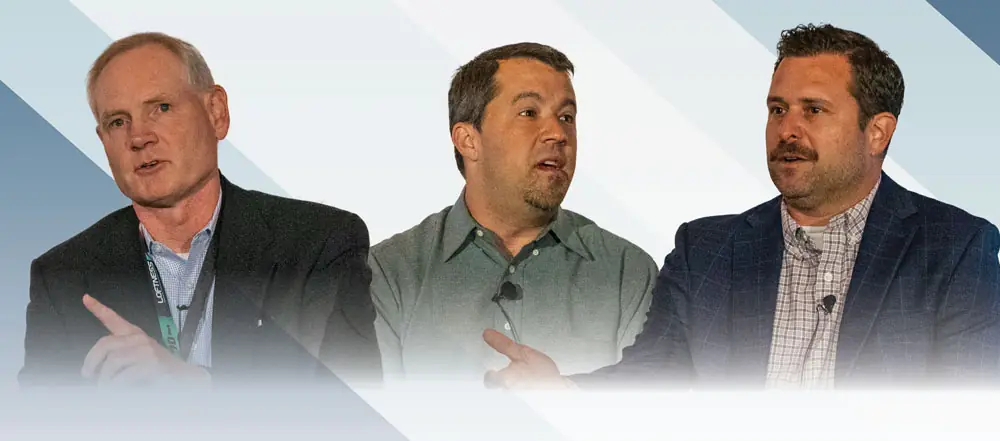
At the 2026 Dealership Minds Summit, we sat down with a distinguished panel of Farm Equipment’s Dealership of the Year alumni. The session featured insights from 3 industry leaders: Neil Messick of Messick’s Equipment (2026), Michael Van Houweling of Van Wall Equipment (2016) and Brady Foster of Birkey’s Farm Store (2007).
What are each of your dealerships doing to grow and train upcoming leaders and managers across the business?
Messick: For us, there’s two aspects.We’ve done a couple of rounds of corporate leadership training. The first round of that was an open call to anybody who wanted to come in and learn a little bit more about dealership operations. 15% of our staff chose to do that since it is an opt-in thing. Not a big commitment. It was about two days worth of classroom learning on dealership ethics philosophies and some basics of tracking KPIs. We followed that up with more in-depth departmental training. Our third round of this, which we haven’t done yet, is to start cycling people through departments that they don’t necessarily work in. We’re taking a pretty broad approach to this and including the whole company in it.
Meet the Panelists
Michael Van Houweling: COO of Van Wall Equipment. Since the 1980s, the dealership group in Iowa has grown to 16 ag stores and 22 total locations.
Neil Messick: Co-owner of Messick’s Farm Equipment. Messick’s Farm Equipment was founded in 1952 by brothers Merville and Marlin Messick. Neil is part of the third generation of family owners.
Brady Foster: President/CEO of Birkey’s Farm Store. Birkey’s started as a small Illinois shop in 1954 and has grown into a 100% employee-owned network. Foster became CEO in 2024.
Another thing we’ve been proactive about is that we have trainers in our parts and service departments that are continually doing seasonal training with people. We’re still trying to build people up way past the years that they were. If you go back a decade ago, it felt like you got one day of computer training and then you were off on your own. We’ve definitely seen the value in continuing to invest in people’s knowledge as they join the dealership.
Van Houweling: Leadership development has started with making sure we get the right people on the team. We’ve had a renewed emphasis on the effectiveness of recruiting talent that we believe can be managers and leaders someday. We have a very specific program with Iowa State Univ. and other universities around Iowa to be on campus and try to find those candidates who have a passion for what we do and seem to have the competency to become a manager or leader someday.
The other part of our overall approach has been very heavy on the on-the-job development. Our leadership team would go around to every one of our locations and spend an hour every month going through the business and financials and figure out what we need to do to get better. So there was a lot of on-the-job training that we accomplished through that effort. We now do that quarterly because we have a regional management structure in place that does that monthly. The third part is more formal training. Our focus has been more what you would consider manger 101 training, making sure that our managers, especially new managers, know the basic blocking and tackling of being a manager. We will enhance that over time with what I think will look more like true leadership training.
Foster: Leadership training starts with identification of the individual and whether that’s a candidate that you’re trying to hire or is somebody that you have already employed. We try to identify those people in the organization who have the ability and desire to do more with the company. Then we try to bring them along and give them additional tasks and test them to see what kind of critical thinking they can do, how fast they can be on their feet and how much ownership they take. We should be going out and hiring 10 college graduates and putting them in a training program.
Last year absorption was a big topic at this conference. Now you’re talking about investing in the future, but also adding more overhead to the business. It’s a balancing act of getting good people and finding ways to keep them productive. We brought a few interns in and we’ve given them tasks. We’ve had around 6 or 7 over the last 3 years. We’ve realized that you can’t just bring an intern in and give them a job and expect them to remember that. They have to have somebody who owns the individual and task, is responsible for that person and manages the projects through it because they need a lot of help and guidance. We’re getting better at fine tuning what an internship looks like. In today’s world, interns are finding their internship now for next summer. If we wait till January or February, we’re behind schedule. It’s early on in that process, but it’s been good to see some people come in with different educations, different thinking and layer them into what we’re doing.
We’re big supporters of these technical programs for technicians where they go and get associate’s degrees. We run 15 or 20 a year through those programs. But what we see is they’ve got an associate’s degree, they’re educated, they want to do more and they grow. We see these people now in parts manager roles, service manager roles, regional manager roles and corporate manager roles. They want more. They’re not happy with where they’re at. Those are the people we have to make sure we identify and challenge and bring up to the level that they need to be at. It’s been interesting to watch these technicians work their way through our organization and look at where they’re all sitting at today. Around 60% of them are still turning wrenches, but there’s around 10% who are in some kind of manager capacity today.
As each of your dealerships have grown over the years, how has that structure evolved at your business?
Van Houweling: For us, we did go through some relatively rapid growth. In 2014, we had 5 dealerships that sold agricultural products. We now have 26. We ran our business more like a 5-location dealership for quite a while. A few years ago, we transitioned to what we now refer to as our regional management structure. We wanted more leadership closer to the team. Similar to what Brady was talking about, seeding the consistency of how we do what we do. The change that we made in our business was to go to a structure where from an operating perspective, we essentially have 3 regions, plus a golf and turf division. We have four folks who are really driving the P&L execution for our business for their region. Those regional managers are responsible for all the departments. Each location they’re responsible for also has a manager that supports and leads, but is also responsible for the overall employee and customer experience at their location. They have responsibility for the P&L for their location. We also have functional leaders for things such as precision ag, accounting, finance, marketing and IT. We functionalized those, including HR. For HR and precision ag, we have regional support folks who are embedded in these regions. As you would expect, we do have centralized functions for parts and service. But that’s what we’ve moved to, to help coach, develop, bring consistency and get the leadership closer to the team itself.
Foster: We’re not much different from what Michael talked about in that structure. How we got there, back in time, we had 6 facilities and 8 owners in the business. Every owner was sitting in a dealership and managing it. That person had the grit, resilience and passion for the business. It worked out really well. What happened was as the owner started to retire and the business started to slowly grow, we ended up in a spot where we had 5 owners and 19 locations. Between the two, we morphed into what Michael was talking about where we have regional managers overseeing things. As owners started to retire, we had to start trusting employees who were not owners in the business to act like owners, think like owners and give them the responsibility of running the dealership.
Gain more insight
As we transitioned to that, we had 100 employees, and then we had 200 employees, and then we had 300 employees. We thought we may need to be entertaining the idea of an HR department. We also had to be thinking about separating our accounting and our business intelligence departments apart from each other. We grew into this shared resource center that we have today. A lot of us are in this model where we don’t have accountants at every location. We have somebody that handles money and invoices and we have accountants in our corporate office. You have 2 or 3 accountants who are supporting all these other locations and somebody still manages some of those other skills at the location, but not necessarily dealing directly with the banks, checking accounts and paying major bills.
From an operational standpoint, it’s always slowly gone into this, but where we’re at today is having three regional managers for the three areas we have. They’re responsible for the P&L of all those locations. Then we have the support team underneath them where we have a director of sales and people who work for him. Their job is to help drive sales. The salesmen don’t work for those people, but their job is to help close deals, find prospects, identify aged equipment and identify buyers. Same thing in parts and services. We have these specialized roles because we can expect our regional manager, or even our store manager, to understand every little tick with warranty and parts returns. These specialized roles support and assist that.
It all started with the fact that we had to trust people who were not financially hung on the business with a personal note or guarantee. It worked out well. We find the right people. People who act and think like owners, those are the ones you want to take with you. The people who are heavily invested in the business, even though they don’t have a financial gain or loss to get from the success or the failure of the business. As you identify those people, talk about leadership. Those are the ones who have carried us as far as we are today. Some of those people are here with us today, but it’s that trust factor, giving them a little bit of rope to make decisions, and they give their people rope to make some decisions. You will morph into where a lot of us are today.
How have each of you worked with your teams at all levels to have some of that financial literacy to understand how what they’re doing is impacting the business’ success and bottom line?
Messick: We’ve spent a lot of time on this lately because this regional thing is new to us. As we’ve rolled this process out, we’ve gone through and tried to identify not just KPIs for the business and things we’re watching, but KPIs that are done in a way that people can actually impact the numbers. When they do the right things, numbers make sense and move in the right way. In the past, we’ve found ourselves really wanting to throw reports in front of people and say, “Oh, do better with this. Impact this.” But the numbers were never really done in a way that the person saw the clear path to impacting those metrics. So that for us has created big moves in the way our business functions.
Van Houweling: Our regional managers and department managers at each location present what they think is their operating plan, their operating budget for the year that we agree on together. Our job is to then have our regional managers review where they’re at with those plans every month. Our leadership team spends time at each location every quarter reviewing where we’re at. There’s a lot of coaching and teaching that happens through that process organically when we have those discussions 4-5times a year. There are regional managers who are well equipped to have the same discussions with them or having those discussions at the locations monthly. Many of us are also working on a dashboard to do comparisons and get the day-by-day operating data and financial results in front of the team. But it’s really that monthly, quarterly and annual budgeting process for us where we accomplish most of our business acumen development.
Foster: We have a financial call every month with our store managers and local leadership. We’re an open book to all of our managers and share all the financial information with them. More importantly for us, it’s the context behind it, because the people that you’re trying to get to manage the numbers are not necessarily accountants. They’re driven by sales and customer relationships. You can show them all the numbers in the world, but you have to put something behind it or else it doesn’t mean anything to them. We’ve got the dashboard and everything feeding into it and you can spend days getting lost. You have to point out, here’s the number that’s important. Here’s the KPI we need to move and here’s how we move it.
We’ve done a really good job in the tough market for the last 3 years. When there’s a deal that pops up and one of the units that’s been paid for inventory, they understand more than just selling the piece of equipment. They understand the best interest costs of that piece every month. They understand what kind of a deal we can get? What’s the score? What do we have to do to get this moved? They understand our borrowings, too. There’s a lot behind the scenes that our accountants deal with everyday that we’ve done a really good job of sharing with the people that make it happen. They understand the impact and what we need to do. If we’re in a spot where we’re not borrowing any money, the piece isn’t aged and we don’t need to take a thin deal on it. But if we’re in a spot where paid inventory is elevated and this paid for piece we’ve had for 300 days with 16 quotes on it and we haven’t sold it yet, something’s wrong. We have to do something about it. It’s a lot, but it’s identifying those numbers that need attention and then getting the action behind what moves that needle.