In just 7 months, Messick’s Farm Equipment experienced a time of unprecedented growth, from 5 stores to 9. We added 3 locations in March 2025 and another that October. In both acquisitions, the previous dealers had open houses scheduled 2 days after our changeover date. We decided not to cancel them.
That meant switching business systems, training employees and preparing the stores to welcome customers almost immediately. Professionally, it was one of the coolest things I have seen in my career. The showrooms were filled without the teams getting buried. It spoke volumes about our people and showed just how much more scalable the dealership had become.
What was not visible that day was the hard work it had taken to get there. We had spent years recognizing the limits of our existing structure and figuring out what needed to change. We did not develop a new capacity, however, simply by adding another layer to the organizational chart.
As we grew, much of our leadership and operational knowledge still lived at our central hub, while the people sent out to support other locations were already carrying responsibilities of their own. They could respond when something became urgent, but it was difficult to provide the consistent coaching and attention every store needed.
We became much more intentional about what should remain centralized, what authority needed to move closer to the stores and where regional leadership could provide better support. Our organizational structure will not fit every dealership, but the questions we worked through may help other dealers recognize when their own management model is beginning to limit their growth.
From 1 Store to 5
Messick’s roots date back to 1952, when my grandfather started the business. The dealership opened in 1953 in Middletown, Pa., and later moved to Elizabethtown. There was an apartment above the original dealership, and I spent the first 2 years of my life living there. That probably tells you how closely the family and business were connected.
My dad, Bob, and my uncle, Ken, ran the dealership for years. They are still involved today and while their version of retirement includes more vacations and time in Florida, when they are home, they are usually at the store cutting grass, running errands or doing the banking.
“A regional leadership model didn’t mean abandoning everything about the hub-and-spoke approach…”
During the early years, our family presence was the sole management system. The family carried much of the
departmental knowledge, provided direct oversight and knew what was happening because they were physically there. As a single-store business, it worked.
Our first major structural change came in 1996, when we opened a second location in Abbottstown. Once it became clear that the third generation was committed to the dealership, we added Halifax in 2010, Carlisle in 2011 and Bendersville in 2014. That brought us to 5 stores.
The structure that emerged was essentially a hub-and-spoke model. Much of the leadership and expertise remained at the large home store, and corporate managers traveled to the satellite locations to provide support and guidance.
That model helped us grow, but eventually it reached its limit.
Where the Model Broke Down
Under the hub-and-spoke model, store managers did not always have complete authority. Someone from the hub might arrive and overrule a local decision, which didn’t always go over so well. We even heard jokes that when somebody from the hub showed up at a satellite location, it must mean somebody was getting fired. Ouch!
The larger problem was that the corporate managers
supporting those locations still had responsibilities at the main hub. Day-to-day fires always pulled them in many directions. They responded when something became urgent, while a store that seemed to be running well might go too long without coaching or attention.
Our people kept the stores moving in the right direction, but the unsteady organizational structure made us reactive. We could operate that way, yet were not getting the consistency we wanted (and needed) across locations.
We saw gaps in the model long before we changed it. I am sometimes a man of action, and tend to move too quickly. Fortunately, I have family members who slow me down. There were several times when we could have tried to do too much, too fast, but thankfully it takes people of many talents to run a business.
The truth is we did not yet have a clear picture of what should replace the old model. We were not sure the right leaders were ready for new positions. We are financially conservative and did not want to add overhead before the company could support it.
We had also previously tried changing the organizational chart without changing anyone’s behavior. That was not always successful, since a different title or reporting line does not automatically change how decisions are made. Some processes were not standardized enough to be managed consistently across stores. Like many dealers, we knew things were not quite right before we could clearly define the problem.
Looking back, I am glad we did not force a new structure before the company was ready. Waiting did not mean ignoring the problem, but it did give us time to figure out what the next model needed to accomplish.
Designing Around Workflow, Not Titles
After the COVID-era equipment boom, acquisition opportunities began coming to us again. We knew another growth phase was possible, so started planning.
We looked at where daily fires were keeping leaders from working on the business. We also talked with dealers and other peers about how larger organizations operated. What did they centralize? What did they regionalize? How did they separate company leadership from day-to-day work?
Then we mapped our workflows.Instead of starting with names and putting people into boxes, we listed job responsibilities, and considered how information and decisions should flow. That process helped us separate three areas: family stewardship, company strategy and daily store operations.
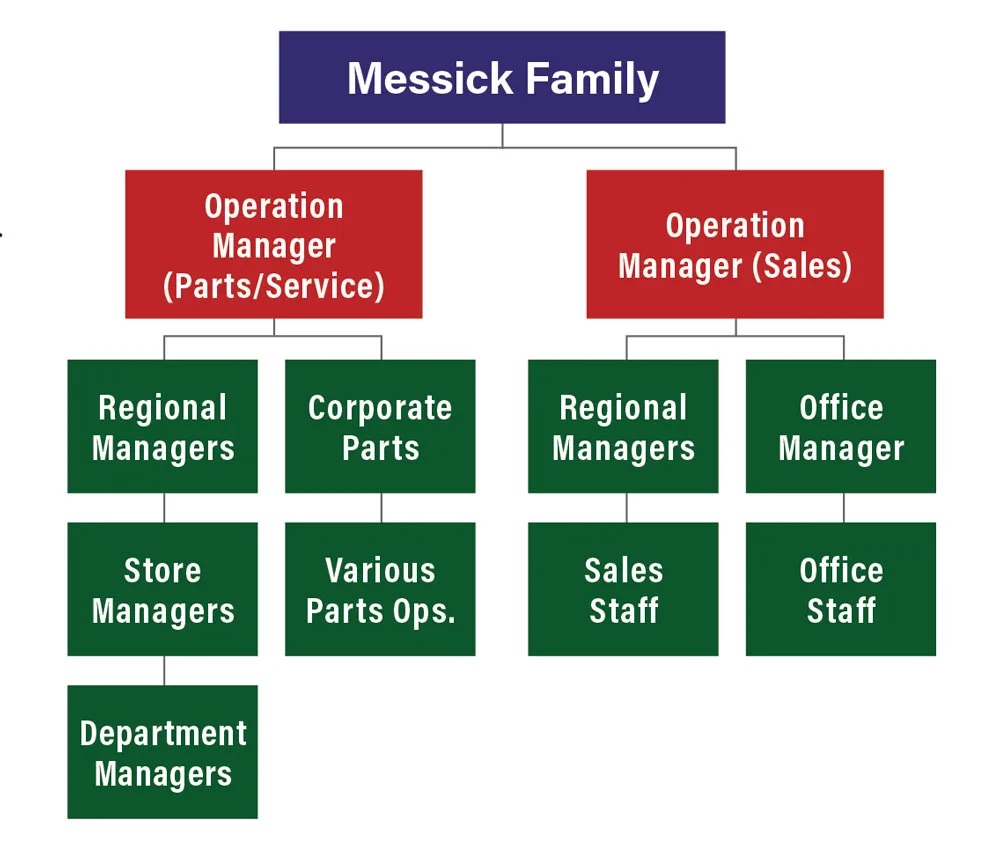
Today, the Messick family functions more like a corporate board. We provide direction and stewardship, but are not supposed to tell every employee how to do a job each day. Family members also work within the structure. I may be an owner, but I still report to people in my own company and take direction from them. We do not view the 3rd generation as the “end all and be all.”
Two operations leaders provide direction across the company. One focuses on parts and service, and the other is deeply involved with sales. Regional managers then support groups of stores and work with store and department managers closer to the daily business.
An Effective Regional Leadership Approach
Our aftersales regional managers oversee parts and service. Those departments work closely together and share many processes. Across 9 locations, parts and service look fairly similar, so those regions can be organized mainly by geography.
The regional leaders concentrate on numbers, processes and consistency. Each is responsible for 3 or 4 locations and visits those stores regularly. They are no longer trying to escape responsibilities at the hub every time they travel. That regular face time helps them build relationships, coach managers and carry good practices from one location to another.
Sales is different. I sometimes describe it as the Wild West. Customer types and product needs vary across our territory, so sales regions must be organized around customers and markets rather than geography alone.
Learn More
To watch Neil Messick’s full presentation and others from the 2026 Dealership Minds Summit, visit Farm-Equipment.com/DMS26videos
The 2026 Dealership Minds Summit Video Replay is brought to you by Aptean.
We are still working through that part of the model. Our first regional sales manager is in place, and we are developing the KPIs needed to manage the role effectively. Once we have it buttoned up, we plan to add more. We do not want to put someone in a position simply because a box exists on the chart.
A regional leadership model didn’t mean abandoning everything about the hub-and-spoke approach. We continue to centralize office-heavy services at our current Mount Joy hub, including parts ordering, warranty filing, whole goods ordering, human resources, payables and receivables. Most satellite locations are staffed primarily with employees serving customers in parts, sales and service rather than duplicating clerical teams.
This intentional setup made the 4-store expansion far more manageable. We know that employees at an acquired dealership already know how to serve their customers and sell parts. They need to learn our point-of-sale and business systems, but we don’t expect them to rebuild every administrative function.
We convert systems on the first day of ownership, which takes preparation. Our team spends roughly 2 months working in the dealership’s space, scrubbing data and providing training. Our employees lead 8-10 classes before the conversion so that when we cut over, it’s “off to the races.”
The Local Store Manager’s Role
Next, let’s discuss the local store manager level. Our definition of a store manager differs from what some dealerships use. The store manager is not necessarily a general manager who owns the entire P&L.
Regional and department managers lead performance in parts, sales and service. The store manager “takes care of home.” That person makes sure the roof is not leaking, the grass is mowed, a truck gets unloaded and the daily location issues are handled. The store manager is the glue that keeps the operation together.
In every case, it is a dual role. We do not have anyone whose only responsibility is managing the store, and we do not hold store managers responsible for the store’s financial performance. That accountability sits with the department and regional managers.
This structure only works when all levels of the company work together. Corporate services provide the operational expertise, regional managers bring consistency and build relationships across stores, and the teams at each location focus on serving customers. I am happy to be the one talking about it, but my goodness, there was a whole company involved in these changes that really deserves the credit for its success.
Lessons for Other Dealers
When someone asked how I measure the success of the new structure, my first answer was, “Do I sleep better at night?”
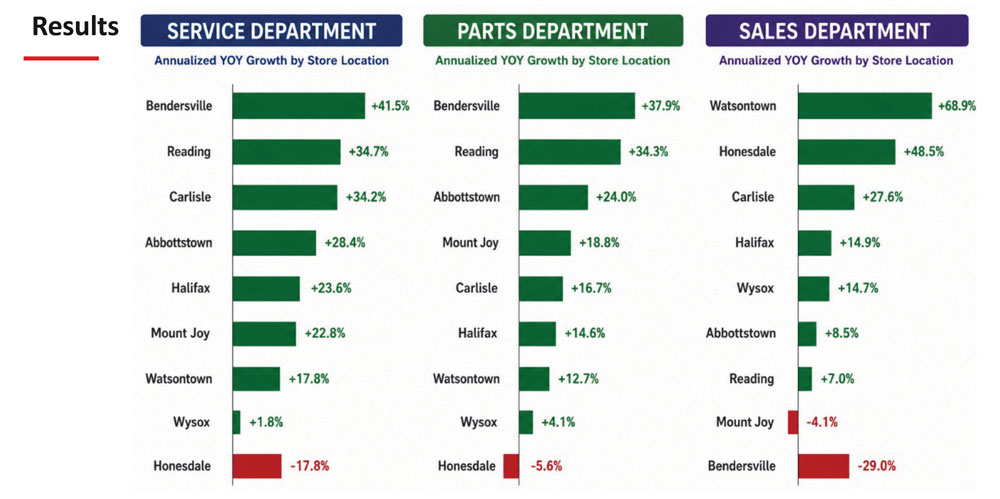
Customer service remains at the top of mind, but we also need a baseline of financial performance. The regional model has tightened processes in visible ways. For years, we operated a service department that was basically break-even. With leaders watching technician efficiency, helping stores close work orders faster and improving collections, we saw an immediate effect on revenue.
I would not attribute every financial improvement to organizational change. Market forces contributed, too. But the new structure has improved our ability to coach stores, maintain consistency and integrate growth.
The open houses 2 days after our acquisitions were a practical test. Nobody got buried. Today, I feel we could hear that another store is right around the corner and nobody would sweat it.
The lesson I hope you take from our experience is not that every dealer should add regional managers. There is no single organizational structure every dealership should copy. Family leadership worked for us at one store. Hub-and-spoke helped take us to 5. Regional leadership and centralized services are now allowing us to operate 9.
We first had to identify where daily fires were pulling our leaders away from their responsibilities and where authority was too far removed from the stores. We also needed more standardized processes, the financial ability to support additional overhead and the right people ready to step into new roles.
The structure is still evolving, particularly on the sales side. But the way our team integrated 4 stores in 7 months showed us that the company is far more prepared for growth than it was before.