Every other year, as summer begins to turn to autumn, Ballweg Implement hosts a harvest party for its customers. This year, Tom and Joan Ballweg — along with the entire team — had more to celebrate: 50 years in business. While the morning of Sept. 12 had gray skies, by party time the clouds had moved on and Ballweg had a beautiful evening to celebrate with customers, topped off with an impressive fireworks display.
But, once the dust had settled from the party, it was time for service manager Lisa Klapper, who planned the party along with Joan and Sue Kalupa, to get back to finalizing combine inspections with the service techs as harvest was just around the corner.
“You can feel the pressure building,” Klapper says. “We sell a ton of combine inspections and those go right up until they go back in the field. We’re pressed up against it right now, getting stuff finished.”
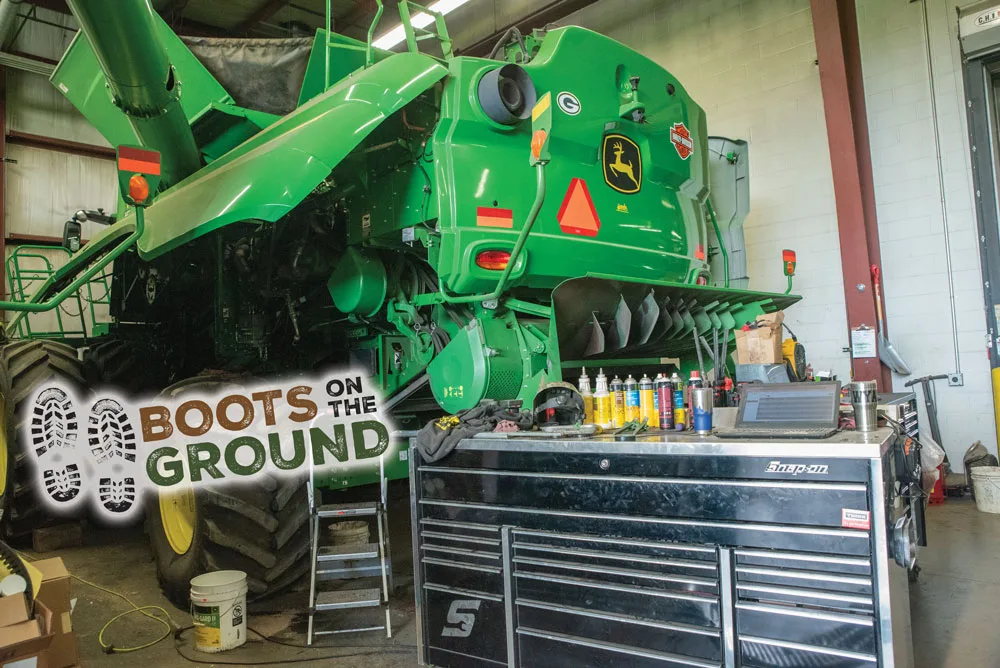
This year’s combine inspections had the additional challenge of working around a parts warehouse renovation that temporarily filled half of Ballweg’s combine shop with parts storage. “It took up half my capacity for combines, which pushed everything back. But, it’s going to be fine,” she says, noting that the new second story parts storage adds an improved level of parts organization.
Klapper says they train customers to bring their combines into the shop as soon as they wrap up harvest. “We have one customer, an older gentleman, who comes in every fall and throws his keys on my desk and says, ‘I’m done. It’s out back and now it’s yours.’”
While many customers sign up for the combine inspection program habitually, the dealership still advertises the program and has picked up quite a few new customers this year, Klapper says.
“You can feel the pressure building. We sell a ton of combine inspections and those go right up until they go back in the field. We’re pressed up against it right now…”
She begins promoting the program in early November and it officially starts Dec. 1. The combine inspection program includes free pick up and delivery, and 10% off parts and labor.
About 15 years ago, the dealership underwent a 9,000-square-foot addition, much of which included new space for the service department. At that time, 2 of the technicians floated the idea of turning the old service shop into a combine shop, Klapper says. “They wanted to make this into a combine dealership. At the time, we did combines but they weren’t a big thing for us.”
The pair started pushing the combine inspections, and today Ballweg completes 90 inspections a year.
The combine parts Ballweg Implement keeps on hand, along with having individuals who “eat, sleep and breathe combines,” is key to the program’s success, says owner Tom Ballweg. “Because of that, a lot of people want us to work on their combines and we take a layered approach to it.”
When a combine comes in for inspection, the tech will go through the combine and create a checklist that includes things the customer should be able to do themself, what they could do themself but will need some advice from a technician on and things they should not do themself. “By doing that, the customer doesn’t get the feeling they are being coerced into buying a huge package,” Ballweg says. “The interesting thing is when you tell somebody that there’s things they can do on their own, they say, ‘Well, if I wanted to do them on my own, I wouldn’t have called you.’”
While Ballweg offers on-the-farm inspections, about 85% are done in the shop.
Combine Clinic
In conjunction with the inspection service, Ballweg Implement hosts a combine clinic each year in either late August or early September focused on service rather than sales. Anyone in Ballweg’s system who owns a combine is invited to the clinic, and Klapper says the crowd is usually a mix of current and prospective customers.
This year’s clinic was held Aug. 27 and divided into 2 sessions — one for walker combines and one for STS combines. The STS clinic is held at 11 a.m. and the walker clinic takes place at 6 p.m. “We do that because those are generally people who use the smaller combines or the older combines or they’re people who have full-time jobs and are farming a little on the side,” she says.
This year Ballweg drew 90 total participants between the 2 clinics.
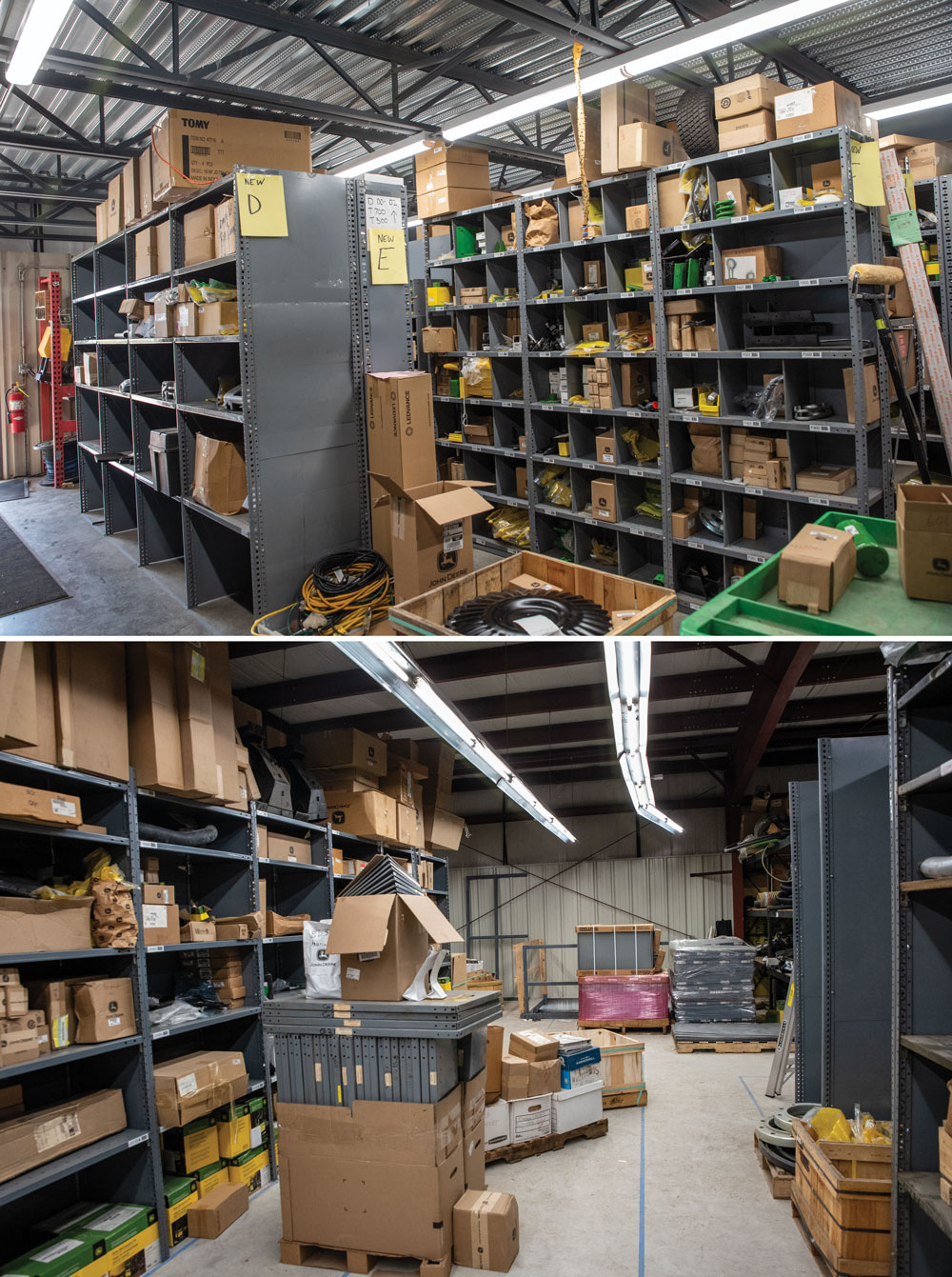
Ballweg Implement recently added a second story to its parts storage. Along with the additional space, the parts department has streamlined its binning system. While the parts are now all moved back into the parts area, the final organization will happen in the winter during slower periods. The new binning system puts everything in alphabetical-numerical order. Kim Schmidt
As harvest approaches, Klapper jokes that she has all the road techs on protein to keep everyone healthy. But, she adds in all seriousness that the best thing as far as preparing for harvest season comes back to those winter inspections. “That has really cut down on the 911 calls we get,” she says. “It’s just such a professional way to approach the harvest when it is your most stressful time. For the farmers, it’s the most stressful time. I think it’s more stressful than the planting season. And those who have taken advantage of that inspection service, sure there’s breakdown, but there’s not these catastrophic breakdowns on these machines that are being maintained.
“That’s the No. 1 selling point you could tell anybody about why you should have an inspection. It’s going to break. It’s a machine. There are moving parts, things break.”
Klapper says when she first started it seemed as if everything was a catastrophic failure, but now the breakdowns that happen tend to be a 1-day fix, or 2 at the worst.
Parts Wins & Losses
Cameron Krinke-Sauer has been working in Ballweg’s parts department since he was 17 years old. Now at age 26, he’s seen how the parts business can ebb and flow.
“I’ve seen an increase in parts sales, but it fluctuates from year to year,” he says. “In COVID there was so much new equipment getting sold that you weren’t selling parts for the equipment that these guys were trading off. Now we’re getting back to the point of guys keeping their equipment a little bit longer with the economy. So you see an increase in parts sales and parts size. Right after COVID it was all a lot of maintenance and now you see a lot more repair parts being sold.”
He’s noticed the way farmers shift with the economy and says while a lot of attention is put on the impact to wholegood sales, it’s the same with parts.
“With the economy changing, a guy might not want to spend $15,000 on getting the right parts to do the repair,” he says. “Then you can see they might want to lean toward either the aftermarket stuff a little bit more.”
This summer, much of Krinke-Sauer’s time has been spent on the parts addition project in the back and not up at the parts counter. “You wouldn’t think missing one guy up front would make a big deal, but it does,” he says. “It’s been fairly steady all year and this has been one of the busier summers we’ve had because you’ve got guys who are going through their combines instead of trading them in. You’ve got people actually working on their stuff before the season and you can tell when people start getting their equipment out.”
“It’s put us in a worse position than we were in during COVID as far as getting parts. Going into fall, it’s going to be a fight…”
And while Krinke-Sauer says the demand for parts from customers is up, the dealership is running into problems getting parts from Deere’s warehouse in Milan, Ill. The problem stems from the modernization project the OEM completed on the computer system at the facility that was expected to be completed in March. “Here we are a couple weeks before October and I don’t know if I can get parts for the next day,” he says. “It’s not a great feeling.”
Ballweg says Deere completed 3 warehouses without any problems. “They went and did the 4th one and it’s like somebody threw a bomb in there and blew it up,” he says. “It’s created huge problems all over the United States.”
Krinke-Sauer says the parts team has been proactively talking with regular customers about the issues they are having, suggesting they take a look at the combine again before they are in the field so they can be prepared for any parts they might need once harvest starts.
“It’s put us in a worse position than we were in during COVID as far as getting parts,” he says. “It’s harder to get parts out of the warehouse now. Going into fall, it’s going to be a fight.”
When things are working as they should, if a customer came in during harvest and needed an auger the next day, in most circumstances the Ballweg staff was able to get it. “Now it seems like they just can’t get anyone to pull the stuff because we can send someone down there to get it, but every time we do that we get charged.”
It’s $50 per packing slip, and Krinke-Sauer explains the way the warehouse is set up requires a printed packing slip to whatever section the part is being pulled from. If he orders 5 parts and they come from 5 different packing lists, that is a $250 charge for someone to go down to Milan and pick it up from will call.
The most frustrating part, he says, is the system just shows parts sitting “in process,” which means the order has been received, but hasn’t been pulled.
While it’s not a challenge that is unique to Ballweg right now, Krinke-Sauer says they need to figure out a solution so they can stay ahead of their competition in terms of having parts available.
In-House Parts Warehousing
The parts department renovation that temporarily filled the combine shop with parts inventory is nearly complete. The parts storage is in a 40- by 60-foot room, and the renovation added a second story doubling the dealership’s parts space.
While the construction part of the job is done, the parts team is still getting everything organized with a new binning system. Over the summer, Krinke-Sauer says they had a few high schoolers who helped out part time in moving inventory, but the true organization of the space needs to be done by the full-time parts staff.
Much of that more extensive reorganization will wait until the winter when the parts department is a bit slower. But for now, he says their big accomplishment is that everything is back in a bin, with the correct bin number on it.
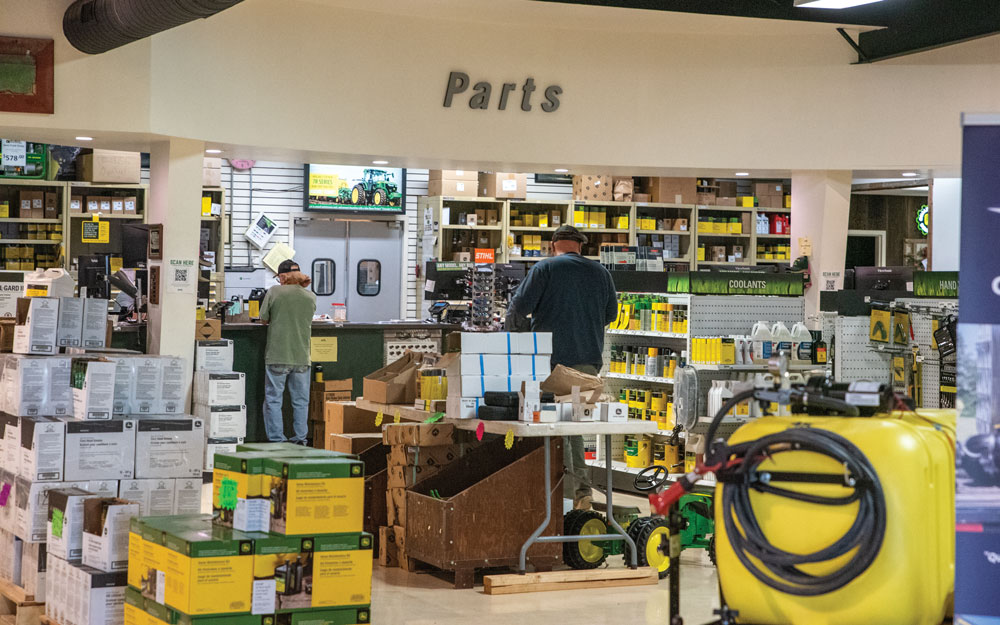
As harvest season was approaching, the Ballweg parts team focused on resetting the showroom with harvest related parts packages. Kim Schmidt
The last time the parts area was renovated predated Krinke-Sauer’s tenure, but he says at that time it was sort of a rush to get all of the parts moved into the new space in one afternoon. Since everything was removed, they can now start fresh with the organization. Now, bins are organized in alphabetical and numerical order when you first walk back from the counter. The upstairs is similar, except with a U in front (U-A, U-B, U-C, etc.)
“It’s a much simpler binning system,” Krinke-Sauer says. “Before we had some that were 1 letter, 3 digits or 1 letter, 2 digits. There was no rhyme or reason to it. Some of the old bin numbers looked like parts numbers too, which isn’t good. Now it’s all streamlined and consistent, which is going to be the biggest thing — that consistency between everything will make it easier for people to figure out.”
Radio Spots
While the parts team is busy planning for another harvest and organizing the storeroom, Ballweg has been out front, marketing through radio spots. This is a tactic he’s used since he first opened the dealership 50 years ago. Currently, he does spots on 3 different stations (2 spots on Mondays, 3 on Wednesdays and 2 on Fridays) that broadcast to different
areas. In most instances they are recorded live, he says, but even when circumstance doesn’t allow that they will record it in a way that makes it sound live when it does air.
“Sometimes the radio personality or I don’t necessarily want to be tied up at the time it would be live,” he says. “So we learn how to have a 4:30 drive home commercial. That’s on Friday and we can record that on Wednesday afternoon and just talk about things that are occurring on Friday.”
Exclusively Online
Watch interviews filmed on location with Tom Ballweg and read previous coverage at Farm-Equipment.com/BOTG
Ballweg uses the spots to advertise the dealership’s different programs and specials, but keeps them lighthearted. Each one lasts about 5 minutes, but if they’re having fun, will go to 15 minutes.
“We will advertise the checkover program for combines when we get close to the middle of the season or the end of the season. We talk about what you should be fixing and many of the radio personalities have no idea what a corn head is or a grain head if you want to have fun.
“One of the radio personalities received a text from a listener and because I was talking about gravity boxes, he asked, ‘What do you haul in a gravity box?’ I said, ‘Well, it’s obvious gravity, you haul grain in a grain cart, so you should be hauling gravity in a gravity box, right?’ And then you can add in there about how gravity is a new type of grain that they’re growing that’s high in protein and low in calories and you just have a little bit of fun with it.”
In addition to using the airtime to talk about what’s going on at the store, Ballweg also uses it as an opportunity to discuss the staff and the good work they’re doing. It has also helped the communities Ballweg Implement has served for the last 50 years get to know him and the entire team a bit more personally.
Farm Equipment's Boots on the Ground series is brought to you by Yetter Farm Equipment.
Yetter Farm Equipment has been providing farmers with residue management, fertilizer placement, and seedbed preparation solutions since 1930. Today, Yetter equipment is your answer for success in the face of ever-changing production agriculture challenges. Yetter offers a full lineup of planter attachments designed to perform in varying planting conditions, multiple options for precision fertilizer placement, strip-till units, and stalk rollers for your combine. Yetter products maximize your inputs, save you time, and deliver return on your investment. Visit them at yetterco.com.