It was an unusually blustery day in mid May when No-Till Farmer Managing Editor Mackane Vogel and I drove out to Watertown, Wis., to meet Tom Ballweg and Sheila Jaeckel of Ballweg Implement (BI) at Tony Peirick’s farm. Peirick, No-Till Farmer’s 2026 Conservation Ag Operator Fellow, has been a Ballweg customer since converting to John Deere equipment a decade ago.
We were hoping to spend some time out in the field while Peirick was planting, but the weather had other plans for us. While we didn’t get out into the field, we did get a close up look at the Hagie STS12 that he was demoing from Ballweg Implement.
Over the years, Peirick has run 6 different Hagie sprayers and has had his current machine for about 10 years and likes what he sees from the updated model, so far.
“It’s a big improvement. I’m really impressed with the difference,” he says.
Demoing a piece of equipment and letting the customer get inside it and using it on their own farm can be the difference between making a sale and missing a sale.
“We’ve known forever that if you demonstrate something rather than just have somebody talk about it, it makes a big difference. Getting in it, driving it, seeing what a piece of tillage equipment actually does in the field, seeing how new technology on a sprayer works — all these things are going to get people more interested in buying the particular item,” Ballweg says.
While it’s known that demos can make the difference, Ballweg says getting a salesperson to take the time to do it can be a challenge.
“It’s extra work,” he says. “It’s extra time that you have to spend with a customer actually being out there and utilizing these products. And in the big scheme of things, when Sheila came to work at Ballweg Implement, one of the jobs we wanted her to do was to go out and do the demonstrations because we knew she could handle equipment and big equipment.”
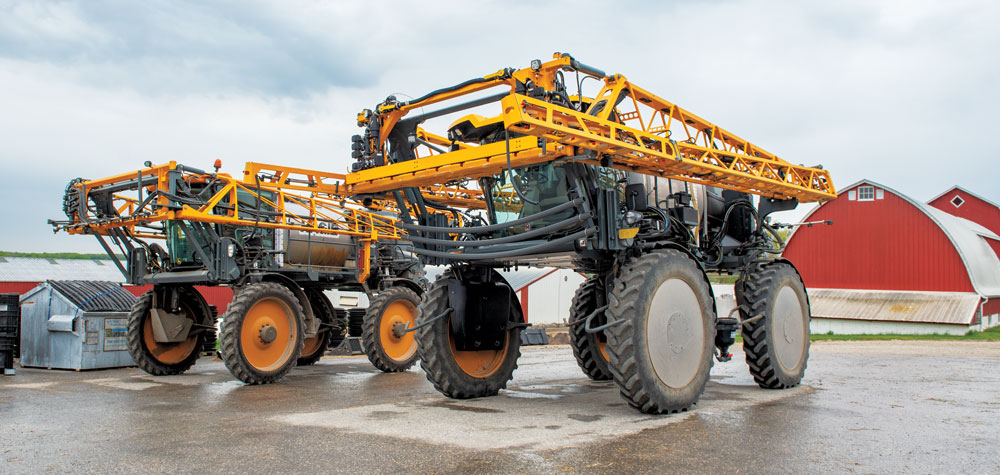
Peirick was finishing up a demo of a Hagie STS12 (shown in the foreground) during the visit. His current Hagie is 10 years old, and he’s impressed by the updated technology on the newer model. Jeff Lazewski
The BI team demos everything from lawnmowers to precision technology and up to tractors and combines. “Whatever it is, if we can get people to use them, we know that they’re going to want to have that new technology,” Ballweg says. “They’re going to want to have the new equipment in the future. It’s a great way to get people to use new equipment.”
The dealership leaves the equipment with the customer to demo, but there is usually a 3-hour limit. There are of course some exceptions, Ballweg says.
“If they’ve got a field that they want to finish and it takes 4.25 hours, they’re not going to be charged for the 1.25,” he explains. “Likewise, sometimes they only use it for 2.5 hours.”
In some instances, a customer might know the job they have is going to take 5-6 hours. In those cases, BI will charge them a rental fee for the balance of the hours over 3. “That way we still get some of the cost compensation back out of the piece of equipment,” Ballweg says.
April Showers Bring Parts Sales
The cold and rainy weather the day of our visit was similar to what most of April looked like in the area. The statewide average for April 2026 was 5.19 inches of rain, nearly 2.5 times the historical statewide average of 2.63 inches, according to the Wisconsin State Climatology Office.
The wet weather delayed planting, which translated to strong parts sales during the month.
“It was wet and cold and the longer people take to get ready to go to the field, the more parts that they buy because you’ve got time to get your pieces of equipment ready,” Ballweg says. “If you have one or two days in which you can plant, then when it starts to rain, you fix the unit and keep it in tip top shape.
“That actually increases our parts sales in the spring vs. a year where you have 2 weeks that it’s beautiful & everybody gets everything done…”
“That actually increases our parts sales in the spring vs. a year where you have 2 weeks that it’s beautiful and everybody gets everything done.”
Ballweg says when the weather is consistently good in the spring, farmers will run the equipment straight through — even if it’s not working as well as it should — and then put it away in the shed until the following spring.
“This year seems to be a really good year for parts because people have had enough time to fix the stuff that they feel needs to be fixed up and put in better condition,” he says.
Clear Speak & Setting Expectations
Agriculture can be a high-stress environment and BI does its best to manage customer emotions and set expectations for how they interact with staff.
“People get stressed and people get pushed into the corner,” Ballweg says. “We try to manage people who are angry and upset. They’re maybe not angry at our employees, but they take that anger out on the employees.”
Ballweg trains the staff — particularly those working the parts counter — to know the difference between yelling and being yelled at. “When someone hits their hand with a hammer, they yell,” he says. “That sounds a lot different than when someone is yelling at you.”
And while he recognizes that it’s likely customers aren’t actually angry with the dealership staff, just directing their frustration at them, it’s inexcusable behavior as far as he’s concerned. It’s a message that is shared with customers constantly — from demos to John Deere Days to everything in between. Each time the customers hear it, so does the staff. That can go a long way in maintaining a solid culture in the dealership where customers want to do business and employees want to work.
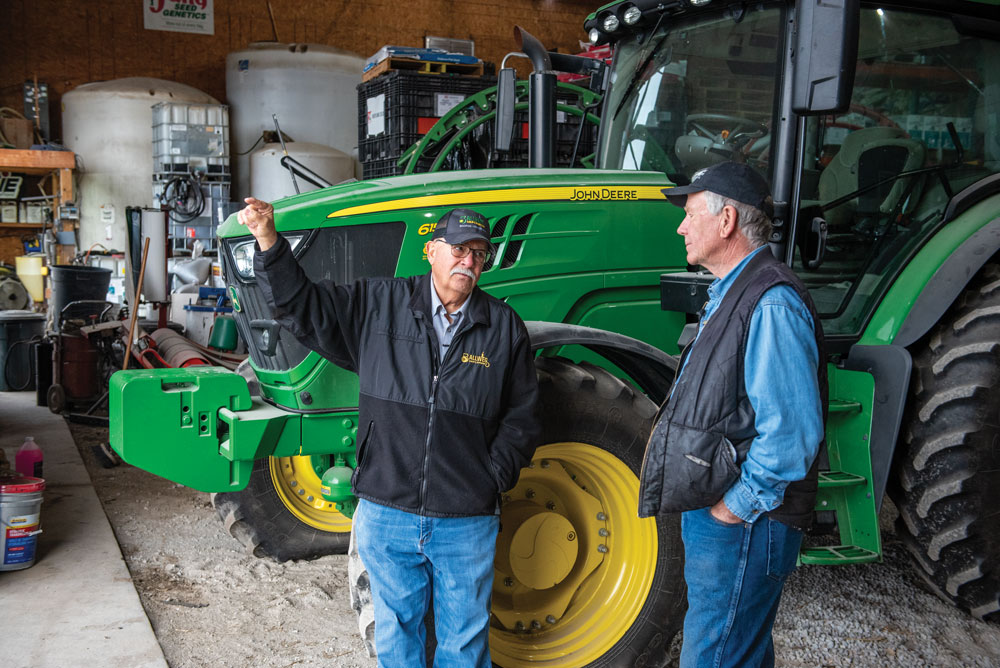
Peirick (right) has been a Ballweg Implement customer since 2016. He worked closely with Tom Ballweg (left) as well as John Deere on a complete fleet conversion. Jeff Lazewski
“We talk about how important it is for them as a customer to be respectful to the individuals who are taking care of them,” Ballweg says.
“We make it clear to them that if they are mean and disrespectful that we will discuss that with them personally and they have to stop that behavior. You wouldn’t get away with that behavior at a hospital, you wouldn’t get away with that behavior at a grocery store, you’re not going to get away with it at Ballweg Implement either.”
The same level of respect is expected of the BI employees as well. When there’s a mutual understanding of expectations, it makes it easier for the parts people, technicians and technology staff.
“Once you get that respect built up, the customer understands you respect them and they will respect you,” he says.
BI employees get to that point with clear speak. As Ballweg explains it, clear speak is — much like it sounds — stating clearly what the expectations are. For him, those expectations are that customers are going to treat Ballweg employees with respect. If they don’t, Ballweg is clear with them. “It’s easier for me to get a new customer than a new employee,” he says.
Managing Used Equipment
As any dealer selling large ag equipment over the last few years is aware, there have been more high-value, low-hour trade-ins than the market can absorb. BI staff talks regularly with its customers about the timing of new equipment purchases and the impact on the dealership’s used equipment inventory.
For customers who always buy new and want to trade every 1-3 years, Ballweg tells them “we have to wait until we can get the glut of used equipment out of the system because they don’t want to pay an extraordinarily high trade price for that piece of equipment,” he says. “And we don’t want to sit on that piece of equipment for a long time eating up interest money.”
Ballweg says the dealership is upfront with customers and explains what the market can handle. “Most of them are pretty good about that,” he says. “It’s just a matter of teaching everybody involved that it’s got to work. It’s no different than if you have too much corn or if you have too many beans — too much of any commodity — the price is going to plummet on it. You don’t want that to happen.”
Learn More
- Watch interview filmed on location and read previous coverage at farm-equipment.com/BOTG
Right now, the primary focus for the BI sales team is moving high horsepower used tractors, which is proving to be a challenge. “There’s more people who want to buy new tractors than there are people who want the low-hour used tractors,” Ballweg says. “So that’s a stress point because you’ve got to be pushing that. I think that’ll loosen up as time goes on and it’s just getting past that period when you’re fighting it.”
Used planters are a similar challenge and can be hard to sell because each customer is looking for a set-up that is specific to their operation. Oftentimes the second-tier customers don’t want all the technology and complexity that comes with it, Ballweg says.
“These guys at the top want all the complexity and technology and the next step down is, ‘I don’t mind some technology but I want this. I don’t want this,’” he says. “That’s stopping those in the middle from selling and that’s putting those low-hour, high-value items really on a slow path.”
Farm Equipment's Boots on the Ground series is brought to you by Yetter Farm Equipment.
Yetter Farm Equipment has been providing farmers with residue management, fertilizer placement, and seedbed preparation solutions since 1930. Today, Yetter equipment is your answer for success in the face of ever-changing production agriculture challenges. Yetter offers a full lineup of planter attachments designed to perform in varying planting conditions, multiple options for precision fertilizer placement, strip-till units, and stalk rollers for your combine. Yetter products maximize your inputs, save you time, and deliver return on your investment. Visit them at yetterco.com.