The most common question at this year’s Dealership Minds Summit was “Where is this market heading?” For platform headers, the answer may be buried — but you can cut through the noise to find what you need.
I spent a couple of days in Springfield, Ill., at the Dealership Minds Summit a few weeks back, and the question I heard most was the one you’d expect: where is this market heading? The one I didn’t expect came up almost as often. Two different dealers pulled me aside about draper headers. Both were sitting on 30-40 foot heads they couldn’t move, and both wondered out loud whether that width had simply fallen out of step with what farmers need.
It’s a fair concern. The good news is the data points somewhere more hopeful than “obsolete.”
Start with the whole category. Platform header supply is down 21% from a year ago and about 42% off the peak in August 2024. Sales volumes fell roughly the same alongside inventory, which kept turn rates about flat year-over-year. That slowdown sounds alarming until you set it next to planters, down closer to 50% from their own high. Planters have their own issues, but they went through a deep enough trough that a lot of dealers finally saw a revival this past spring, leading the front edge of a new-normal replenishment rhythm. Headers aren’t planters, and plenty of variables separate the two, but the shape of what’s happening at least rhymes with the planter story.
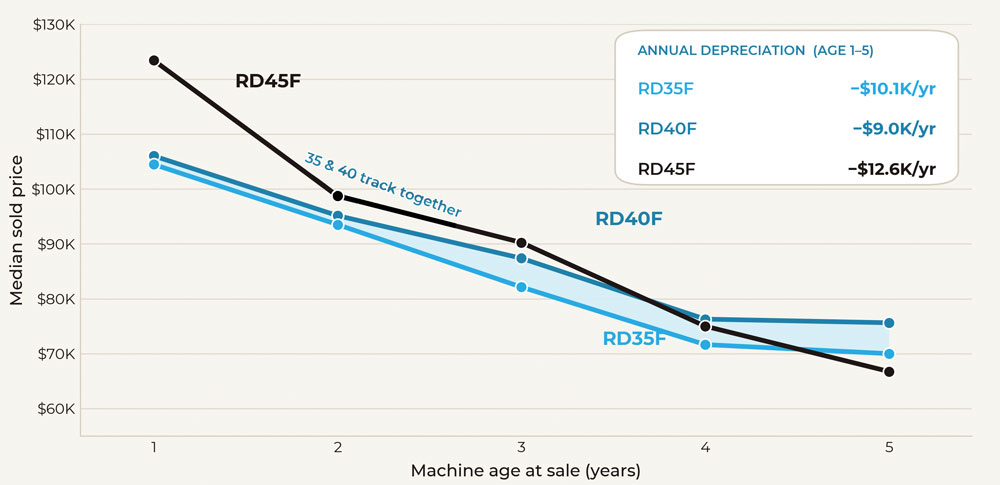
Draper Value Dynamics: median sold price by machine age, RD35F / RD40F / RD45F. Tractor Zoom Pro
Once you get past the headline number and into the model level, the widths aren’t moving evenly. For this analysis, I looked at 3 plentiful late-model drapers: John Deere’s RD35F, RD40F and RD45F. According to Tractor Zoom data, there are fewer than half as many RD35Fs on the market as there were a year ago, and 43% fewer RD40Fs. The RD45F? Supply is essentially flat, right where it sat last year. Same brand, a few feet apart on the spec sheet, very different pictures. So this isn’t a market-wide demand problem. It’s a size-specific one, and it has a cause.
The 35 and 40 sit on one side of the combine-capacity line; the 45 sits on the other. They’re all flex-draper platforms, but the 35 is certainly a mid-size head and the 45 is a large-operation head. A Class 8 combine reaches engine load just fine with a 35 or 40 foot head in a normal crop, so those widths ride with the mid-size operator. A 45 only earns its keep behind the newest high-capacity machines, so its fortunes ride with big-combine adoption.
Here’s why those supply data points matter. Used equipment supply moves in 3 ways: what flows in, what gets consumed, what exports out. If production of any size were ramping up or down hard, supply would respond, and I’ll go out on a limb and assume nobody’s been dramatically ramping up header orders these past few years, and the exit of headers has also been consistent.
That leaves consumption. If farmers were trading in their smaller heads and moving up in size, you’d see 35- and 40-foot supply stack up and larger-head supply tighten. We’re not seeing that.
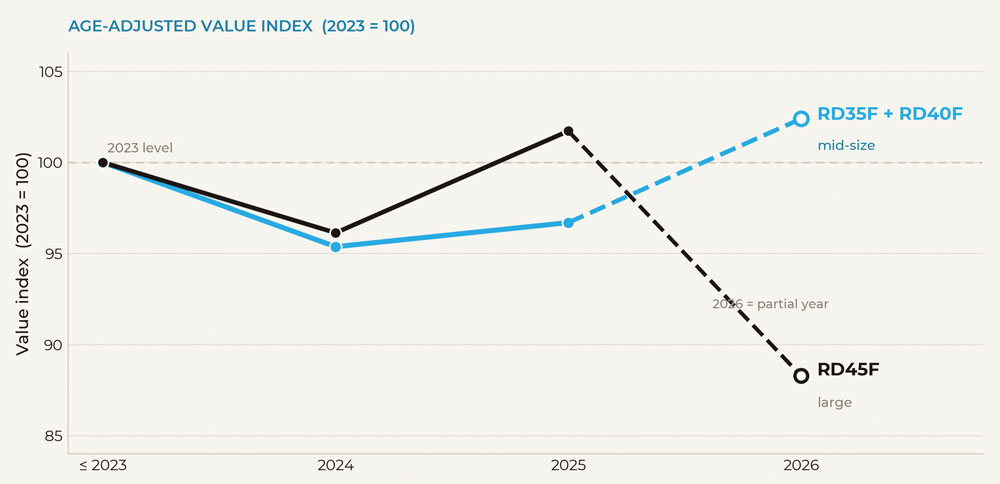
Age-adjusted value index: mid-size pair vs. RD45F. Tractor Zoom Pro
What the data shows instead is that most buyers are holding what they have. The difference is that the 45 sits on higher supply with a steady but relatively slower turn rate. That could be the newer, higher-throughput combines taking share of the harvester market and bringing new headers with them, or it could be anticipatory stocking. Dealers holding larger heads for the bigger combines they expect to come. My read is the latter.
Whatever the reason for the 45’s higher retained supply, the values are diverging too. The average RD35F list slid from about $101,000 to $92,000 over two years, and the RD45F fell harder, from $116,000 to just over $95,000. Those list averages are dragged down by an aging mix, exactly as you’d expect — as a model line matures, the heads selling each year are older, and older iron sells for less. But have they fallen equally?
Control for that age effect, though, and most of the drop disappears. Age-for-age, values have held close to where they were — and that’s where the two groups start to diverge. Below is a graphic showing sold values once they’re controlled for age; because the 35 and 40 track together, I combined them into one mid-size index and set that against the larger 45.
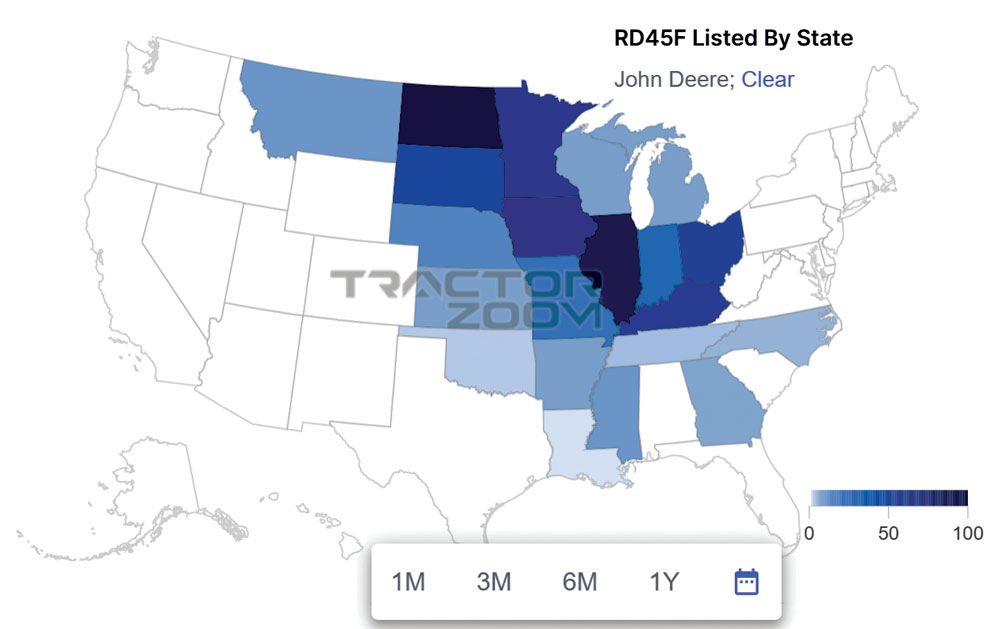
RD45F supply concentration. Tractor Zoom Pro
There’s also a geography wrinkle that holds part of the solution. The 35s cluster in the lower Ohio River Valley, pulled south by heavy listings across the Deep South; the 45’s epicenter shifts north, with North Dakota holding the lion’s share. That mostly makes sense given the crop mix in those areas. But dealer by dealer, it creates a mismatch — some lots carry too much of a width for their trade area, which is part of why the heads that do list are sitting longer, with RD35F days advertised up 22% and the RD45F up 15% year over year. This mismatch can smooth out over time through trade and wholesaling, and therein lies the opportunity, especially for the tighter smaller heads.
So, back to the two dealers in Springfield. Your slow-moving smaller drapers aren’t necessarily running out of demand. They’re caught in a buyer hesitation on the trades that normally feed them, and they’re geographically out of sync. Three things follow. First, don’t panic. There will be a replenishment cycle, though it’ll take time and more annual depreciation along the way (refer to the value-dynamics chart above to decide whether those annual value losses are something you want to stomach). Second, don’t broadly discount your headers like dead weight. Price them to the demand in your CRM, and run a report to see which models and sizes are drawing the most interest. Finally, with those numbers in hand, don’t sit on a width your trade area doesn’t want. Move/trade it to where the buyers are. The real cost here isn’t as simple as the inventory sitting out your window. This is a supply-and-demand dynamic that’s industry-wide, and the solution is sitting in the data.
Trade Values & Trends is brought to you by Tractor Zoom.

Tractor Zoom transforms and connects big data into real-time actionable insights, accelerating a dealership’s heavy machinery and farm equipment business. Our solution, the only one providing transparent, comparable sales data, connects multiple data systems into one easy to use CRM and equipment valuation platform, empowering dealers to optimize decisions, maximize inventory turns, and increase your team’s efficiency and effectiveness. Spend less time on unproductive tasks and more time growing your customer base as we revolutionize the way you drive profitable decisions in the equipment industry.
Andy Campbell is the Director of Insights at Tractor Zoom, where he helps equipment dealerships turn data into faster decisions, better alignment, and stronger margins. Raised on a multi-generation Iowa farm, Andy blends deep ag roots with experience in Fortune 500 companies, tech startups, academia, and as a consultant to make sense of what’s really driving the farm equipment market.