In this episode of On the Record, brought to you by Associated Equipment Distributors, we look at John Deere’s proposal for a 2-year labor contract extension with the UAW. In the Technology Corner, Noah Newman explores the PTx OutRun autonomous platform. Also in this episode, the Farm Capital Index declines again and we look at what to expect in the used equipment marketing going forward.
.png)
This episode of On the Record is brought to you by Associated Equipment Distributors — the leading association in North America for the equipment distribution industry.
Power up your Q3 with AED’s must-attend lineup of leadership events, industry conferences, and hands-on training built to connect and elevate equipment professionals. From the high-impact Leadership Conference to the Women in Equipment Conference, plus expert-led seminars and certification programs, AED delivers real-world insights, skill-building, and unmatched networking opportunities that drive performance and growth. Whether you’re developing your team, staying ahead of industry trends, or building stronger relationships, AED’s Q3 programming gives you the edge to compete in today’s economic challenges. Learn more at www.aednet.org.
TRANSCRIPT
Jump to a section or scroll for the full episode...
- Deere Seeks 2-Year Contract Extension with UAW
- Dealers on the Move
- Farmers Gain Trust in Autonomy with PTx OutRun Retrofit Kit
- Commodity Ticker
- Farm Capital Index Drops in June
- ‘New Normal’ for Used Equipment Market
- DataPoint: Irrigated Area Increased 10-fold, Per Acre Water Use has Declined
Deere Seeks 2-Year Contract Extension with UAW
According to news reports, John Deere has offered the United Auto Workers a 2-year extension of its current labor contract that expires in 2027 and is seeking a decision by Aug. 31.
Eric Hodson reports that a July 6, post on the UAW 450 Members Facebook page provided additional details as shared to their members.
The post reads in part, quote:
"Today, Local Union Presidents and Shop Chairpersons met with UAW Vice President Laura Dickerson. During that meeting, we were informed that John Deere has proposed extending our current collective bargaining agreement by an additional two years, moving the expiration date to October 31, 2029.
“This proposal was initiated entirely by the company. It was not requested by the UAW, and it is not the result of contract negotiations.”
Under the company’s proposal, the existing contract language would remain unchanged. All current wages, benefits, and contractual provisions would stay in place, with the following exceptions:
- A 4% General Wage Increase (GWI) effective November 1, 2026
- A 4% General Wage Increase (GWI) effective November 1, 2027
- The scheduled lump-sum payment would move to November 1, 2028
- Employees would receive a $3,000 ratification bonus if the proposal is approved
Dealers on the Move
This week’s dealers on the move are Horizon Ag & Turf and RDO Equipment.
Canadian John Deere dealers Horizon Ag & Turf and Battle River Implement announced they will merger operations, effective November 30, 2026. The Battle River Implements locations will be rebranded to Horizon Ag & Turf. The combined operation will have 17 locations.
John Deere dealer RDO Equipment has entered into a definitive agreement to acquire True North Equipment’s ag locations in North Dakota and Minnesota. The acquisition adds 8 more locations for RDO for a total of 42 ag locations.
Farmers Gain Trust in Autonomy with PTx OutRun Retrofit Kit
Here in the Technology Corner today, we’re talking about the PTx OutRun autonomous platform — a retrofit kit that enables autonomous grain cart, and now more recently, tillage operations. Mike Schlitt, PTx strategic marketing manager, shares a few stories from the field about how OutRun is winning farmers over in the race to autonomy.
“In some scenarios, there were several growers who specifically said someone on the farm wasn’t available, they had something they had to do, and if OutRun wasn’t there, that (tillage) pass would’ve been put on hold until they were available again.”
“Another scenario … the wife on the farm who is also raising their children was constantly being pulled into the grain cart. This freed her up. she could take care of the family, and her husband could run the grain cart through OutRun while he was in the combine.”
“It’s (autonomy) a way to add efficiency. It’s no different than planting at high speed. You’d never do it until you had confidence in it, until you believed that it works, and you saw that it worked. As autonomy gets out there, you’ll start to see that it’s a viable option, this is something that works, I can depend on it, I can rely on it, I have awareness of what it’s doing and now I have the freedom of is that the most important place that I need to be or can I be somewhere else or can someone on the farm who’s helping me be somewhere else. I think it will be adopted, it just has to gain trust.”
2026 Precision Farming Dealer Most Valuable Dealer Precision Agri Services started testing OutRun last year and even explored using it with a Horsch seeder. Precision Agri Services CEO Bill Lehmkuhl says there were a few glitches with the system at first, but nothing major that couldn’t be worked through, and his experience with OutRun has been positive so far.
“I had experience with the systems from Raven and Smart Ag. We were originally one of the Smart Ag dealers. Things have come a long way as far as ease of install of the system, functionality of user interface, and I think it will continue to grow. It’s a viable system for those who don’t have enough help in the fall on the grain cart side of things. You can allocate that labor over to somebody else, either doing tillage and/or seeding. The other aspect of it is taking that same system and being able to do tillage and/or seeding with it like some of the OEMs are going down that road, such as John Deere being able to do autonomous tillage, etc.”
There’s a one-time hardware investment and annual service fee for the kit. OutRun utilizes Starlink to overcome rural connectivity challenges. It’s compatible with John Deere 8R (2014+) and Fendt (900s) tractors.
Commodity Ticker
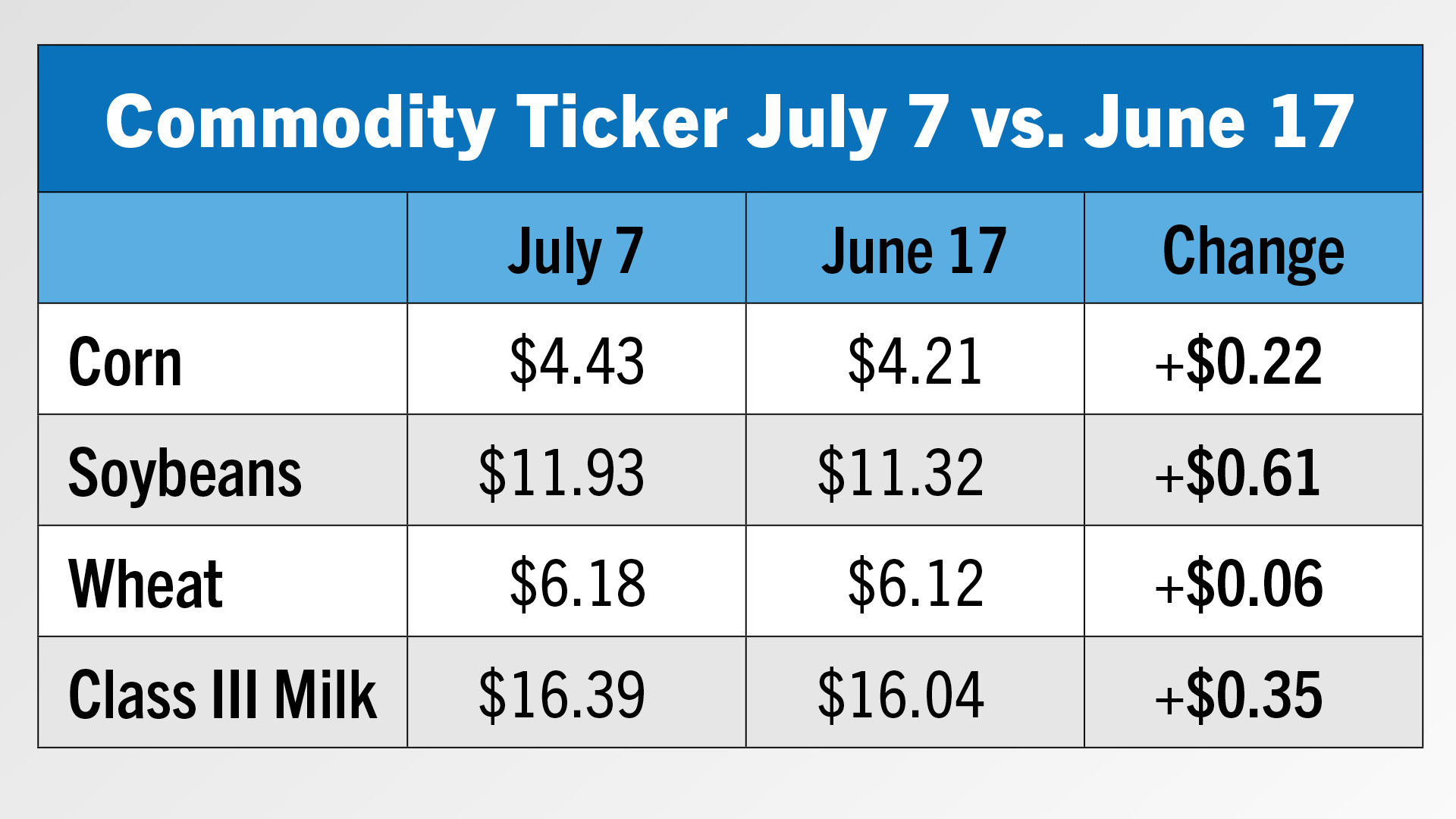
As of July 7, corn prices were $4.43, up 22 cents from our last episode. Soybeans closed at $11.93, up 61 cents. Wheat closed at $6.18, up 6 cents and Class III milk prices closed at $16.39, up 35 cents.
Farm Capital Index Drops in June
Farmer sentiment fell again in June according to the latest Purdue University-CME Group Ag Economy Barometer, dropping from 119 in May to 113 points in June.
June’s Current Conditions Index was 26 points below its December 2025 reading, reaching its lowest level since December 2024.
Only 12% of respondents indicated that their farm operations were better off in June than they had been a year ago. Looking ahead to the next 12 months, 22% of respondents expect their farms to be better off financially a year from now.
The Farm Capital Index fell to its lowest level since September 2024.
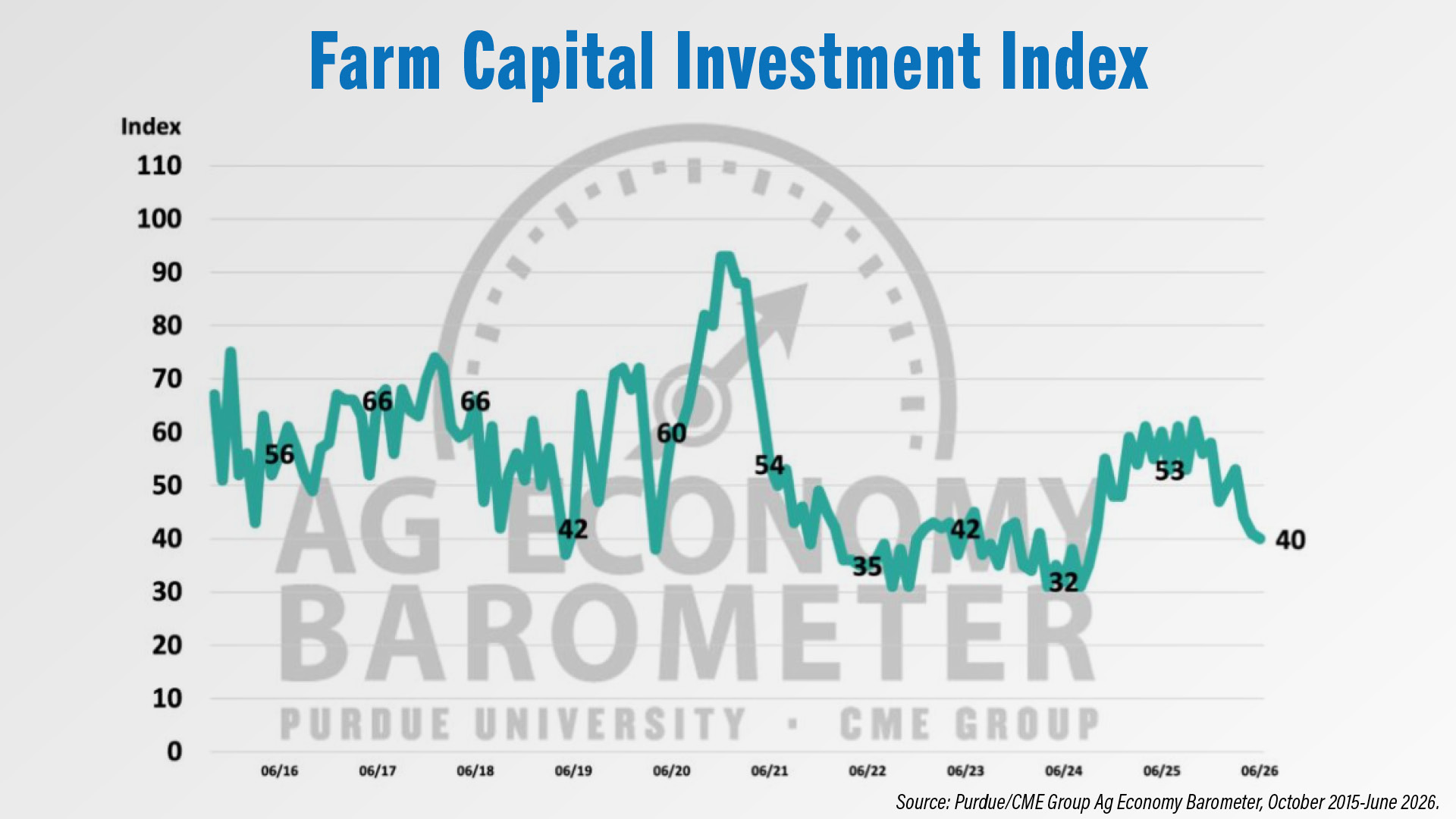
The Farm Capital Investment Index fell 1 point to 40, its lowest level since September 2024. However, it is still 5 points above that September 2024 low. Looking back at the historical data since 2015 on the Farm Capital Investment, the lowest reading recorded is 31 points. The Farm Capital Investment Index dropped to that level 4 times during the period — August 2024, April 2024, November 2022 and September 2022.
The highest reading since 2015 was a 93, hit in both December 2020 and January 2021.
‘New Normal’ for Used Equipment Market
The used equipment market is shifting, says Andy Campbell, director of insights for TractorZoom. And while it’s not a total recovery, it is becoming more predictable.
According to Campbell, for the most part auction and dealer sold values are fairly strong. He says this is likely due to there being a lower supply and people need to replace equipment they either don’t have or have sold.
Combines are a good example of this, he says.
Currently, the combine market is in a better place than it was a year ago. Campbell says, it’s not dramatically better, but measurably, noting that “For dealer principals and used equipment managers who have been grinding through a difficult inventory correction the last few years, that distinction matters.”
For example, Class 8 combine supply is down 16% year-over-year, and it sits 37% below the peak we saw in August 2024. Campbell says that’s real progress. He adds that the inventory problem that defined 2024 has not gone away, but it has shrunk.
"Whether it's all used equipment or combines, the top pieces of information that people should be watching, top one absolutely are actual dealer sold values. I'd say now this year more than any other year in the past, and that's for a couple different reasons. One, that we're seeing a bit of a return or a rebound to some actual sales happening. And I think any bit of information that indicates where sales might be is worth chasing right now considering where we're at in the farm economy. The other piece is that auction values can be a good litmus test to how the economy's doing, but there's just less of those than there have been in the past. And so with fewer data points, it's harder to gather exactly what's happening in the market. But dealer actual sold values for us right now are telling probably the most predictive tale of what we're hearing from dealer sentiment in those kind of conversations.”
"And so yeah, I'd say of any piece of data that we're following right now, it is the absolute actual deal sold values. And then beyond that one, quote activity is another piece that I think that precedes obviously some sales, but it also is of a really good predictor in the conversations we're having with the demand in your region and at the interest level. And so we're starting to see that pick back up in some areas, especially here recently as the corn market just rebounded a little to see if that triggers a little bit higher buyer sentiment and activity from the farmers.”
In a recent webinar, Campbell says dealers ranked combines as the top concerning category that they’re watching, which given the time of year is not surprising.
"The second biggest reason why I'm paying attention to combines now is if we rewind this whole story back about three years, planters were the first piece of equipment to really take a big drop in sales when we hit that post-pandemic supply increase and net farmer income decrease. And so the second category of equipment that really took that hit was combines.”
"Planters, we saw a nice resurgence in May to June on the sales side. And if everything plays out equally, then we might see that resurgence again now for combines. And so it's poised to be ready for that replacement cycle to happen. And obviously now being July and August, it's the prime time to sell some combines.”
Campbell says that we should know by the end of July if the combine replacement cycle has kicked in. You can read more about Campbell’s assessment of the combine market on Farm-equipment.com.
DataPoint: Irrigated Area Increased 10-Fold, Per Acre Water Use Has Declined
This week’s DataPoint is brought to you by the Dealership Minds Summit. To take advantage of the America 250 sale, register at DealershipMindsSummit.com.
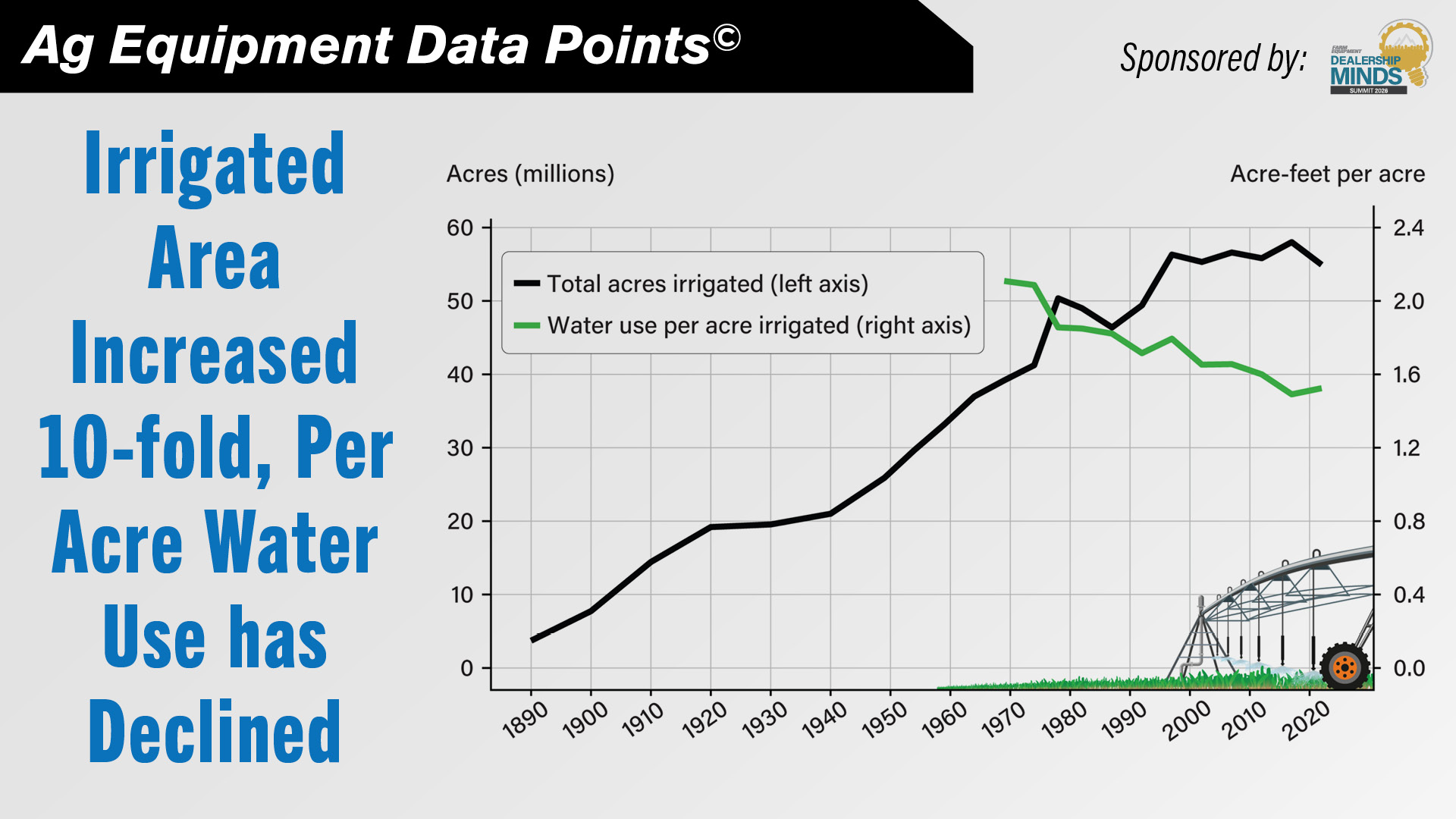
Irrigated agriculture in the U.S. has expanded significantly since it was first included in the Census of Agriculture in 1890, according to USDA.
This expansion reflects investments at the Federal, state, and local levels in infrastructure to deliver surface water to farms and ranches, as well as expansions in groundwater irrigation driven in part by improvements in well drilling and pumping technologies, reports Nicholas Potter.
However, water supply and other constraints have limited expansion since about 1997, when the growth of irrigated area began to stall.
In 2022, there were 54.9 million acres of irrigated agricultural land in the U.S., down from the peak of 58 million acres in 2017 and also below the 56.3 million acres reported in 1997.
During this same period (beginning in 1969), water use intensity — the amount of water applied per acre in acre-feet — has generally declined.
The average water use per acre irrigated was more than 2 acre-feet in 1969 and decreased to a low of 1.49 acre-feet in 2018 before increasing slightly to 1.52 in 2023.
Potter says the reduction in water use per acre of irrigated land is driven by farmers’ adoption of pressurized irrigation systems and other improvements in water application technologies.
On the Record is now available as a podcast! We encourage you to subscribe in iTunes, the Google Play Store, Soundcloud, Stitcher Radio and TuneIn Radio. Or if you have another app you use for listening to podcasts, let us know and we’ll make an effort to get it listed there as well.
We’re interested in getting your feedback. Please feel free to send along any suggestions or story ideas. You can send comments to kschmidt@lessitermedia.com.