Margins are tightening, inventory is sitting longer, and buyers are taking weeks—not days—to commit. For many ag equipment dealers, the challenge isn’t just moving iron—it’s protecting profitability in every deal. In response, many dealers are putting more focus on getting the full value out of every deal—not just from the iron, but from everything that surrounds it.
Turning Every Deal into Predictable Profit
One of the biggest shifts has been toward building more consistency into each sale. Equipment margins can fluctuate. Backend income doesn’t have to. Dealers who consistently include protection products are offsetting margin compression and stabilizing per-unit profitability. It’s not about pushing add-ons—it’s about making sure every deal is structured to contribute to overall profitability.
What’s Actually Moving Used Equipment Right Now
Demand for late-model used equipment remains strong, but buyers are cautious. Questions about machine history and potential repair costs can slow deals down or stall them entirely.
Dealers who are moving used inventory efficiently are doing one thing well: reducing uncertainty.
Extended coverage helps shift the conversation. Instead of focusing on “what could go wrong,” buyers can focus on ownership with some guardrails in place. That tends to speed up decisions, reduce price friction, and improve close rates.
Why Bundled Deals Are Winning
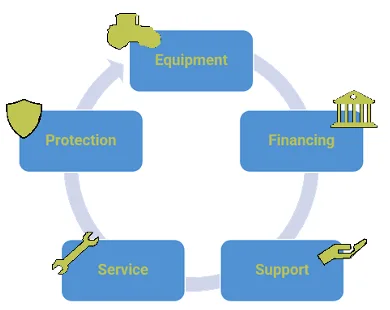
Today’s buyers expect more than a machine. They’re looking for a complete solution—financing, service, and protection all working together.
The dealers who are seeing the most success aren’t saving protection for the end of the conversation. They’re introducing it early and positioning it as part of how the machine will be owned and supported over time.
It’s a small shift in timing, but it changes how customers perceive the value.
Service: The Profit Engine Behind Every Deal
Service departments continue to be one of the most stable parts of the dealership.
Extended coverage plays directly into that by helping:
- Create more interactions with the dealership
- Keep the shop consistently busy
- Create a more predictable workload
It also helps align the dealership internally. Sales and service aren’t operating in silos—each sale is helping build future service activity.
Keeping Customers Connected
There’s also a longer-term impact that’s becoming more important: retention.
When equipment is covered, customers are more likely to return to the dealership for service and support. That creates more touchpoints and helps maintain the relationship over time. Instead of a one-time transaction, the deal becomes the starting point for ongoing engagement.
Taking a More Holistic Approach
This is an area where many dealers are refining their approach—and where Ag Guard has been working closely with its dealer network.
In a number of cases, Ag Guard has partnered with dealers to develop programs that increase the number of machines protected—not only through Ag Guard coverage, but alongside manufacturer extended programs as well.
The focus isn’t on replacing one solution with another. It’s on building a holistic coverage strategy that fits the dealership’s mix of new and used equipment, aligns with how their sales team works, and supports their service goals.
When that approach is in place, protection becomes a natural part of the deal rather than something added on late in the process.
Case Study
A 25-year Ag Guard dealer partner faced a challenge that will sound familiar to many dealerships today: Used equipment was generating interest, but deals were slowing down at the final stage. Buyers hesitated, negotiations stretched longer, and too many conversations ended in price pressure.
“The issue wasn’t demand—it was confidence.”
The Shift: Competing on Value, Not Price
Instead of adjusting pricing, the dealership chose a different path: reduce uncertainty for the buyer. Working with Ag Guard, the team implemented a simple but intentional change. Rather than offering protection as an add-on at the end of the sale, they built coverage directly into their used equipment packages from the start—positioning it alongside financing, service, and ownership expectations. Every machine was now presented as a more complete, lower-risk purchase.
What Changed - The impact was immediate and measurable:
- Equipment began moving more quickly, improving overall inventory turnover
- Conversations shifted away from “what might go wrong” to “how this machine will be supported”
- Buyers were more open to upgrading coverage when it was introduced early
- Deal margins improved without relying on discounting
- The dealership’s service pipeline strengthened with more covered units in the field
Perhaps most telling, buyer behavior changed:
- About half of customers chose to upgrade into additional manufacturer-backed coverage
- Another 40% opted for Ag Guard coverage
- Only a small minority stayed with the included basic protection
Why It Worked
By addressing the biggest barrier—uncertainty—the dealership made it easier for customers to move forward with confidence.
Instead of asking buyers to evaluate risk on their own, the dealership reframed the purchase as a supported ownership experience. That shift not only accelerated decisions, but also created stronger alignment between sales and service.
The Takeaway
In a slower market, moving used equipment isn’t just about finding the right buyer—it’s about structuring the deal so that the buyer feels confident saying yes.
For this dealership, a straightforward, bundled approach turned used inventory into a more complete solution—improving turnover, protecting margins, and building longer-term customer relationships in the process.
To see how leading dealers are building more profitable, predictable deals visit www.AgGuard.com or connect with our team at info@agguard.com or 816-223-1978
Looking Ahead to The Dealership Minds Summit
These are the kinds of conversations that are continuing to take shape across the industry—and they’ll be front and center at this year’s Dealer Minds Summit.
As dealers look for ways to stay consistent in an inconsistent market, the focus is shifting toward strategies that:
- Add stability to each deal
- Reduce buyer hesitation
- Keep customers engaged after the sale
In a slower market, the dealers who win won’t just sell more equipment—they’ll build better deals. The difference is in how every unit is structured, supported, and carried forward after the sale.
Related Content:
- Winter is Coming! Do You Need a Better Winter Service Program? (93/2024)
- How Dealers Can Use ROI to Sell More than Farm Equipment (5/1/2026)
- Warranties Provide Dealers Certainty in Uncertain Times (5/1/2025)
- How to Move Aging Inventory Faster: Tap into a Powerhouse Strategy Dealers Often Overlook (7/1/2025)
- Making More Money When Times Are Tough: How Loyal Customers Can Help (5/8/2024)
- An Overlooked Tool for Managing and Selling Used Equipment (7/8/2024)