When dealers talk about return on investment (ROI) on coverage, they are rarely referring to ROI in the traditional financial sense. In practice, the conversation is about the value created by the investment — value delivered through reduced risk, improved predictability and better control over ownership outcomes. While coverage is unlikely to generate a positive cash return during normal ownership, it can contribute to a measurable economic return when equipment is resold or traded, in addition to delivering substantial value through risk reduction and predictability.
In that sense, ROI on coverage shows up in two ways. The first is a return of value during ownership — through reduced volatility, clearer repair decisions, steadier service relationships and fewer post‑failure disputes. The second is a return when the machine is traded or sold, because coverage makes equipment easier to value, easier to explain and easier to move. In combination, these benefits help improve both operating efficiency and balance‑sheet outcomes for dealers.
Coverage delivers greater value when more customers choose some form of protection, but that outcome is driven less by persuasion and more by alignment. Customers enter ownership decisions with different risk tolerances, equipment profiles and cost structures. Those differences materially shape the value dealers realize from coverage programs.
Coverage Levels & Economic Return
At the highest end of the coverage spectrum are customers who prioritize maximum certainty. These customers purchase new equipment, remain under full factory warranty and often add maintenance or uptime agreements. From a value standpoint, this segment produces the most predictable outcomes: high participation in protection programs, stable service relationships and minimal friction when issues arise.
The next tier consists of customers buying used equipment who want expanded protection but remain anchored to manufacturer‑sponsored programs. OEM‑sponsored coverage tends to be more comprehensive, is more likely to offer goodwill consideration, protects against high‑dollar failures and keeps machines within structured repair channels. The value here shows up through retained service work, reduced dispute risk and longer equipment retention cycles — particularly on late‑model machines.
An often‑overlooked component of coverage value is its impact on equipment liquidity. Machines that remain covered — whether through OEM programs or well‑structured aftermarket coverage — are easier to price, easier to explain and easier to sell. Coverage reduces uncertainty for the next owner, supports residual values and — in many cases — enables stronger trade‑in values and faster resale, creating a tangible economic return at the end of the ownership cycle.
For dealers, this value appears not only through service retention, but in faster inventory turns and more defensible pricing when equipment re‑enters the market.
A large share of coverage value, however, is generated in the middle of the market. Customers running used, off‑lease or higher‑hour equipment understand that failures are likely but want risk managed at a reasonable cost. Shared‑risk, dealer‑driven programs fit this need. These customers are not seeking comprehensive protection; they are seeking predictability, faster decisions, and fair outcomes when something breaks. For dealers, this segment often produces the strongest marginal value through service capture, relationship durability, reduced exposure to goodwill concessions, and improved marketability when equipment is resold or traded.
At the opposite end are customers whose purchase decisions are driven almost entirely by upfront price. These customers will often decline coverage regardless of structure. From a value perspective, the objective is not conversion at all costs, but clarity and consistency. Offering coverage consistently preserves trust and sets expectations — even when coverage is declined. Attempting to force alignment where none exists tends to dilute value rather than enhance it.
Coverage ROI is a Portfolio Outcome
The practical takeaway is that ROI on coverage should be viewed as a portfolio outcome, not a product outcome. Dealers improve returns not by pushing every customer toward the highest level of protection, but by increasing the number of customers who participate at a level that fits how they operate.
When coverage is aligned:
- Fewer customers walk away completely uncovered
- Service and parts capture becomes more consistent
- Repair conversations are less adversarial
- Used equipment turns faster and often commands stronger trade‑in and resale values
- Long‑term customer value is better protected
Importantly, ROI — understood as a return of value — is not maximized when every customer buys the same coverage. It is maximized when fewer customers carry all the risk, and the coverage they choose aligns with their economic reality.
The Value Case, Simplified
From a dealer standpoint, coverage delivers the greatest value when:
- More customers participate at some level
- There are fewer ugly surprises when machines go down
- Risk is structured instead of negotiated after failure
- Equipment re-enters the market with less uncertainty
Seen this way, coverage creates value by reducing variability — making outcomes more predictable, service revenue steadier, inventory more liquid and customer relationships more resilient when failures occur.
The Role of Extended Service Contracts
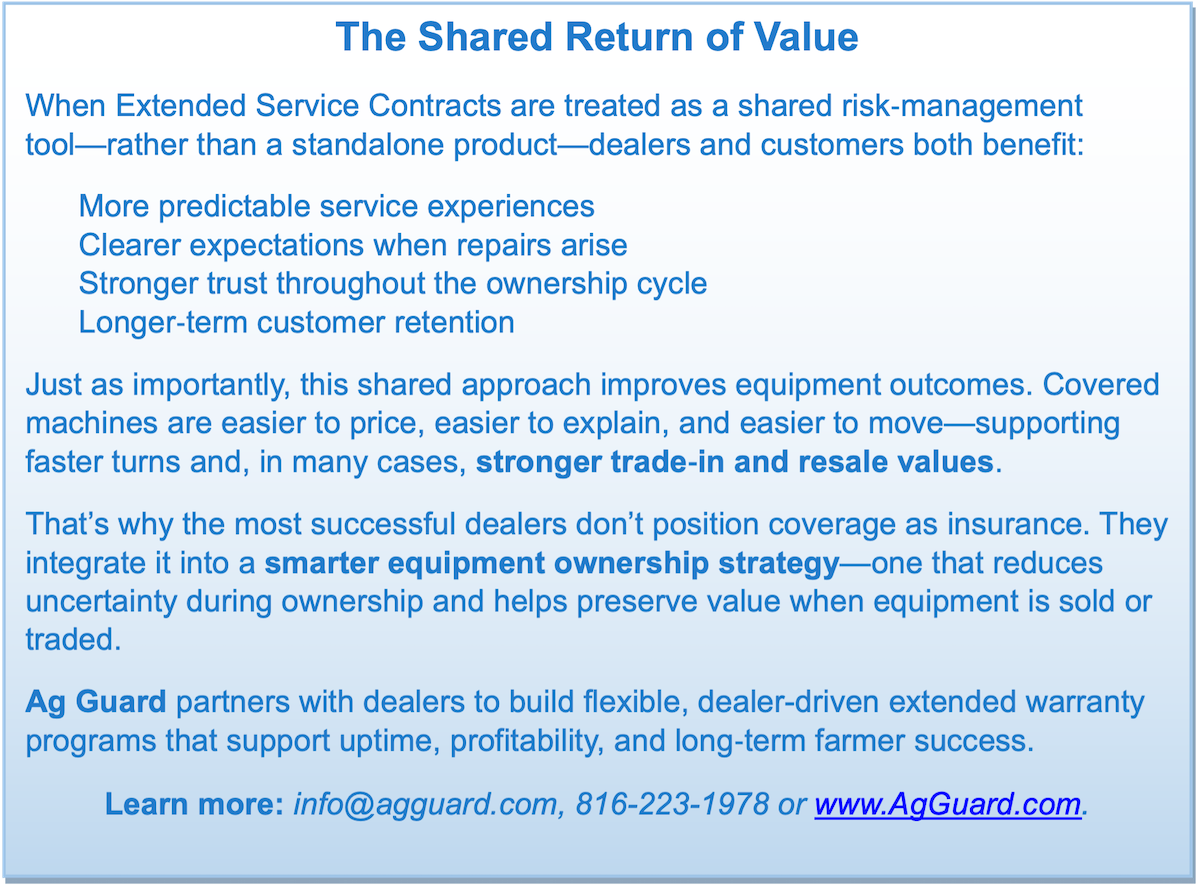
Within this broader coverage portfolio, Extended Service Contracts (ESCs) play a particularly important role. ESCs deliver value well beyond the contract itself — for both dealers and customers.
For dealers, ESCs provide:
- Protection of dealer reputation when repairs arise
- Higher customer loyalty and repeat purchases
- Stronger parts and service retention
- Incremental revenue on equipment already sold
ESCs help convert equipment sales into long‑term customer relationships and more stable ownership cycles.
For Customers, ESCs provide: 
- Protection from unexpected repair costs
- Faster decisions and less downtime during critical seasons
- Predictable ownership costs and peace of mind
- Confidence knowing their dealer has them covered
The Bottom Line
Coverage isn’t something you bolt onto a sale. It’s the infrastructure that stabilizes the entire ownership experience.
Dealers who structure coverage as a portfolio reduce volatility, protect margins, and strengthen customer loyalty across the full equipment lifecycle. The ROI isn’t theoretical — it shows up as predictable operations, more liquid used inventory, and customers who stay with you longer.
Related Content:
- Warranties Provide Dealers Certainty in Uncertain Times
- How to Move Aging Inventory Faster: Tap into a Powerhouse Strategy Dealers Often Overlook
- Making More Money When Times Are Tough: How Loyal Customers Can Help
- An Overlooked Tool for Managing and Selling Used Equipment
- How Dealers Can Use ROI to Sell More than Farm Equipment