In this episode of On the Record, brought to you by Associated Equipment Distributors, we look at the impact interest rates are having on the ag market. In the Technology Corner, Noah Newman visits with strip-tiller Robert Boyle. Also in this episode, coverage from the first-ever Ag Equipment Intelligence Executive Summit, CNH moves to a dual branding model and Ritchie Bros. completes its acquisition of BigIron.
.png)
This episode of On the Record is brought to you by Associated Equipment Distributors — the leading association in North America for the equipment distribution industry.
Get ready for a powerful start to the year with AED’s packed lineup of Q1 and Q2 events designed to connect, educate, and energize industry professionals. From high-impact conferences and hands-on training sessions to exclusive member gatherings and strategic leadership programs, AED is bringing together top experts and forward-thinking dealers to share insights that drive growth. Whether you’re looking to sharpen your team’s skills, stay ahead of emerging trends, or expand your network, our first-half-of-the-year events deliver unmatched opportunities to elevate your business and strengthen your competitive edge. Visit www.aednet.org/ for more information.
TRANSCRIPT
Jump to a section or scroll for the full episode...
- Inaugural Ag Equipment Intelligence Executive Summit
- Interest Rates Remain Pressure Point
- Commodity Ticker
- Innovative Farmer Boosts Efficiency with 360 RAIN, Precision Tech & Mixed Fleet
- CNH Dual Branding Changes
- Ritchie Bros. Completes BigIron Acquisition
- DataPoint: Farm Financial Stress Exposure
Inaugural Ag Equipment Intelligence Executive Summit
We are back from a successful Ag Equipment Intelligence Executive Summit, a first-ever peer learning and networking event on ag machinery market intelligence held in Chicago on May 19-20.
There was a wide representation of the entire ag machinery industry – dealers, distributors, manufacturers and lenders, suppliers and key association execs, including a strong representation of businesses of all types from Canada.
The registrants gathering in Chicago represented $32.2 billion in annual sales and the oversight of more than 24,000 employees.
Interest Rates Remain Pressure Point
The Wall Street Journal reported that during Fed officials’ meeting last month, they all but abandoned the question of whether to cut interest rates and have begun to seriously weigh whether to raise rates.
During Ag Equipment Intelligence’s Executive Summit, Cleveland Research analyst Chris Johnson touched on the impact of interest rates in his economic outlook.
"And so questions, do we see this oil price spike come through? As we see it, yeah, it will right now with our base assumptions, we will see some pressures for the next 12 months, but we do see it as transitory that in back half of 27 we start to see that inflation come down, but whether it's PCE pricing, core PCE, which excludes the impact of automotives and some other categories, or even inflation CPI at that side, you begin to see this shock that limits the Fed's toolkit for the next 12 to 18 months. And so when we look at pushing out the rate cut, we had come into the year hoping for 3-4 cuts, 4 cuts at the high end, 2 at the conservative end and we had seen a couple rate cuts, correct? Like this is the federal funds rate, this is what the Fed manages and the Fed has two mandates."
"They want full employment and they want inflation. We're stuck in this category of neither fish nor foul here. And so what we see is the federal funds rate probably in our view going to have to stay here. I don't see rate increases yet in our view, but I don't see it coming down further to a place that spurs some categories. And a really quick point on that. With the Fed funds rate right now at 3.6 roughly, you get the 30 year rate of mortgages at 6.3. What's interesting is in our work, what spurs and unlocks this residential market that's been frozen is an interest rate around five. You need the 30 year rate around five for the American consumer to start spending again. Obviously it's not as relevant to the ag machinery market, but I think it's an interesting conversation point when you start to think about the broader macroeconomy optimism about the market."
"So as we kind of freeze here and we don't see any more interest rate cuts, that's a problem."
Commodity Ticker
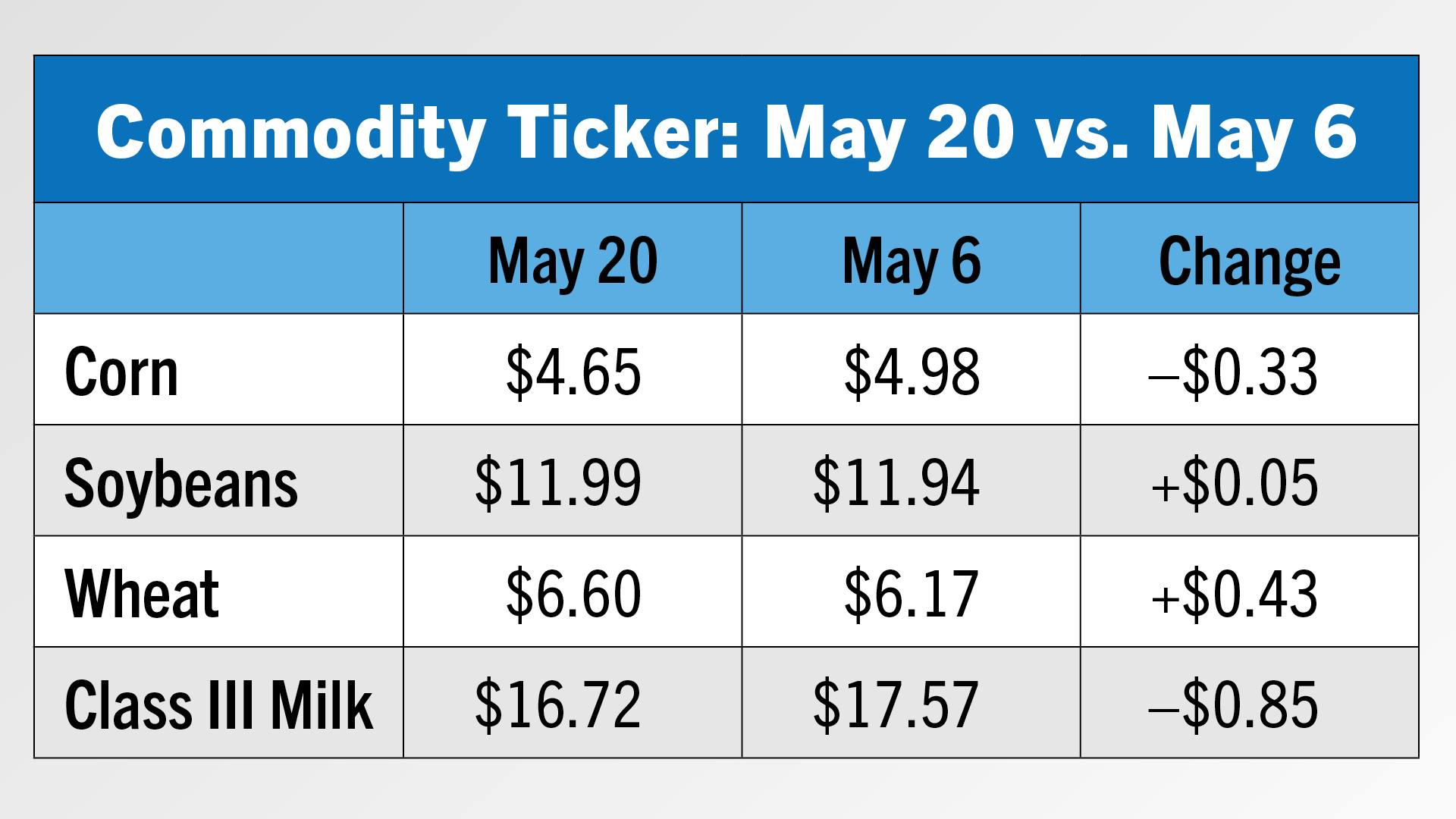
As of May 20, corn prices were $4.65 down 33 cents from our last episode. Soybeans closed at $11.99, up 5 cents. Wheat closed at $6.60, up 43 cents and Class III milk prices closed at $17.57, down 85 cents.
Innovative Farmer Boosts Efficiency with 360 RAIN, Precision Tech & Mixed Fleet
On this special road edition of Technology Corner, we pay a visit to innovative farmer Robert Boyle in Coolidge, Ariz. Boyle reveals some of the secret weapons — including 360 RAIN — that help boost his profitability and efficiency on soils receiving only 7 inches of rain annually.
Noah Newman: "We're here in Coolidge, Arizona for a special road edition of Technology Corner here with 2026 strip-till innovator of the year, Robert Boyle to talk technology. And Robert, we have a big piece of technology behind us here. The 360 rain. Tell us a little bit about it when you get out of this."
Robert Boyle: "So this is our autonomous sprinkler. We're using it to irrigate this crop of corn. It's our second crop with it. We've had an oak crop before that. We're using 225 gallons a minute. We're irrigating a hundred acres. Right now we're getting around on it. It takes us about seven days to get around on that corn and then be back on it. Puts on six tenths of an inch is what we're putting on right now. And then I'm putting all my fertilizer on with it. We're getting way better utilization through the banding of the fertilizer through the wide drop of the rain unit than we are with our flood irrigation. Probably going to be able to use half the liquid fertilizer we've been using."
Newman: "And out here where you get only about seven inches of rain per year, that water conservation's really important to you and the efficiency. So how much does this help with that?"
Boyle: "Oh, it's cut our water usage on our corn in half."
Newman: "Wow."
Boyle: "And then when we can cut the water usage on our corn in half, that's to let us expand our acres on our other crops that we're growing. And then with this thing being completely mobile, this machine will follow our crop rotation around the farm. We're not dedicated to just one section of the farm that we can run it on."
Newman: "And as we were driving around, you controlled from your phone, right? I saw."
Boyle: "Yeah. All the adjustments, faults, anything like that, everything runs off your phone. There's one keypad on the back that you can adjust things back there, but other than that, everything is all through the app."
Newman: "Very cool. Now, what are some other big pieces of technology that you're using in your operation here that's giving you a lot of bang for your buck?"
Boyle: "So I have telemetry on everything. All my tractors, I run ops center or razor tracking, which are compatible and so I can figure out where all my equipment's sitting at any point of the day or night. We run Crohn hay balers. I have the Chrome Smart Connect and on that every morning I can see how many bales I've made, what the weights are, moisture, how many tons per field. And so I can even see where the bales are dropped through the field."
Newman: "And it's interesting how much of a mixed fleet you have out here on your farm. I mean, every different color you could think of you have out here, but you're able to manage it all with the John Deere Operations Center, right?"
Boyle: "So I have their tracker on all the machines and then also Razor, which is a compatible company with them. So we run a complete mixed fleet of brands and manufacturers on equipment between Cases, McCormicks, Fords. So we use OpsCenter and Razor tracking in combination to where we can put trackers on all the equipment. I can see where every baler gets parked at night. Every swather gets started in the morning, but it's really key when you're dispatching your help in the morning that I can know, "Hey, I have 300 bales here, 600 bales over there, so I know where I need to send the guys and in what order."
Newman: "Awesome. Well, Robert, thanks for giving us a tour of your farm out here. Completely different ball game out here in Arizona than our neck of the woods back in Brookfield, Wisconsin. So it's been a very interesting tour."
CNH Dual Branding Changes
Ag Equipment Intelligence learned that CNH underwent a larger layoff round and reorganized leadership responsibility in key sales, dealer development and other positions now managing BOTH the New Holland and Case IH businesses interests for its dealer network. Several at this week's Ag Equipment Intelligence’s Executive Summit described it as a “purpling” of the organization known for its New Holland (blue) and Case IH (red) colors.
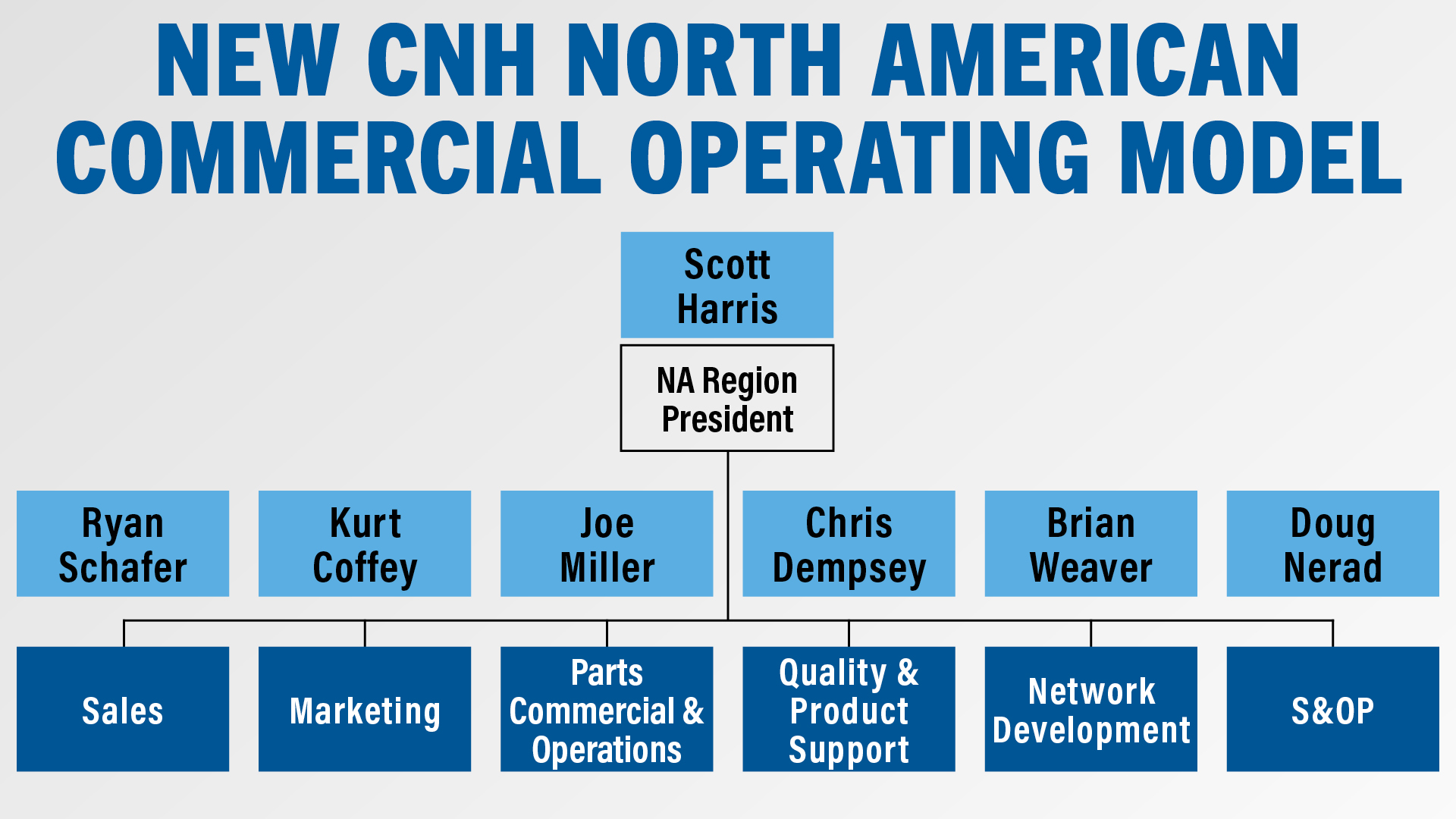
Look for on-going coverage of this news on Farm-Equipment.com
Ritchie Bros. Completes BigIron Acquisition
Auctions came up a number of times during Ag Equipment Intelligence’s Executive Summit between presentations and roundtable discussions.
Those discussions came on the heels of RB Global’s May 19 announcement that it had completed its acquisition of BigIron Auction Company.
During RB Global’s first quarter earnings call ahead of the closing, CEO Jim Kessler had noted the acquisition had received HSR approval and noted that they find the ag sector “very attractive in the U.S.”
Following the official close, Kessler said, “The BigIron team brings deep expertise and strong relationships within the U.S. agriculture market, which complements our broader marketplace capabilities. This move expands our presence in a highly attractive category, adds differentiated expertise across U.S. agriculture, including agricultural real estate transactions, and advances our operating strategy of pairing scale with specialized market leadership.”
DataPoint: Farm Financial Stress Exposure
This week’s DataPoint is brought to you by the Dealership Minds Summit, coming to Springfield, Illinois, Aug 4-5. To view the program and to register, visit DealershipMindsSummit.com
Farmland and machinery values are particularly important in determining farms’ capacity to refinance or restructure debt during periods of negative profits, notes Ty Kreitman, associate economist with the Federal Reserve Bank of Kansas City.
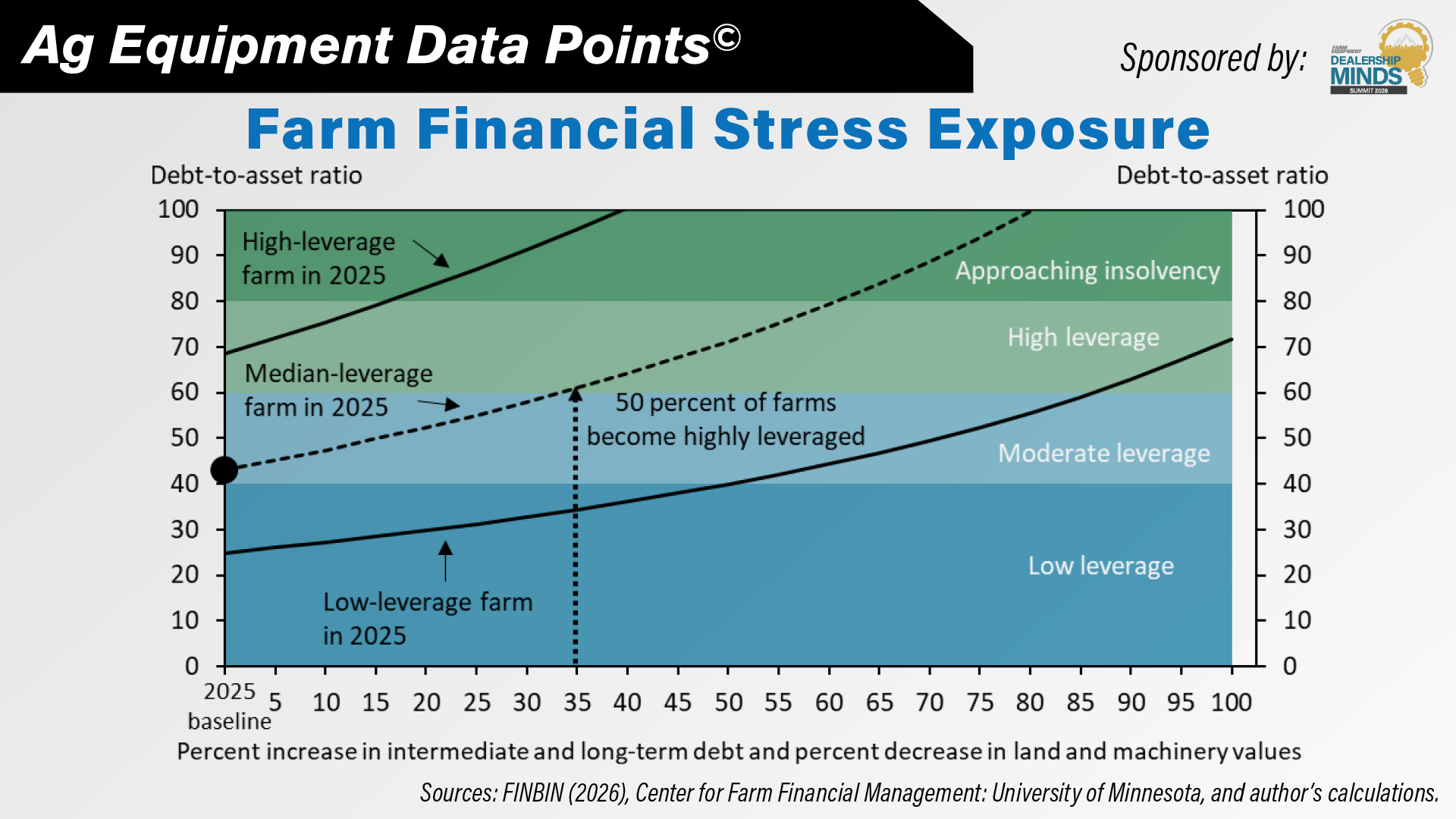
He says, this chart shows that most farms would only become exposed to financial stress if increased collateralization of losses corresponded with rapid declines in asset values. The median farm had a debt-to-asset ratio near 45% in 2025 — the black black on this chart. For those farms to reach high leverage, land values and machinery would need to decline by 35% and intermediate and long-term debt would also need to increase by 35% — the dotted line crossing into the light green area.
The average high-leverage farm had a 70% debt-to-asset ratio in 2025. To approach insolvency, these farms would need to see a 20% decline in land and machinery values combined with a 20% increase in intermediate and long-term debt — the solid black line crossing into dark green area.
Such a rapid pace of debt accumulation and asset depreciation, he says, has not been seen since the 1980s farm crisis, when prolonged and severe losses drove rapid debt accumulation and widespread asset liquidation.
On the Record is now available as a podcast! We encourage you to subscribe in iTunes, the Google Play Store, Soundcloud, Stitcher Radio and TuneIn Radio. Or if you have another app you use for listening to podcasts, let us know and we’ll make an effort to get it listed there as well.
We’re interested in getting your feedback. Please feel free to send along any suggestions or story ideas. You can send comments to kschmidt@lessitermedia.com.