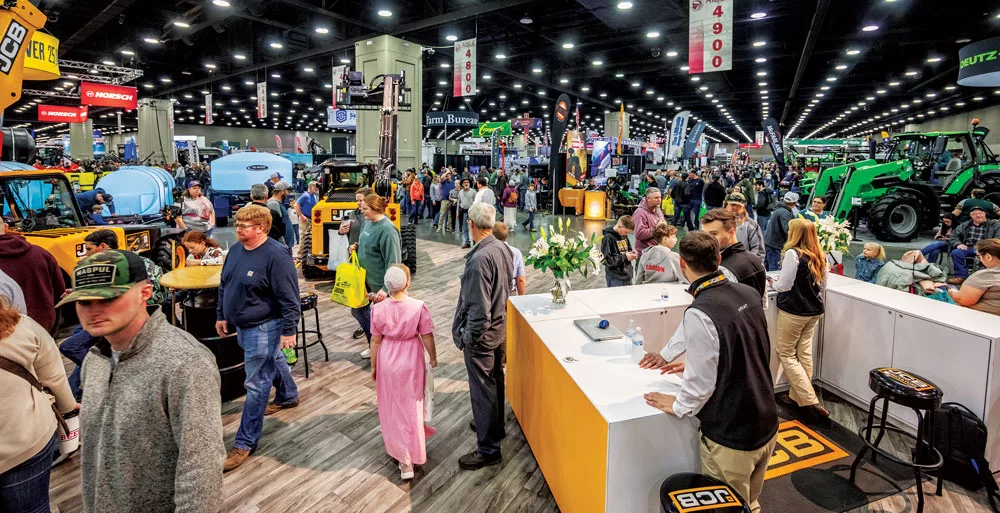
There’s no doubt 2025 was a challenging year for the ag industry, but the farmers, dealers and manufacturers Ag Equipment Intelligence editors visited during the National Farm Machinery Show in Louisville, Ky., are cautiously optimistic about 2026, even if some familiar challenges remain.
“There’s more optimism, but I don’t know if it’s entirely based on reality or it’s more because we’ve been in this dip for a while now and people have been holding off on buying new equipment,” said Dustin Friesen, sales director for Harvest International. “Over the last 2 years, a lot of farmers have tried to get through one more season (without buying upgrades). There have been a lot of delayed decisions. But at a certain point, guys are going to have to make some choices. In the meantime, we’ve been doing more custom work. It’s been an interesting market, and we’ve had to get creative.”
If value and ROI can be shown, Dru Egli, eastern corn belt territory manager for SurePoint Ag, said farmers will still make some purchases. “They’re not thinking about the ‘cool factor’ anymore. It’s all about, ‘Is this going to add value to my operation and bottom line?’
“We’ve gotten a mixed bag (from dealers), with some doom and gloom and some very optimistic ones,” he added. “Overall, the sentiment is people are buying stuff, they’re just watching those dollars a little closer and making sure it makes sense, not just buying the shiny, cool new thing.”
Tony Wisker, vice president of sales for Great Plains Manufacturing’s ag division was surprised by the positivity in some farmer comments he’s heard.
“It’s not that they’re looking to spend a bunch of money, but they’re managing through it (challenging times) like all of us, finding ways to get more efficient and delay some upgrades. It hasn’t been overly negative in the conversations I’ve had,” he said.
“From a retail perspective, 2026 is going to have the same challenges we faced in 2025,” he added. “Until we get some commodity prices that sustainably go up, we’ll continue to struggle in the equipment business. When we finish 2026, we’ll be in about the same place sales wise as we were in 2025. There will be some ups and downs. It’s all going to come out in pretty much a wash compared to what we did in 2025.”
Whisker said inventory is still a challenge, but noted that Great Plains has worked to help drive dealer inventory down, including reducing production on the manufacturing side to running incentives to help dealers retail products.
“All the manufacturers are doing the same,” he said. “In the next 5 years, inventory management is going to be top of mind for dealers. How do they have the right amount of stuff on the lot, and not too much? In the last couple years, they’ve had too much and now they’re paying for it. Going forward, they’re going to be more careful managing it, which is going to increase the challenge for us as the manufacturer to have the right stuff available at the right time.”
Marty Gray, CEO of John Blue Co., expects 2026 to be flat but noted the company’s revenue was up slightly in 2025. Challenges that impacted 2025 are still present at the start of 2026, he noted. “Tariffs are still a huge detriment to the industry,” he said. He added that it’s impacting the manufacturer on the supply chain side and it’s impacting the industry on the demand side, “taking China out of the equation.” He added that despite the challenges, John Blue is continuing to invest in its people, R&D and marketing because the turnaround will come. He said that was key to why the company saw growth in 2025.
Highlights from ASABE’s Agricultural Equipment Technology Conference
Ahead of the National Farm Machinery Show, the American Society of Agricultural and Biological Engineers (ASABE) held its 2026 Agricultural Equipment Technology Conference (AETC). The annual conference brings together engineers and students for 2 days of education, discussion and celebration of the AE50 Award winners. Below are a few highlights from the meeting. Watch for more coverage online.
Farming & Solar Panels. Scott Shearer, professor and chair of food, agricultural and biological engineering at Ohio State Univ., delivered a presentation about agrivoltaics, which is defined as agricultural production underneath or adjacent to solar panels.
Shearer shared some of his biggest takeaways from the university’s Madison Fields Solar Project in Madison County, Ohio, which launched in 2024. Spread across more than 1,900 acres, the 180 MW solar facility is one of North America’s largest test grounds for research into agrivoltaics.
A couple years into the project, Shearer has concluded the following essentials must be in place for a successful solar farm design for agrivoltaics:
- All solar piers should be in line between major service roads.
- Minimal turn radius at end-row is 50 feet.
- Minimum pier to pier distance between panel rows is 20-22 feet.
- Most equipment should be fitted with cameras on sides and rear of machine to enhance operator visibility.
- Equipment operators should be able to stow position on a row-by-row basis.
- Will agricultural fertilizers and pesticides leach zinc from hot dipped galvanized piers?
He also adds the following requirements for subsurface drainage systems on solar farms:
- Site should be designed for tile drainage from beginning.
- Underground collector wiring must meet code, and you must consider tile interference.
- Drive piers first, install tile next and finish construction.
- Internal service roads are dams (cement stabilization).
- All equipment should be FWA, 4WD, etc.
- All collector wiring must be buried between rows — consider tillage depth.
- All combiner boxes must be placed within pier rows.
Craig Lee, director of sales for Geringhoff, says they expect 2026 to be stable to slightly better than 2025. “Granted things dropped pretty heavily in 2025,” he says, “so we’ve got a ways to go to get back to where we’d really like to be.”
But as many have noted during this downturn, Lee says they’ve been through the ups and down before. “All we can do is keep going everyday.”
Lee says Geringhoff’s order shows the larger, higher tech units still have a market, but some of the smaller machines seem to be sitting on the lot longer then he’d like to see.
The livestock sector continues to be a strong segment for equipment. Marc Ivy, sales manager for Bush Hog, Dixie Chopper and RhinoAg, says cattlemen are continuing to do well and are buying rotary cutters. He notes the municipal business is also performing, but row-crop customers continue to be strapped.
Strip-Till Traction
You didn’t have to walk too far on the Kentucky Expo Center showroom floor to see some sort of strip-till equipment on display. The reduced tillage practice continues to gain steam as it offers farmers a way to increase their nutrient use efficiency and combine the benefits of tillage and no-till.
Harvest International, Kuhn Krause, Land Luvr, Lynx, Unverferth, Vulcan, Yetter and Zimmerman were among the several manufacturers showcasing new toolbars and row units.
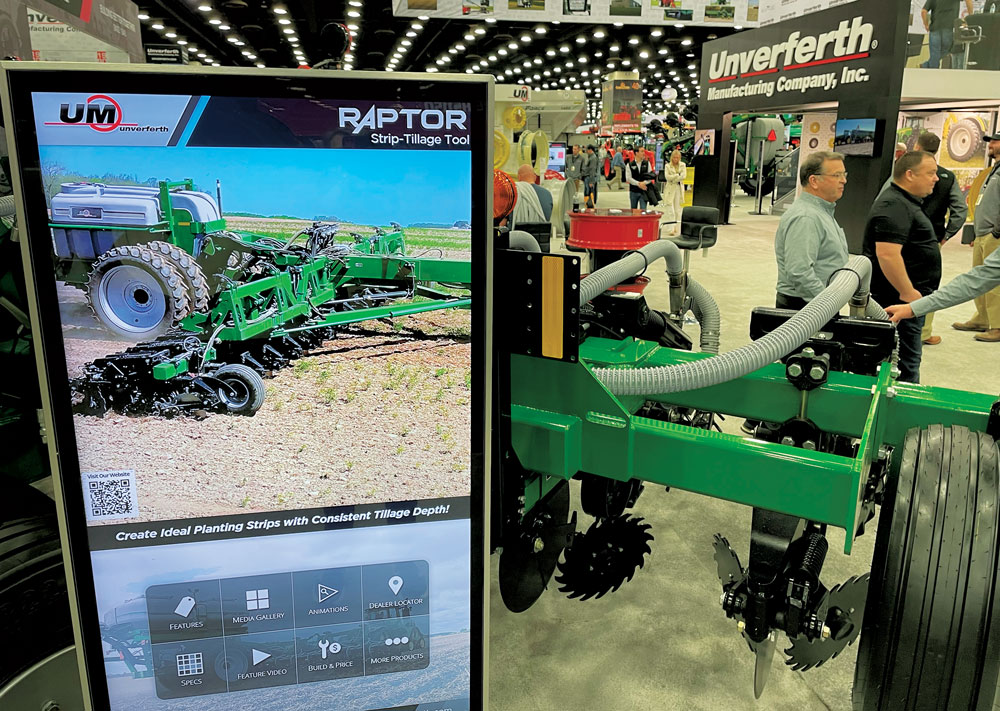
Unverferth showcased the latest version of its Raptor strip-till tool. Its Orthman 1tRIPr strip-till machine was also on display. Unverferth was one of several manufacturers highlighting strip-till solutions at the show, as interest in the reduced tillage practice continues to pick up steam. Noah Newman
Attendees got their first look at Landoll’s brand-new VERTISTRIP machine, which might look somewhat familiar to hardcore strip-till enthusiasts. Landoll recently acquired the license to it from Hawkins and AGROdeviate.
“It’s been tested and proven in the field over the last few years in anticipation of this launch,” says Ryan Hulme, VP of product navigation for AGROdeviate. “One of the things that makes this machine unique is the functionality and how friendly it is for users. We’re trying to control everything we can from the cab. We’re running row cleaners from the cab just like the planter. We come back with downpressure controlled from the cab. We also control our finishing with pneumatic baskets. Everything on here (the row unit) is adjustable without tools.”
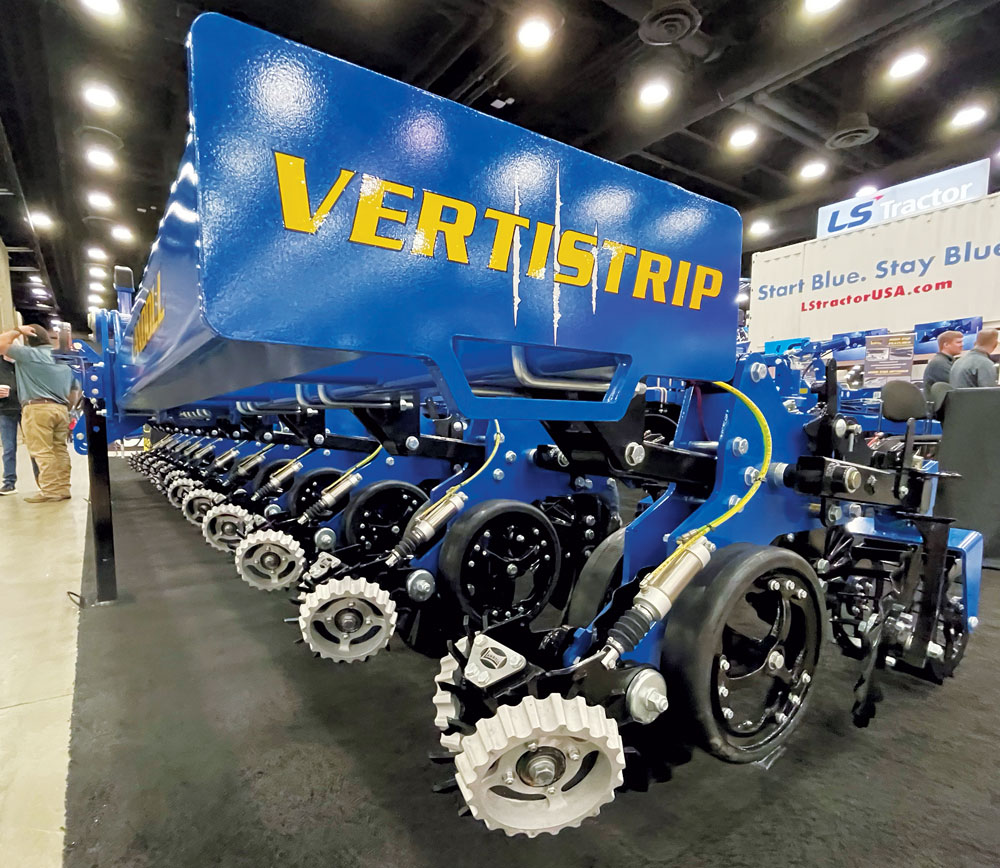
Attendees at the 2026 National Farm Machinery Show got their first look at the Landoll VERTISTRIP strip-till machine. It’s new under the Landoll brand, after the company acquired the license to it from Hawkins and AGROdeviate. Noah Newman
We’re told farmers who bought the unit from Hawkins will still be able to go through them for parts and service, but moving forward all business will go through Landoll for new VERTISTRIP purchases.
AI & Precision
Precision technology was also at the forefront as farmers look for new ways to maximize inputs and boost efficiency.
PTx/Precision Planting showcased a bevy of cutting-edge planter, sprayer and harvest technologies including the brand-new ArrowTube delivery system. It’s going through another round of beta testing this spring but could be available on a limited basis later this year.
“The ultimate goal of ArrowTube is to orient seeds, trying to stick them tip down in the furrow for better, more consistent emergence,” says Caleb Stuber from PTx/Precision Planting. “It’s also a high-speed system, so not only are we able to orient the seeds as they come out, but we’re spacing very well.”
We got our first look at SeedIQ, an AI-driven platform that delivers insights from Beck’s Root Reveal and Practical Farm Research (PFR) data.
“SeedIQ brings together decades of research and real-world performance data into one easy-to-use platform,” says Scott Beck, president of Beck’s. “Our goal is to give every product the opportunity to perform at its best by helping farmers make confident, informed decisions.”