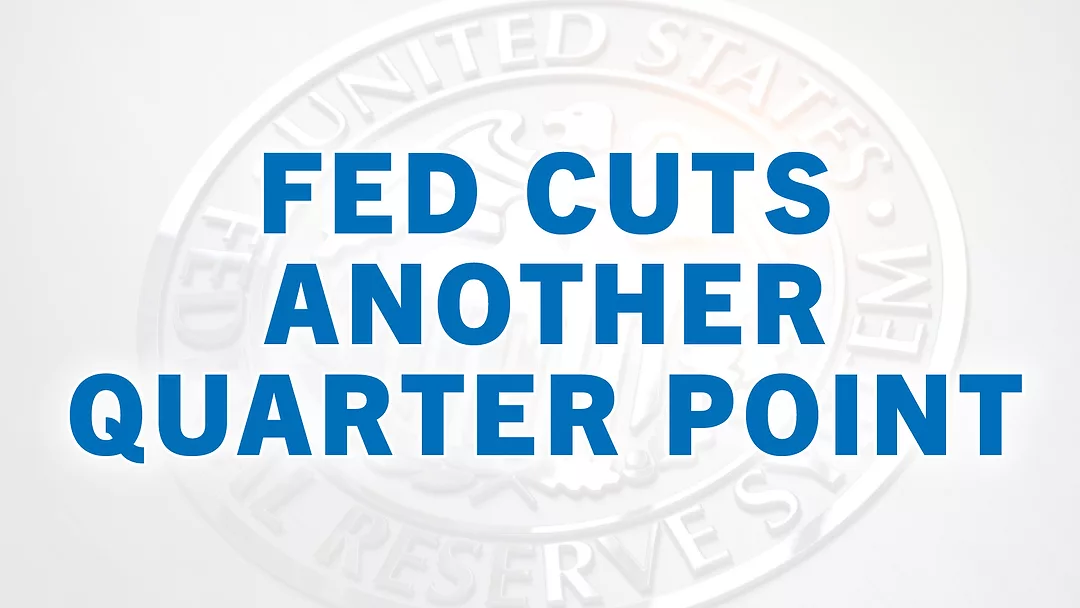
On Dec. 10, the Federal Reserve announced another quarter point rate cut, lowering it to 3.5-3.75%.
Similar to the cut made in October, the Federal Reserve Open Market Committee said it “seeks to achieve maximum employment and inflation at the rate of 2% over the longer run.” The statement went on to say that uncertainty about the economic outlook remains elevated, and the committee is attentive to the risks on both sides of its dual mandate and judges that downside risks to employment rose in recent months.
I checked in with AgDirect’s Greg Roberg to get some perspective on what this latest cut means for farm equipment dealers and their customers and the impact it could have on 2026.
"This has been a good week for some good news for production agriculture, dealers, farmers, lenders, anybody that's in the industry. We got the announcement earlier this week that the Trump administration is going to send out checks here at the end of February in the neighborhood of 11 to 12 billion to producers across the country to help bridge that gap where commodity prices have been down, which may be impacted by tariffs, likely are, with some of the trade talks we have with some of our international partners. That was some good news."
"And then, of course, with interest rates. Now you got to kind of temper your expectations when interest rates are lowered. And what I mean by that is this is short-term money. So at its core, these are borrowing costs that banks, lenders can borrow overnight. It's called Fed funds. And so that sets that rate, and then prime is always 3% over. So we went from 4% Fed funds rate to 3.75 yesterday. So we'll see prime go to 6.75 today. Prime is always 3% over whatever the Fed funds rate is. So that's good news. So that means short-term operating is going to be cheaper."
The rate cut announcement came while our editors were visiting Yetter Farm Equipment. Andy Thompason, regional sales manager, provided some perspective on what the cut means to the manufacturing and equipment inventory retail side of the business.
“From a sales standpoint, the easiest thing is we just stop, because the sales are not there. But then the optimism is we want to be ready to roll when people are ready to start purchasing. There's a lot of things that have to happen in between that. And so carrying costs and inventory, I mean, that inventory, somebody owns inventory. And retailers, manufacturers, suppliers, whatever, somebody's always got to own that inventory right there. And so, we're in business the same as every farm is. We've got to be able to generate positive income, and we've got to be able to sustain. We know when we're not seeing that. And so the same thing, I mean, that's one of those factors that is going to have a trickle down all the way from the actual raw manufacturers, all the way down to the end users.”
We also stopped at Bottons Farm in Cambridge, Illinois, to visit with Monty Bottons. Here's what he had to say from the farmer's perspective.
"You look at how much it's cost to produce an acre of corn or soybeans, how much that cost has increased in the last 10 years, is it double, Mike? I mean, it's probably nearly double those inputs in there. So all of that requires additional working capital, which typically is from operating notes. So we've doubled our interest expense, and as those percentages go up, that eats into our bottom line even more."
"Look at what equipment prices have done. 10 years ago, was there a million dollar combine? There is today. And you take that times a quarter point on a million dollar note, that gets to be some serious money pretty quick. So anything there to help with the liquidity of the farm and be able to make working capital more available is always welcome; anything that can help us on the mid-range debts associated with farm equipment is welcome."
"And the other thing that'll do is it'll improve the balance sheet of farmers who own land or long-term assets, because as interest rates go down, typically land values go up, which then gives them more ability to flex their balance sheet to do additional acquisitions for equipment and those kind of things, because they have a larger base in order to borrow from."
In the 2026 Dealer Business Outlook & Trends report, dealers ranked interest rates impact on customers’ purchases No. 8 on their list of top concerns, down from No. 1 in the 2025 report. As it relates to interest rates impact on dealer finances, dealers ranked it No. 9 on the list.
Watch the full version of this episode of On The Record