
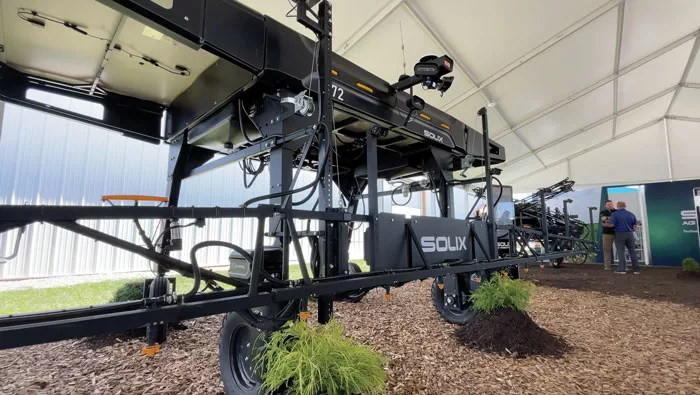
While moods were good at the Farm Progress Show at the end of August in Decatur, Ill., in terms of foot traffic and conversations manufacturers were having with customers, the manufacturers Farm Equipment editors spoke with during the show by and large are expecting the current downturn in the ag equipment market to push into 2026.
Business Outlook
A year ago, when editors attended the show, most manufacturers were calling for a tough 2025 with the picture looking better in 2026. That optimism for 2026, now seems to have faded.
Tony Wisker, vice president of sales for Great Plains Ag Division, said his outlook is mixed. “There’s a lot of headwinds for sure between tariffs and commodity prices,” he said.
“So I’m expecting that the rest of this year is still going to be kind of slow. But you also look around and the crops look great, from Kansas all the way here to Illinois. Everything is looking good. There’s some optimism in the crops and in the yields are going to be strong.”
He added that the quality of the crops gives him some optimism going into 2026, but stressed there are a lot of challenges that go along with that, a sentiment he said most people share.
“They’re looking for the positive, they’re looking for the optimism,” Whisker said. “There’s a lot of inventory still out there on dealer lots. There’s things we’re going to have to work through before we can get things really going again on the manufacturing side. But everybody’s looking for that ray of hope and that positive outlook.”
Ryan Schaefer, vice president of New Holland North America, agreed it’s looking like there will be good yields this year, but added he doesn’t think they will be as good as USDA is forecasting.
With the variety of external pressures — trade, tariffs and interest rates for example — impacting the larger ag industry and more specifically manufacturers, Schaefer said “It’s a learning environment with how we navigate those pressures.”
Eric Raby, Claas senior vice president for the Americas Region, agreed noting there is still pressure on the commodity side of things.
“The USDA comes out, it’s good or bad, and prices temporarily drop. If it’s the best corn crop we’ve ever had, well that just drives them right down,” he said. “But when you have a good yield, irrespective of pricing, it still is better than having a bad yield.
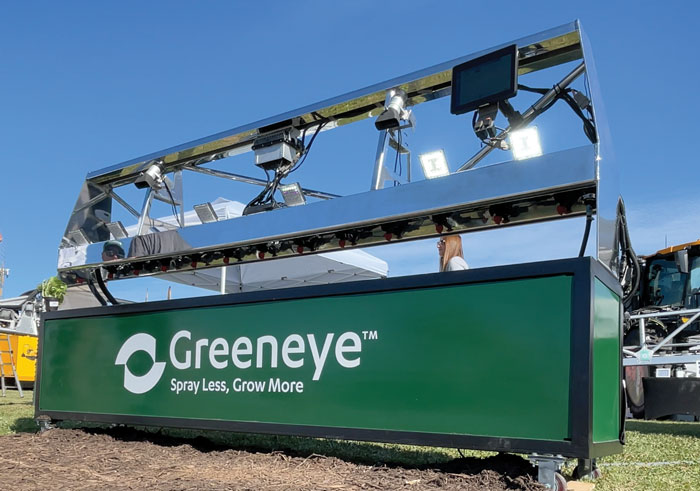
Cody Boeck of Boeck Farm Outfitters in Exeter, Neb., says his customers are saving big money on inputs with the Greeneye Technology kit for sprayers. Noah Newman
Raby added it’s important to watch what the long-term and midterm look like for corn and soybeans, as they are the two most important crops Claas is dealing with. “The other one is what is the impact, especially in the equipment business with the tariffs? We kind of got through with some of the major markets. We have an agreement with the EU, we have an agreement with Canada,” he said.
“But now we have another steel and aluminum tariff that is quite significant. Regardless of where you’re from, it affects everyone in the industry. Everyone’s trying to come to terms with how that looks. That’s a significant thing that we haven’t fully overcome yet, and that could actually have somewhat of a negative effect, I hate to say. It depends on how it actually ends up. We’ll see in the next couple of weeks if there’s any changes.”
Brandon Montgomery, senior brand manager for Fendt in North America, echoed the others and said the outlook for the industry as a whole has softened. Looking to 2026, he expects farmers to have the same “tightening of the belt, watching what they spend and making sure their cashflow is in a good positive situation.”
He added, “You can’t get wrapped around the axle of negativity, and you just have to keep pushing forward.”
Another manufacturer commented that dealers are still stocking, but it has slowed. He said business is significantly lower than 5 years ago, but only moderately lower than a year ago.
Mike Vujea, sales manager for J&M Mfg., said he’s hoping by the end of this year, but maybe by the end of 2026, to see some improvement in the market. “Just like anybody else, any of our competitors, we’re holding firm on things and just doing what you can to slow production because you don’t want to over-make for the next year.
Nathan Zimmerman, eastern regional sales manager for Ag Leader, said a lot of their customers feel like they have a good crop, particularly those who use fungicide. However, the increase in fertilizer prices is weighing on farmers and could impact what they spend their money on. “Farmers are going to spend their money on input before anything else,” he said. “Dealers still want to talk, but we’re getting less commitment than we like to see.”
“Things will pick up eventually,” said Vujea. “We’ve been doing this since 1960. It’s been cyclical ever since.”
Precision Trends
Cody Boeck’s Exeter, Neb.-based Boeck Farm Outfitters became the first U.S. dealership to sell and service Greeneye Technology. We caught up with Boeck at the Greeneye booth to discuss the benefits and challenges of the smart spray system and the preparations his dealership made to handle the cutting-edge tech.
“We’ve had a lot of amazing feedback,” Boeck says. “With a technology like this, you have one idea of how you’re going to use it. Then when you get through a season you see some different opportunities, so that’s been cool to see how customers are using this in different ways.
“We started our business in the planter space, and we saw planters go from chain driven, dumb machines into electrically driven smart machines. The next machine on the farm to be able to do that is going to be the sprayer. We met with the guys who developed Greeneye Technology — a great group of guys with great vision. The combination of the people, the technology and where we think the sprayer space is going, this was a no-brainer for us.”
Autonomy was once again a big theme at this year’s show and will continue to be in the foreseeable future as the technology continues to evolve and grow.
Solinftec announced it’s expanding its footprint to Kansas, Iowa, Wisconsin and Texas after establishing strong operations in Illinois and Indiana.
“For the third consecutive season, our Solix robots are delivering outstanding results in reducing herbicide and water use while enabling real-time agronomic insights,” said Guilherme Guiné, COO of Solinftec North America. “By expanding to new regions, we’re helping more producers improve their operations while preserving valuable natural resources.”