In this episode of On the Record, brought to you by Associated Equipment Distributors, we take a look at how the additional 407 tariff lines to the steel/aluminum tariff list will mean for manufacturers and dealers. In the Technology Corner, Noah Newman visits with Agri Spray Drones during the Farm Progress Show. Also in this episode, the impact of tariffs on Brazilian ag equipment exports and used equipment prices trend downward.
.png)
On the Record is brought to you by Associated Equipment Distributors — the leading association in North America for the equipment distribution industry.
Explore the 2025 AED Annual Education Seminars lineup which includes seminars on Parts Management, Service Management, and Branch/Store Management.
Additionally, don't miss the upcoming conferences, such as the Finance/HR Symposium, Leadership Conference, Women in Equipment Conference, and Policy Conference.
Contact us for more information about how you can register for these events.
TRANSCRIPT
Jump to a section or scroll for the full episode...
- 407 New Lines Added Steel & Aluminum Tariff List
- Dealers on the Move
- Drone Distributor Puts New Model to Test Before Launch
- Tracking Crop Prices
- Tariffs Will Bring Brazilian Ag Machinery Exports Down to Zero
- Used Equipment Prices Trend Downward
- DataPoint: Machinery Cost Estimates for 2025
407 New Lines Added Steel & Aluminum Tariff List
The U.S. Department of Commerce recently announced on Aug. 15 that it would be adding 407 new tariff lines to the Section 232 steel/aluminum tariff lists — this includes many items made by farm equipment manufacturers, as well as key components and parts. These items are now subject to a 50% tariff on their steel and aluminum content, effective August 18.
To get the latest on this issue, Managing Editor Christine Book checked in with Daniel Fisher, senior vice president of government & external affairs at Associated Equipment Distributors (AED).
Fisher says this will have a substantial impact on the equipment industry and its customers — unnecessarily driving up costs and creating uncertainty. He shared details of what can be expected in the wake of these items now being subject to a 50% tariff on their steel and aluminum content.
"In the immediate term, it creates a great deal of uncertainty. So there was no waiver or no leeway for if you had ordered the equipment already or if it was on the boat or it was in transit. So really effective on August 15th, was when this decision was announced. Effective August 18, these new tariffs took effect. So if you had ordered equipment, you had quoted equipment for a customer, that price was basically no longer valid almost immediately. So of course that creates a lot of uncertainty, certainly raises the cost on dealers purchasing the equipment, and of course the customers who are ultimately going to be the end user of the equipment. It increases compliance costs. These tariffs are extraordinarily hard to understand when you take the reciprocal tariffs, you take Section 232. In some countries, depending on the country, you may have Section 301 tariffs."
"Then if you're in the U.S. and Canada, you have the USMCA thing going on. And so it really just adds a great deal of compliance and complexity, which of course has added cost to it as well. And if you're not a major importer, it can be quite confusing even. It certainly is confusing for a lot of even customs brokers and others who are still trying to navigate the situation. And of course it's ultimately going to increase the cost on farmers, dealers, and OEMs when you have this imported equipment that is now subjected to a 50% tariff on the steel and aluminum content, which of course is a significant piece, portion of what is contained in the equipment."
AED is now focused on action items they’re urging OEMs and dealers to take in getting the message to elected officials in Congress to share with the Trump administration.
"Obviously the ag sector has been hit particularly hard in recent times. This will only increase costs on the customers and it's just imperative that the entire equipment industry weigh in with their lawmakers and educate them about the impact this will have. And the hope is that a ground swell on Capitol Hill appears and that there's some pushback against the administration in terms of this expansive list of derivative products that are now included in the Section 232 tariffs."
Dealers on the Move
This week’s Dealer on the Move is Sydnestricker Nobber Partners. The John Deere dealer has assumed the responsibility of 5 dealership locations in the Southern Tier of New York and Northern Pennsylvania, following the closure of the current John Deere dealer, Port Crane, N.Y.-based Lindsey Equipment.
Drone Distributor Puts New Model to Test Before Launch
One manufacturer I spoke with at the Farm Progress Show said it’s been a challenging economic year for most in the ag equipment space, but he pointed to the drone industry as one that appears to be doing better than others. That seemed to be the case at the Agri Spray Drones booth, as founder Taylor Moreland showed off the new EAVision J150 drone. But he wanted to make sure it was battle-tested before its big reveal. That’s why he brought one with over 11,000 acres on it to the show.
“Every drone brought to market, whenever it’s announced, nobody has tested them. It’s just brought to market. It comes from China, or wherever it comes from, and they don’t use drones like we do. They test them there, but they don’t use them like we do here in the U.S. We’ve learned that over our many years in this industry. What we wanted to do, before we actually launched it, let’s get over 10,000 acres on at least one unit. And then let’s run at least a couple dozen with other operators doing real world applications. Since June, there have been several dozen flying with different operators. We said if we’re not spraying for a customer, doing fungicide or cover crops, then we’re just going to be spraying water. We’re just trying to rack up hours on it. What’s going to break first before we launch it. We’ve replaced two parts, that’s it.”
The EAVision J150 drone has a 20-gallon tank, 180-pound spreader capacity and can cover 65-plus acres per hour at 30 MPH max speed.
Tracking Crop Prices
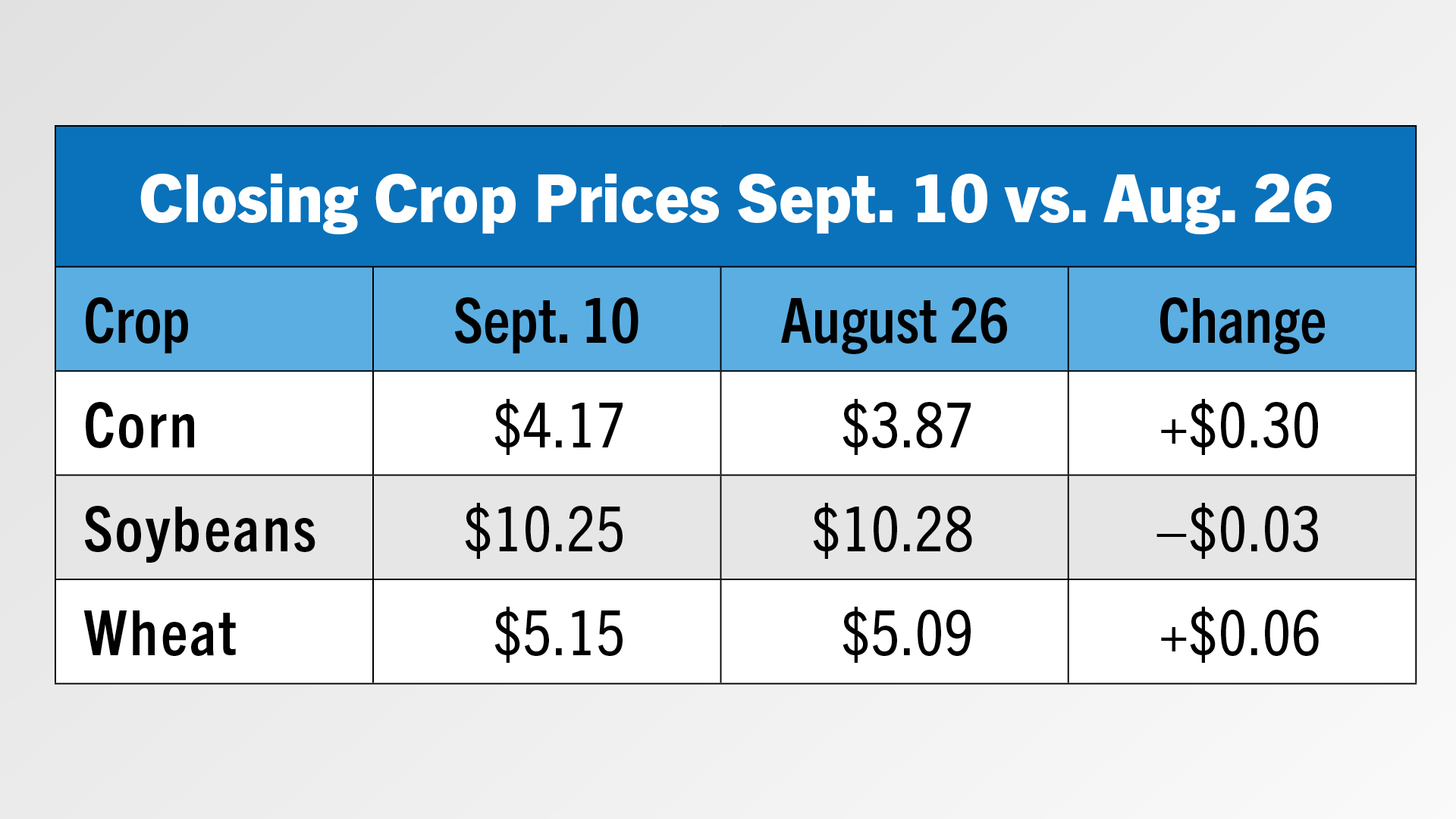
As of September 10, corn prices were $4.17 up 30 cents from our last episode. Soybeans closed at $10.25, down 3 cents. And wheat closed at $5.15, up 6 cents.
Tariffs Will Bring Brazilian Ag Machinery Exports Down to Zero
In other tariff news, our South American correspondent Luis Vieira reports that tariffs are hitting the Brazilian ag machinery market hard.
The tariffs imposed by the Trump administration at a rate of 50% to Brazilian products will completely interrupt all machinery exports to the American market, according to Cristina Zanella, director of Competitiveness, Economy and Statistics at the Brazilian Assn. of Machinery and Equipment Manufacturers (Abimaq).
“There will be a bigger impact starting next month (September). Exports will go down to zero, these tariffs have taken out all of our competitiveness in that (American) market,” said Zanella.
The U.S. represents 26% of Brazilian machinery exports or $300 million monthly, per Abimaq data.
“If you look at all countries, only India had a tariff as high as Brazil received. Some countries have a smaller difference (in tariffs) due to a high proportion of steel and aluminum,” added Zanella.
Used Equipment Prices Trend Downward
According to the newest Sandhills Global market reports, asking prices for used tractors and combine harvesters on TractorHouse.com and other Sandhills platforms are trending down. Both markets posted monthly and year-over-year decreases in August. Market factors influencing this trend include unchanged interest rates and lower crop prices.
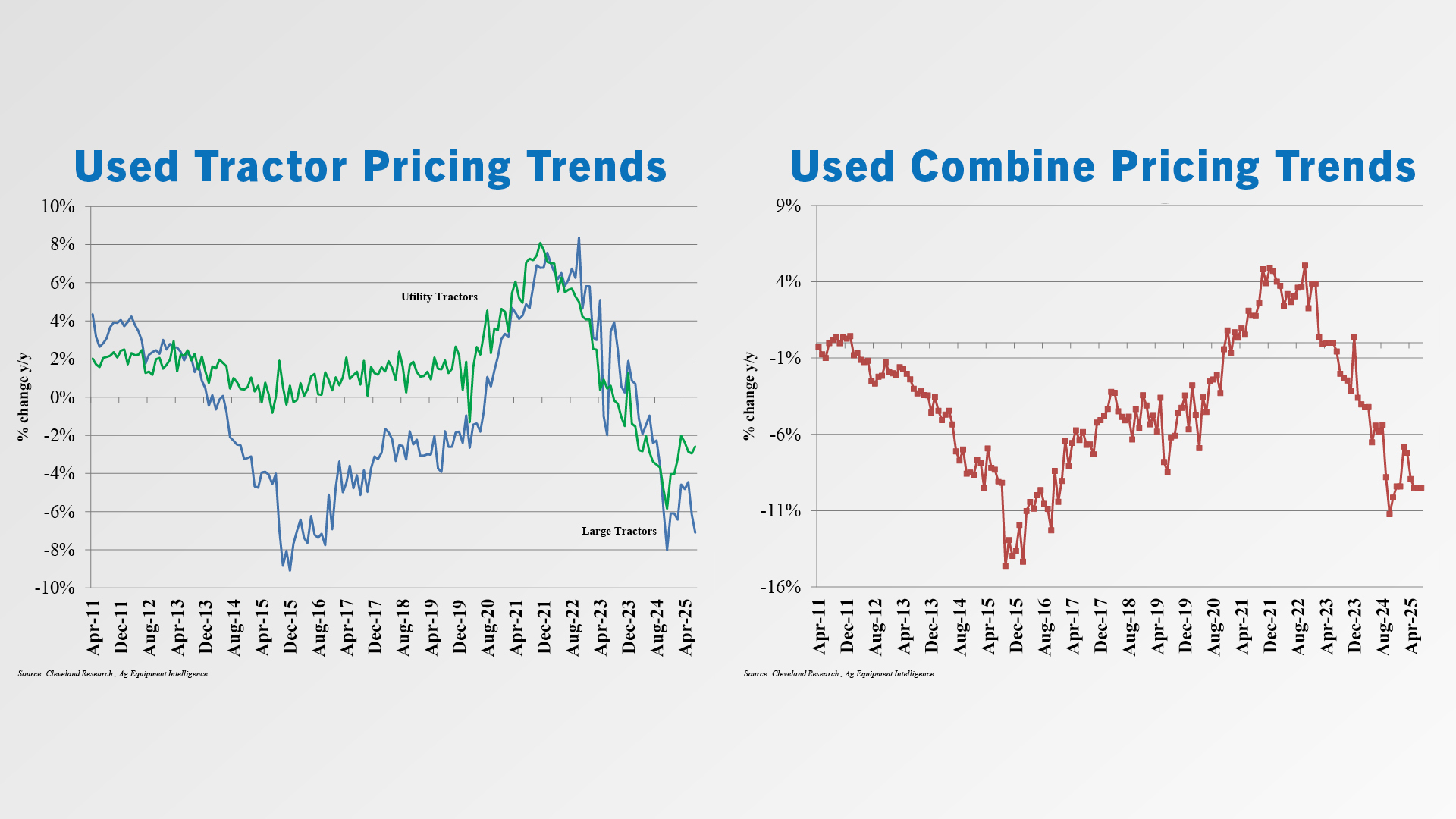
Our latest Dealer Sentiments Report confirms the trend. According to the latest data, used equipment pricing was down 7% year-over-year in July vs. down 6% the previous month with most pricing pressure on combines.
Used row-crow tractor pricing was down 7% vs. down 5% the previous month. Used combine pricing, according to the Dealer Sentiments Report, was down 9%, flat with the previous month.
DataPoint: Machinery Cost Estimates for 2025
This week’s DataPoint is brought to you by the Precision Farming Dealer Summit, coming to St. Louis Jan. 5-6. To learn more and register, visit PrecisionDealerSummit.com.
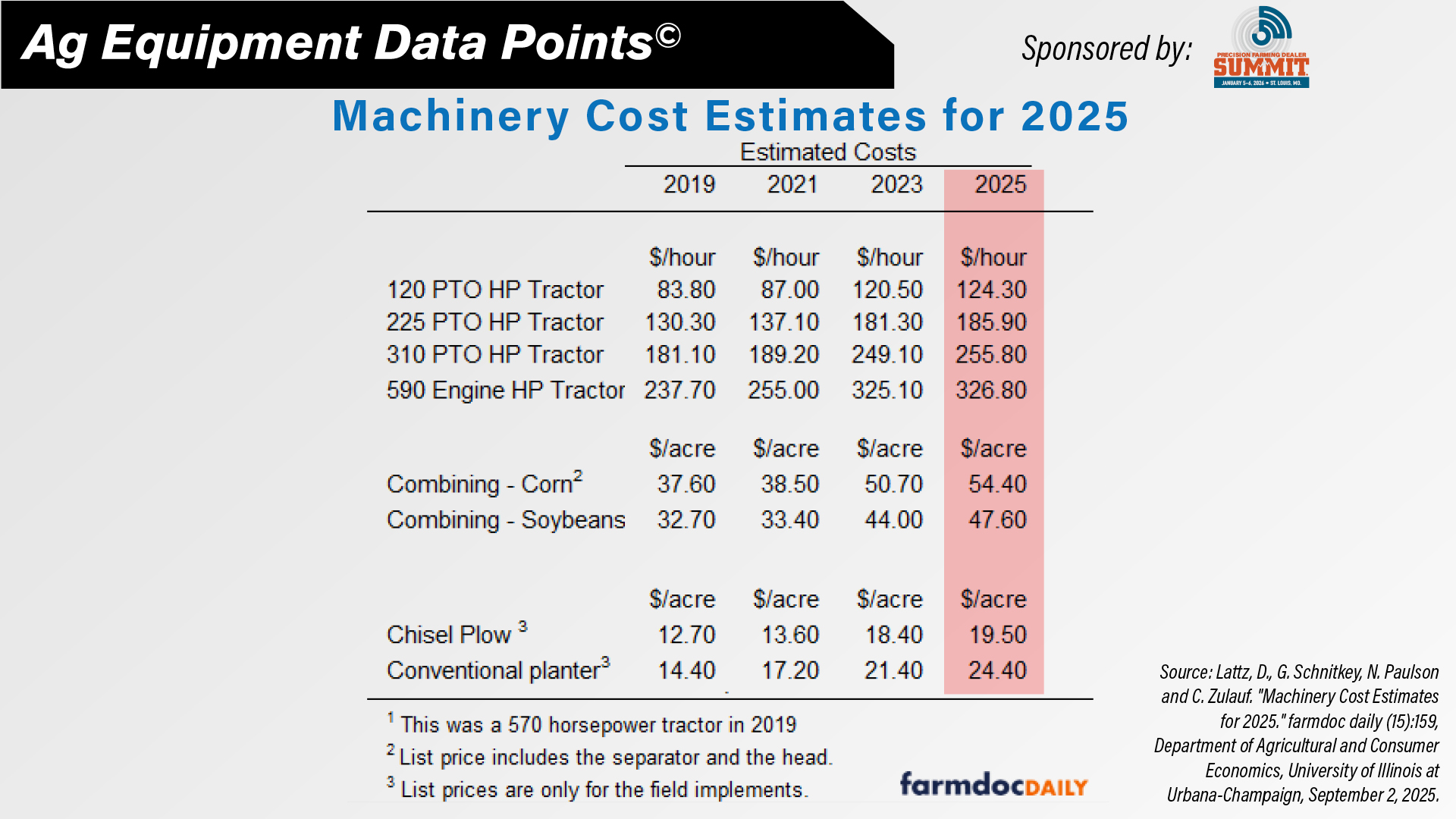
The Department of Agricultural and Consumer Economics at the University of Illinois tracks machinery costs every two years. Its latest update was released earlier this month. It should come as no surprise that estimated costs for most machinery operations are higher in 2025 than in 2023. The majority of the cost increases are associated with higher list prices for machinery.
The estimated cost for combining corn is $54.40 per hour, up from $50.70 in 2023 and $37.60 in 2019.
For a 590 horsepower tractor, the 2025 estimated cost is $326.80, up nearly $90 per hour since 2019.
On the Record is now available as a podcast! We encourage you to subscribe in iTunes, the Google Play Store, Soundcloud, Stitcher Radio and TuneIn Radio. Or if you have another app you use for listening to podcasts, let us know and we’ll make an effort to get it listed there as well.
We’re interested in getting your feedback. Please feel free to send along any suggestions or story ideas. You can send comments to kschmidt@lessitermedia.com.