Takeaways
- Success ultimately comes down to having the right team and managing the business well, always treating customers as you would like to be treated.
- Plan ahead for the sales/service cycles by anticipating your customers’ needs and working with the shortline reps ahead of time.
- A demo-style sales tactic works well to show clients the real-life benefits of going with a new option, or how to shift their approach in the field.
Farmers across the Delta know Hobbs Farm Implement for its personal service, trusted brands and the ability to show, not simply tell a customer, why a piece of equipment is worth the investment. From its east central Arkansas base to the large reach it has today, the dealership has built its reputation on understanding its customers, carrying the brands they need and backing them with service that keeps their operations running smoothly through the season.
Built Around a Diverse Customer Base
The Delta is a very diverse and strong production agriculture region. Hobbs Equipment’s territory, customers and offerings reflect that fact, servicing farmers all throughout the Delta, Mississippi, Louisiana, West Tennessee and the Missouri Bootheel.
The farms the dealership works with vary in size, but most fall into a mid-to-large-scale category. “A typical farm today, I’m going to say, is probably in that 1,500- to 2,500-acre range, but there are farms a lot larger too,” says Dewayne Hobbs, eldest son of founder Larry Hobbs. He and his two brothers now run the family business.
The crops harvested in the area are equally mixed. Corn, cotton, soybeans, rice and, Hobbs says, other specialty crops continue to pop up more, such as sweet potatoes and peanuts. That diversity shapes not only the equipment farmers need but also the timing of their purchases and service work.
Hobbs makes it clear that the dealership’s brand lineup isn’t chosen randomly. Every decision starts with what the farmer needs and is the best fit for their budget, farm, and success. Over the years, that philosophy has helped Hobbs Farm Implement become a resourceful go-to location.
Hobbs Farm Implement
Location: Colt, Ark.
Ownership: Dewayne, Randell and Shannon Hobbs
Customer Base: Typical customers farm 1,500-2,500 acres and crops grown in the region include corn, cotton, soybeans and rice, along with some specialty crops like sweet potatoes and peanuts.
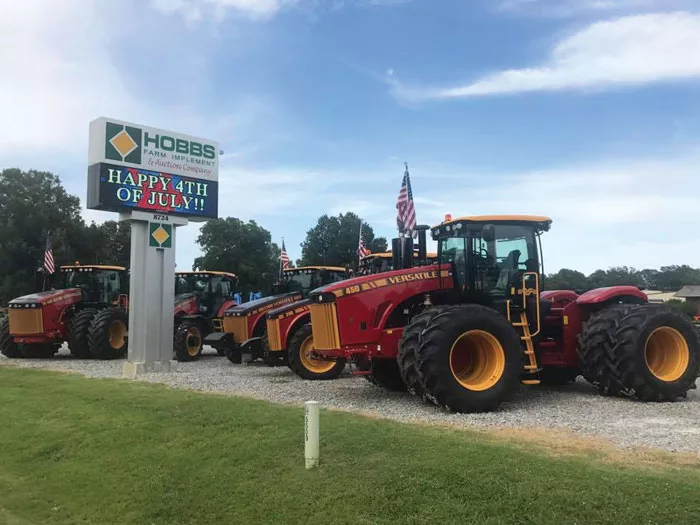
Lines Carried: Versatile, Westfield, Drago, Bestway, McFarlane, Unverferth, Brent, Harvest International, Kuhn Krause, Yetter, Lemken, Bigham, Kioti
“We’ve got a reputation for being one of the larger corn head dealers in the southern part of the United States, and that’s one of our specialized areas,” he adds. That wasn’t always the case — it developed over time as the dealership recognized the need and built expertise in that segment.
The lineup today also includes a mix of well-known and specialty brands. Used John Deere and Case IH equipment plays a role, along with shortline manufacturers that each bring unique advantages. Drago corn heads, Krause and Kuhn Krause tillage equipment, Lemken speed discs, and Unverferth grain handling options all can be found on the lot. On the tractor side, Hobbs carries Versatile for large 4WDmodels and Kioti for smaller commercial tractors.
The Right Tool for the Right Farmer
Selling equipment in a region with varied crops and soil conditions takes more than just a pretty product brochure. It requires a salesperson with local knowledge and the ability to get the right information from the customer.
Hobbs confirms this, and explains that the Lemken tillage tools especially require a deeper degree of this questioning than other lines. “We’ve got to know the right questions to ask. Are they doing fall tillage primarily? Or spring tillage? What soil type are they in? Are they heavy residues or just fallow tillage?”
“We’ve got to know the right questions to ask. Are they doing fall tillage primarily? Or spring tillage? What soil type are they in? Are they heavy residues or just fallow tillage?”
Tillage options are wide-ranging and performance depends heavily on matching the tool to the specific farming practice. Hobbs says his sales team’s understanding of local soil types and conditions is key to making sure farmers get the best fit.
In many cases, Hobbs Farm Implement is known for showing products in action, being very hands-on with a demo-style sales approach.
This approach is especially effective with equipment like Drago corn heads.
“Typically, we’re looking at a bushel, two, three bushel per acre,” Hobbs explains of the potential savings. “Many times we go out there in the field and we throw a square down and say, ‘Hey, look, here’s the comparison.’”
Sometimes that means showing a farmer how their current equipment is losing more than they realize. Hobbs explains: “A lot of times they say, ‘Oh, my head is not losing that much.’ Many times that then becomes: I didn’t have any idea what’s wrong with my head, or what can I do to make my head better? We’ll even go as far to try to help them with their heads, but we’ll still show them a difference in our new ones.”
He says that a real-life look at the economic benefits of what Hobbs has to offer, whether through production or life of the tool itself, works great. “We like to be right out there with them,” he adds, of the customer experience they’re known for.
Shortlines, Parts & Service
Hobbs values the opportunities that come with representing shortline manufacturers. “Definitely, it’s a partnership,” he says. “You need a company that when times do slow down, they’re workable, they’re flexible.”
That flexibility extends to inventory management and marketing support, helping the dealership avoid becoming overloaded with unsold equipment during slower cycles. Having a good shortline company representative is essential to these partnerships being successful, Hobbs explains. He says it’s nice when they come by to keep him and the staff aware of changes, work together as a team and find ways to get through tough times, such as earlier this year.
It’s also a stark contrast to the high-pressure environment he associates with some mainline dealerships. “I don’t have somebody breathing down my neck pushing me to sell when we can’t sell,” Hobbs says. “There’s a lot of pressure involved when you get in with the big guys.”
He adds that when the economics are right, the Hobbs Farm Implement team sells a good number of used larger machines, like combines.
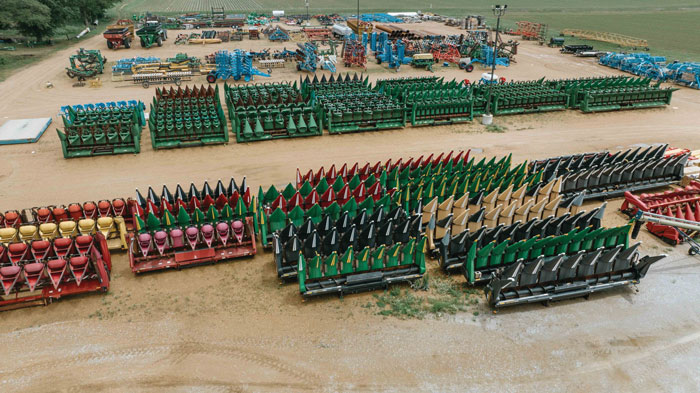
Hobbs Farm Implement has made a reputation for itself for being one of the largest corn head dealers in the southern U.S. Source: Hobbs Farm Implement
The company’s website helps customers find what they’re looking for, learn more about brands, but also see real-time equipment deals. Customers can view both new and used inventory for 13 shortline brands, as well as other used equipment available.
In turn, an area that remains strong even when equipment sales slow is parts and service. “So many farmers are not buying new equipment,” Hobbs explains. “They’re just maintaining their older machines, and that’s been a real plus to our parts and service department. We do a tremendous amount of service calls.” They offer parts direct from the manufacturer, but also general catalog services.
The dealership prepares for these up-and-down parts/service cycles by monitoring and adjusting parts orders, and staffing accordingly. “We really like to see a part moving through 3-4 times turnover in a season,” Hobbs says. Watching parts availability and avoiding overstock is a constant balancing act, especially with the rising cost of parts. “Parts are like equipment. They’re not cheap either anymore,” he notes.
Adapting to the Market
Like other dealerships, Hobbs has seen its share of ups and downs. “I’ve been in the office personally for 23 years, and the first 5 months of 2025 were the worst 5 months I had seen in my history of being in the office,” he says.
Yet the turnaround came quickly. “June turned around. It was about the third-best June we’ve ever had,” Hobbs adds. A rise in corn acreage in the Delta played a role. “This year we’ve seen a big swing up in acres of corn in the Delta, and anticipated it would probably come around.”
While July and August stayed strong, Hobbs remains realistic about the rest of the year. “After this, I don’t think it’s going to be good unless something really changes,” he says.
For Hobbs, the dealership’s success ultimately comes down to having the right team and managing the business well.
“Keeping good help and keeping a positive outlook is an important part. Management — just making the right moves from day to day, a strong inventory control and simply doing our best — that’s all I know to do.”