Purdue University and the CME Group released the July Ag Economy Barometer on August 5. The index fell for the second time in a row, down 11 points from June’s reading. Michael Langemeier and Jame Mintert with Purdue’s Center for Commercial Agriculture say the decline was “fueled by U.S. farmers’ weaker perceptions regarding both current conditions and their expectations for the future.
They say weaker income prospects in 2025 were largely responsible for farmers’ weaker appraisal of current conditions. However, producer sentiment remains much more positive than at this time last year, with nearly three-quarters of July’s survey respondents reporting that the U.S. is headed “in the right direction.”
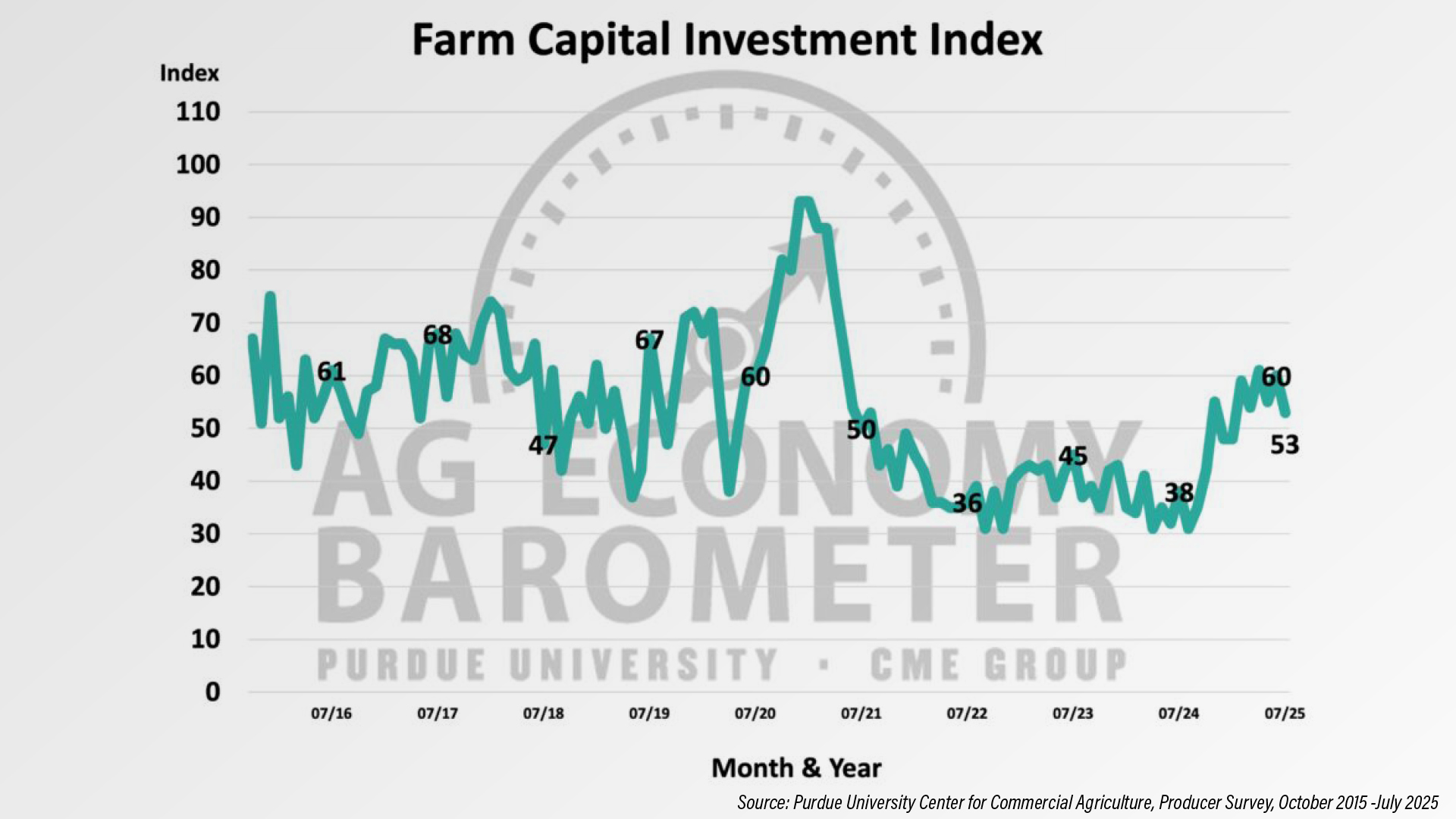
Concerns about weak income prospects in 2025 were evident in the July survey as the Farm Financial Performance Index fell 14 points compared to a month earlier. This month’s decline left the index at a reading of 90, indicating that more farmers expect weaker rather than stronger income in 2025 compared to 2024. In turn, the decline in farmers’ income prospects helped push the Farm Capital Investment Index down.
James Mintert: "The Farm Capital Investment Index fell seven points to 53, but that was still 15 points higher than a year earlier. So the investment index, you know, if there’s one that kind of surprises me is that maybe the strength we’ve seen in the investment index. And now it’s not back to the levels we saw in 2020 and early 2021, when the index was above 90 for a period of time. But it’s still quite a bit stronger than it was a year ago."
"And if you look at the responses to the question, that index is based on, the percentage this month reporting it's a good time to make Investments did fall to 20% from 24%. Um, a year ago that good time was percentage was 13% and the percentage reporting bad times rose to 67% from 64% in June. But it, it’s interesting that we’re getting, 20% of the people saying that it’s a good time to make investments. You know, when historically going back, we were hovering around 10% or not too long ago, a little over a year ago. Explain that for me."
Michael Langemeier: "The only thing I can think of is, we’ve got some livestock producers in there that are primarily livestock. Maybe they have some crops too. There’s a lot of diversified farms in the Western Corn Belt, uh, that, that perhaps think this is a good time. That's the only, maybe that’s stretching a bit, but that’s the only thing I can think of that might be propping this up a little bit."
James Mintert: "Well that, yeah, that’s a pretty good explanation I think, and it probably is a supporting factor."
Watch the full version of this episode of On The Record